by Editor | Aug 1, 2021 | News
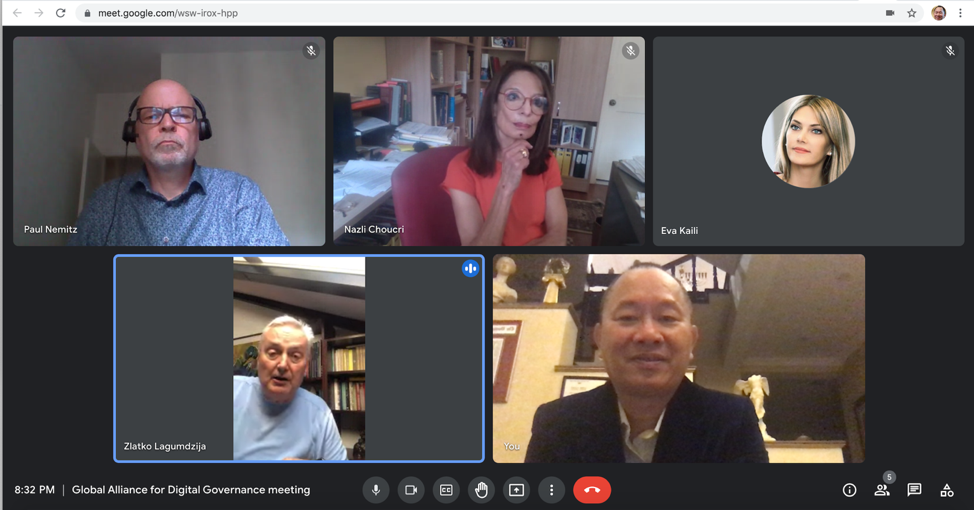
On July 30, 2021, key coordinators of Global Alliance for Digital Governance (GADG) met to define core works and plans of GADG 2021 – 2022. Professor Nazli Choucri (MIT), MEP Eva Kaili, Zlatko Lagumdzija (former PM of Bosnia and Herzegovina), Paul Nemitz (Principal Advisor of European Commission), and Nguyen Anh Tuan (CEO of Boston Global Forum) discussed and contributed significant works and preparation for the Policy Lab “Fundamental Rights in AI & Digital Societies: Towards an International Accord”, co-organized by Boston Global Forum and Club de Madrid for September 7-9.
One of the most important decisions in the GADG Coordinator meeting was to build a system which monitor governments and companies. This Monitor System can view violations of ethical values and standards of the Social Contract for the AI Age and AI International Accord by governments and large organizations. The platform will alert against the misuse of Artificial Intelligence (AI), personal data, and negligence of cybersecurity. Its name is the GADG Monitor, and it will be introduced at the BGF-Club de Madrid Policy Lab on September 7-9.
Club de Madrid and Boston Global Forum will collaborate in building and developing the Global Alliance for Digital Governance.
by Editor | Aug 1, 2021 | Event Updates
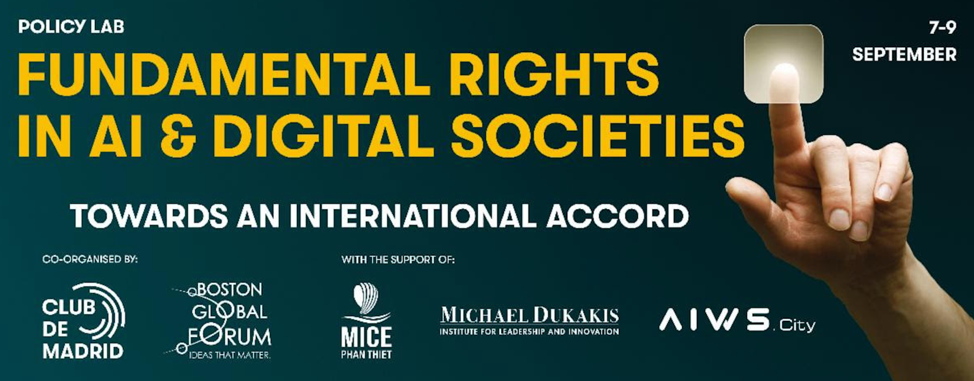
Dates: September 7-9, 2021
Co-organizers: Club de Madrid and Boston Global Forum
Paul Twomey served from 2003 to 2010 as the President and CEO of ICANN, a role which the New York Times described as “the Chief Operating Officer of the Internet”. He will speak at Plenary I of the Policy Lab together with Paul Nemitz, Principal Advisor of the European Commission, and two members of Club de Madrid, Hanna Suchocka of Poland and Carl Bildt of Sweden.
Plenary I: Setting the context for a rights-based international accord
Panelists:
- Paul Twomey, Fellow and Core Theme Leader at the Global Solutions Initiative; Distinguished Fellow at the Centre for International Governance Innovation; Commissioner of the Global Commission for Internet Governance and former CEO of ICANN
- Jerry Jones, Advisor of CdM, Executive Vice-President, Ethics and Legal Officer, Live Ramp
- Paul Nemitz, Principal Advisor in the Directorate General for Justice and Consumers at the European Commission
- Hanna Suchocka, Prime Minister of Poland (1992-1993), Member of Club de Madrid
- Carl Bildt, Prime Minister of Sweden (1991-1994), Member of Club de Madrid

by Editor | Jul 26, 2021 | News
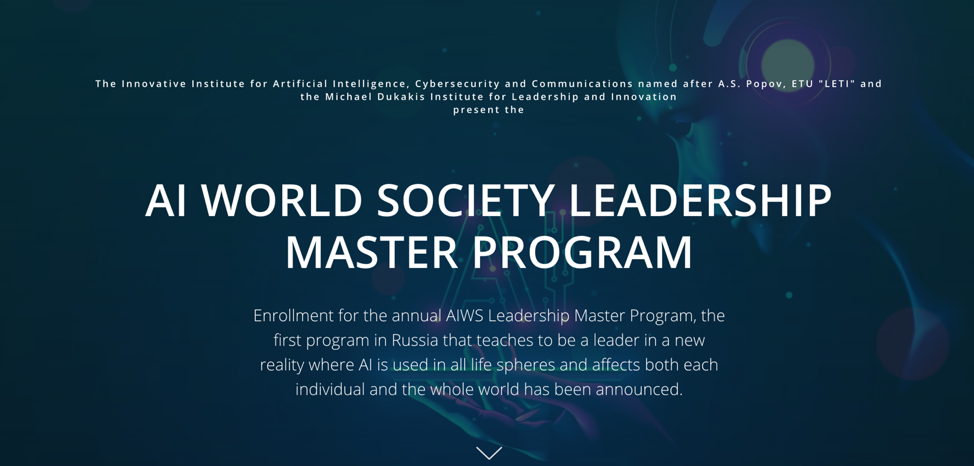
The AIWS LEADERSHIP MASTER PROGRAM educates young global leaders that will shape the world in the AI Age, focusing on innovation, AI technology, and leadership. AI technology is the basics and foundation for leadership, applying an innovative model in education: study by practice, especially as we shape and mold leadership into a global one through the United Nations Centennial Initiative and Remaking the World.
Student is able to study with distinguished leaders and thinkers, to have opportunities to applying knowledge through innovative projects and practice becoming a young global leader in the United Nations Centennial Initiative and Remaking the World, to be a member of AIWS University and AIWS City for lifelong learning, and they will join an elite community, able to receive support for innovation and leadership careers.
The AIWS Leadership Master Program 2020 – 2021 is done by the Popov Innovative Institute for Artificial Intelligence, Cybersecurity and Communications, ETU “LETI”, Saint Petersburg and the Michael Dukakis Institute for Leadership and Innovation. From 2021 – 2022, the book “Remaking the World – Toward an Age of Global Enlightenment” will be a course of this program.
by Editor | Jul 26, 2021 | News
Members of AI International Accord Team are discussing its standards and challenges in its implementation.
The standards are based off the Social Contract for the AI Age, the foundation for a peaceful, secure, and prosperous world in the AI Age. Only with these standards could the AI International Accord will solve problems of AI and Digital Age.
However, there are challenges to the implementation of these standards, most notably non-democratic countries such as China. If the democratic world does not unite and act in solidarity to protect the norm, it will face great danger of totalitarianism. To contribute to that solidarity, the Global Alliance for Digital Governance is the beginning of the important effort and mission.
by Editor | Jul 26, 2021 | Event Updates
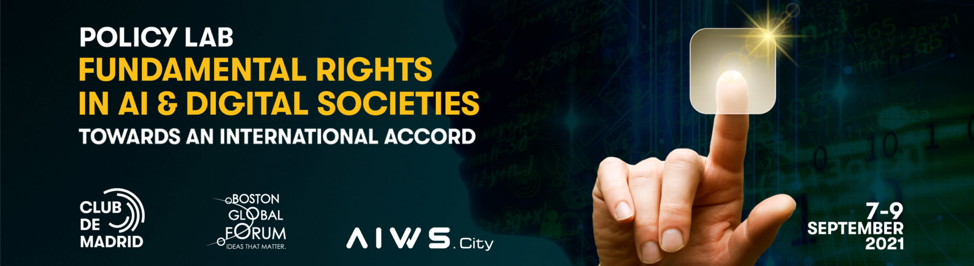
For 2021, CdM in partnership with BGF will organize a Policy Lab on Fundamental Rights in AI & Digital Societies: Towards an International Accord. This Policy Lab will be organized online, September 7-9. On a multistakeholder basis, discussions will focus on:
- Opportunities and threats for fundamental rights in AI & digital societies;
- Transatlantic approaches to protect fundamental rights in AI & digital spaces;
- The elements & process for an international legal framework to protect fundamental rights in AI & digital spaces.
- The elements & process for an international legal framework to protect fundamental rights in AI & digital spaces, toward AI International Accord.
- Concept and Ecosystem for Digital and AI Society
- Global Alliance for Digital Governance
Eva Kaili, Member of European Parliament, Chair of Center for AI of the European Parliament, and coordinator of Global Alliance for Digital Governance, will be a lead speaker at the panel “Toward an International Accord: Global Alliance for Digital Governance” of the Policy lab.
Aside from Boston Global Forum thinkers and Club de Madrid Members, the Policy Lab will also gather representatives of governments, academic institutions and think tanks, tech companies, and civil society. The outcome —a set of policy recommendations on building an international legal framework to protect fundamental rights in AI and digital spaces— will be shared with national governments and decision-makers in multilateral organizations, amongst others, so as to better inform the debate.
by Editor | Jul 19, 2021 | News
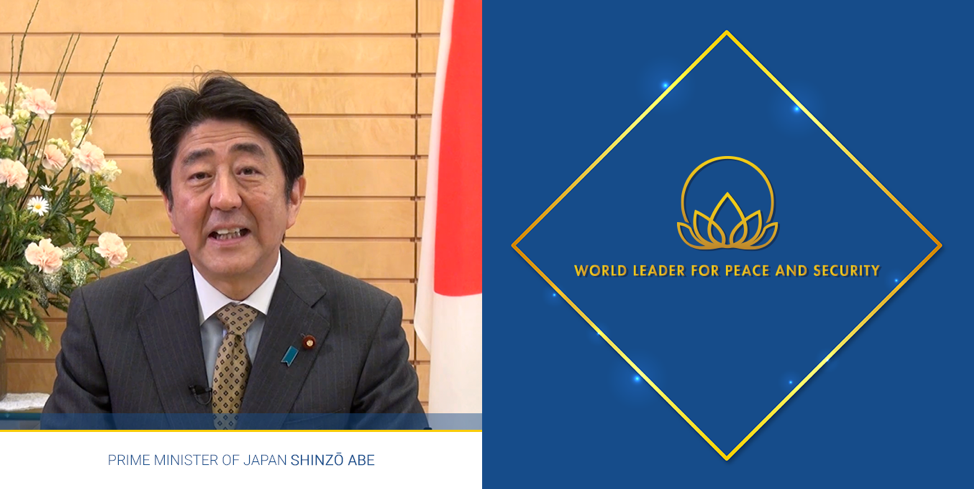
Remaking the World – Toward an Age of Global Enlightenment was officially released on Boston Global Forum and the United Nations Centennial Initiative. We are grateful to World Leader Award recipients that contributed:
Ursula von der Leyen, President of the European Commission, 2020 World Leader for Peace and Security Award, An AI Ecosystem of Trust
Vaira Vīķe-Freiberga, 6th President of Latvia (1999-2007), President of World Leadership Alliance – Club de Madrid (WLA-CdM) 2013-2019, 2019 World Leader for Peace and Security Award, AI in the next century of the United Nations
Ban Ki-Moon, Secretary-General of the United Nations (1/1/2007 – 31/12/2016), Lead the UNESCO Global Education First Initiative, 2016 World Leader for Peace and Security Award, Building Partnerships
Shinzō Abe, Prime Minister of Japan (9/2006-9/2007, 12/2012-9/2020), 2015 World Leader for Peace and Security Award.
Vint Cerf, “Father of the Internet”, Vice President and Chief Internet Evangelist for Google, Co-author of Social Contract for the AI Age, 2019 World Leader in AI Society Award, A People-Centered Economy
Judea Pearl, Professor of Computer Science and Director of the Cognitive Systems Lab at the University of California, Los Angeles, recipient of the A.M. Turing Award, 2020 World Leader in AI World Society Award. Radical Empiricism and Machine Learning Research and The Domestication of Causal Reasoning
Stavros Lambrinidis, Ambassador of the European Union to the United States, 2021 World Leader in AI World Society Award, An AI “Bill of Rights” in the Digital Age
by Editor | Jul 19, 2021 | News
The Academic Board of AIWS Leadership Master Program will use Remaking the World – Toward an Age of Global Enlightenment as an official course for the program from the 2021-2022 academic year. Some distinguished contributors of the book will teach this course and speak to students.
Distinguished Contributors include:
- Shinzo Abe, Prime Minister of Japan
- Ash Carter, Former US Secretary of Defense
- Vint Cerf, “Father of the Internet”, Google
- Nazli Choucri, Massachusetts Institute of Technology (MIT)
- Ramu Damodaran, Chief of United Nations Academic Impact
- Michael Dukakis, Former Governor of Massachusetts, Chair, Boston Global Forum
- Eva Kaili, Member of the European Parliament
- Robin Kelly, U.S. Representative (Illinois),
- Ban Ki-moon, the United Nations Secretary-General
- Taro Kono, Defense Minister, Japan
- Stavros Lambrinidis, EU Ambassador to the United States
- Ursula von der Leyen, President of European Commission
- Yasuhide Nakayama, Defense State Minister, Japan
- Andreas Norlén, Speaker, Swedish Parliament
- Joseph Nye, Harvard University
by Editor | Jul 19, 2021 | News
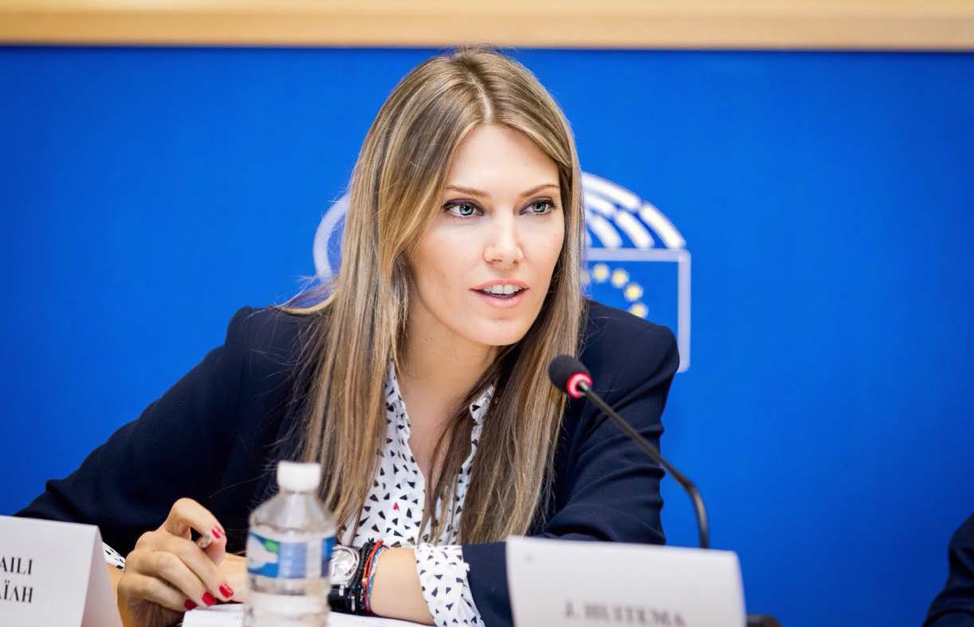
On July 15, 2021, BGF and AIWS established the Global Alliance for Digital Governance (GADG). GADG will:
- Coordinate of resources: governments, international organizations, corporations, think tanks, civil society, and influencers for AI and a digital sphere for good, to make these resources more effective, to synthesize and maximize their impact, and to create more implementation-oriented conferences.
- Protect fundamental values and standards proposed in Social Contract for the AI Age, in AI International Accord and in the book Remaking the World – Toward an Age of Global Enlightenment.
Planned projects in 2021 – 2022:
Using AIWS Innovation Platform to:
- Create lists of governments, organizations, companies, leaders, and thinkers that follow GADG’s mission.
- Collect information:
- Goals, purposes
- Research, pieces, initiatives, plans, events, and conferences
- Human resources and financial capital.
- Impacts and influences of individuals
- Their difficulties and challenges
- Contact information of leaders
In 2021 – 2022, focus on:
- Governments: USA, Japan, EU, Finland, Sweden, Australia, UK, Canada, Germany, France.
- International organizations: UN, OECD, UNESCO, Club de Madrid, IPAC, GPAI, Atlantic Council, and World Economic Forum.
- Significant conferences: Munich Conference and Riga Conference.
- Businesses: Google, the Patrick McGovern Foundation etc.
Influencers, Coordinators of GADG will connect these resources for the mission, as well as suggesting ideas and actions to engage organizations, leaders, and governments to optimize resources to create a more powerful impact.
by Editor | Jul 19, 2021 | Event Updates
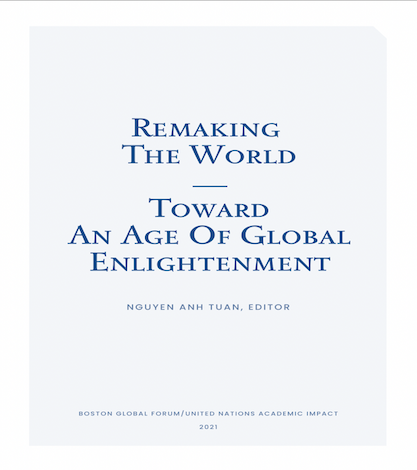
On July 15, 2021, the book Remaking the World – Toward an Age of Global Enlightenment, was officially posted on Boston Global Forum and United Nations Centennial Initiative for download.
The book proposes pathways toward a more humane, peaceful, and secure world, largely by harnessing the potential of Artificial Intelligence (AI), blockchain, and other Digital Age technologies.
Distinguished contributors to the book include:
- Shinzo Abe, Prime Minister of Japan
- Ash Carter, Former US Secretary of Defense
- Vint Cerf, “Father of the Internet”, Google
- Nazli Choucri, Massachusetts Institute of Technology (MIT)
- Ramu Damodaran, Chief of United Nations Academic Impact
- Michael Dukakis, Former Governor of Massachusetts, Chair, Boston Global Forum
- Eva Kaili, Member of the European Parliament
- Robin Kelly, U.S. Representative (Illinois),
- Ban Ki-moon, the United Nations Secretary-General
- Didzis Kļaviņš, University of Latvia
- Taro Kono, Defense Minister, Japan
- Zlatko Lagumdzija, Former Prime Minister, Bosnia & Herzegovina
- Stavros Lambrinidis, EU Ambassador to the United States
- Ursula von der Leyen, President of European Commission
- Yasuhide Nakayama, Defense State Minister, Japan
- Paul Nemitz, Principal Advisor, European Commission
- Nguyen Anh Tuan, CEO, Boston Global Forum
- Andreas Norlén, Speaker, Swedish Parliament
- Joseph Nye, Harvard University
- Zaneta Ozolina, University of Latvia, Co-Chair of Riga Conference
- Thomas Patterson, Harvard University
- Judea Pearl, University of California, Los Angeles (UCLA)
- Alex “Sandy” Pentland, Massachusetts Institute of Technology (MIT)
- Sir Iain Duncan Smith, MP, UK Parliament
- Vaira Vike-Freiberga, President of World Leadership Alliance-Club de Madrid, Former President of Latvia
Here is the link: http://bostonglobalforum.org/bgf2022/publications/remaking-the-world-the-age-of-global-enlightenment-2/