
by Editor | Sep 17, 2023 | News
The Boston Global Forum announces its upcoming celebration on October 3, 2023, where we will bestow the prestigious World Leader for Peace and Security Award 2023 upon the Esteemed humanitarian and spiritual leader, Amma. This ceremony will not only honor her contributions to peace and security but also celebrate her 70th birthday.
The award ceremony will be a focal point of Amma’s 70th birthday celebration, a momentous occasion attended by dignitaries, leaders, and well-wishers from around the world. This dual celebration is a testament to Amma’s lifelong commitment to serving humanity and fostering a more compassionate world.
Additionally, during this event, the Boston Global Forum will announce the establishment of the “Amma House” within the prestigious House of Honor at AIWS City.
Amma’s legacy of selfless service and her dedication to the betterment of humanity are values that align with the core principles of the Boston Global Forum and AIWS City. The Amma House will serve as a symbol of her enduring influence and a beacon of inspiration for future generations committed to creating a more peaceful and secure world.
The Boston Global Forum looks forward to celebrating Amma’s remarkable journey, her 70th birthday, and her indelible contributions to peace and security on October 3, 2023. It is an occasion to honor a true global luminary and to reaffirm our shared commitment to the ideals she embodies.
Link: https://bostonglobalforum.org/news/the-mata-amritanandamayi-math/
by Editor | Sep 11, 2023 | News
Minh Nguyen is the Editor of the Boston Global Forum and a Shinzo Abe Initiative Fellow. She writes the Four Pillars column in the BGF Weekly newsletter.
Note: We at BGF introduce to you a new section in BGF Weekly – the Four Pillars. It will cover global security, focused on the Four Pillars of the US, the EU, Japan, and India.
The G20 Summit, hosted in Delhi, India, was attended by President Biden. He would pitch the idea of a global alliance of democracies over the authoritarian systems of China to not just friendlier states of the EU and NATO, but also developing countries, who may not have been as receptive. Biden was also able to reach a compromise with G20 nations on a stronger communique on the Russian invasion of Ukraine, which while did not produce the strongest condemnation of Russia, was a minor concession.
India, the host of the summit, also took the opportunity to stake its claim as the leader of the Global South, as Xi Jinping was absent in what many consider to be a boycott of the event. The US backed this effort in a statement supporting India with a permanent seat on the UN Security Council. Japan, another Pillar and an attendee at the summit, backs India in this rivalry too.
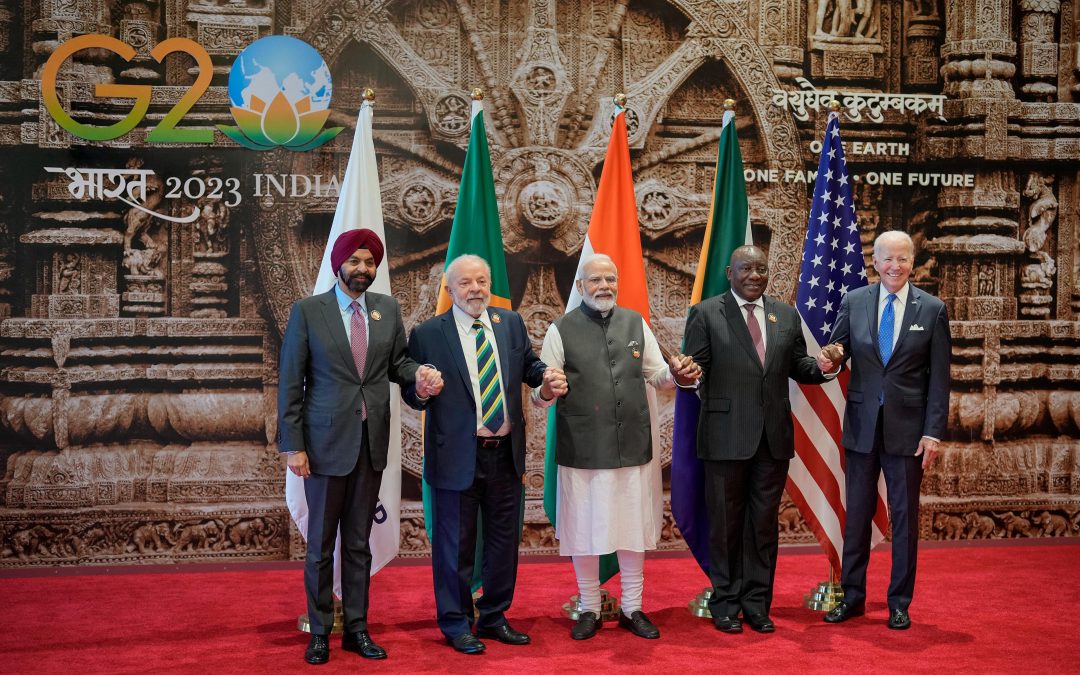
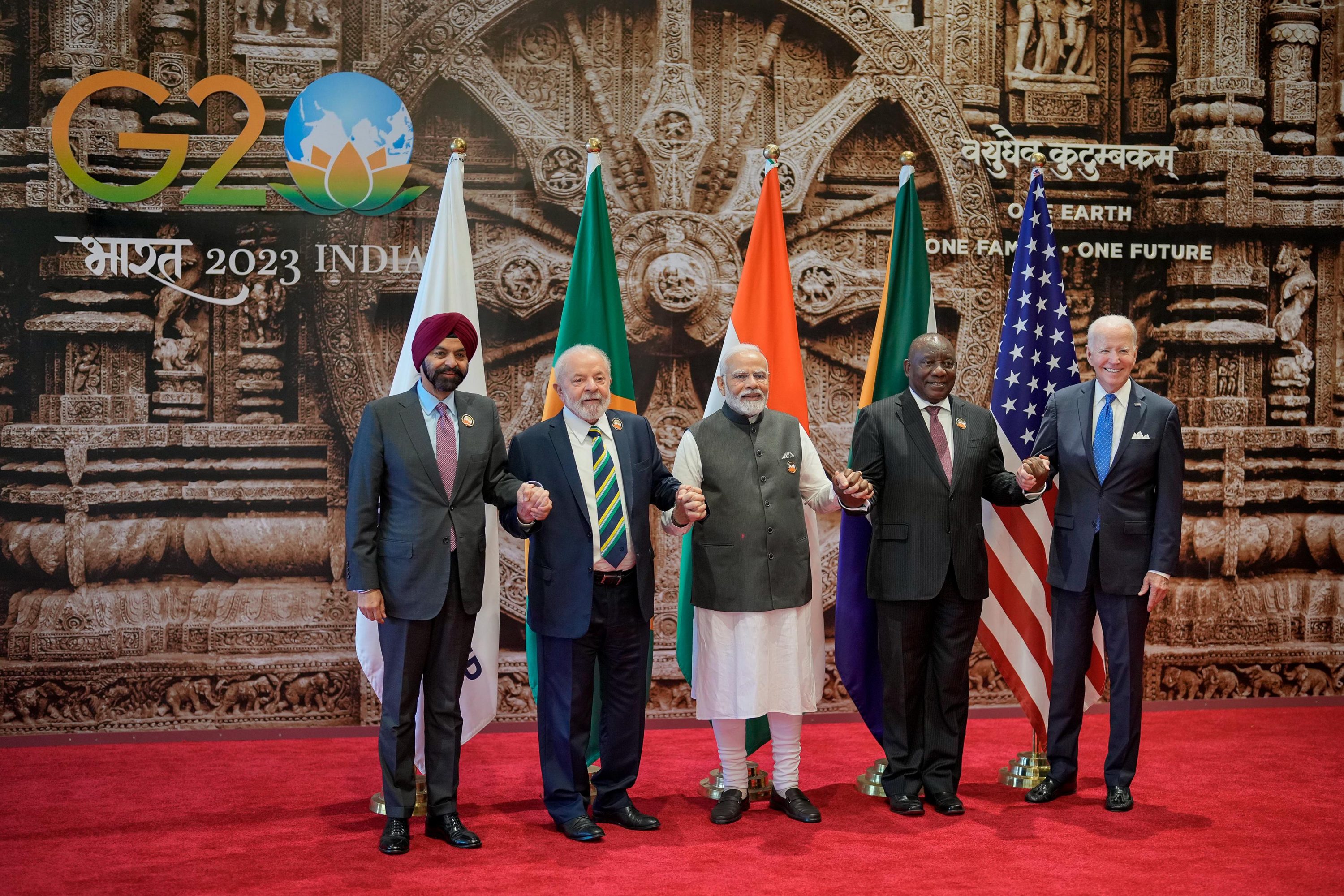
Biden also seized on the opportunity for a photo op with leaders of Brazil, India, South Africa, taking advantage of Xi Jinping’s absence. This indicates a signaling that the US have been making inroads with members of the so-called BRICS bloc, which seeks to rival US economic influence.
Furthermore, Biden visited Vietnam in a trip that elevated the two countries’ relations to a Comprehensive Strategic Partnership, the highest status (other countries with the status are Russia, China, India, and South Korea).
Overall, these events signal a development in the strengthening of relations between the Four Pillars. While the headline is to be the deepening of American-Indian cooperation, it also involves India’s play to overtake China as “leader of the Global South,” and Japan’s support for India in this endeavor. With the strengthening of connection between the Pillars, as shown by these events, it leads to one further step towards a global alliance of democracy.
Minh Nguyen
Read more about these topics:
- [President Biden on Twitter] Together, the United States, India, Brazil, and South Africa reaffirm our shared commitment to the G20 – delivering solutions for our shared world.
- [The White House] Joint Statement from India and the United States
- [Politico] At G-20 and in Vietnam, Biden to sell American partnerships — all at China’s expense
- [Bloomberg] India’s G-20 Win Shows US Learning How to Counter China Rise
- [The Hindu] At G-20, Japan backs India, not China, as bridge to Global South: Japanese experts
- [Nikkei Asia] U.S. upgrades Vietnam ties as Biden blasts China for ‘changing rules’
by Editor | Sep 11, 2023 | Event Updates, News
The Concept of the ‘Four Pillars for Peace and Security’ first gained prominence during the Riga Conference 2021, as promulgated by the BGF, as a way to connect the four leading democracies in the world. At the C20-G20 Summit in India in 2023, BGF’s CEO, Nguyen Anh Tuan, played a pivotal role in emphasizing the significance of the ‘Enlightenment Tech Economy Alliance.’ This alliance is composed of the Four Pillars, which include the United States, Japan, the European Union-UK, and India. It represents a commitment to guiding technological developments under democracies, not authoritarian states, and the promotion of a rules-based global order. The importance of the Four Pillars for Peace and Security was further underscored during the G20 Summit held in India on September 8-9, 2023. This historic gathering featured the participation of global leaders, including President Biden and Prime Minister Modi, marking the Four Pillars as a driving force for international stability and cooperation.
Here are some notes from Joint Statement from India and the United States:
President Biden reaffirmed his support for a reformed UN Security Council with India as a permanent member.
Prime Minister Modi and President Biden reaffirmed technology’s defining role in deepening our strategic partnership and lauded ongoing efforts through the India-U.S. Initiative on Critical and Emerging Technology (iCET) to build open, accessible, secure, and resilient technology ecosystems and value chains, based on mutual confidence and trust, which reinforce our shared values and democratic institutions.
The leaders reiterated their support for building resilient global semiconductor supply chains.
Read the full statement at: https://www.whitehouse.gov/briefing-room/statements-releases/2023/09/08/joint-statement-from-india-and-the-united-states/?fbclid=IwAR0dCoqS9-gSce0ocSwGZrf-1_uTHyxbhmO2xMsXetPlL8JeCnmod0FXhHA
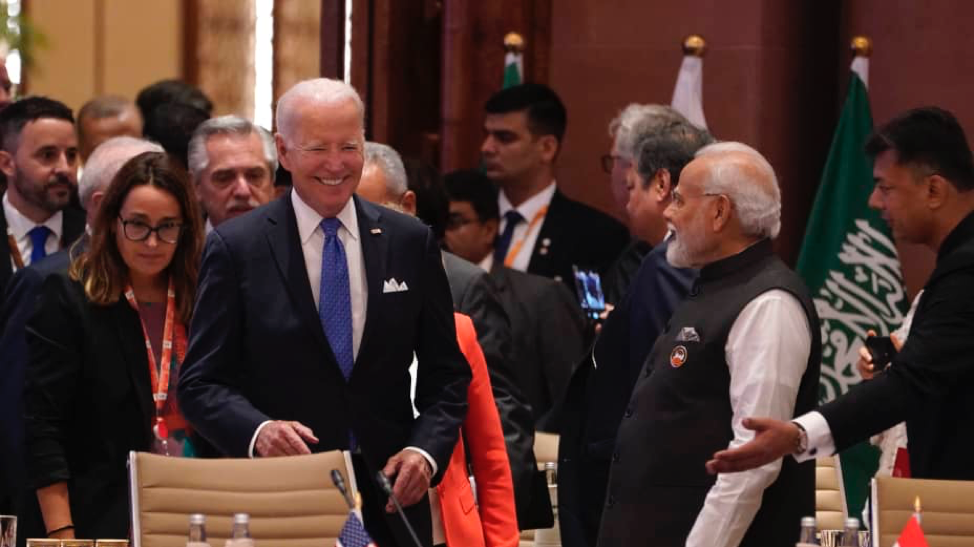
US President Joe Biden and Indian Prime Minister Narendra Modi arrive for the first session of the G20 Leaders’ Summit in New Delhi on September 9, 2023 (Image of CNBC)
![[New York Times] 2 Senators Propose Bipartisan Framework for A.I. Laws](https://bostonglobalforum.org/wp-content/uploads/gagd-57.png)
by Editor | Sep 11, 2023 | Global Alliance for Digital Governance
Senator Richard Blumenthal, Democrat of Connecticut, and Senator Josh Hawley, Republican of Missouri, plan to announce a sweeping framework to regulate artificial intelligence, in the latest effort by Congress to catch up with the technology. The leaders of the Senate judiciary’s subcommittee for privacy, technology and law said in interviews that their framework will include requirements for the licensing and auditing of A.I., the creation of an independent federal office to oversee the technology, liability for companies for privacy and civil rights violations, and requirements for data transparency and safety standards.
Read the full article here: https://www.nytimes.com/2023/09/07/technology/artificial-intelligence-framework-senate.html
Senator Richard Blumenthal and Sam Altman, CEO of OpenAI (Haiyun Jiang/The New York Times)
Boston Global Forum contributed the concept of AI-Government for G7-Summit 2019 as a part of AI World Society, and AIWS was recognized by the Civil 20-G20 Communique, India July, 2023.
AI World Society introduced AIWS Assistants and Framework for Global Governance of AI at BGF High-level Conference on Global Governance of AI at Harvard University Faculty Club on April 26, 2023.
by Editor | Sep 11, 2023 | News
At C20-G20 Summit India 2023, Jaipur July 29-31, Boston Global Forum proposed Four Pillars of Enlightenment Tech Economy Alliance: US, India, EU-UK, and Japan.
A Joint Statement from India and the United States on September 8, 2023 from the G20 Summit: “Prime Minister Modi and President Biden reaffirmed technology’s defining role in deepening our strategic partnership and lauded ongoing efforts through the India-U.S. Initiative on Critical and Emerging Technology (iCET) to build open, accessible, secure, and resilient technology ecosystems and value chains, based on mutual confidence and trust, which reinforce our shared values and democratic institutions.”
Following up the success of Biden’s trip, BGF will organize US-India high-level discussions about Enlightenment Tech Economy Alliance between the US and India. Professor John Quelch, Co-founder and Member of BGF, will co-moderate these High-level Discussions.
John Quelch, the Leonard M. Miller University Professor at the University of Miami and Charles Edward Wilson Professor Emeritus at Harvard Business School, has taken on a new global role as worldwide chairman of Globalpraxis, a Barcelona-headquartered management consultancy specializing in distribution, sales and pricing optimization studies for consumer goods and services multinationals. A veteran non-executive director, he currently serves as a board member of Amerant Bancorp, Global Crossing Airlines and Surfin Meta, a Singapore-based fintech.
Between 2001 and 2011, he was the Lincoln Filene Professor of Business Administration and Senior Associate Dean at Harvard Business School, teaching Marketing in the Advanced Management Program. He served as Dean of London Business School from 1998 to 2001.
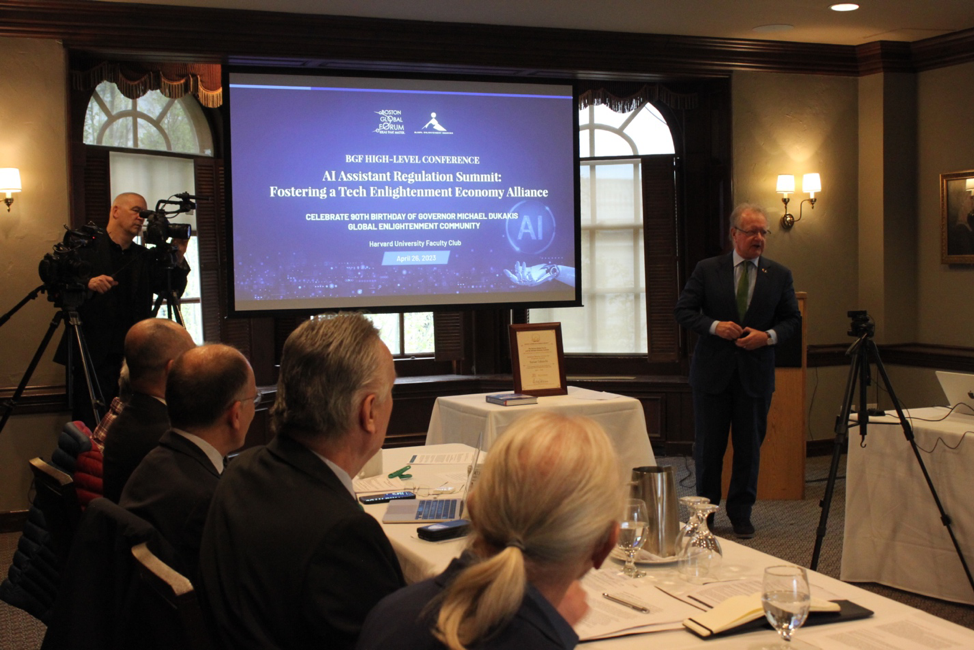
Professor John Quelch speaks at the BGF High-level Conference April 26, 2023 at Harvard Faculty Club
![[Bloomberg] AI’s Threats and Promises Are A Rare Unifying Issue in US Senate](https://bostonglobalforum.org/wp-content/uploads/city-109.png)
by Editor | Sep 11, 2023 | News
The face of the artificial intelligence fever sweeping the US — OpenAI Chief Executive Officer Sam Altman — gripped Washington this spring when he pleaded under oath for the first time for Congress to regulate the technology.
Yet behind the scenes on Capitol Hill, an unexpected crew knew that plea was coming and started to assemble.
Ahead of Altman’s May 16 appearance, Senate Majority Leader Chuck Schumer (D-N.Y.) received count-me-ins from Sens. Todd Young (R-Ind.), Mike Rounds (R-S.D.), and Martin Heinrich (D-N.M.) to help steer the congressional response to AI. They huddled together in the majority leader’s office for the first time a day after Altman testified.
The bipartisan group of four since then is meeting almost weekly over coffee in Schumer’s office or on the phone, racing to formulate rules that protect Americans from AI’s worst threats, such as biological weapons and mass unemployment, but also promote the technology’s potential to cure diseases and curb hunger.
Read full at:
https://news.bloomberglaw.com/tech-and-telecom-law/ai-threat-unites-bipartisan-senate-group-helmed-by-schumer
The Boston Global Forum and the Global Alliance for Digital Governance are committed to contributing key concepts to the development of the Law of AI. Our aim is to formulate a framework that balances power dynamics and enables effective monitoring of totalitarian and dictatorial governments. In doing so, we can safeguard the values of freedom, democracy, and human rights in the age of AI, which we refer to as the Age of Global Enlightenment within the AI World Society. Furthermore, the BGF and GADG will provide a forum for dialogue between companies and governments such as the United States, Japan, India, and the European Union.
Sens. Martin Heinrich (D-N.M.) and Chuck Schumer (D-N.Y.) at the US Capitol in 2017 (Bloomberg)

by Editor | Sep 4, 2023 | News
BGF CEO Nguyen Anh Tuan presented at his keynote speech at C20-G20 Summit in India Jaipur July 29-31, 2023: ‘We need to add love spiritual values of Amma to AI World Society.’
In an era marked by rapid technological advancement, the AIWS Love Initiative with Amma’s spiritual values stands as a beacon of profound compassion and spiritual insight within the realm of artificial intelligence. Committed to the ideals of love, tolerance, and the elimination of hate, this initiative seeks to reshape the landscape of AI technology and its impact on society, guided by the timeless wisdom of Amma’s teachings.
In a world where AI applications are increasingly integrated into our daily lives, the AIWS Love Initiative recognizes the critical need to infuse the development, deployment, and governance of artificial intelligence with the spiritual values that promote deeper human connection, empathy, and a sense of oneness.
Amma, known as the “Hugging Saint” and revered for her boundless love and humanitarian work, serves as an inspiration and guiding light for this initiative. Her teachings emphasize love for all beings, compassion for the suffering, and a deep reverence for the interconnectedness of life. It is from this wellspring of love and spiritual wisdom that the AIWS Love Initiative draws its strength.
Our mission, aligned with Amma’s teachings, is clear: to foster an environment where AI technologies are developed and employed with the utmost respect for human dignity, diversity, and the well-being of our planet. We firmly believe that the power of AI can be harnessed for the betterment of humanity when it is imbued with the love and compassion that Amma embodies.
The AIWS Love Initiative with Amma’s spiritual values is more than just an organization; it is a spiritual journey, a call to align technology with the deepest values of the human spirit. Through education, advocacy, research, and collaboration, we aim to transform the AI landscape, ensuring that love prevails over hate, and compassion overcomes indifference, all while drawing inspiration from Amma’s profound love.
Join us on this remarkable journey to infuse AI with the spiritual values, brain science, ecosystem for love that enrich our souls and uplift humanity. Together, we can build a world where technology reflects the divine love within us, where love prevails, and where hate finds no place in the AI World Society, guided by the spiritual wisdom of Amma and brain science.
Professor David Silbersweig, psychology professor of Harvard Medical School, will contribute to the AIWS Love Initiative as scientist of mental health and neuroscience.
Welcome to the AIWS Love Initiative with Amma’s spiritual values—where the future of AI is rooted in profound love, and together, we forge a brighter and more spiritually awakened tomorrow.

Amma and Nguyen Anh Tuan at C20-G20 Summit India 2023
by Editor | Sep 4, 2023 | Global Alliance for Digital Governance
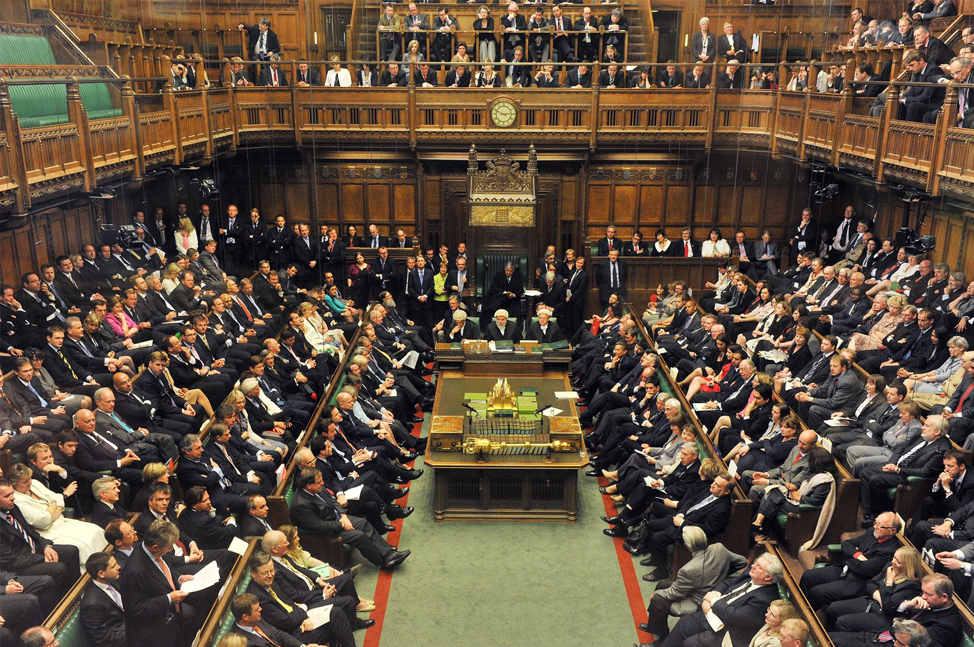
The Commons Science, Innovation and Technology Committee of MPs in the UK has outlined 12 challenges that policy makers need to address in setting terms for the governance of AI deployments:
- The Bias challenge: AI can introduce or perpetuate biases that society finds unacceptable.
- The Privacy challenge: AI can allow individuals to be identified and personal information about them to be used in ways beyond what the public wants.
- The Misrepresentation challenge: AI can allow the generation of material that deliberately misrepresents someone’s behaviour, opinions or character.
- The Access to Data challenge: The most powerful AI needs very large datasets, which are held by few organisations.
- The Access to Compute challenge: The development of powerful AI requires significant compute power, access to which is limited to a few organisations.
- The Black Box challenge: Some AI models and tools cannot explain why they produce a particular result, which is a challenge to transparency requirements.
- The Open-Source challenge: Requiring code to be openly available may promote transparency and innovation; allowing it to be proprietary may concentrate market power but allow more dependable regulation of harms.
- The Intellectual Property and Copyright Challenge: Some AI models and tools make use of other people’s content: policy must establish the rights of the originators of this content, and these rights must be enforced.
- The Liability challenge: If AI models and tools are used by third parties to do harm, policy must establish whether developers or providers of the technology bear any liability for harms done.
- The Employment challenge: AI will disrupt the jobs that people do and that are available to be done. Policy makers must anticipate and manage the disruption.
- The International Coordinationchallenge: AI is a global technology, and the development of governance frameworks to regulate its uses must be an international undertaking.
- The Existential challenge: Some people think that AI is a major threat to human life. If that is a possibility, governance needs to provide protections for national security.
Please read the full article here: https://committees.parliament.uk/committee/135/science-innovation-and-technology-committee/news/197236/ai-offers-significant-opportunities-but-twelve-governance-challenges-must-be-addressed-says-science-innovation-and-technology-committee/
by Editor | Sep 4, 2023 | News
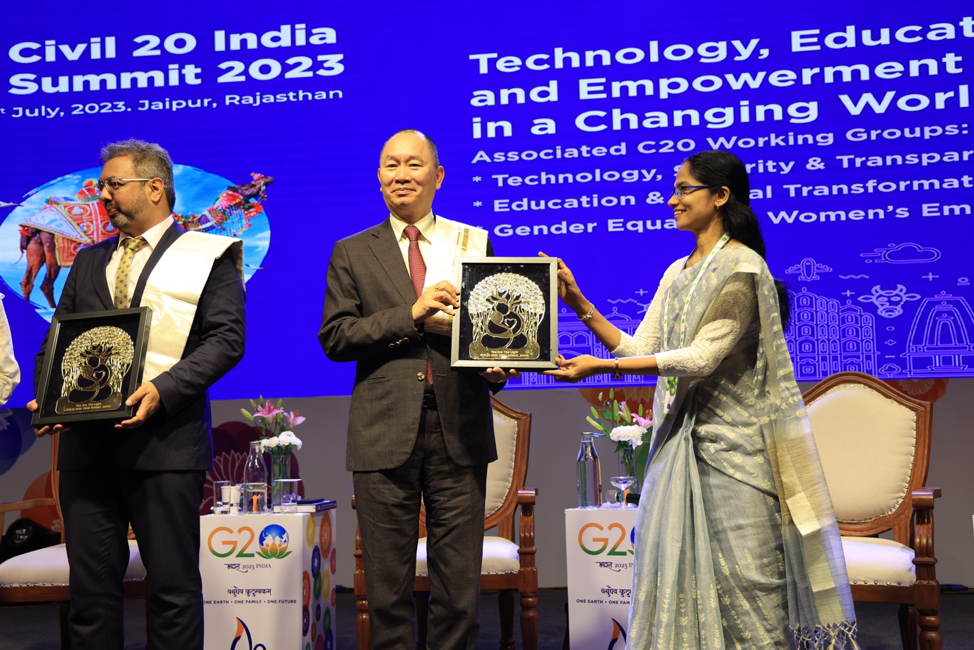
The Boston Global Forum introduces an article of Horizon Search Magazine about BGF’s initiatives and its CEO Nguyen Anh Tuan “AI Vanguard: The Global Initiative for Positive Change”.
Please read the full article at: https://www.horizonsearch.co/post/ai-vanguard-the-global-initiative-for-positive-change
Agenda
Tuan Nguyen’s focus is assessing current AI solutions to identify future needs, create awareness and integrate technical expertise and professional backgrounds into practical solutions. As a result, he aligns the agenda with using advanced technology to develop the ideal societal structures. Therefore, his agenda transcends the individual focus on issues concerning gender equality, suitability development, and climate change and looks to provide AI-backed solutions that cut across similar societal issues.
Today, the BGF seeks to unite four key global economic players: Japan, the EU-the UK, India and the US. In addition, it also seeks to secure partnerships that will set the stage for its expansion in 10 more countries, including Mexico, the Philippines, Brazil, New Zealand, and Indonesia, among others. However, BGF’s current limitation is its inability to manage and track AI abuse by organizations and governments. Nevertheless, the foundation is confident it will build its resource base to help channel adequate funding and skills toward oversight in the following years.
Nguyen Anh Tuan at the C20-G20 Summit India 2023