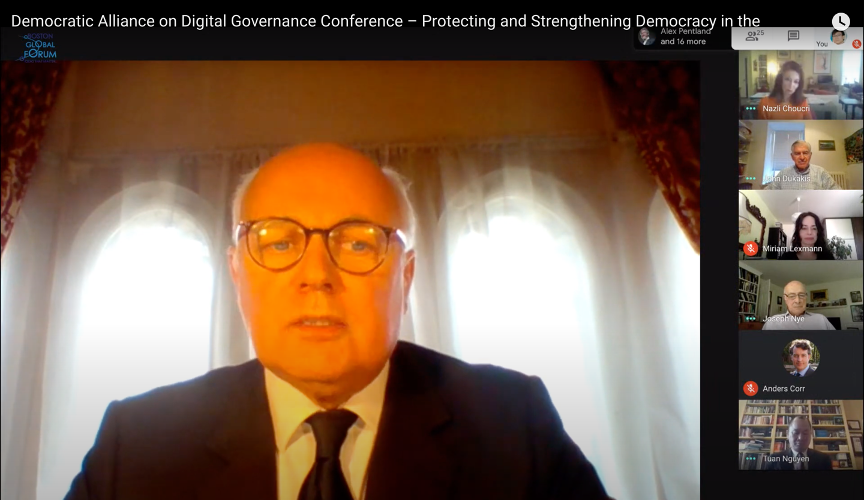
British MP Sir Iain Duncan Smith criticized China and saw China as a big threat and peril to the peace and security of the world in his speech at the Democratic Alliance on Digital Governance Conference on July 1, 2020. Governor Michael Dukakis, co-founder and chair of the Boston Global Forum (BGF), moderated this conference with other speakers and panelists that included
Political Leaders: Liam Byrne, UK Member of Parliament, the Chair of the Parliamentary Network on the World Bank & IMF, Ichiro Fujisaki, former Japanese Ambassador to US, Senator Kimberley Kitching, Parliament of Australia, Co-chair of Inter-Parliamentary Alliance on China (IPAC), Miriam Lexmann, Member of European Parliament, Co-chair of IPAC, Jamil Mahuad, former President of Ecuador, Beatriz Merino, former Prime Minister of Peru, Yasuhide Nakayama, Member of the House of Representatives of Japan, the State Minister for Foreign Affairs, Andreas Norlén, Speaker of the Swedish Parliament, Nam Pham, Assistant Secretary, Massachusetts, Vaira Vike-Freiberga, former President of Latvia.
Scholars and Thinkers: Professor Nazli Choucri (MIT), Prof. Koichi Hamada (Yale), Prof. Joseph Nye (Harvard Kennedy School), Prof. Thomas Patterson (Harvard Kennedy School), Prof. Alex Pentland (MIT), Marc Rotenberg (Director of the Center on AI and Digital Policy (CAIDP), Michael Dukakis Institute, former President of EPIC), Prof. David Silbersweig (Harvard), Nguyen Anh Tuan (CEO of the Boston Global Forum (BGF)), Prof. Dick Vietor (Harvard Business School)
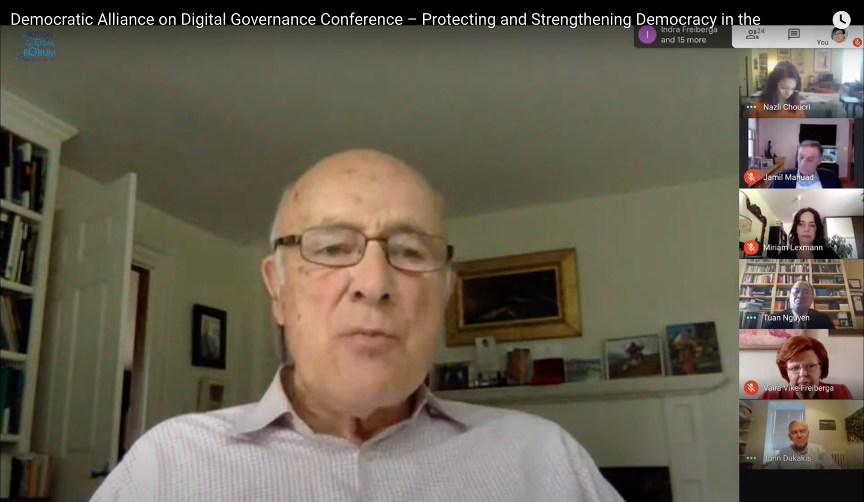
On July 1, 2020, at Democratic Alliance on Digital Governance conference, Professor Joseph Nye, Member of the BGF Board of Thinkers, Mentor of AIWS.net, presented his view about US-China relations in the section “New Alliance, New Order, New Democracy” with other speakers and panelists.
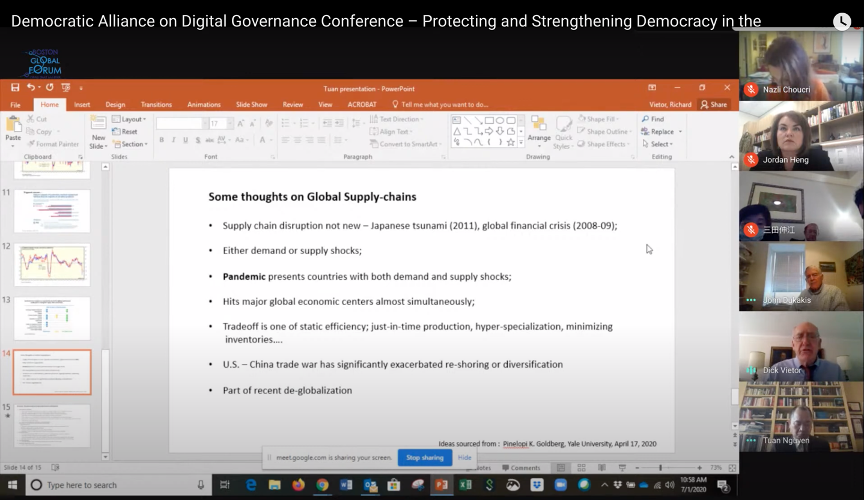
On July 1, 2020, at Democratic Alliance on Digital Governance conference, organized by the Boston Global Forum, Professor Richard Vietor, Harvard Business School presented “Global Economic Effects of COVID-19 Pandemic” at the section “New Supply Chain, New Economy, New Democracy”.
Some thoughts on Global Supply-chains
Supply chain disruption not new – Japanese tsunami (2011), global financial crisis (2008-09);
Either demand or supply shocks;
Pandemic presents countries with both demand and supply shocks;
Hits major global economic centers almost simultaneously;
Tradeoff is one of static efficiency; just-in-time production, hyper-specialization, minimizing inventories…
S. – China trade war has significantly exacerbated re-shoring or diversification
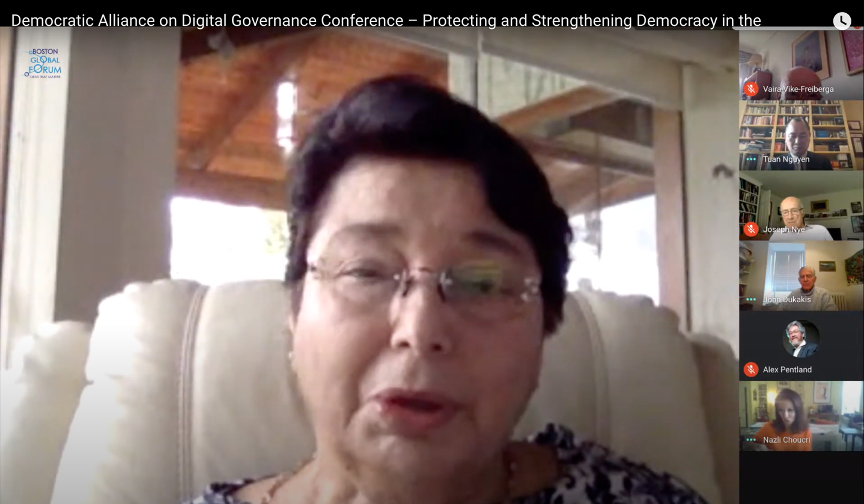
During the section “New Alliance,New Order,New Democracy”, she presented on how China impacted in Peru.
Beatriz Merino is a panelist of this section at Democratic Alliance on Digital Governance conference on July 1, 2020, organized by the Boston Global Forum (BGF). She is the representative of the BGF in Peru.
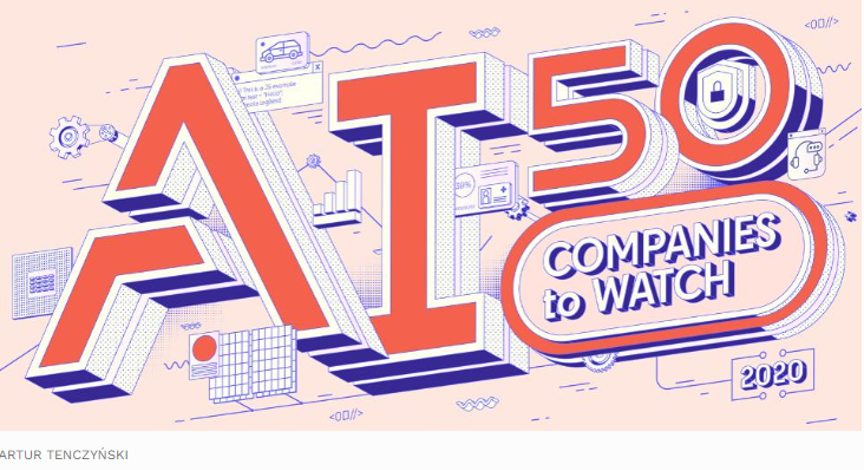
Artificial intelligence is beginning to be usefully deployed in almost every industry from customer call centers and finance to drug research. Yet the field is also plagued by relentless hype, opaque jargon and esoteric technology making it difficult for outsiders identify the most interesting companies.
To cut through the spin, Forbes partnered with venture firms Sequoia Capital and Meritech Capital to create our second annual AI 50, a list of private, U.S.-based companies that are using artificial intelligence in meaningful business-oriented ways. To be included, companies had to be privately-held and focused on techniques like machine learning (where systems learn from data to improve on tasks), natural language processing (which enables programs to “understand” written or spoken language), or computer vision (which relates to how machines “see”).
The list was compiled through a submission process open to any AI company in the U.S. The application asked companies to provide details on their technology, business model, customers and financials like funding, valuation and revenue history (companies had the option to submit information confidentially, to encourage greater transparency). In total, Forbes received about 400 entries. From there, our VC partners applied an algorithm to identify the 100 with the highest quantitative scores and then a panel of eight expert AI judges identified the 50 most compelling companies.
To support AI application in the world society, Artificial Intelligence World Society Innovation Network (AIWS.net) created AIWS Young Leaders program including some MIT Researchers, as well as Young Leaders and Experts from Australia, Austria, Belgium, Britain, Canada, Denmark, Estonia, France, Finland, Germany, Greece, India, Italy, Japan, Latvia, Netherlands, New Zealand, Norway, Poland, Portugal, Russia, Spain, Sweden, Switzerland, United States, and Vietnam.