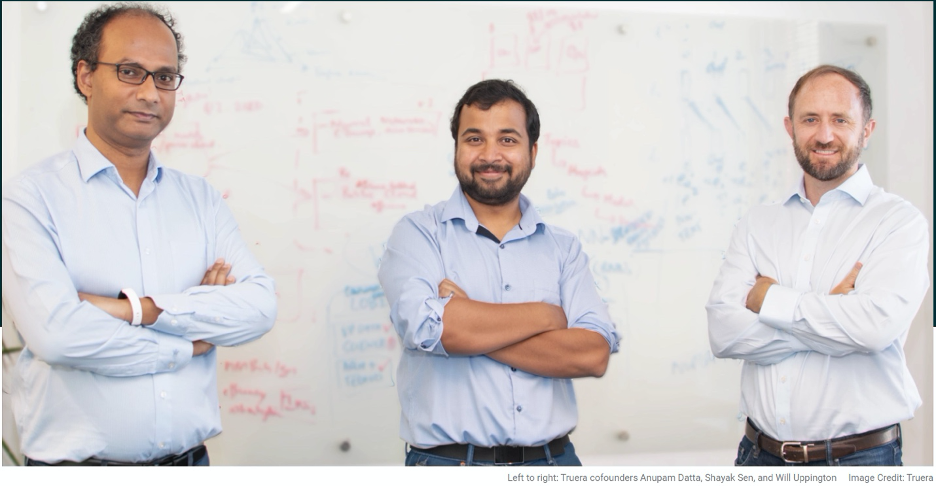
As AI impacts more industries and areas of society, startups are building testing tools to help companies and governments assess the state of their models and identify potential compliance issues. Google Cloud chief AI scientist Andrew Moore recently predicted that the AI development pipeline will someday center on testing and validation. But Truera, previously known as AILens, says it’s building a different kind of platform, based on the work of co-founders Anupam Datta and Shayak Sen, whose explainability AI research considers causality and cooperative game theory, as well as fairness and bias.
Datta, who is on leave from his job as a professor at Carnegie Mellon University, told VentureBeat the research behind Truera began in 2014, when CMU researchers uncovered forms of gender bias in online advertising but lacked tools to understand how to measure that bias. The Truera platform can detect and help mitigate problems that occur in AI models, like bias imbalances, changes in data distribution that can impact predictions, and stability over time. Datta said customers are using this feature more as a result of anomalies brought on by COVID-19.
In the field of AI and causality, Professor Judea Pearl is a pioneer for developing a theory of causal and counterfactual inference based on structural models. In 2011, Professor Pearl won the Turing Award, computer science’s highest honor, for “fundamental contributions to artificial intelligence through the development of a calculus of probabilistic and causal reasoning.” In 2020, Professor Pearl is also awarded as World Leader in AI World Society (AIWS.net) by Michael Dukakis Institute for Leadership and Innovation (MDI) and Boston Global Forum (BGF).
This is a talk at the Dialog of “Disputing Territories and World Peace”
Seiichi Eto, the Japanese Minister of State for Okinawa and Northern Territories Affairs, talks about the Senkaku Islands on the Boston Global Forum, August 8, 2020.
He criticizes: China does not have sovereignty over the Senkaku Islands, and China is unfair in claiming that they belong to China, creating tensions in the Senkaku Islands of Japan.
Print out this when you watch this video and watch the video while watching the material.
More information about the Senkaku Islands can be found here.
Other videos about the Senkaku Islands can be found here and here.
Professor Thomas Patterson, Harvard Kennedy School, Co-founder of the Boston Global Forum and AIWS.net, is co-author of the Social Contract 2020, A New Social Contract in the Age of AI.
He recently posted his writing in the Opinion Section of Boston Globe, July 27, 2020 with title “The GOP’s moral trap”.
He wrote:
“The Republican Party has shattered the longstanding norm that political power should be used with restraint rather than weaponized and taken to its lawful limits. It’s about to pay the price.
Democracies depend on norms — unwritten rules about how leaders and citizens should behave. One norm is forbearance — the idea that political power should be used with restraint rather than weaponized and taken to its lawful limits. Such norms have little standing in today’s Republican Party.”
Professor Caroline A. Jones, MIT, has joined the History of AI Board at AIWS.net. She is a Professor in History, Theory, and Criticism of the Architecture Department at MIT.
She wrote a chapter of the book “Possible Minds: 25 Ways of Looking At AI” (2019), whose co-authors are Judea Pearl, Alex Pentland, Max Tegmark, Stuart Russell, and others. She said “Humans must truly understand intelligence to re-create it”, and “As we enshrine computation as the core of smartness, we would be well advised to think of the complexity of our ‘wet’ cognition, which entails a much more distributed notion of intelligence that goes well beyond the sacred cranium and may not even be bounded by our own skin.”
In preparation for the Policy Lab, WLA-CdM and BGF will be organizing a series of preliminary online roundtables that seek to fuel and enrich deliberations within the Policy Lab. The first of these roundtables took place on 12 May, 2020, and focused on the deployment of digital technologies in response to COVID-19 pandemic, and their implications on privacy rights.
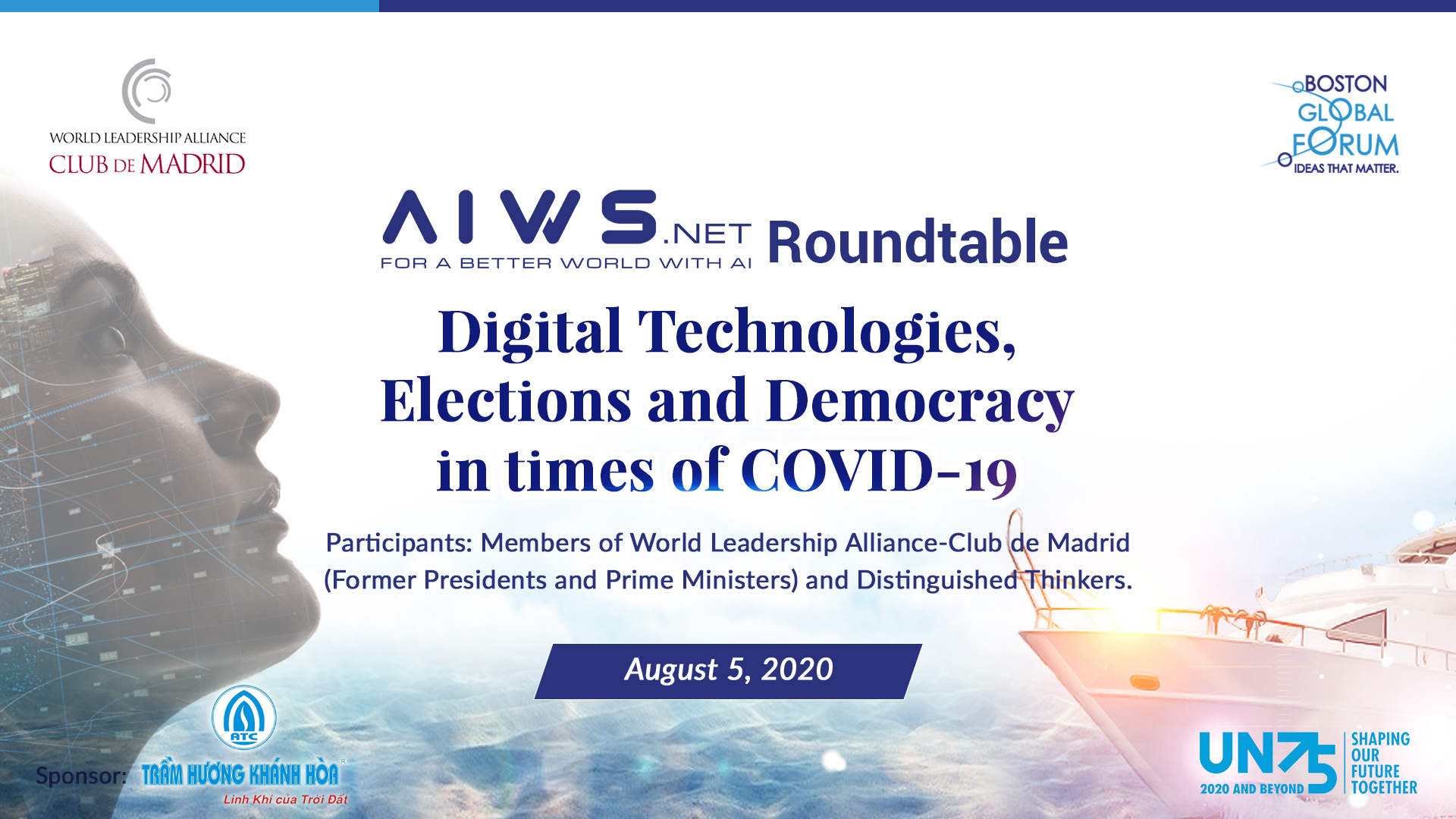
A second online roundtable on Digital Technologies, Elections and Democracy in times of the COVID-19 pandemic will be held on August 5, 2020 and analyse how digital technologies can contribute to protecting democracies and guaranteeing free, fair and transparent elections in times of global emergencies.
In the present COVID-19 context and from a democratic perspective, the development of a new Social Contract on Digital Governance and Artificial Intelligence acquires renewed relevance as the imperative of improving preparedness and government responses to global crises becomes ever more evident.
These policy discussions are part of the Multilateralism and Global Cooperation track of WLA-CdM’s 2020-2022 Programmatic Strategy. They will serve tobring the digital transformation angle into WLA-CdM’s 2020 Policy Dialogue on ‘Multilateralism that delivers’ and, through the latter, to our contribution to the UN75 process and global discussions on the much needed reinvigoration of the multilateral system.