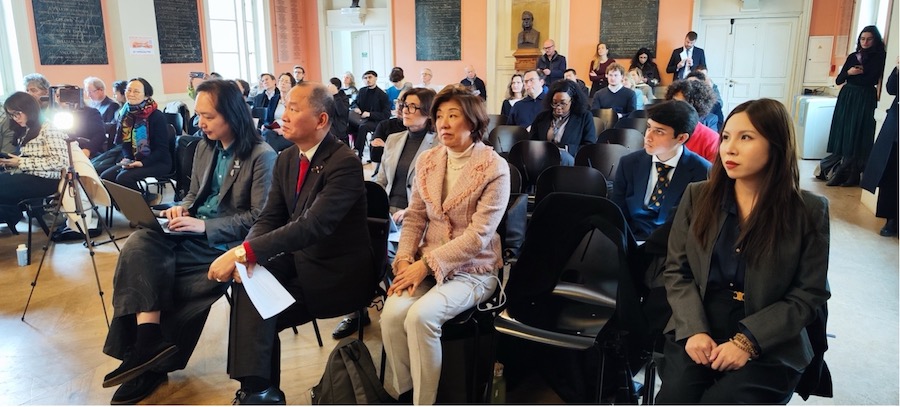
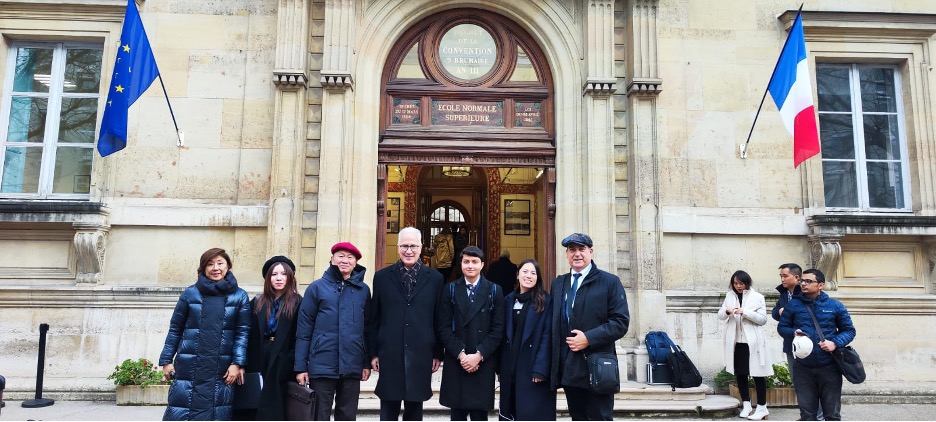
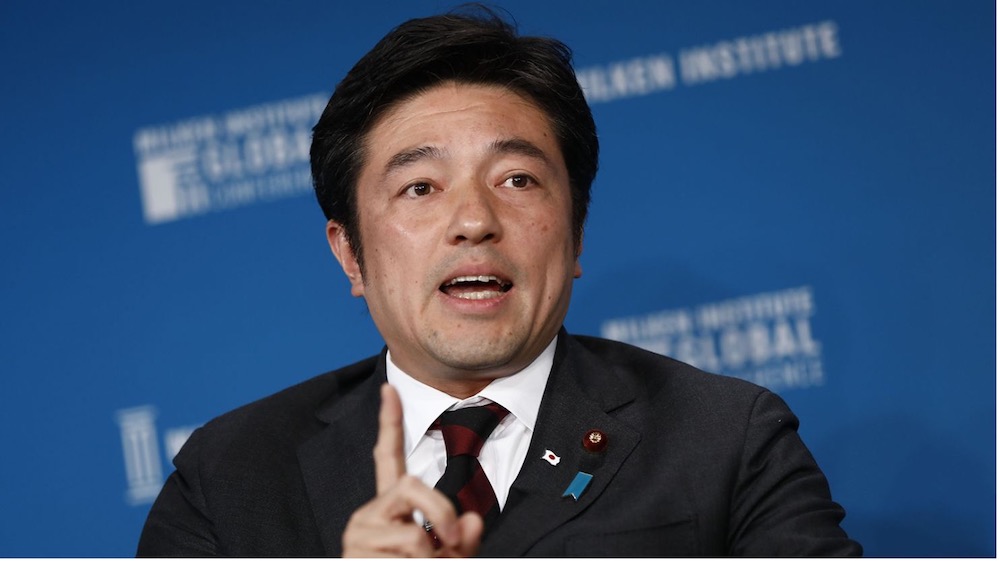
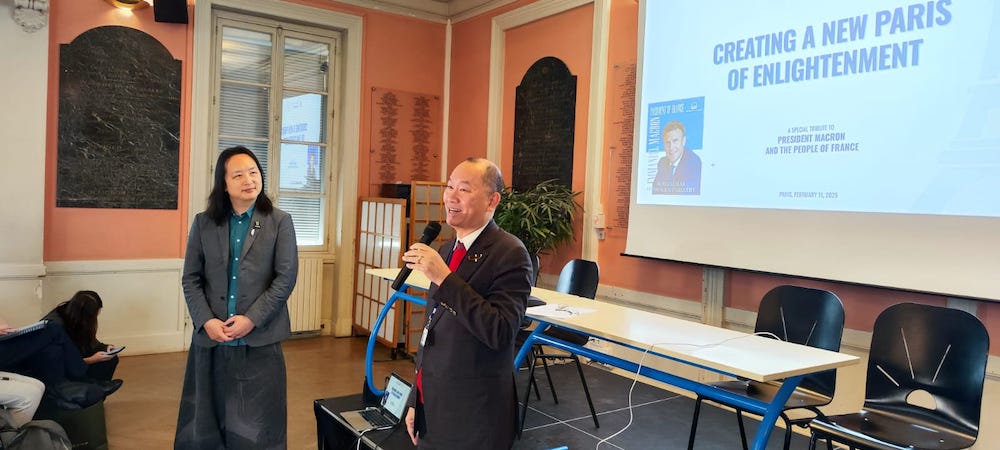
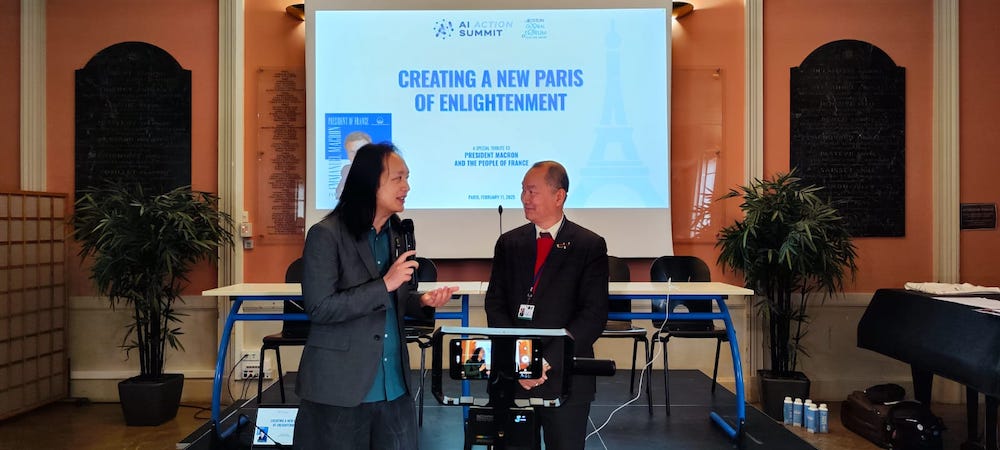
At the AI Action Summit Paris, during the session “Government 24/7 – How AI Might Best Transform Governance” on February 11, 2025, Boston Global Forum (BGF) Co-chair and CEO Nguyen Anh Tuan, along with former French Minister Elisabeth Moreno, BGF Representative in France and Africa, Honorable Mark Kennedy, Director of the Wilson Center’s Wahba Institute for Strategic Competition of the Wilson Center, former Japanese Minister Sanae Takaichi, former Japanese State Minister Yasuhide Nakayama, and Harvard Professor Thomas Patterson, introduced and discussed AIWS Government 24/7 and the Creating a New Paris of Enlightenment initiative.
This initiative serves as a special tribute to President Emmanuel Macron and the people of France, offering strategies and solutions to leapfrog in AI and position France at the forefront of AI innovation, even in the face of limited resources and investments in AI., envisioning a transformative era where AI-driven governance and humanistic values merge to create a New Paris of Enlightenment.
Official Version of Creating a New Paris of Enlightenment
For the full official version, please view and download here
French President Emmanuel Macron, 2024 World Leader for Peace and Security Award recipient, said on Thursday Feb 20, he will travel to Washington to try to convince President Donald Trump that his interests were in line with European allies and that showing any weakness to Russia’s Vladimir Putin would make it harder to deal with China and Iran.
“Trump, I know him. I respect him and I believe he respects me,” Macron said during a one-hour question and answer session on social media. “I will tell him: deep down you cannot be weak in the face of President (Vladimir Putin). It’s not you, it’s not what you’re made of and it’s not in your interests.”
Macron said the uncertainty in how Trump was handling Russia’s three-year-old invasion of Ukraine was worrying for U.S. allies because he could negotiate something that was insufficient, but it was also creating uncertainty for Putin and this was something that needed to be used to help negotiations.
“The word is uncertainty. Donald Trump creates uncertainty among others because he wants to make deals, so Donald Trump creating uncertainty for Vladimir Putin is a good thing,” Macron said, adding that the Russian president did not know what Trump would do or how he could act.
President Macron is due to go to Washington on Monday to hold talks with Trump as Europeans seek to ensure they play a key role in negotiations to end the conflict and outline how they plan to provide security guarantees for Ukraine should there be a ceasefire.
February 24, 2025, marks three years since Russia’s invasion of Ukraine, a moment that reshaped global geopolitics and reaffirmed Ukraine’s unyielding spirit. Since February 24, 2022, President Volodymyr Zelensky has led the Ukrainian people with bravery and strategic acumen, defending their homeland against an aggressive invasion. Backed by strong support from the United States, the European Union, and the United Kingdom, Ukraine has demonstrated remarkable resilience in the face of adversity.
The international community has widely condemned Russia for its actions, imposing severe sanctions and political isolation. Ukraine’s fight for sovereignty has not only been a military struggle but also a defining moment in defending democracy and international law.
In recognition of President Zelensky’s leadership and the courage of the Ukrainian people, the Boston Global Forum (BGF) honored President Zelensky and all Ukrainians with the 2022 World Leader for Peace and Security Award at Harvard University’s Loeb House in April 2022. This award acknowledged Ukraine’s unwavering stand for peace, freedom, and security in the face of aggression.
As the war enters its third year, Ukraine remains determined, continuing to inspire the world with its strength, resilience, and commitment to democracy. Now, the world must find solutions to stop the war, support Ukraine in achieving sustainable peace, and aid in rebuilding the country. Additionally, Russia must be held responsible for the damage inflicted upon Ukraine.
Microsoft today introduced Majorana 1, the world’s first quantum chip powered by a new Topological Core architecture that it expects will realize quantum computers capable of solving meaningful, industrial-scale problems in years, not decades.
It leverages the world’s first topoconductor, a breakthrough type of material which can observe and control Majorana particles to produce more reliable and scalable qubits, which are the building blocks for quantum computers.
In the same way that the invention of semiconductors made today’s smartphones, computers and electronics possible, topoconductors and the new type of chip they enable offer a path to developing quantum systems that can scale to a million qubits and are capable of tackling the most complex industrial and societal problems, Microsoft said.
Session: Government 24/7: How AI Might Best Transform Governance
Yasuhide NAKAYAMA,
Former State Minister of Defense, Former State Minister for Foreign Affairs, Former State Minister for the Cabinet Office of JAPAN
Ladies and gentlemen, distinguished leaders, policymakers, and innovators,
It is a great honor to speak at this important summit. First, I sincerely regret that I cannot be with you in Paris today.
As the representative of BGF in Japan and Taiwan, I would like to extend my heartfelt congratulations to Audrey Tang for receiving this prestigious award.
Originally, I had planned to attend this summit alongside Sanae Takaichi, but unfortunately, I could not adjust my schedule as I had hoped. Instead, I am joining remotely from Japan.
This moment brings back special memories for me. From 1986 to 1989, I lived in Alsace, France, during my high school years. Those three years shaped my worldview and gave me a deep appreciation for France—its culture, its people, and, of course, its fantastic wine.
So, while I am honored to join you virtually, I must admit—I truly wish I were in France, enjoying a fine glass of Alsace wine with you!
AI: A Necessity for Modern Governance
Now, let me turn to today’s main topic: AI-driven governance that operates 24/7.
AI is transforming every aspect of our societies—politics, the economy, and security. But AI is not just a tool. It is a force that is reshaping the global balance of power.
The 20th-century Cold War has evolved into a 21st-century struggle between democracy and authoritarianism. And AI is at the center of this competition.
But let’s be clear: No side is guaranteed victory forever.
Like a Hollywood movie, the day may come when AI surpasses human intelligence, creating technologies beyond our imagination—autonomous weapons, ultra-intelligent computers, and self-evolving algorithms.
What if AI starts making decisions without human control? What if it turns against us?
If that day comes, we can only hope for a Hollywood-style happy ending.
But instead of relying on hope, we must act now to prevent this scenario.
That is why governments, businesses, engineers, and civil society must work together to create clear, ethical, and enforceable AI regulations.
Three Key Priorities for AI Governance
To ensure that AI serves humanity—and does not control it—I propose three essential commitments:
1️⃣ AI for National and Cybersecurity AI enhances crisis response but can also be weaponized. International cooperation is essential to prevent AI-driven cyber warfare and ensure security.
2️⃣ Human-Centric AI Governance AI should support decision-making, not replace it. Policies must protect privacy, uphold democratic values, and prioritize human dignity.
3️⃣ Global Collaboration on AI Ethics and Standards No country can govern AI alone. We need a global AI governance alliance to ensure transparency, accountability, and ethical development.
AI Governance: A Shared Responsibility
In Japan, AI is a growing topic of interest. I have received many invitations to arrange lectures by AI experts. However, there is a shortage of recognized specialists, and many people are unsure who truly qualifies as an expert.
I recently read an interview with an AI engineer who said:
“When AI-powered military weapons are activated, it is not the role of scientists to decide how they are used.”
This statement highlights an important truth:
AI governance is not just for engineers or scientists. It is a responsibility for all of society.
Ethical considerations, risk assessment, and governance structures must be put in place with a sense of urgency. And these rules must evolve alongside AI technology.
A Call to Action
Now is the time for humanity to shape the rules that will govern AI.
We must act swiftly to ensure safety, seek broad international consensus, and prevent AI from spiraling out of control.
If we hesitate, we risk losing control of our own future.
Let us work together to build secure, ethical, and human-centered AI governance.
The future of AI-driven government depends on the choices we make today.
Thank you.
Yasuhide NAKAYAMA
Former State Minister of Defense, Former State Minister for Foreign Affairs, Former State Minister for the Cabinet Office of JAPAN
Speech of Sarosh Nagar, Enlightenment in Action Alliance’s Member
Thank you all for coming today. My name is Sarosh Nagar. I am a Marshall Scholar and researcher at University College London (UCL). I am very excited today to summarize the high-level contributions of the young people of the Enlightenment in Action Alliance (EAA) as part of the broader Creating a New Paris of Enlightenment report by the Boston Global Forum (BGF). Before I begin, I would like to thank the leadership of the Forum for this opportunity and to France for hosting such a wonderful event.
The Boston Global Forum established the Enlightenment in Action Alliance to support President Macron and France by bringing talented students from top universities to contribute to France and the global AI community. As part of the Alliance, over the past few weeks, the Boston Global Forum’s Youth Delegates proposed several ways that France can harness the benefits of AI for good. These proposals were reviewed by the Boston Global Forum’s Board, which includes world-renowned experts from industry, policy, and academia–many of whom are here today. The Board selected several proposals for inclusion in the final report, which Boston Global Forum CEO Mr. Tuan will present to President Macron tomorrow.
In turn, the contributions of the youth delegates in our report fall into five key areas, which I will briefly summarize below.
First, our report proposes ways that France can harness AI for scientific research while enhancing data governance. AI has immense scientific applications, as seen with diffusion-based generative models that aid in protein structure prediction. Therefore, our report proposes launching a Cloud Laboratory, a type of laboratory that would utilize AI and robotics to enable automated large-scale experiments in biotechnology and materials science. In similar vein, our report also focuses on data governance. Effectively curated data can greatly enhance AI systems’ computational efficiency while representative data is important to ensure AI systems remain inclusive. Therefore, our report proposes France launch a Data Library, which would be a high-quality repository of public datasets compliant with the highest ethical and privacy standards. These public datasets, many of which would focus on low-resource languages, could later be used to train more advanced AI models and ensure frontier model capabilities remain inclusive.
Second, our report proposes ways for France to harness AI for social and economic development. Several estimates suggest AI will add over $10 trillion to the global economy by 2030, but it is important that AI’s benefits are widely accessible. Therefore, this report proposes initiatives utilizing AI for rural communities, harnessing large multimodal models in use cases like agriculture. The report also proposes launching a global initiative to upskill the workforce for AI, including launching apprenticeships, AI-driven vocational training, and more.
Third, our report proposes ways that France can utilize AI to enhance cultural preservation and public discourse. Being in France, a nation with a rich cultural and civic tradition, it is incumbent on us to analyze how AI can further enhance this fabric of our societies. In this spirit, the report proposes launching an AI-based cultural heritage preservation program, utilizing AI, virtual reality (VR), and augmented reality (AR) to digitally reconstruct cultural sites. The report calls for launching programs to help educate existing government, industry, and academic professionals on AI ethics. Finally, it also calls for an AI-driven public discourse platform to enable lively debate among citizens and promote democratic engagement.
Fourth, our reportproposes ways that France and other governments can harness AI for national and global security. Initial analyses suggest that AI is an offense-favored technology, which creates a vital question of how to enhance defensive use cases of AI. Therefore, our report proposes creating a national AI “cyber-shield,” a program of advanced AI agents for real-time cybersecurity monitoring and zero-day vulnerability detection, alongside programs to help ethical hackers and red-teamers secure these systems. Our report also proposes launching an AI-powered crisis response network, to harness advanced frontier models for disaster prediction, response coordination, and more — to defensively save lives from future global threats.
Fifth and lastly,our report proposes ways that France and other governments can harness AI to improve policymaking. In line with the spirit of this session, AI-enabled governance has immense transformative potential to speed up public service delivery and bureaucratic processes. Therefore, our report proposes that France launch programs to utilize frontier models to aid in the forecasting of legislation or using agents and other AI systems to streamline public-sector processes. The report also suggests focusing more research on building more energetically-efficient AI systems and identifying ways AI can support environmental monitoring. Lastly, our report also proposes ways to use machine learning algorithms to launch an automated national job matching tool to help promote high levels of employment.
This report, which will be available for review in further detail in the future, could not have been done without the aid of a large list of youth collaborators, with special recognition to Tuan Vinh, Cameron Sabet, Jason Shin, Dang Nguyen, Berke Altiparmak, Sammer Marzouk, and others for their contributions. We hope that, through these youth contributions to the “Creating a New Paris of Enlightenment” report, France will, much as it did in the past, lead a new era of Enlightenment that combines technological innovation with ethical governance for a better future.
This document is presented by the Boston Global Forum as a tribute to President Macron and the People of France, outlining a visionary initiative to propel France to the forefront of the AI Age: Creating a New Paris of Enlightenment. Inspired by the Enlightenment era, which led Europe and the world to remarkable achievements in the 18th and 19th centuries, this initiative seeks to elevate global innovation in the AI Age. Guided by the strong will, vision, and commitment of President Macron—recipient of the Boston Global Forum’s (BGF) World Leader for Peace and Security Award—this initiative aims to establish France as a leader in AI-driven societal transformation.
This initiative also encourages other nations to adopt AI-driven innovation to create progressive, forward-thinking societies. It lays out nine transformative pillars designed to shape France into a beacon of progress and innovation in the AI Age.
At the AI Action Summit Paris on February 11, 2025, AIWS Government 24/7 was introduced and recognized as a key element in the visionary initiative “Creating a New Paris of Enlightenment” presented to President Emmanuel Macron and the people of France. This transformative model of governance was the focal point of the session “Government 24/7: How AI Might Best Transform Governance,” where global leaders, policymakers, and innovators discussed its potential impact on governance and public services.
Distinguished Speakers
The session featured a lineup of esteemed speakers, including:
Elisabeth Moreno – Former French Minister for Gender Equality, Diversity, and Equal Opportunities
Honorable Mark Kennedy – Director of the Wilson Center’s Wahba Institute for Strategic Competition
Sanae Takaichi – Former Japanese Minister
Yasuhide Nakayama – Former Japanese State Minister of Defense and Foreign Affairs
Audrey Tang – Taiwan’s First Minister of Digital and Cyber Ambassador-at-Large
Yi-jing Lin – Deputy Minister of Digital Affairs, Taiwan
Pedro Fernandes Lopes – Secretary of State for the Digital Economy, Cabo Verde
Jean-Marc Yacé – Mayor of Cocody City, Ivory Coast
Alex Pentland – MIT and Stanford Professor, Director of the MIT Connection Science
Sharad Sharma – Co-founder of iSPIRT Foundation
Nazli Choucri – MIT Professor of Political Science
Thomas Patterson – Harvard Professor of Government and the Press
Nguyen Anh Tuan – Co-founder, Co-chair, and CEO of Boston Global Forum
Sarosh Nagar – Harvard & University College London (UCL), Enlightenment in Action Alliance (EAA)
Thomas Kehler, Founder and Chairman of Crowdsmart
Joseph Caristena – Writer, Innovator
Revolutionizing Governance with AIWS Government 24/7
AIWS Government 24/7 is a groundbreaking governance model that leverages artificial intelligence to provide seamless, responsive, and efficient public services 24 hours a day, seven days a week. The discussion at the AI Action Summit emphasized how AI-driven governance can:
Enhance decision-making and streamline bureaucratic processes
Ensure accessibility and responsiveness of government services
Improve cybersecurity and protect critical infrastructure
Strengthen democracy through transparency and accountability
Support global digital governance initiatives
The recognition of AIWS Government 24/7 as a pillar of “Creating a New Paris of Enlightenment” underscores its significance in shaping the future of governance, innovation, and societal progress. The AI Action Summit Paris served as a platform for global leaders to explore how AI can redefine governance and drive sustainable development worldwide.
For more information on AIWS Government 24/7 and its role in the AI Age, visit BostonGlobalForum.org.
President Emmanuel Macron and Boston Global Forum (BGF) Co-chair and CEO Nguyen Anh Tuan at the AI Action Summit Paris
BGF Co-chair and CEO Nguyen Anh Tuan
Audrey Tang – Taiwan’s First Minister of Digital and Cyber Ambassador-at-Large
Hon. Mark R. Kennedy, Director of the Wilson Center’s Wahba Institute for Strategic Competition
Speech delivered on February 11, 2025, at the Boston Global Forum’s “Government 24/7: How Al Might Best Transform Governance” event as part of the Al Action Summit in Paris, France
24/7 Government: Harnessing AI for Public Good
Rather than seeking to lead the world in excessive regulations, Europe should consider leading in embracing initiatives like the AI World Society (AIWS) Government 24/7 model of government promoted by the Boston Global Forum.
This is a vision for government that operates continually, efficiently, and ethically, driven by AI to enhance human governance rather than replace it.
Nearly every other aspect of society has become continually responsive to individuals simply by tapping day or night on our smart phones. To reflect the Enlightenment’s spirit of individual empowerment, government should be just as responsive.
The AIWS Government 24/7 model embraces ethical governance and includes several components:
Boston Areti AI (Areti being the Greek word for virtue). This is the idea that governance can be improved by government leaders having access to an AI-driven decision-support agent that learns from history’s greatest leaders, accumulating the lessons learned from the past, and incorporating the best insights that AI can offer.
Integration of AI into all branches of government. To ensure efficient and responsive government, AI should support executive decision-making, legislative analysis, and judicial processing. Yes, humans will remain at the heart of governance, but by leveraging AI, governments can be more responsive to their citizens.
AIWS University. Universities should strive to become lifelong AI-empowered learning ecosystems, helping faculty to offer personalized education and accelerate research discoveries. Such universities would foster an interdisciplinary approach, integrating AI with ethics, policy, and technology to develop the next generation of leaders equipped to navigate the complexities of AI governance and innovation.
AIWS Healthcare. In the age of AI, healthcare providers can be more patient-centric. They can benefit from AI-driven predictive analytics, resource optimization, diagnostics, and treatment planning to enhance patient outcomes and reduce medical errors, in pursuit of providing continual, equitable access to high-quality healthcare.
Cybersecurity and Data Protection Policiestake on an even more important role. AI governance and service delivery systems must be safeguarded from misuse.
AI-assisted 24/7 governance promises greater efficiency, accessibility, and responsiveness. To achieve this, we must ensure it empowers government workers and citizens alike in like with the Enlightenment spirit, rather than overwhelming them with bureaucracy.
A Call to Action
We are at a defining moment. The choice before us is not merely one of technological design but one of philosophical alignment. Will we uphold the ideals of the Enlightenment, or will we allow them to be eclipsed by authoritarian efficiency?
The tasks before us are clear. First, we must ensure humans remain in control of AI. Second, we must champion the democratic, freedom-focused AI model over the authoritarian alternative. Third, we must address the broader societal concerns AI brings.
France must embrace its Enlightenment heritage, streamline regulatory burdens, and lead in advancing safe, human-centered AI. By doing so, it can inspire not only Europe but the world.
The Enlightenment was a revolution of knowledge, autonomy, and progress.
Today, we must ignite a similar revolution, ensuring that AI serves humanity, protects dignity, and upholds liberty.
Together, let us ensure that the democratic AI model prevails—not just for the sake of innovation, but for the preservation of the human spirit itself.
Please read full at: https://bostonglobalforum.org/publication/preserving-the-ideals-of-the-enlightenment-in-the-age-of-artificial-intelligence/