Re: Input for AI Action Plan – A Strategic Vision for US AI Leadership: Supporting Security, Innovation, Democracy and Global Prosperity
Introduction
Artificial Intelligence (AI) is more than a technological breakthrough—it is a transformative force shaping the future economy, security landscape, global power dynamics, and daily life. The US, along with its international allies and private sector leaders, must navigate a pivotal moment where their choices will determine whether AI advances democracy and human progress or fuels authoritarianism and societal instability. To ensure AI remains a force for good, a comprehensive strategy must prioritize:
Keeping AI and AI-enabled technologies under human
Securing US AI leadership and economic
Retaining collaborative government oversight of AI
Addressing societal risks posed by AI while strengthening democratic
Expanding the benefits of AI
These challenges require decisive action to prevent AI from being exploited for dominance and control. With strategic leadership, the US and its allies can harness AI to uphold democracy, drive economic growth, and promote global stability.
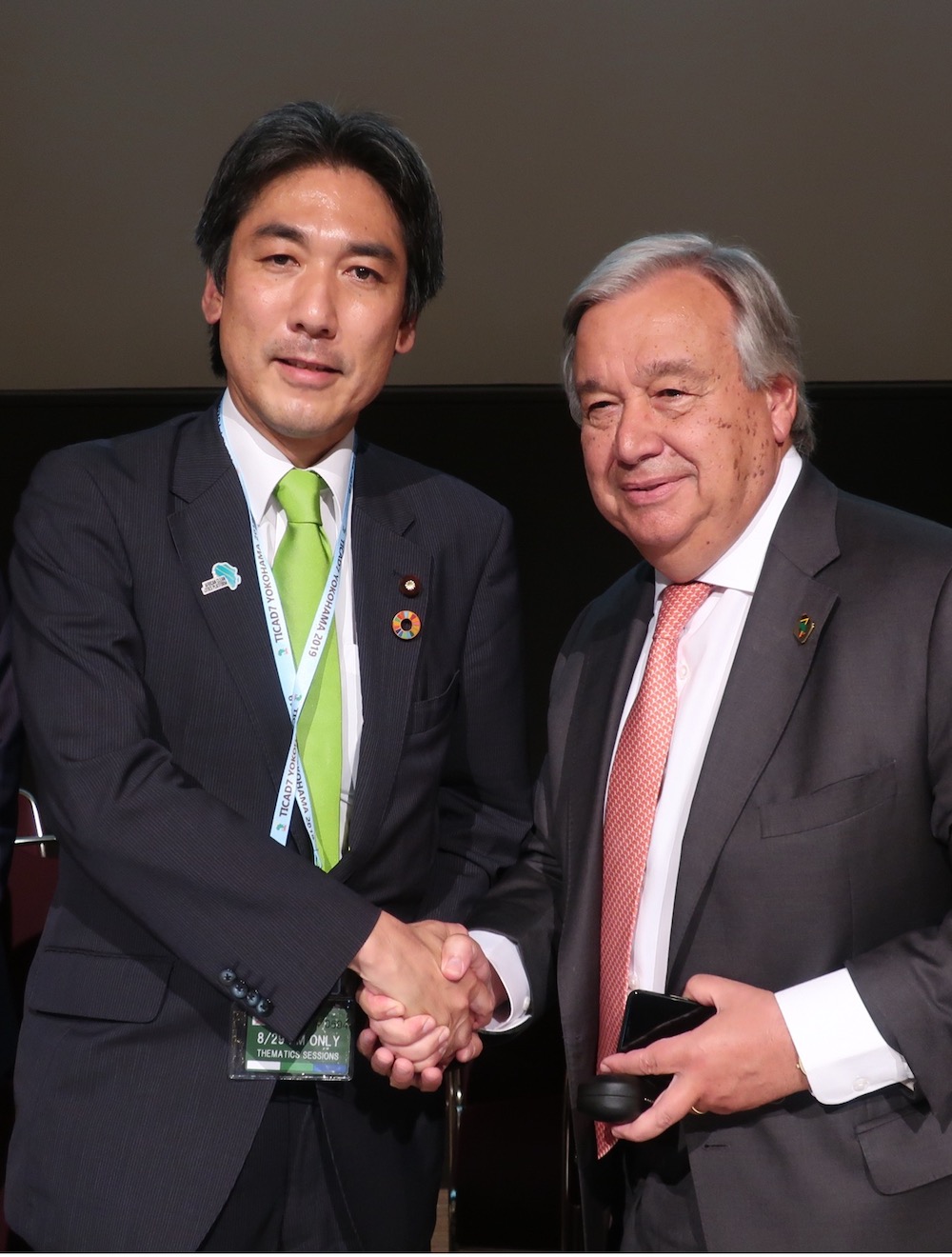
Minoru Kiuchi serves as Japan’s Minister of State for Science and Technology Policy in the Ishiba Cabinet, a position he assumed on October 1, 2024, under Prime Minister Shigeru Ishiba. A veteran member of the Liberal Democratic Party (LDP) and the House of Representatives, Kiuchi represents Shizuoka Prefecture’s 7th District, having been elected seven times since 2003. With a distinguished career spanning diplomacy and politics, he brings a wealth of experience to his current portfolio, which also includes responsibilities for Economic Security, the “Cool Japan” Strategy, Intellectual Property Strategy, and Space Policy.
Born on April 19, 1965, in Tokyo, Kiuchi’s early life was shaped by international exposure, living in Bonn, West Germany, from ages six to ten due to his father’s role as a police attaché. This experience ignited his fluency in German and a global perspective, later honed at the University of Tokyo’s Faculty of Arts and Sciences, where he majored in International Relations. Joining the Ministry of Foreign Affairs in 1989, Kiuchi served as a diplomat in Germany and as the official German-Japanese interpreter for Emperor Akihito and prime ministers Ryutaro Hashimoto and Keizo Obuchi. His diplomatic tenure included key postings in Bonn and Augsburg, where he studied political science, deepening his expertise in international cooperation.
Transitioning to politics in 2002, Kiuchi won his first election as an independent before aligning with the LDP to support Shinzo Abe’s leadership. He held significant roles under Abe, including Parliamentary Vice-Minister for Foreign Affairs (2012-2014) and State Minister for Foreign Affairs (2014-2015), showcasing his adeptness in foreign policy and economic strategy. Known for his close ties with Germany and his strategic foresight, Kiuchi has been a vocal advocate for innovation, economic security, and Japan’s role in global technology networks.
As Minister of State for Science and Technology Policy in 2025, Kiuchi is driving Japan’s ambition to enhance its research and development capabilities, notably through initiatives like the “Integrated Innovation Strategy 2025,” which he discussed at the 77th Comprehensive Science and Technology Innovation Conference. At the 4th Shinzo Abe Conference, he plays a pivotal role as a keynote speaker about AIWS Government 24/7—a vision of continuous, AI-driven governance. His leadership bridges science, technology, and economic security, honoring Shinzo Abe’s legacy while positioning Japan as a global leader in the Age of Global Enlightenment.
Nguyen Anh Tuan is a visionary leader and innovator who has used his deep understanding of global technology, media, and governance to look forward to a world governed by a social contract of promise and possibility. He serves as the Co-Chair and CEO of the Boston Global Forum (BGF), co-founded in 2012 with former Massachusetts Governor Michael Dukakis.
BGF has emerged as a “think and do” tank dedicated to fostering peace, security, and innovation through international collaboration, particularly at the intersection of artificial intelligence (AI), cybersecurity, political exchange, and cultural exchange. It is a mission Tuan personifies; in other capacities he is a Distinguished Member of the Wilson Center’s Institute for Strategic Competition Steering Committee, co-founder of the Michael Dukakis Institute for Leadership and Innovation (MDI) and of the AI World Society (AIWS) Initiative, launched with Governor Dukakis in 2017, to advance ethical AI development. His AIWS Government 24/7 Initiative—envisioning AI-driven governance with governments serving citizens 24/7—earned him the title of Person of the Year 2018 from Vietnam National Television (VTV). In January 2025, Nguyen Anh Tuan was honored with the UNGSII Award at Davos, recognizing his outstanding leadership and contributions to advancing the Sustainable Development Goals (SDGs) through AI innovation.
Tuan has also co-authored influential works, including the Social Contract for the AI Age (2020) and Remaking the World – Toward an Age of Global Enlightenment (2021), shaping new political and social models for a better, safer, and more prosperous world through a humane pursuit and deployment of creative technological advance.
With deep ties to academia, Tuan served on the Harvard Business School Global Advisory Board (2008-2016) and chaired the International Advisory Committee of the UNESCO-UCLA Chair on Global Learning and Global Citizenship Education (2015-2017). As Fellow at Harvard Kennedy School in 2007, he researched trends in electronic media, further solidifying his expertise. His initiatives, such as Global Cybersecurity Day and the BGF-G7 Summit Initiative reflect his commitment to peace and security in the digital age.
This was the spirit which infused the launch of the Shinzo Abe Initiative for Peace and Security—founded on July 10, 2022— honoring the legacy of Japan’s late Prime Minister Shinzo Abe in fostering global peace and innovation. It also animates the selection each year of a World Leader for Peace and Security, whose recipients reflect the ideal of what Tuan has described as “global enlightenment”, ranging from statesmen to civil servants, spiritual leaders to political figures.
Hailing from Nha Trang in Vietnam, he envisions his hometown as a global innovation city, drawing inspiration from Boston. Tuan’s remarkable career began with groundbreaking contributions to Vietnam’s digital landscape. He founded VietNet, the country’s first TCP/IP-based Internet service provider, and later established VietNamNet, Vietnam’s leading online newspaper, where he served as Founder, CEO, and Editor-in-Chief from 1997 to 2011. Under his stewardship, VietNamNet became a platform for reform, introducing the innovative “VietNamNet Online Roundtable” to engage the public in live discussions with political, social, and cultural leaders. His pioneering efforts earned him recognition as one of Vietnam’s Top 10 Outstanding Young Talents by the government in 1996.
Tuan’s recent efforts include advocating for the AIWS Film Park, a hybrid cinema hub blending natural and AI-driven studios, and fostering Vietnam-U.S. film collaboration, as highlighted at the BGF Roundtable on March 11, 2025, at Harvard. Today, Nguyen Anh Tuan continues to bridge cultures, technologies, and ideas, driving a future where AI and humanity coexist for the greater good.
Tuan’s leadership has positioned BGF as a key player in addressing emerging global challenges. His humility and sense of inclusion have made all who know and have worked with him a part of his great adventure, an adventure which, in its truest sense, is eight billion people strong.
March 19, 2025
Writer: Ramu Damodaran, Founding Chief of the United Nations Academic Impact, former Editor-in-Chief of the United Nations Chronicle, and Permanent Observer of the University for Peace to the United Nations.
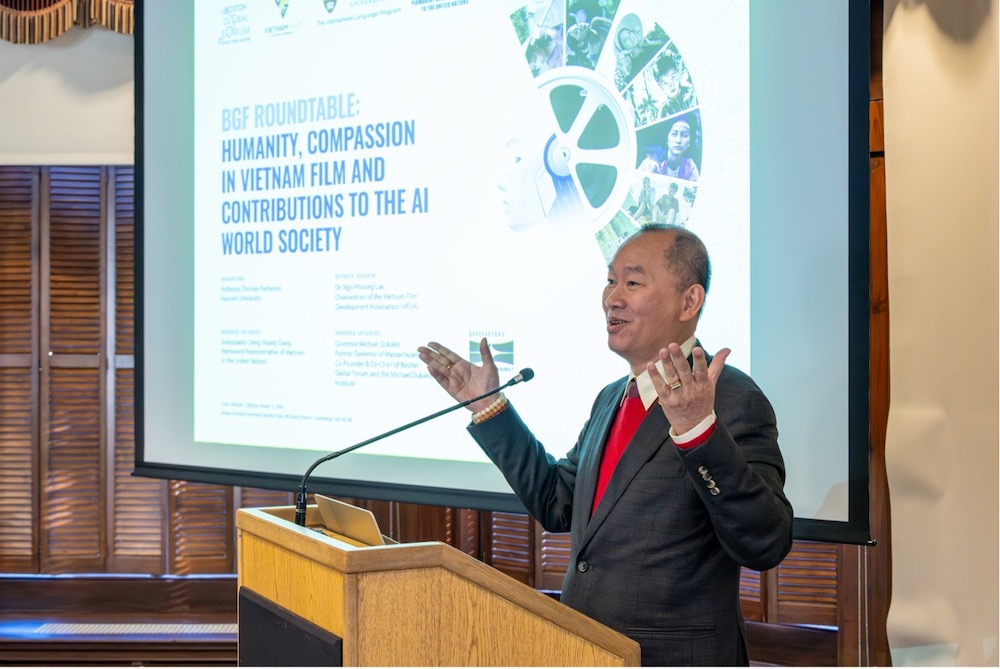
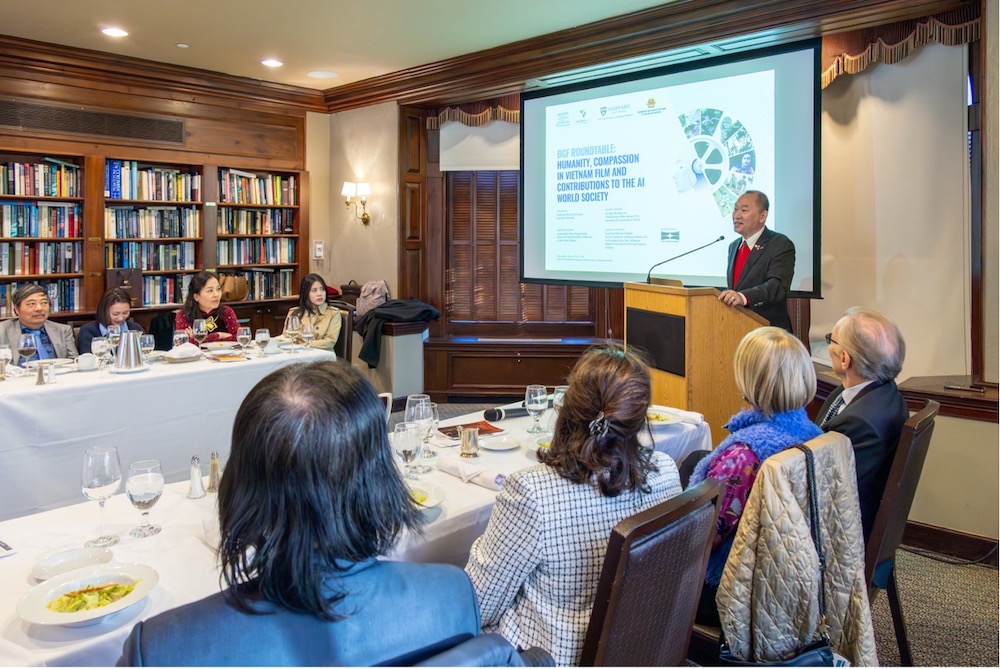
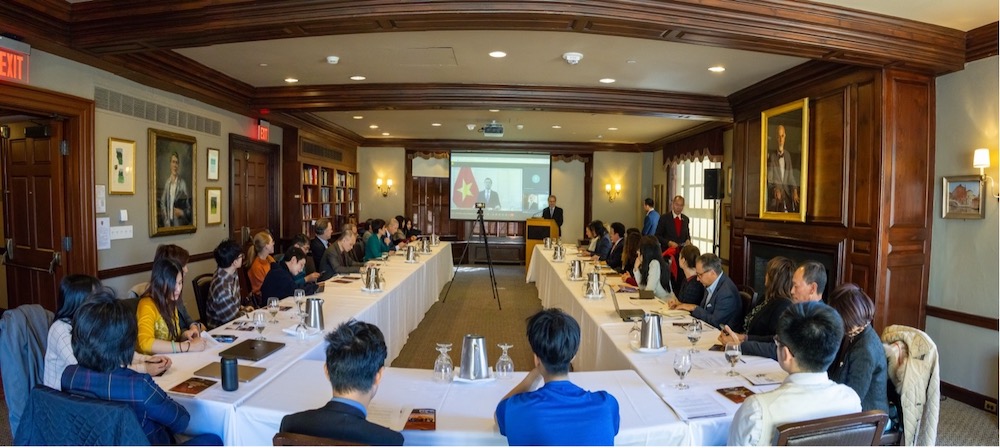
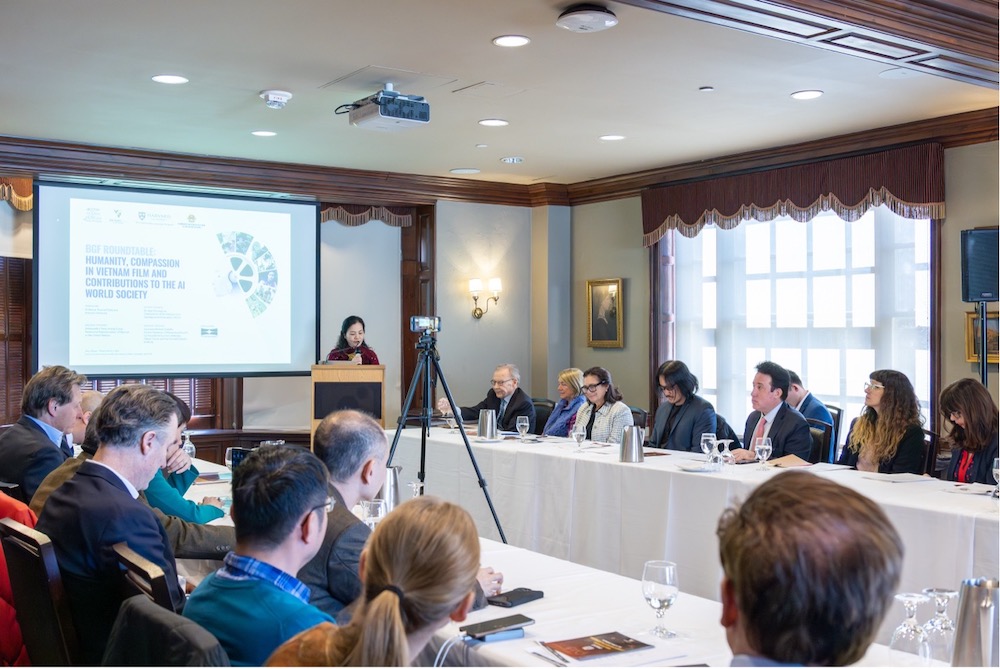
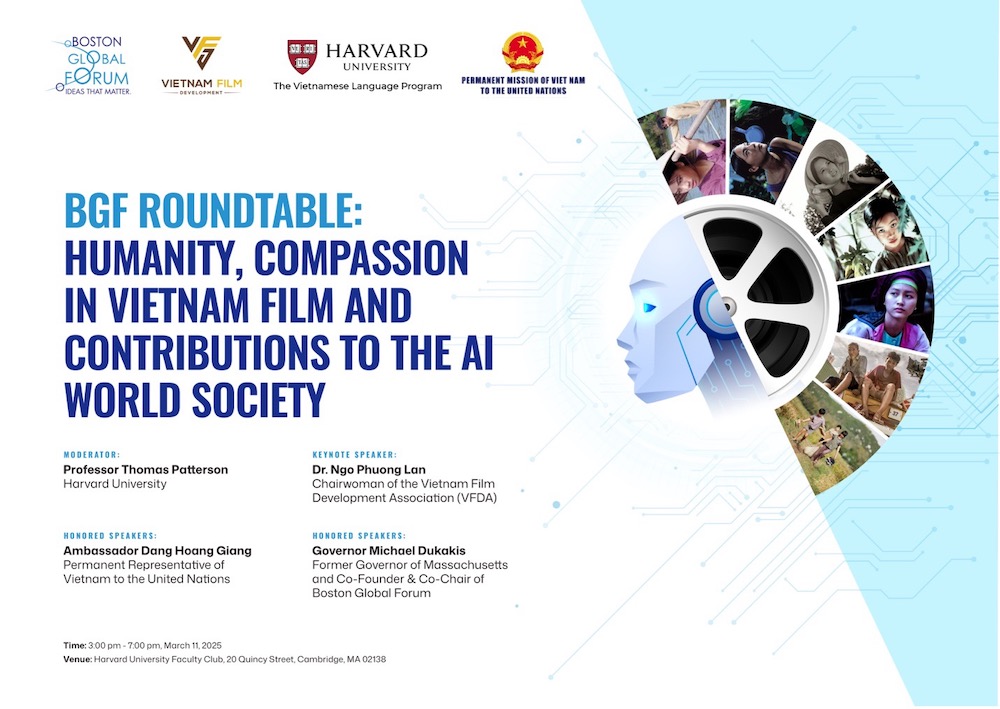
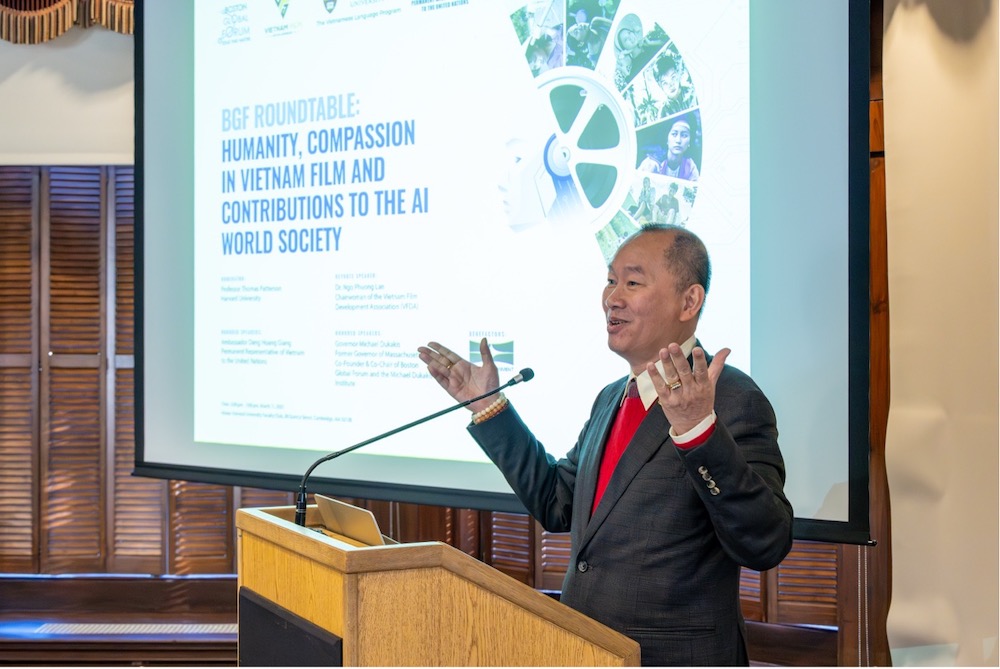
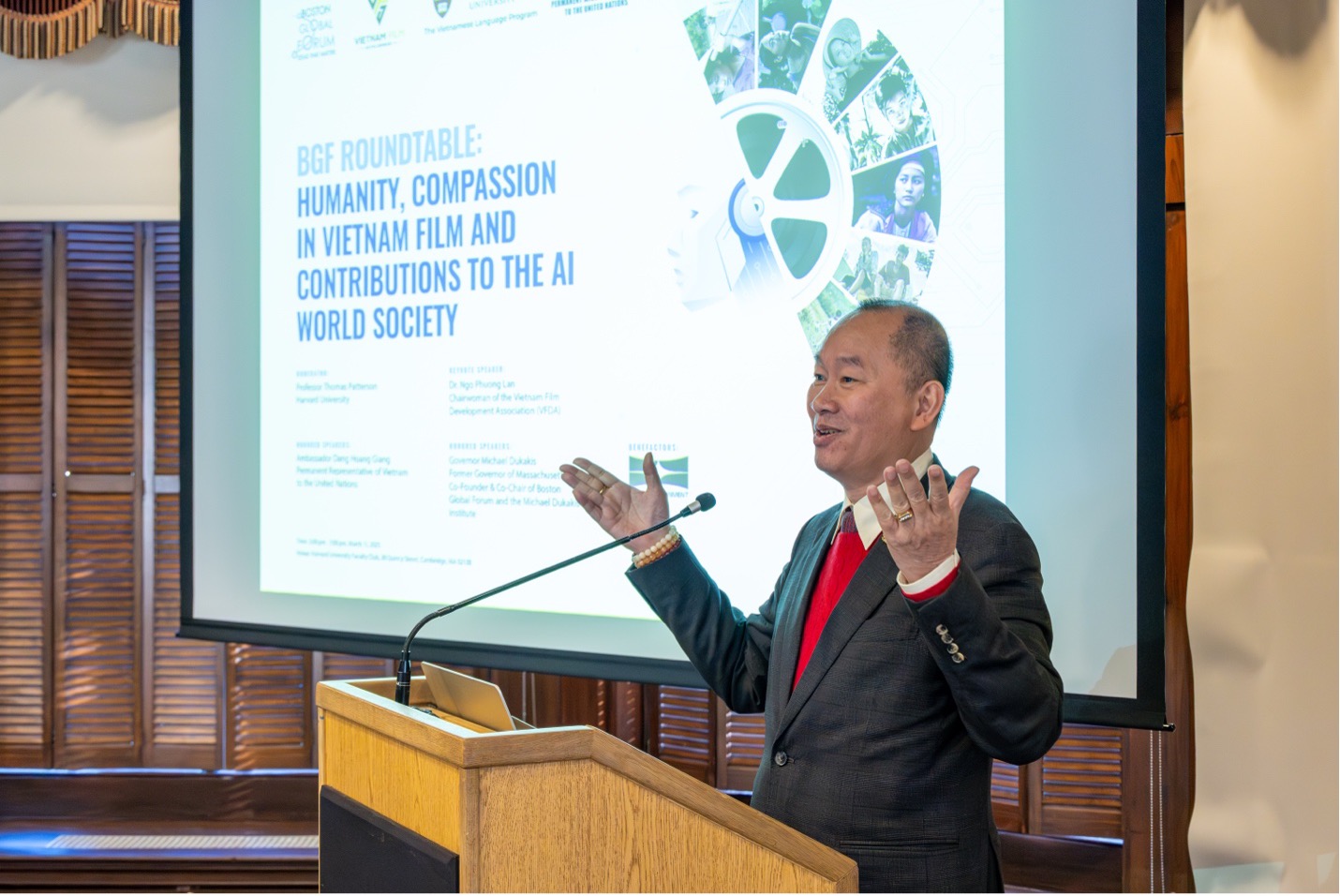
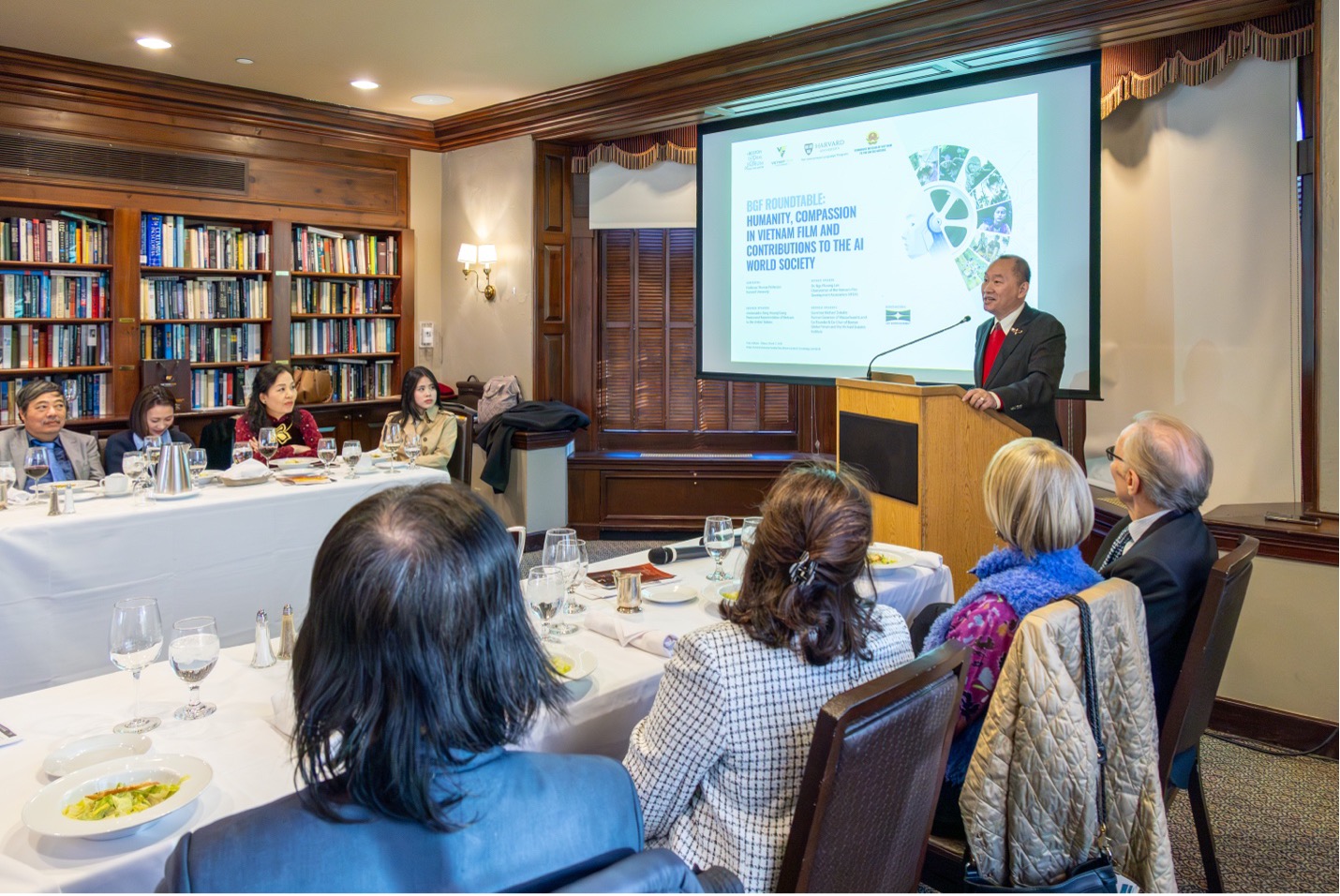
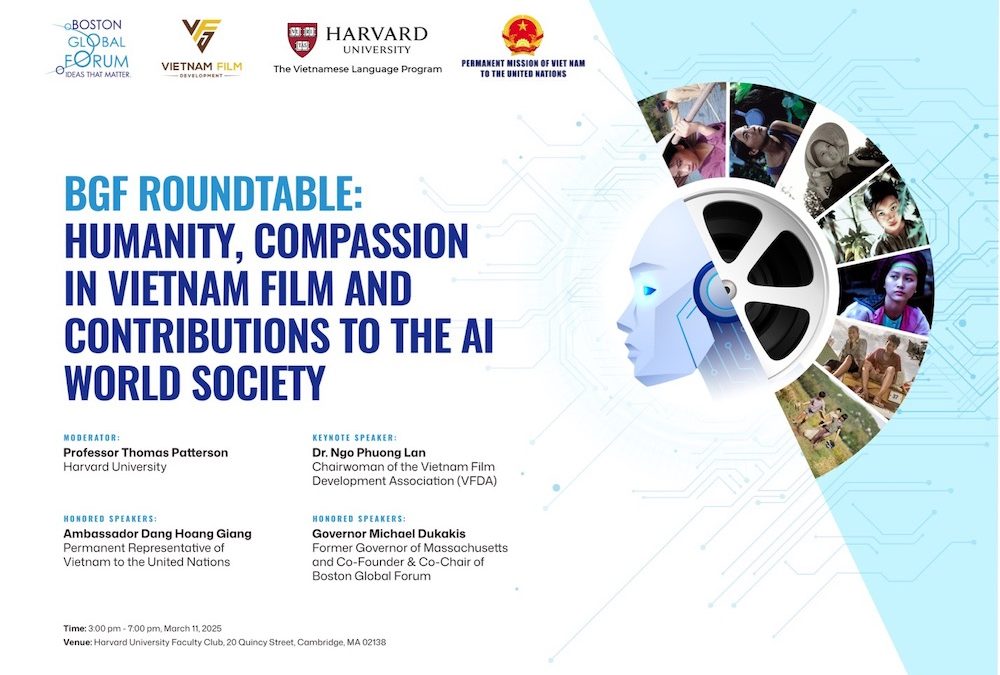
Cambridge, MA – March 11, 2025 – A historic roundtable at Harvard University Faculty Club celebrated 30 years of normalized Vietnam-U.S. relations, uniting leaders from film, academia, government, and innovation to shape cinema’s future in the AI era. Hosted by the Boston Global Forum (BGF), Harvard University, the Permanent Mission of Vietnam to the United Nations, and the Vietnam Film Development Association (VFDA), the event—”Humanity and Compassion in Vietnamese Film and Contributions to the AI World Society”—ignited groundbreaking partnerships and a shared vision for AI-driven storytelling.
A Day of Insightful Dialogue
Professor Thomas Patterson of Harvard’s Kennedy School of Government opened with warm introductions, paving the way for vibrant discussions. Key speakers included Ambassador Dang Hoang Giang, Permanent Representative of Vietnam to the United Nations; Governor Michael Dukakis, Former Governor of Massachusetts and BGF Co-Chair; and Dr. Ngo Phuong Lan, VFDA Chairwoman, whose keynote captivated attendees.
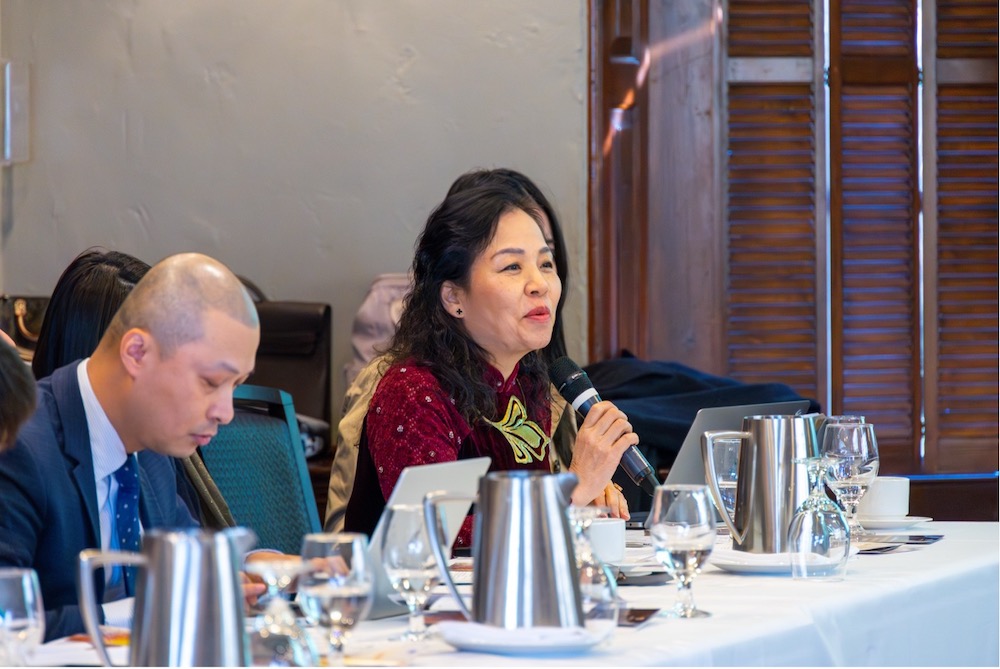
Dr. Ngo Phuong Lan traced Vietnam’s cinematic ascent, stating, “In the past five years, our films have earned global acclaim, with box office revenues in the tens of millions. The revised Cinema Law has welcomed foreign crews, yet our success lies in reflecting Vietnamese identity—patriotism, family values, and compassion, even toward former enemies.” Her insights, rooted in her 2007 book Modernity and Nationality in Vietnamese Cinema, highlighted a fusion of growth and authenticity.
Ambassador Giang emphasized film’s unifying power, saying, “It’s an honor to represent Vietnam here. This collaboration with BGF and Harvard explores film, humanity, and technology. Vietnamese cinema mirrors our history and soul, and AI can enhance it while preserving emotional depth.” He cast the Vietnam-U.S. partnership as a bridge of empathy and creativity.
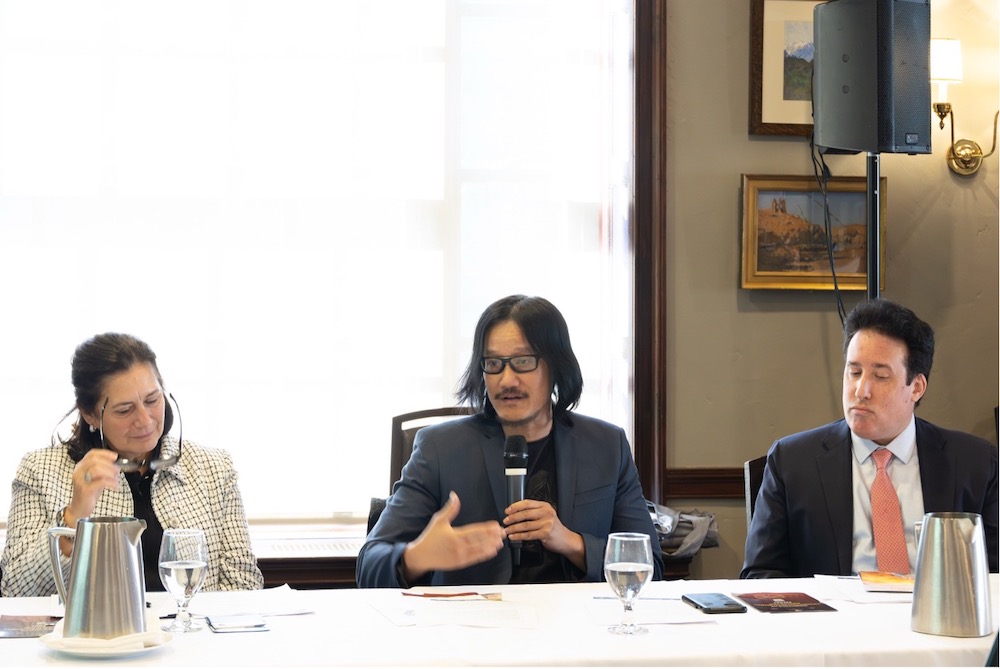
Governor Dukakis welcomed guests warmly, noting, “Today, Vietnam and the USA stand as comprehensive strategic partners, marking 30 years of progress. This milestone launches deeper collaboration.” He unveiled the AIWS Film Park—a pioneering hub linking Vietnam with Boston, New York, and Hollywood—the Friends of Vietnam-U.S. Film Collaboration, and plans to promote the Da Nang Asian Film Festival, envisioning a future enriched by technology and mutual understanding.
Notable Attendees and Initiatives
Attendees included Ambassador Dang Hoang Giang; Nguyen Hoang Nguyen, Deputy Permanent Representative to the UN; Meg Montagnino-Jarrett, Massachusetts Film Office Director; Angela Peri, Boston Casting Founder; and Matthew Salloway, Filmmaker and CEO of GSI Ventures. Academics and filmmakers featured Tony Bui (Columbia University), MIT’s Robert Desimone and Nazli Choucri, and Harvard’s Jeff Saviano and Sara Archambault of the Shorenstein Center.
Key initiatives announced:
AIWS Film Park: A hybrid hub in a beautiful Vietnamese city, blending natural and AI studios to connect global creators with Boston, New York, and Hollywood.
Friends of Vietnam-U.S. Film Collaboration: A program uniting figures like Dukakis, Cameron Kerry, and Ngo Phuong Lan to foster film ties.
Da Nang Asian Film Festival: Plans to elevate its profile in Boston and beyond.
Nguyen Anh Tuan, BGF Co-Chair and CEO, closed with optimism: “Today marks a new chapter—the AIWS Film Park, launched amid 30 years of Vietnam-U.S. relations, has earned support from Harvard, MIT, Columbia, UCLA, and Boston’s distinguished figures. Our Friends of Vietnam-U.S. Film Collaboration unites notable friends here, and including Ambassadors Nguyen Quoc Dung and Dang Hoang Giang, Governor Michael Dukakis, Cameron Kerry, Mark Kennedy, and everyone joining us today. Today’s event continues the momentum of the AI Action Summit held in Paris last month, where the Boston Global Forum co-organized a session with the French government on AIWS Government 24/7—AI-driven governance serving citizens around the clock. This laid the groundwork for our gift, ‘Creating a New Enlightened Paris,’ presented to President Macron and the French people to position France as an AI leader. Today’s outcomes will be shared with President Macron as a legacy of the 2025 AI Action Summit.”
A Legacy and a Future
The roundtable concluded with remarks from Le Vinh Hoa, Director of Harvard’s Vietnamese Language Program, and Nguyen Anh Tuan, followed by a networking dinner. Attendees left inspired, ushering in an era where AI and cinema unite Vietnam and the U.S., blending innovation with humanity.
In an email sent to Agency for Global Media employees, obtained by Reuters and The New York Times, the agency’s human resources director told employees they were being placed on administrative leave with full pay and benefits, until notified otherwise.
The 4th Shinzo Abe Conference, held at The Okura Tokyo on March 28, 2025 and hosted by the Boston Global Forum (BGF) under the theme “Government 24/7: AI and Finance Platforms,” will conclude with the groundbreaking Tokyo Accord for Government 24/7: AI and Finance Platforms. “Government 24/7: AI and Finance Platforms” envisions a future where artificial intelligence (AI) powers a platform to assist government work and serve citizens 24 hours a day, 7 days a week, while a finance platform, also operating 24/7, supports public services and citizens. This finance platform will innovate and reform financial systems using AI, digital tools, and quantum computing, ensuring efficiency and resilience. Building on Shinzo Abe’s legacy of innovation and stability, this pioneering framework harnesses AI platforms for continuous governance and integrates financial systems, positioning Japan as a leader in ethical AI and economic advancement.
Speakers (by Alphabet):
Jonen, Tsukasa, Economic Commentator
Kanehara, Nobukatsu, Executive Director, The Sasakawa Peace Foundation; Professor, Doshisha University; The Inaugural Deputy Secretary-General of the National Security Secretariat
Kano, Takehiro, Ambassador Extraordinary and Plenipotentiary, Permanent Delegate of Japan to UNESCO
Kiuchi, Minoru, Minister of State for Science and Technology Policy
Matsuo, Yutaka, Professor from Tokyo University (AI)
Moreno, Elisabeth, Former French Minister
Nakayama, Yasuhide, Representative of BGF Japan and Taiwan; Former Deputy Minister of Defense, Former Deputy Minister of Foreign Affairs
Nguyen, Tuan, BGF Co-Chair and CEO
Poort, Joris, CEO, Rescale
Tang, Audrey, The First Minister for Digital Affairs, Republic of China
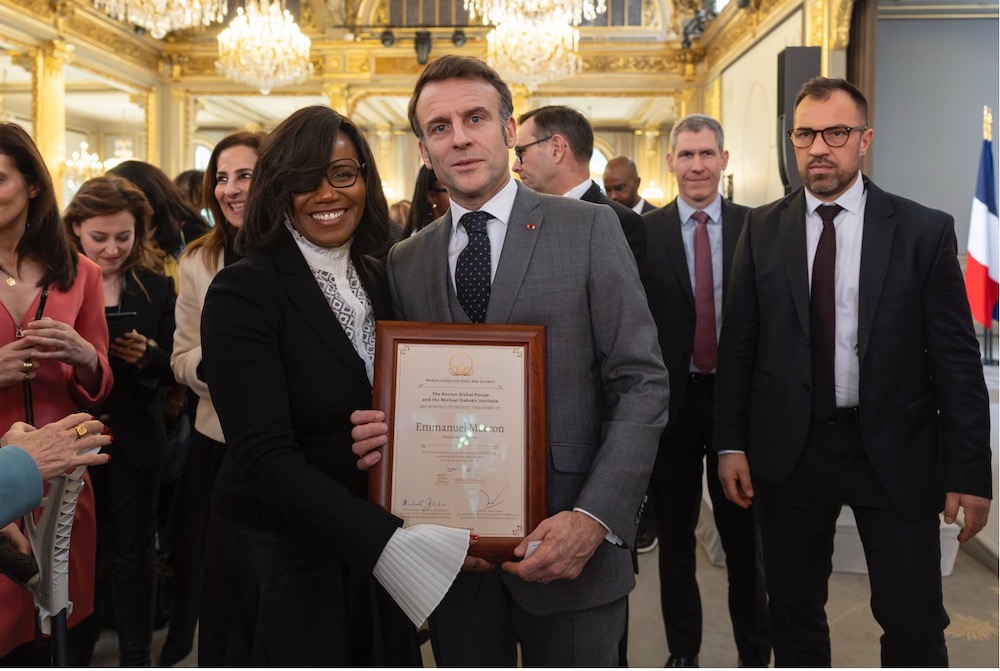
In a primetime address on March 5, 2025, French President Emmanuel Macron, recipient of the BGF World Leader for Peace and Security Award, issued a strong call for a significant European rearmament, emphasizing the urgent need for the continent to bolster its defense capabilities amid rising security threats from Russia. Macron also announced that he would begin consultations with European allies on the potential use of France’s nuclear deterrent as a broader shield for Europe. His remarks signaled a pivotal shift in France’s defense posture and underscored the growing concerns over Europe’s strategic vulnerabilities in the current geopolitical climate.
President Macron received the Plaque of Honor for the “BGF World Leader for Peace and Security Award.”
Co-Chair and CEO, Boston Global Forum BGF Roundtable: “Humanity and Compassion in Vietnamese Film and Contributions to the AI World Society” Harvard University Faculty Club, Cambridge, MA March 11, 2025
My dear friends,
Congratulations on the successful U.S. visit by the Vietnam Film Development Association (VFDA) delegation, led by our esteemed friend Dr. Ngo Phuong Lan, Chairwoman of the Association. The delegation engaged in meaningful events across Hollywood, Washington DC, New York, and Boston, culminating in today’s historic gathering at Harvard University.
Celebrating 30 years of normalized Vietnam-U.S. relations, this event marks a profound milestone: the launch of a pioneering initiative—the AIWS Film Park—to advance cinema through Vietnam-U.S. collaboration. This project will create natural film studios paired with cutting-edge AI technology in a beautiful Vietnamese city. It will be a hub for creators, filmmakers, screenwriters, directors, stars, investors, and producers, linking to Boston, New York, and Hollywood. Today, distinguished figures from Harvard, MIT, and Boston—an intellectual capital of the world—have expressed enthusiastic support for this vision.
We have officially announced the Friends of Vietnam-U.S. Film Collaboration, uniting notable friends in this roundtable, and including Governor Michael Dukakis and Former Acting Secretary of Commerce Cameron Kerry. From Vietnam, we have VFDA Chairwoman Ngo Phuong Lan and our Vietnamese attendees. We warmly welcome Vietnam’s Ambassador to the United States, Nguyen Quoc Dung, and his spouse, Tran Thi Bich Van, as well as Ambassador Dang Hoang Giang, Permanent Representative to the United Nations, to this esteemed group. We will also support and connect the Da Nang Asian Film Festival with Boston.
Ladies and gentlemen, today’s event continues the momentum of the AI Action Summit held in Paris last month, where the Boston Global Forum co-organized a session with the French government on AIWS Government 24/7—AI-driven governance serving citizens around the clock. This laid the groundwork for our gift, “Creating a New Enlightened Paris,” presented to President Macron and the French people to position France as an AI leader. There, I met with President Macron and Prime Minister Trudeau, discussing AI and modern cinema among other topics. The outcomes of today’s roundtable, especially the AIWS Film Park Initiative, will be shared with President Macron and the AI Action Summit organizers as a key result of the 2025 Summit.
Dear friends, as we close this meaningful roundtable, we begin a new chapter of collaboration and historic initiatives. With Boston’s unwavering support, we will turn these noble dreams into reality. I extend my heartfelt gratitude to all of you for your presence and invaluable contributions. My thanks go to our partners—Harvard University, the Permanent Mission of Vietnam to the United Nations, and VFDA—for co-organizing this extraordinary event with the Boston Global Forum. I also thank our BGF staff and supporters for making today a resounding success. Together, we embark on a journey to create lasting value. My deepest gratitude to you all.
At the historic BGF Roundtable, “Humanity and Compassion in Vietnamese Film and Contributions to the AI World Society,” held at the Harvard University Faculty Club, the AIWS Film Park emerged as a central highlight, symbolizing a bold new vision for cinema in the AI age. Co-organized by the Boston Global Forum, Vietnam Film Development Association (VFDA), Harvard University (Vietnamese Language Program), and the Permanent Mission of Vietnam to the United Nations, the event also celebrated 30 years of U.S.-Vietnam normalization, marking a significant milestone in bilateral relations. Powerful remarks from Governor Michael Dukakis, Ambassador Dang Hoang Giang, and Chairwoman of VFDA Dr. Ngo Phuong Lan, Mr Dinh Trong Tuan, VFDA underscored the importance of the AIWS Film Park as a hub for creativity, technology, and global collaboration. Their statements marked a historic moment in advancing Vietnam-U.S. film partnerships and shaping the future of AI-driven storytelling.