by Admin | Sep 11, 2014 | Event Updates
September 11, 2014, BOSTON, MASSACHUSETTS – Former Massachusetts Governor Michael Dukakis and Professor Joseph Nye of Harvard Will Lead Boston Global Forum Talks on Building a Framework for Peace and Security in the Pacific, a New Pacific Peace Initiatives at 7:00 PM EST on Wednesday, September 17 at the Harvard Faculty Club. This is the second Global Conference in a series of international meetings that began in April this year.
Former Mass Gov. Michael Dukakis to Lead Boston Global Forum Talks on Building a Framework for Peace and Security in the Pacific, aiming at reducing tensions between China, the U.S. and Japan.
7:00 PM EST, Wednesday, September 17th.
The Harvard Faculty Club, 20 Quincy Street, Cambridge, MA.
Live-streamed at www.bostonglobalforum.org
Together with Boston Global Forum speakers in Cambridge and online delegates from around the world, Michael Fuchs, the Deputy Assistant Secretary of State for Strategy and Multilateral Affairs, and Bonnie Glaser, the senior associate of Center for Strategic & International Studies (CSIS) Pacific Forum will open the discussion on building Code of Conduct in the South and East China Sea. Professor Joseph Nye will discuss his Soft power theory in building peace and reconciliation in Asia-Pacific region. And the Hon. Kevin Rudd, the former Australia Prime Minister will end the session with a discussion on the New structure for the Pacific.
Speakers: Governor Michael Dukakis; Kevin Rudd, former Australia Prime Minister; Prof. Joseph Nye; Bonnie Glaser, the CSIS Pacific Forum’s senior associate; Ambassador Swanee Hunt.
Global Discussants: Amb. Ichiro Fujisaki; Michael Fuchs, Deputy Assistant Secretary of State; Amb. JD Bindenagel; , Prof. Dairokuno Kosaku; Prof. Suzanne Ogden; Prof. John Quelch; Prof.Thomas Patterson; Prof. Richard Rosecrance; Prof. Jin Canrong; Dr. Patrick M. Cronin; Seiichi Kondo, special advisor to the Japan’s Minister for Foreign Affairs; Llewellyn King; Zengke He; Prof. Allison Graham; Marie Dianger; Richard Pirozzolo;, Masahiko Sasajima;, Dr. Hoang Anh Tuan.
Boston Global Forum was founded two years ago by former Massachusetts Governor Michael Dukakis, Distinguished Professor JD at Harvard University; Prof. John Quelch, Charles Edward Wilson Professor of Business Administration at Harvard Business School; Prof. Thomas Patterson, Bradlee Professor of Government and the Press, Harvard Kennedy School, and Nguyen Anh Tuan, Editor-in-Chief, Boston Global Forum and the Founder and Chairman of VietNamNet Media Group and VietNet, the first Internet Service Provider in Vietnam.
Boston Global Forum brings together international thought leaders into an open forum to address issues that affect the world at large and to serve as an inspirational role model for global collaboration. Its mission is to identify, discuss, and propose meaningful, creative, and practical solutions to profound and pressing societal issues.
Boston Global Forum has already had a positive impact on improving working conditions Asia’s manufacturing centers as part of its 2013 initiatives.
For Immediate Release, please contact:
Nguyen Anh Tuan, Tel: +1 617-286-6589, Email: [email protected]
or Dick Pirozzolo, Tel: + 1 617-959-4613, Email: [email protected]
by Admin | Sep 6, 2014 | News
(BGF) – On the American Interest, Richard Rosecrance shared his view on Overbalance of Power in reference to maintain peace and security in the world, and its change through time. He also gave his thoughts on China’s intention towards the overbalance of western power.
Richard Rosecrance is the adjunct professor of Public Policy at Harvard Kennedy School, and also Research Professor of Political Science at the University of California and Senior Fellow in the Belfer Center for Science and International Affairs. He also is a major contributor to the Boston Global Forum in building a Framework for Peace and Security in the Pacific.
Click here to read the full article published in the American Interest.
The Emerging Overbalance of Power
(August 22, 2014) – When good guys have preponderant power, things tend to be all right—even with a Chinese accent.
Vast accumulations of power in world politics invariably come crashing down, or at least that is the conventional wisdom of most historians and realist policy analysts. Any “overbalance of power”, whether in the form of powerful regional or global empires, hierarchic dynasties, or other kinds of hegemonic orders, eventually bites the dust because efforts to counterbalance ultimately succeed. If nature abhors a vacuum, international politics punctures an imbalance; imperial nabobs and other over-reachers always get their comeuppance.
If the lesson stopped there, things would be oh-so-simple and clear. Yet balance-of-power systems fail, too, because of the inherent rivalries they provoke. As shown by the constant tension engendered by the rise and fall of great powers, bipolarity is the least stable of systems, though based on an ostensible balance of power. The systems fail because one member (or set of members in alliance) strives for primacy, and a mere balance does not deter action by either side. The fact is that we live in a war-prone state system no matter how we arrange its power geometry—and the jury is still out on whether weapons of mass destruction have changed anything in that regard.
The matter does not end there. It begins anew when we ask: How is peace spread over any given region of the world? It is done by getting nations to join and cooperate within what becomes a huge overbalance of power. Indeed, an overbalanced peace born of voluntary cooperation is vastly better than a balanced one born of mutual fear. Overbalancing can be good if it comes into being in a certain way to serve certain purposes. But how, more specifically, do we distinguish good from bad overbalances, and, insofar as their dynamics go, how do we separate justifiable from illegitimate uses of force on behalf of maintaining or protecting an overbalance of power?
In judging whether an overbalance is good or bad for peace and security, the means of augmenting power are the main determinant. The European Union is an overbalance of power in its region, and it is a good overbalance because none of its members has ever been coerced to join. It operates consensually.
In other cases, the means of creating an overbalance may be in some sense illegitimate according to the norms of the day, but the ultimate effect can still be beneficial. Every state, after all, is an “empire” of sorts by origin. Most are formed through aggrandizement, whether of territory, people, or even other states. Yet depending on its behavior, a state may become a boon. It was not for nothing that Machiavelli commented about 500 years ago that all benign political orders rest on antecedent crimes. Thus the United States now owns about half of what used to be Mexico, but it is difficult to argue that the U.S. Southwest or its original inhabitants’ progeny have suffered as a result of the transfer of power. As Hobbes showed in Leviathan, even smaller states are in effect empires in the sense that civil society—once set up as part of the social contract—becomes a hierarchical overbalance of power to protect citizens from violent death only at the cost of their personal sovereignty.
Click here to continue reading.
by Admin | Aug 25, 2014 | News
(BGF) – The tensions in the South China Sea still rise high without a solution to the disputes, despite the fact that the Philippines, Vietnam, Taiwan, America have urged to have it resolved, however, China ignored all the calls and insists on what it wants to do.
America pointed to China for creating the tension. In return, China accused America for meddling, and encouraging countries such as the Philippines and Vietnam to beard China.However, for ASEAN countries, their foreign ministers dared not to bring themselves to name China as the source of the tension because of its overwhelming power.
Click here to read the full story reported by the Economist or visit the Economist website.
America, China and South-East Asia continue to talk past each other over the South China Sea
August 16, 2014
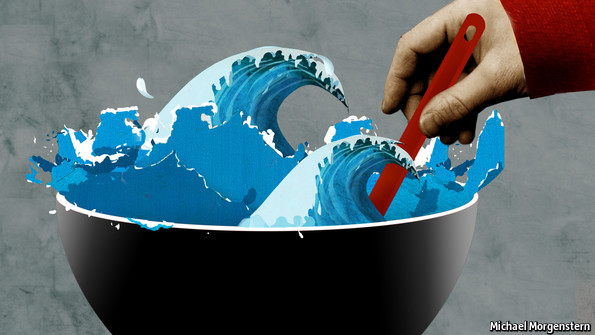
(Photo Credit: Michael Morgenstern, the Economist)
TENSION in the South China Sea has now reached the point where references to tension have become an issue. “Someone has been exaggerating or even playing up the so-called tension in the South China Sea,” Wang Yi, China’s foreign minister, said on August 9th. By “someone”, of course, he meant America. He was speaking in Naypyidaw, Myanmar’s capital, where the ten foreign ministers of ASEAN, the Association of South-East Asian Nations, were holding their annual meeting. So when they agreed on a communiqué referring to “increased tensions” in the sea, many scored it as a diplomatic victory for the United States.
American officials saw the inclusion of the phrase as a sign that ASEAN’s members were readier to present a united front against Chinese aggression towards rival claimants to territory in the sea. China’s “nine-dashed line”, its vague cartographic claim to most of the sea, encroaches on the claims of four ASEAN members. A State Department official cheered the group’s movement away from “diversionary issues” and “happy talk”. It was reasonable to conclude, he said, that “the Chinese are feeling the heat”. Reasonable, perhaps, but almost certainly inaccurate. If China is alarmed about the mounting regional antagonism stoked by its behaviour in the South China Sea, it is certainly not letting on.
Click here to continue reading.
by Admin | Aug 25, 2014 | News
(BGF) – The Pentagon filed a diplomatic complaint with the China People’s Liberation Army as a Chinese warplane flew within 30 feet of its Naval plane and executed aggressive move which posed a risk to the air crew, the New York Times reported on Friday.
Click here to read the full article or visit the New York Times website.
Pentagon Says Chinese Fighter Jet Confronted American Navy Plane
August 22, 2018 | By Helen Cooper
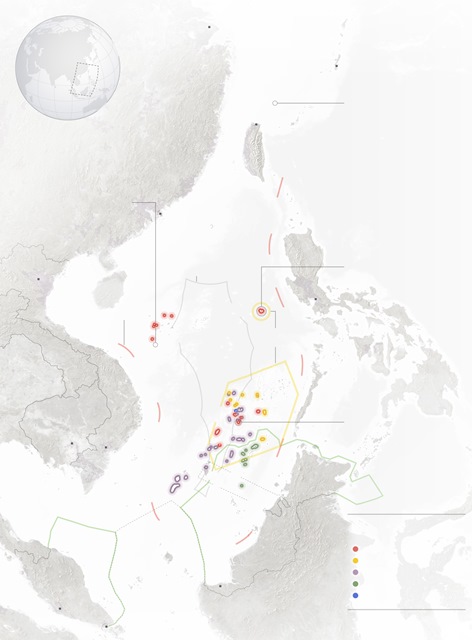
(Photo Credit: Territorial Disputes in the Waters near China)
WASHINGTON — A Chinese fighter jet flew within 30 feet of a Navy surveillance and reconnaissance plane this week in international airspace just off the Chinese coast, the Pentagon said Friday.
The encounter, known as an intercept, was “very, very close, very dangerous,” said Rear Adm. John Kirby, the Pentagon press secretary.
The Pentagon filed a diplomatic complaint with the People’s Liberation Army on Friday morning, Defense Department officials said. As of Friday afternoon, it had not received a reply.
The episode, which occurred on Tuesday, began with the Chinese warplane flying closely underneath the Navy’s P-8 Poseidon. It then moved parallel to the naval plane, with the wingtips of the two aircraft separated by less than 30 feet.
As a final maneuver, the Chinese fighter executed a barrel roll, apparently to show off its weapons payload to the American pilot. A barrel roll is just as it sounds: A fighter jet rolls over and then levels out. Admiral Kirby called it an aggressive move.
Click here to continue reading.
by Admin | Aug 21, 2014 | News
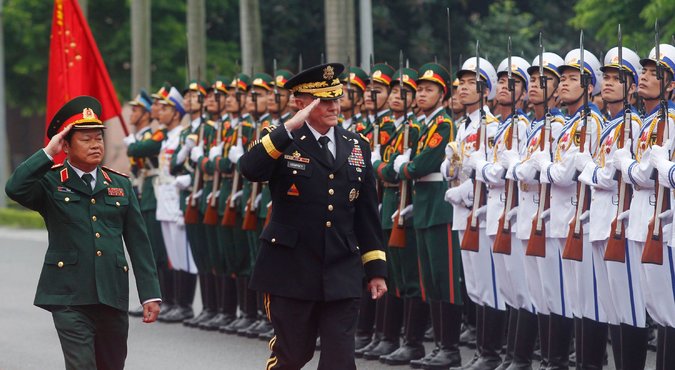
(BGF) – The arms embargo to Vietnam is likely to be eased by the United States, which might allow Vietnam to acquire U.S. weapons, particularly in the field of maritime surveillance, to increase its defense abilities. According to New York Times report, The chairman of the Joint Chiefs of Staff, Gen. Martin E. Dempsey, visited Vietnam for the first time in an effort to improve the relationship with Vietnamese military. However, the move is seen by China as going against Beijing in the contest over South China Sea.
Click here to read the full story or visit the New York Times website.
In China’s Shadow, U.S. Courts Old Foe Vietnam
HO CHI MINH CITY, Vietnam — The chairman of the Joint Chiefs of Staff, Gen. Martin E. Dempsey, courted Vietnam over the past several days. He was the first chairman in more than 40 years to visit the old enemy of Washington, now envisioned as a new partner that will acquire American weapons and help offset the power of China.
General Dempsey, who graduated from West Point as the Vietnam War was winding down, never served here, but his visit capped a vibrant effort by the United States and Vietnam to reconnect. A longstanding embargo on lethal weapons sales by the United States is likely to be eased, he said, and Washington would then begin discussions on what equipment Vietnam would buy, most likely in the field of maritime surveillance.
Vietnam has suddenly become more important to Washington as the United States and China are increasingly at loggerheads over the South China Sea, one of the world’s most vital trading routes. Vietnam is crucial because of its strategic position bordering China, its large population of nearly 100 million and its long coastline on that sea.
Click here to continue reading
by Admin | Aug 18, 2014 | News
(BGF) – The U.S Secretary of State John Kerry wrapped up his eight-day diplomatic trip by outlining one of its concerns is stability in the South China Sea and that a constructive relationship with China will help maintain peace and stability in the Asia-Pacific as well as combat the climate change issue and human rights, according to a report by Matthew Lee from the AP.
Click here to read the full article or visit the AP’s website.
Kerry eyes US-China partnership despite tensions
August 13, 2014 | By Matthew Lee
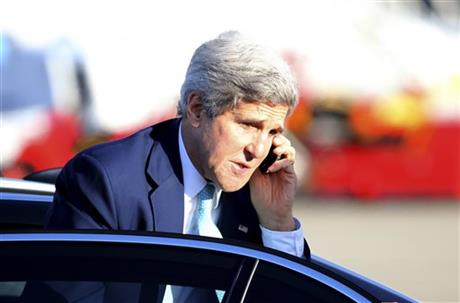
(Photo credit: Rob Griffith, Pool from AP)
HONOLULU (AP) — Despite tensions and a clear but officially unacknowledged rivalry, improving U.S. cooperation with China is critical to maintaining stability and security in the Asia-Pacific as well as combating the effects climate change, U.S. Secretary of State John Kerry said Wednesday.
Wrapping up an eight-day, around-the-world diplomatic trip and his sixth visit to Asia as America’s top diplomat, Kerry outlined renewed priorities for much of the Obama administration’s much-touted “pivot to Asia” during its final 2 ½ years, including a focus on strengthening U.S.-Chinese partnership in areas of agreement and bridging gaps in areas of contention.
“One thing I know will contribute to maintaining regional peace and stability is a constructive relationship between the United States and China,” Kerry said in an address to the East-West Center think tank in Honolulu. “The United States welcomes the rise of a peaceful, prosperous and stable China: one that plays a responsible role in Asia and the world and supports rules and norms on economic and security issues.”
“We are committed to avoiding the trap of strategic rivalry and intent on forging a relationship in which we broaden our cooperation on common interests and constructively manage our differences and disagreements,” he said.
Click here to continue reading.
by Admin | Aug 11, 2014 | News
(BGF) – Secretary of State John Kerry participates in the annual Association of Southeast Asian Nations Regional Forum in Myanmar to seek to ease tension in the South China Sea which is raised after China deployed an oil rig in the waters claimed by Vietnam and implemented several aggressive actions against Vietnam marine police. This incident also raised serious question among China’s other small neighbors about its long-term strategy, according to the Boston Globe.
Click here to read the full article or visit the Boston Global website.
Kerry seeks to ease S. China Sea tension
August 9, 2014 | By Mathew Lee, AP
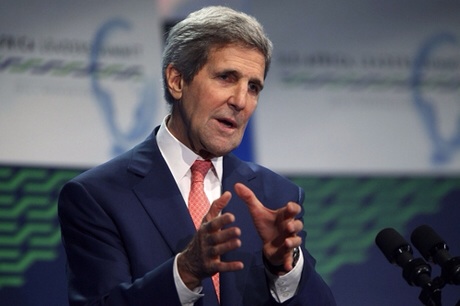
(Photo credit: Secretary of State John Kerry. Reuters)
NAYPYITAW, Myanmar — Secretary of State John Kerry is in Myanmar seeking to calm tensions in the South China Sea between China and its smaller neighbors.
Amid concerns about recent provocative steps taken by China and others regarding several disputed territories in the sea, Kerry arrived in Myanmar early Saturday for a Southeast Asian regional security forum. The conflicting claims are expected to be high on the agenda.
US officials with Kerry said he would be urging the Chinese and others to take voluntary steps to ease the mounting discord, while they continue to work on a binding code of conduct for activity around disputed areas.
The United States and others fear that an escalation in tension could hamper international shipping and lead to conflict. Washington has said for years that maintaining calm in the South China Sea is a US national security interest, to the annoyance of China.
The United States is calling for a freeze on actions that change the status quo, such as seizing unoccupied islands and land reclamation.
Click here to continue reading
by Admin | Aug 7, 2014 | Event Updates
Boston, August 5, 2014
Dear friends and fellow,
On August 4, 2014, the Boston Global Forum hosted its second conference in a month-long series that engaged various political and thought leaders on the crises in Asia and how to build a framework for peace and stability in the region.
The Boston Global Forum is grateful for the participation of Governor Michael Dukakis, Professor Richard Rosecrance, Professor Joseph Nye, Professor Richard Cooper, Professor Ezra Vogel, Professor Thomas Patterson, Professor John Quelch, Ambassador David Warren, Ambassador JD Bindenagel, Professor Suzanne Ogden, Ambassador Ichiro Fujisaki, Mr Bui Duc Lai, Special Advisor of Chairman of Vietnam National Assembly, Lawyer Luong Van Ly, Professor Tuong Lai, Bui Viet Lam of VietNamNet and many others, for their insightful and engaging contributions to the important discussion.
Given yesterday’s success, the Boston Global Forum is confident that as it continues engaging scholars and political leaders, it will be able to make a meaningful contribution to the crises in Asia.
As always, we thank you for your continued support and hope that you will attend the conference, as well as our future conferences and events.
Boston Global Forum Staff
by Admin | Aug 6, 2014 | Highlights
(BGF) – On August 4, 2014, Boston Global Forum organized an online conference in recognition of the 100 WWI and addressed strategies to improve tensions in the Pacific.
Aug 4, 2014 | By Dick Pirozzolo
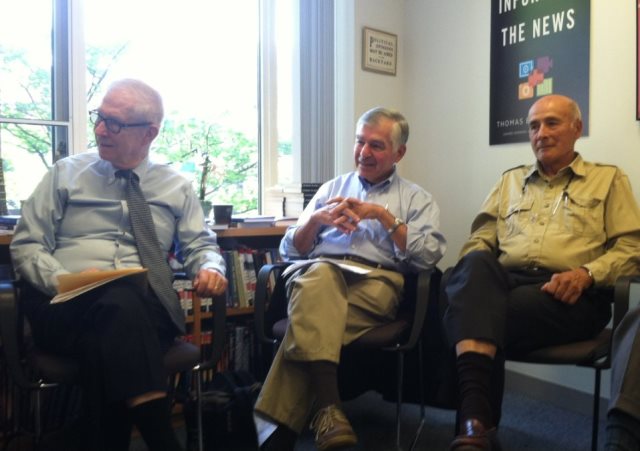
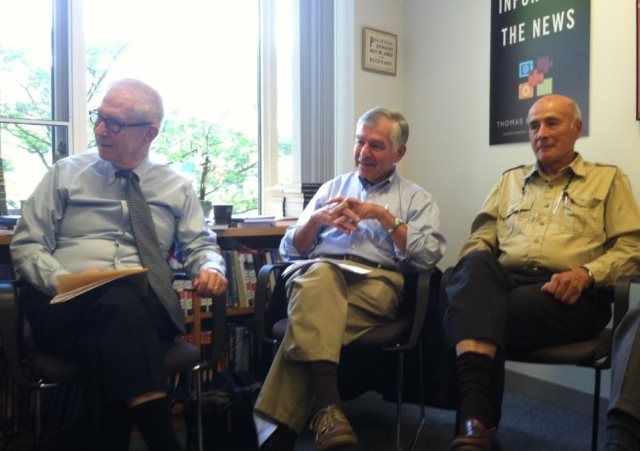
(Photo: Prof. Richard Rosecrance (l), Former Massachusetts Gov. Michael Dukakis and Prof Joseph Nye took part with delegates from around the world.)
Boston Global Forum today addressed the United States continuing role in the Pacific in the face of mounting tensions between China, Japan and Vietnam.
Michael Dukakis and Joseph Nye moderated the discussion at the Harvard Kennedy School in Cambridge with delegates from Hanoi, Ho Chi Minh City, Washington D.C., London and Tokyo participating by online video links.
In recognition of the 100th anniversary of Britain’s declaration of war against Germany, the talks began with a review of lessons to be learned from so-called inevitable wars followed by strategies to improve current relations among Asia-Pacific nations and how to avoid having disputed territories in the Pacific become flash points
Boston Global Forum brings together international thought leaders into an open forum to address issues that affect the world at large and to serve as an inspirational role model for global collaboration. Its mission is to identify, discuss, and propose meaningful, creative, and practical solutions to profound and pressing societal issues.
Boston Global Forum was founded two years ago by former Massachusetts Governor Michael Dukakis, chairman, and Distinguished Professor JD at Harvard University; John Quelch, Charles Edward Wilson Professor of Business Administration at Harvard Business School; Thomas E. Patterson, Bradlee Professor of Government and the Press at Harvard Kennedy School; and Nguyen Anh Tuan, Editor-in-Chief, Boston Global Forum and the Founder and Chairman of VietnamNet Media Group and VietNet, the first Internet Service Provider in Vietnam.
The Forum has already had a positive impact on improving working conditions Asia’s manufacturing centers as part of its 2013 initiatives.
___________________________
Dick Pirozzolo is the founder and managing director of Pirozzolo Company Public Relations; and is a member of Boston Global Forum’s Editorial Board.