The Policy Brief – Social Contract for the Artificial Intelligence Age. Safety, Security, and Sustainability for the AI World from The Riga Conference 2020, by Nazli Choucri, Tuan Nguyen, and Marc Rotenberg, can be read and dowloaded here.
The Center for AI and Digital Policy today released the first global ranking of countries based on their progress toward AI policies that are innovative, trustworthy and respect human rights and democratic values.
The ground-breaking analysis of AI policies and practices in 30 countries by a team of international experts found ambitious plans and wide disparities, on metrics such as data privacy, face surveillance, and public participation. Some countries are making strong progress. Others have work to do to catch up with this fast-moving and far-reaching technology.
The report – the AI Social Contract Index — was produced by the Center for AI and Digital Policy. The Center is part of the Michael Dukakis Institute for Leadership and Innovation in Boston.
“The response of governments to the complex challenges of artificial intelligence are critical to translate the promise of this technology into economic progress that respects democratic values,” said Governor Dukakis. “The goal of the AI Social Contract Index is to develop a baseline for best practices and to ensure that AI fulfills its potential to improve growth and well-being around the world.”
The year-long assessment focuses on fundamental rights, rule of law, and democratic governance. Policies and practices were evaluated for top 25 countries by gross domestic product and five other high-impact countries. The AI Index will be updated annually as national policies evolve and as more countries and new issues are added to the assessment.
The AI Social Contract Index will be announced at the World Leader for Peace and Security Award ceremony at AIWS Palace of the AIWS City on December 12, 2020.
The Riga Conference 2020 was a great success with final session, including panelists Baltic presidents of Finland Sauli Niinisto, Kersti Kaljulaid of Estonia, Egils Levits of Latvia and Gitanas Nausėda of Lithuania. The President of European Commission stressed in her speech that “the Riga Conference has become a key of annual appointment for transatlantic relation.”
The Paper “SOCIAL CONTRACT FOR THE ARTIFICIAL INTELLIGENCE AGE. SAFETY, SECURITY, & SUSTAINABILITY FOR AI WORLD” by Nazli Choucri, Nguyen Anh Tuan, Marc Rotenberg was published as a Policy Brief at the Riga Conference 2020
NATO Secretary General Jens Stoltenberg at the Rīga Conference 2020 said during his speech,
“NATO 2030 has three objectives.
First, it’s about staying strong militarily.In a challenging security environment, we need to continue to invest in deterrence and defence. Not only in tanks and bullets. But also in cyber and other new capabilities.
Second, we must make NATO a stronger political Alliance. It’s not news that Allies sometimes have their differences. But NATO is the only place where North America and Europe meet every day. So it’s the best place to sit down, remember what unites us, and solve our differences together.
And third, NATO needs a more global approach. Not because we want to be a global alliance. But because so many of the challenges we face are global. Like terrorism, cyber-threats, the proliferation of nuclear weapons and of course the rise of China. So we need to work ever more closely with our partners. And with other organisations like the United Nations and the European Union, to protect our values and way of life. And to defend the global rules-based order.”
Ministers of Defense of the UK, Canada, France, Japan and the Baltic countries were speakers at the Riga Conference 2020.
In discussions with his co-panelists, the defence ministers Mr. Jüri Luik from Estonia, Dr. Artis Pabriks from Latvia, and the Rt Hon Ben Wallace from the United Kingdom, Minister Sajjan also stressed the important role defence investment can play in economic recovery. Additionally, the panel discussed how NATO members needed to stand united and move forward cohesively in order to combat the worst effects of the pandemic. Minister Sajjan highlighted the importance of integrating the concept of resilience in our national and collective defence approaches, allowing Canada and its NATO Allies to help overcome complex challenges, such as COVID-19.
This is a reprint of an article originally published here.
BERLIN | NEW YORK (IDN) – People around the world are realizing that capitalism driven by Artificial Intelligence (AI) requires crafting a new sort of Social Contract, based on “stakeholder capitalism”, that is, capitalism that benefits everyone.
“Such capitalism cannot measure itself by money alone, but instead must encompass all aspects of human life, using metrics such as those developed to quantify the UN’s Sustainable Development Goals (SDGs),” says Alex Pentland, director of MITConnection Science, an MIT-wide initiative. He previously helped create and direct theMIT Media Laband theMedia Lab Asiain India.
“Perhaps the greatest achievement of the SDGs that sustainability, as well as access to opportunity, education, and health now have quantitative metrics, agreed to by every nation on earth, that can be used to guide both enterprises and nations to a more sustainable, inclusive, fair, and lower risk future,” he writes in a contribution for the UN Academic Compact (UNAI).
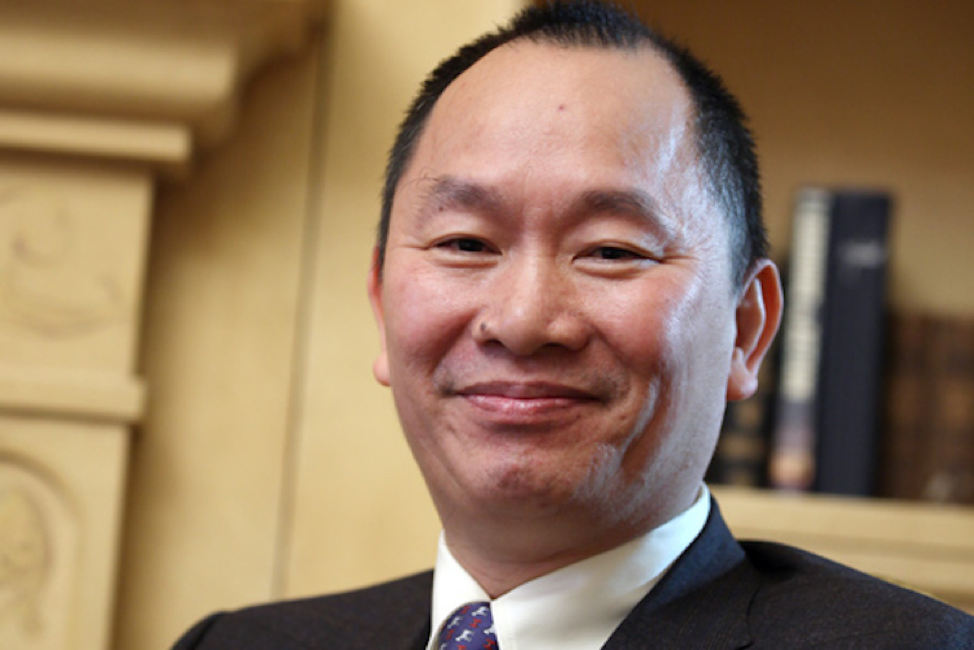
“We cooperate with the United Nations Academic Impact through the United Nations 2045 Initiative,” said Nguyen Anh Tuan, CEO of the Boston Global Forum (BGF), Director of the Michael Dukakis Institute for Leadership and Innovation (MDI) and Co-Founder of the AI World Society Innovation Network (AIWS.net).
The United Nations 2045 initiative includes roundtables, ideas, concepts, solutions, essays, and reflections looking ahead to the global landscape in 2045, when the UN completes its first centenary, in areas of these technologies, including artificial intelligence, cybersecurity and weapons systems, among others.
“Such a compilation which looks both to the horizon ahead and the role of the United Nations in making it beneficial and secure would be timely,” Mr Tuan told IDN in an email interview.
He was speaking about the Virtual Policy Lab ‘Transatlantic Approaches on Digital Governance: A New Social Contract in the Age of Artificial Intelligence’ from September 16-18.
The World Leadership Alliance – Club de Madrid (WLA-CdM) in partnership with the Boston Global Forum (BGF) organised the Transatlantic and multi-stakeholder dialogue on global challenges and policy solutions in the context of the need to create a new Social Contract on digital technologies and AI.
“By comparing American and European approaches in the creation of a new Social Contract on AI and digital governance, under the critical eye of former democratic Heads of State or Government, this policy dialogue stimulated new thinking and brought out ideas from representatives of governments, academic institutions and think tanks, tech companies, and civil society, from both regions,” Mr Tuan said.
At the same time, he added, the discussion generated a space to encourage and strengthen Transatlantic cooperation on the new Social Contract of digital governance in the framework of needed reforms of the multilateral system and needed global responses to common problems such as the global health crisis of COVID-19. The dialogue also served as a platform to establish a Transatlantic Alliance for Digital Governance (DADG).
One of the panels was moderated by Mr Ramu Damodaran, Chief of the UN Academic Impact. Explaining the views of the panellists, Mr Tuan said the panellists agreed that DADG will use standards of the Social Contract for the AI Age to: support fundamental rights, the rule of law, and democratic institutions, especially in the aftermath of COVID-19; and maintain peace and security (including AI and cyberspace) in Alliance members, and around the world.
They also agreed to address challenges, threats, and perils from any countries in the world, including climate change, pandemics, cyberattack, harmful AI, extreme nationalism, totalitarianism, dictators, destruction natural resources, or others that violate the Social Contract for the AI Age, and create new models, methodologies, concepts, and initiatives to make a better and smarter world.
“This smarter world is a democratic one with deep-applied AI,” said Mr Tuan.
The Transatlantic Alliance on Digital Governance includes 1. Democratic governments; 2. Companies in democratic countries; and 3. Intellectual Societies.
Mr Tuan said they also talked about the Activities of Transatlantic Alliance on Digital Governance:
– Unite Inter-Parliamentary Alliance on China, Global Partnership on AI, World Leadership Alliance-Club de Madrid, OECD, Boston Global Forum, AIWS Innovation Network (AIWS.net) and top universities into an alliance
– “Democratic Alliance on Digital Governance”
– Discuss and decide strategies for a peaceful, safe, effective, and smart world.
– Maintain peace and security for the world.
– Maintain standards of the Social Contract for the AI Age in global business such as setting up and maintaining the Supply Chain 2020.
– Create international laws and accords based on standards of the Social Contract for the AI Age.
– Enforce international laws and accords.
– Create systems for Global Monitoring and Judging such as Global Courts and Global AI Citizen.
Below two further questions IDN asked Mr Tuan and his answers:
Question: Have the discussions paved the road to the creation of an initiative to monitor governments as well as companies in using AI and generate an AI Ethics Index at all levels?
Mr Tuan: Yes. We spoke about solutions to monitor AI developments and uses by governments, corporations, and to assess whether they comply with the norms and standards codified in the Social Contract for the AI Age. Noncompliant actors will be identified and publicized through fact-based reports.
We named the AI Ethics Index as the AI Social Contract Index, which is linked to the standards of Social Contract for the AI Age.
The AI Social Contract Index is a global survey that will allow policymakers and the public to assess progress toward trustworthy AI based on normative goals.
The AI Ethics Index has these objectives:
(1) to evaluate a country’s AI policies and practices in 2020,
(2) to compare the AI policies and practices of various countries in 2020, and
(3) to evaluate a country’s AI policies and practices over time.
The AI Ethics Index will focus on human rights, rule of law, and democratic governance metrics. Endorsement and implementation of the OECD AI Principles will be among the primary metrics.
Opportunities for the public to participate in the formation of national AI policy, as well as the creation of an independent, national commission to address AI challenges, will be included among the metrics. Patents, publications, and investment are important metrics for AI policies, but they will not be considered here. The AI Ethics Index will be published on an annual basis and will evolve as country practices change and new issues emerge.
The first edition of the AI Social Contract Index will examine policies and practices in the Top 25 countries by GDP and other high impact countries. These countries, ranked in order, are US, China, Japan, Germany, India, France, UK, Italy, Brazil, Canada, Russia, Korea, Spain, Australia, Mexico, Indonesia, Netherlands, Turkey, Saudi Arabia, Switzerland, Poland, Taiwan, Thailand, Sweden, Belgium. (Source: Statistics Times. “High impact” countries include Israel and Estonia.)
Question: How do American and European approaches compare with each other in the creation of a new Social Contract on AI and digital governance?
Mr Tuan: The Boston Global Forum integrates both sides of the Atlantic. We call for the maintenance and protection of democratic values. The Social Contract for the AI Age is a new Social Contract on AI and digital governance. It is not only AI and Digital, but also involves politics, economy and society. The Social Contract for the AI Age seeks to build a multi-stakeholder, inclusive society in all aspects of life across politics, government, economics, business, and industry.
The Social Contract for the AI Age values creation, innovation, philanthropy, and mutual respect. It seeks the right of freedom on, and access to, the Internet worldwide. The Social Contract for the AI Age seeks to make the world a locus of responsible interaction—a place where every person’s contribution is recognized and everyone has a right to knowledge and access to information, where no one is above the law, where money cannot be used to subvert political process, and where integrity, knowledge, creativity, honesty, and tolerance shape decisions and guide policy. In short, the Social Contract for the AI Age seeks to build a world where all are recognized and valued, and all forms of governance adhere to a set of values and are accountable and transparent. It is a world where global challenges are met by collective action and responsibility. [IDN-InDepthNews – 11 October 2020]
The Policy Paper “Social Contract for the Artificial Intelligence Age – Safety, Security, & Sustainability for AI World” by Nazli Choucri, Nguyen Anh Tuan, and Marc Rotenberg will be published as an official document at the Riga Conference 2020.
The Rīga Conference takes pride in itself as the meeting place of local and global elites since its inception in 2006. In the past, the Rīga Conference have been honored with the presence of countless heads of state, heads of government, ministers, NATO and EU officials, and ambassadors – from all around the world. In addition to the extensive list of speakers, over 500 participants attend the conference every year, listening to and interacting with high-level policy makers.
Over the course of the last decade, The Rīga Conference has built a reputation across the region. Highlights have included having the Prime Ministers of Latvia, Poland, Estonia, Lithuania, and Finland together in the same room to discuss economic growth in a time of austerity; the presentation by Georgian President Mikheil Saakashvili in 2008 and the address by President of the United States George W. Bush in 2006.
The Rīga Conference 2020 will be taking place on the 12th and 13th of November, 2020. This is a special year for The Rīga Conference since it is it’s 15th anniversary. The event will proceed in a hybrid form- with a limited number of participants in person and a wider audience online. This year, amongst other things, the relevance of NATO on both sides of the Atlantic, COVID-19 consequences for defence, a post-pandemic global order, EU resilience in crisis, as well as Infodemia and other issues will be debated.
Horasis organize Horasis Extraordinary Meeting Virtual Event, October 1, 2020 06.30-23.00 Central European Summer Time.
The Horasis Extraordinary Meeting is the world’s foremost gathering of business leaders who interact with key government officials and eminent thought leaders. Under the theme Unite. Inspire. Create, 500 of the most senior members of the Horasis Visions Community gathered virtually to overcome the profound economic, political and social disruptions caused by Covid-19. The Horasis Extraordinary Meeting offers the conceptual backbone and action platform to advance the recovery – envisioning and implementing novel business models, new political cooperation and deep social cohesion.
Antonio Guterres, Secretary-General, United Nations, presented a keynote speech. There are presidents, prime ministers who are speakers.
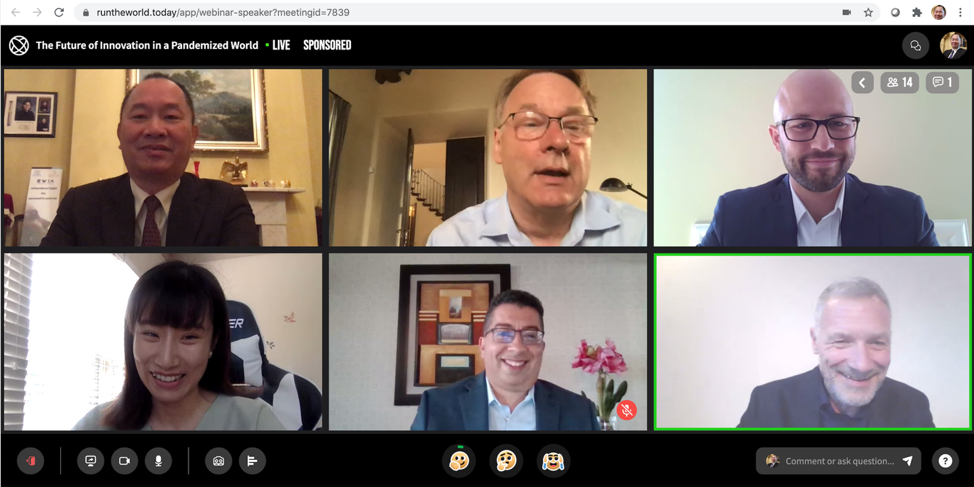
Mr. Nguyen Anh Tuan, CEO of the Boston Global Forum, was a speaker at the Horasis Extraordinary Meeting. He spoke about the Social Contract for the AI Age and AIWS City at the Panel “The Future of Innovation in a Pandemized World”.
Last week the Boston Global Forum (BGF) and the World Leadership Alliance-Club de Madrid (WLA-CdM) organized a policy lab on Translatlantic Approaches to Digital Governance: Social Contract for the AI Age. The event featured several panels on the growing importance of AI and digital policy. It is clear that the process of “digitalization” is accelerating. Countries are now confronting new challenges, as well as new opportunities.
Advances in AI raise policy issues that must be assessed. We must now focus through dialogue, tolerance, learning and understanding on key principles and practices for an agreement among members of society for shared social benefit. And we believe it is vitally important that democratic leaders make clear our support for fundamental rights and the rule of law in this Age of AI. We want to ensure that AI supports sustainable development, inclusion, fairness and accountability.
Our next step is to build public support for the Social Contract for the Age of AI. This global declaration sets out a human-centric approach for the governance of AI. The Social Contract is the outcome of a collaboration over the last several years between the BGF and the CdM/WLA.
We are asking you to join us, as signatories, in support of this initiative. Over the next several months, we will reach out to innovators, thinkers, advocates, and other world leaders. Our aim is to build support for the Social Contract and to educate the public about the many issues we will confront in the years ahead. We are also developing monitoring mechanisms so that we can begin to assess national progress toward the goals that we have set out.
You will find more information about the Social Contract for the Age of AIhere. If you would like to endorse, please contact Tuan Nguyen, director of the Michael Dukakis Institute.
Thank you for your continued interest in this work.
Sincerely,
Governor Michael Dukakis, Boston Global Forum, and
President Vaira Vīķe-Freiberga, Latvia and World Leadership Alliance-Club de Madrid
Thank you to the World Leadership Alliance-Club de Madrid and Boston Global Forum for inviting me to deliver some introductory remarks to this timely and important event on the theme – Transatlantic Approaches on Digital Governance: A New Social Contract in the Age of Artificial Intelligence
I’m speaking to you from my home city of Melbourne, where more than 5 million people are living under a strict lockdown as we grapple with an outbreak of the COVID-19 infection.
At the moment we have a 9pm to 5am curfew.
We cannot go outdoors for more than one hour a day to exercise, one trip to do essential shopping, nor can we travel more than 5 kilometers from our homes.
Nearly all businesses and community facilities are closed.
I know many of you have had similar experiences in your home cities over the course of this extraordinary year.
The impact of this global pandemic has been felt by all of us, and all of our lives have been changed by it.
We have learned some very important lessons this year.
We have learned that community still matters.
We have learned that solidarity still matters.
We have learned, or been reminded, that individual freedom has to be balanced against the common good.
We have learned that government still matters, and that competent government matters a great deal.
We have learned that transparency is better than concealment.
We have learned to value our health-care workers, and that cutting spending on public health is a false economy.
Most of all, we have learned that facts matter; that truth matters; that accurate and timely information matters.
More concretely, we have learned that science matters.
Science holds the key to understanding the multiple challenges posed by COVID-19, to responding effectively to those challenges – and ultimately – to defeating COVID-19 and saving the lives of millions of people.
That’s why it’s so timely that you are meeting – thanks to the wonders of contact-free global conversation – to discuss the role of science and technology in responding to the challenges of our century, of which the COVID-19 pandemic will not be the last.
We have had transnational and even global pandemics before.
We had plague, smallpox and cholera.
A hundred years ago we had the so-called Spanish Flu.
Nearly forty years ago we saw the advent of HIV/AIDS.
But while this is not the first global pandemic, it is the first pandemic in a globalised world.
It is the first pandemic in the era of the smartphone, of social media, of instantaneous global information and disinformation.
When Mark Twain wrote that “a lie can travel around the world and back again while the truth is lacing up its boots” he could not have known how true that would be in the year 2020.
Perhaps the most important challenge we face is how to prevent the wonderful technologies we now possess being misused; being put at the service of lies and propaganda and the promotion of hate-filled conspiracy theories.
The pandemic will elicit an examination of the social contract – what is the volonté générale, or the mens una, or have the inputs for utilitarian outcomes shifted?
We may need to examine whether the freedoms and rights that the citizenry of a western liberal democracy has traditionally enjoyed and that have been given up by the citizenry during the last few months will be altered, and whether there will be a ceding of those rights and freedoms to governments, given the course of this pandemic and the fact that no society can guarantee that we can be free of another wave, or indeed, another pandemic.
And in this century we may also face an examination of innate human morality and the foundation that that provides in a society, balanced against an artificial intelligence.
But the post-COVID world will not be the pre-COVID world.
We can never go back to life as it was in 2019, as individuals, as communities or as nations.
The challenge facing all of us, as leaders, as legislators, as policy-makers, as shapers of public opinion, is to see that all these lessons are learned, that truth prevails over propaganda and science over mythology.
Science has given us the technology we need to defeat not only COVID-19, but all of the multiple challenges we face.
What we need now is the political will to use it effectively.
Thank you, and all the best for your discussion over the next two days.
On September 17 at Session I: The AIWS Social Contract 2020 and AIWS Innovation Network: A Platform for Transatlantic Cooperation, the Lead Speaker and Facilitator was Nazli Choucri, Boston Global Forum Board Member and Professor of Political Science at the Massachusetts Institute of Technology (MIT)
Panel discussion:
Esko Aho, WLA-CdM Member, Prime Minister of Finland (1991-1995)
Vaira Vike-Freiberga, WLA-CdM Member, President of Latvia (1999-2007)
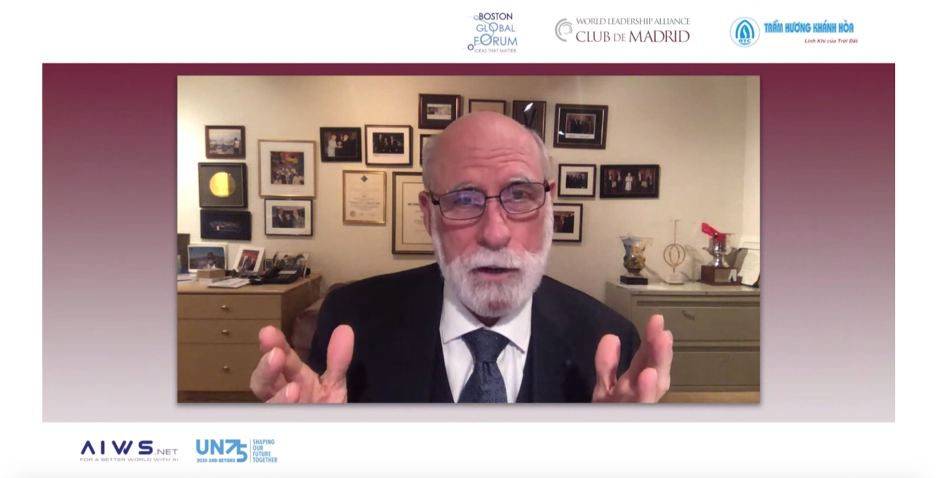
Vint Cerf, Father of the Internet, Chief Internet Evangelist, Google
Nguyen Anh Tuan, CEO of the Boston Global Forum, “Presentation AIWS City, a practicing of The Social Contract 2020, A New Social Contract in the Age of AI”
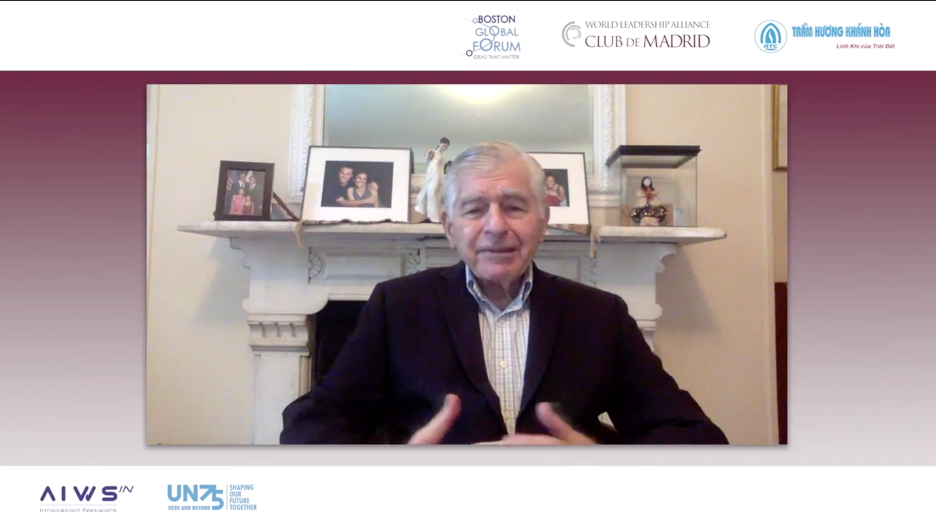
The panel discussed the Social Contract for the AI Age and AIWS City. In this session participants are President Vaira Vike-Freiberga, Vint Cerf, both World Leader in AIWS Award recipients, Professor Nazli Choucri, MIT, Board Member of the Boston Global Forum, Michael Dukakis Institute, History of AI at AIWS.net, Mr. Nguyen Anh Tuan, CEO of the Boston Global Forum. Professor Choucri is lead speaker and moderator of this session. She talked about the Social Contract for the AI Age, and Mr. Tuan introduced new concepts found in the Social Contract for the AI Age such as Intellectual Society and Smart Democracy, as well as the model of AIWS City.