Basically, there are two types of business leader: A progressively enthusiastic and imaginative leader, and an increasingly consistent leader.
In 2018, Elon Musk was put under serious scrutiny. He expected to make a record number of Model 3 vehicles. To do this, he pulled a very late move to manufacture another creation line in a tent close to his huge processing plant. Nonetheless, he needs to send his vehicle to various areas. This included China, in additional to the United States, Europe, and numerous different locations. To a point where Tesla is all around abused and is producing stable benefits each quarter a bit.
Basically, there are two types of business leader: A progressively enthusiastic and imaginative leader, and an increasingly consistent/level leader.
The first type is one with an innovative vision. These pioneers can make thoughts for their plan of action quicker than the organization can execute them, such as Elon Musk, who gives extraordinary thoughts and incredible identities. Elon regularly takes a shot at the following enormous things and offers special thoughts.
The second is CEOs who can make an organization go about as a productive machine, such as Tim Cook. Tim Cook focuses on administrations and the business area.
Be that as it may, both were gotten up to speed in ashes in light of their particular shortcomings. Elon Musk has appeared numerous controversies throughout 2018: being irritated at the SEC, brutal and eccentric cutbacks, and smoking weed on Joe Rogan’s podcast. He has done numerous things that Tim Cook will never do. Tim Cook, then again, was intensely affected by his absence of inventiveness. The iPhone is never progressive, and Tim Cook is now fixing the iPhone with each dollar it has worth and emptying cash into Research and Development (RnD).
An individual like Tim Cook will be exceptionally useful for anyone like Elon. Cook is a lord in making a decent organization, which implies the operational part of an organization will work extraordinarily whenever kept running by Cook. What’s more, an individual like Elon will be useful for somebody like Tim Cook. At the point when Apple required development, Elon demonstrated a record of making colossal activity thoughts that fit what the organization was doing. He will almost certainly offer a dream for Apple whenever enlivened to do as such.
Obviously, there are individuals who appear to fit every one of the generalizations. Does Jeff Bezos case fall into the condition? He appears to be very innovative and furthermore, has essential business standards. That may be the reason he left Wall Street to begin Amazon since he had an innovative thought and would not like to work in the monetary segment. He is additionally renowned for sending his email to the staff. He additionally does not permit introductions of Powerpoint or Slide at meetings since they are exhausting. He has a considerable amount of innovative beliefs and forms and has a significant enthusiastic identity. He likewise runs Amazon great, however, that might be on the grounds that he has a bolster, and furthermore has a business foundation.
So any reasonable person would agree that you can take a look at an official or business pioneer and see where they are on the Creative range – Business Operations.
The best case for a business is the place you have an individual like Tim Cook and Steve Jobs in the indistinguishable organization from Apple. That is the reason Apple is so fruitful (in addition to Johnny Ives/Woz), and right now they have such a lot of money tucked neatly away, which they will spend on RnD. This is on the grounds that they have an imaginative pioneer and a functioning master that they have been effective with.
In times like this, AI development needs adjustment so it won’t get out of hand; rules and principles need to be followed. This is the focus of BGF- MDI’s development of the AIWS initiative to come up with a set of moral values and norms for AI so it can become more transparent.
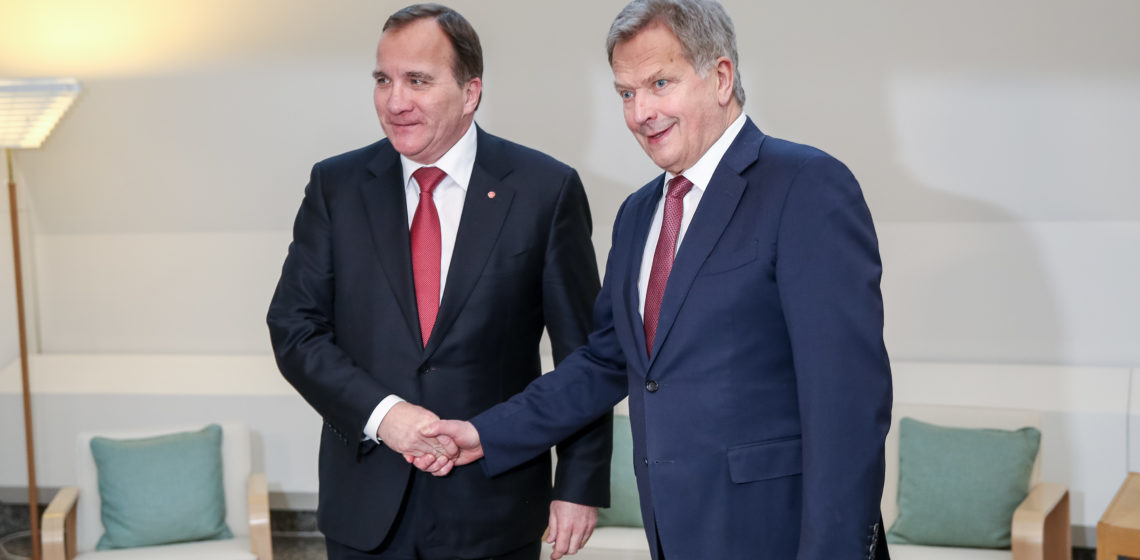
On Jan 28, 2019 President of the Republic of Finland Sauli Niinistö met Prime Minister of Sweden Stefan Löfven in Mäntyniemi.
During the meeting, The President and the Prime Minister discussed the cooperation between Sweden and Finland, European defense cooperation, and issues related to the Arctic region based on cooperation and friendship between the two sides.
On December, 2018 President Sauli Niinistö – President of the Republic of Finland received the World Leader for Peace and Cybersecurity Award from the Boston Global Forum (BGF) and the Michael Dukakis Institute for Leadership and Innovation (MDI) for his leadership role in establishing Finland as a vital member of the world community and his support of The European Centre of Excellence for Countering Hybrid Threats.
In this role, he has fostered the understanding of, and solutions to the numerous threats we face from political forces, economic instability, military intervention, civil unrest, climate change, and unsafe Internet practices.
President Niinistö expressed his honor to receive this award and emphasized that countries should make every effort to increase citizens’ awareness in all areas of society and strengthen cooperation among nations, as well as rules for international borders.
By following somebody’s cerebrum movement, this innovation can reproduce the words that an individual hears with extraordinary lucidity. This leap forward tackles the intensity of discourse amalgamation and man-made consciousness. It additionally establishes the framework for helping the individuals who can not address recapture the capacity to speak with the outside world.
This research study is led by Prof. Nima Mesgarani, a principal investigator at Columbia University’s Mortimer B. Zuckerman Mind Brain Behavior Institute.
This research is to combine the recent advances in deep learning (deep neural network) with the latest innovations in speech synthesis technology to reconstruct intelligence speech from human auditory cortex. This approach has been demonstrated with positive results for the next generation of speech Brain-Computer Interface (BCI) system, which can not only restore communications for paralyzed patients but also have the potential to transform human-computer interaction technologies.
Future breakthroughs that the technology could lead to include a wearable brain-computer interface that could translate an individual’s thoughts, such as ‘I need a glass of water’, directly into synthesized speech or text. “This would be a game changer,” said Prof Mesgarani. “It would give anyone who has lost their ability to speak, whether through injury or disease, the renewed chance to connect to the world around them.”
In the primary logical investigation, Columbia neuroscientists made a framework that makes an interpretation of straightforward, conspicuous words into words. By following somebody’s cerebrum movement, innovation can reproduce the words that an individual hears with extraordinary lucidity. This leap forward tackles the intensity of discourse amalgamation and man-made consciousness. It additionally establishes the framework for helping the individuals who cannot address recapture the capacity to speak with the outside world.
These discoveries have been distributed in logical reports. “Our voice associates us with companions, family and our general surroundings,” said Nima Mesgarani, Ph.D., the lead writer of the article and a key examiner of the article at Columbia University’s Mortimer B. Zuckerman Institute for Brain Behavior Research. “With the present research, we have a potential method to reestablish that capacity. We have appeared, with the correct innovation, these individuals’ musings can be deciphered and comprehended by anybody audience members. ”
Many years of research have demonstrated that when individuals talk – or even envision talking – narrating action models show up in their cerebrums. Specialists, attempt to record and interpret these models with the goal that they can be converted into words.
Be that as it may, finishing this accomplishment demonstrated testing. The underlying endeavors to unravel mind signals neglected to make anything like straightforward words. Dr. Mesgarani’s gathering has changed to a profession, a PC calculation that can integrate discourse in the wake of being prepared on the accounts of the speakers.
“This is a similar innovation utilized by Amazon Echo and Apple Siri to give verbal solutions to our inquiries,” said Dr. Mesgarani, additionally an associate teacher of an electrical building at the School of Engineering and Science, getting familiar with Columbia’s Fu Foundation Application.
To instruct individuals to articulate the cerebrum’s action, Dr. Mesgarani teamed up with Ashesh Dinesh Mehta, MD, Dr., a neurosurgeon at the Northwell Medical Neurology Institute.
“Working with Dr. Mehta, we have requested that epilepsy patients experience mind medical procedure to tune in to the idioms of various individuals, while we measure the examples of cerebrum action”, Dr. Mesgarani said. “Apprehensive models have prepared the elocution.”
Next, the specialists requested that comparative patients tune in to the speaker perusing the digits somewhere in the range of 0 and 9 while recording cerebrum flags that could be gone through the articulation. The final product is a voice that sounds like a robot perusing a series of numbers. To check the precision of the chronicle, Dr. Mesgarani and his group have allocated people to tune in to the accounts and report what they hear.
“We found that individuals can comprehend and rehash sounds about 75% of the time, higher and go past every single past exertion,” Dr. Mesgarani said. “Delicate elocution set and incredible neural system speak to the sound that patients at first heard with astounding exactness.”
Dr. Mesgarani and his group intend to test the following increasingly complex words and sentences, and they need to run comparable tests on cerebrum signals transmitted when one talks or envisions talking.
“In this situation, if the wearer supposes ‘I require a glass of water’, our framework can take the cerebrum flag produced by that idea and transform them into blended words, verbally,” Dr. Mesgarani said. “This will be a distinct advantage. It will enable any individual who can not talk, regardless of whether through damage or ailment, the chance to enhance to interface with their general surroundings.”
What we expect came true finally. This success will especially make the AIWS ideas come true. People will be more honest; unable to say something different from what they are thinking, and cannot be false. The cultural values of AIWS to build a faithful and honest society now have the opportunity to implement, to make AIWS a reality.
According to Mr. Nguyen Anh Tuan – Director of The Michael Dukakis Institute for Leadership and Innovation, Co-Founder, and Chief Executive Officer of The Boston Global Forum: “What we expect came true finally”.
“This success will especially make the AIWS ideas come true. People will be more honest, unable to say something different from what they are thinking, not be false. The cultural values of AIWS to build a faithful and honest society now have the opportunity to implement, to make AIWS a reality,” said Mr. Nguyen Anh Tuan.
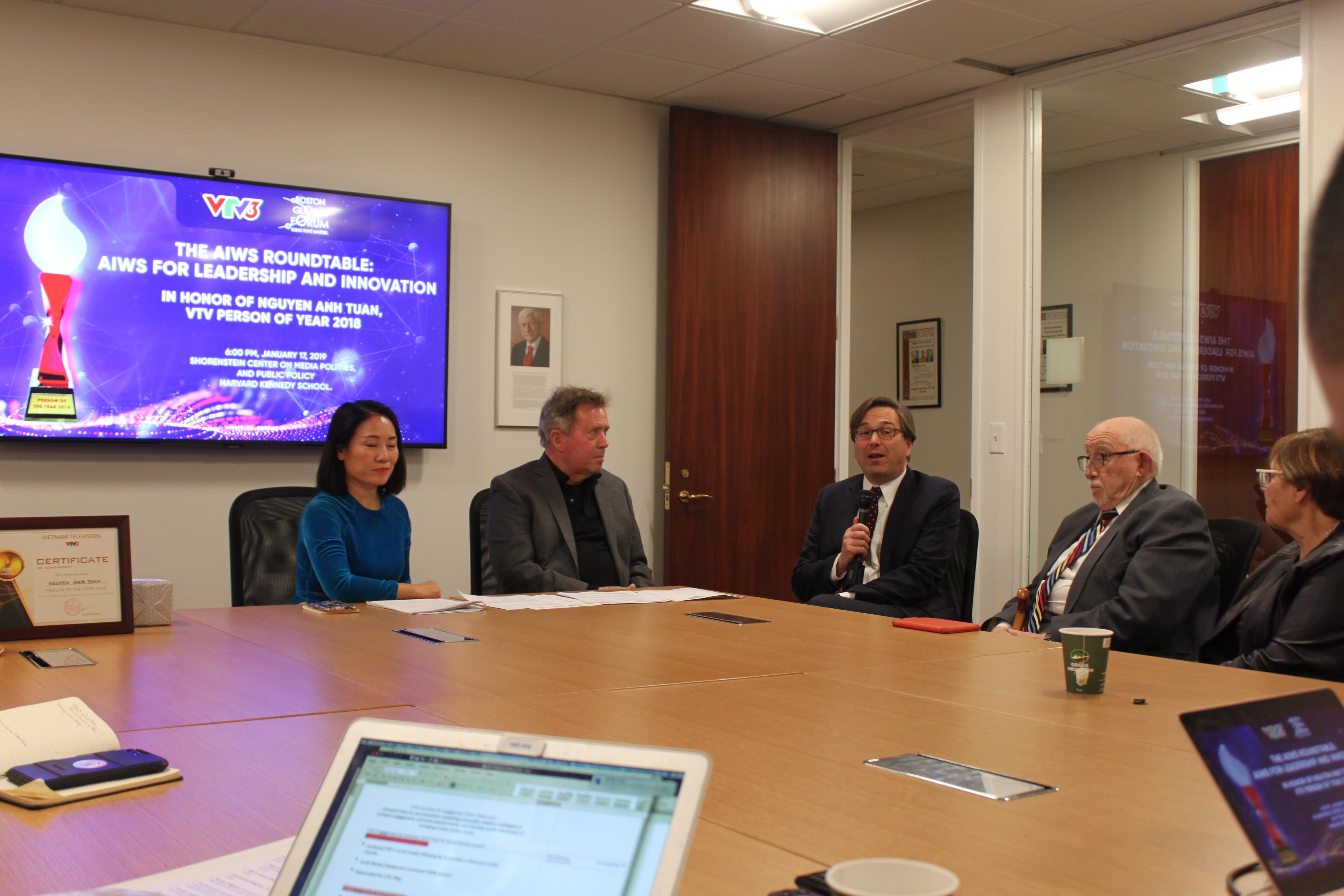
On January 17, 2019 Professor Jason Furman – Chairman of the Council of Economic Advisers and chief economist of former POTUS Obama, and professor at Harvard University’s Kennedy School of Government – gave a talk about AI issues in AIWS Roundtable, which was held by Vietnam National Television (VTV) and Boston Global Forum (BGF).
On January 17, 2019 Professor Jason Furman – Chairman of the Council of Economic Advisers and chief economist of former POTUS Obama, and professor at Harvard University’s Kennedy School of Government – gave a talk about AI issues in AIWS Roundtable, which was held by Vietnam National Television (VTV) and Boston Global Forum (BGF).
Prof. Furman thinks the most important thing to understand is that technology is not a destiny. “It doesn’t tell us what is going to happen to jobs, it doesn’t tell us what is going to happen to wages, what is going to happen to our economy and our society,” said Furman.
“Technology can give us new choices and new opportunities so that sense can make everything better, but only if we are the user,” Furman noted.
“Literally, in Switzerland have very similar technology, there’s a lot of people who are unemployed, literally, Switzerland has a very high level of employment. There’s nothing to do with the terminators. There’s nothing to do with the killer robots. Everything to do with are the economic policy, institutions and the culture…”
About unemployment question, he gave an example: “we have had technology replace humanity for a long time, we can work for 4 hours/week and earn the same amount that we earn in 1900 working 50 hours/week. We want to be richer!”
According to Prof. Furman, there are new types of jobs, there are more demand for all types of jobs and our jobs have changed. Technology will replace certain tasks, but not entire jobs. That is likely what is going to happen in the future.
“But the question is: are you going to prepare people for those jobs, give them the skills and the training? …Robots got a lot of quality. They got a lot of people being disappointed and left down. The way to come about that is education, training, having a system that helps place people in jobs. But the most important in all of this is the more innovation we have, the better sets of options and choices we have as long as we are willing to do what we need to take advantage of,” he explained.
Furman said one of the advantages that machine have is that some of these problems may actually be solvable on the machine side than the human side, but only we put an effort into it.
“The reason we should worry about is not that they are worse than people, but we might be able to solve their problems more easily than we solve the problems of people.”
The government of Singapore has released an Artificial Intelligence (AI) governance framework to help businesses in the Republic, along with other partners, that will grapple with issues surrounding the ethical use of Artificial Intelligence.
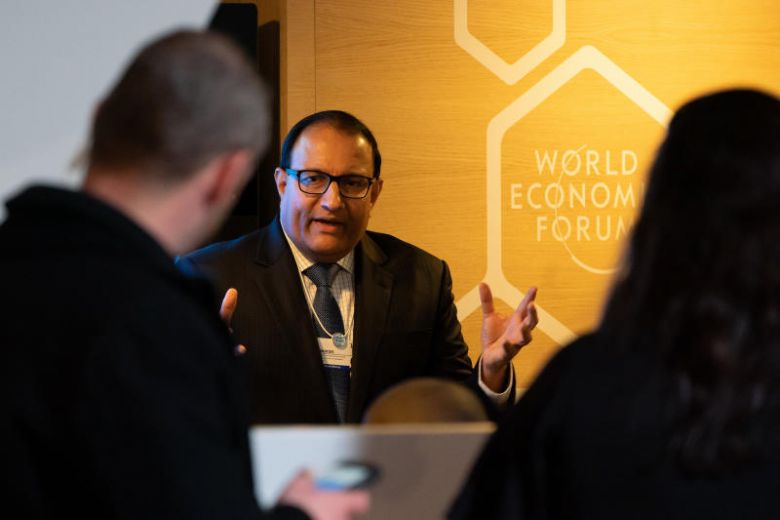
The AI ethical framework was announced by Mr. Iswaran, Singapore’s Minister for Communications and Information, at the World Economic Forum (WEF) in Davos, Switzerland. It documents how AI can be responsibly and ethically used.
The model framework is founded on two high-level principles: AI implementations should be human-centric, and decisions made or assisted by AI should be explainable, transparent and fair to consumers.
Dubbed as a “living document,” the framework was put together using feedback from leading industry experts. This in turn enhances trust in and understanding of AI, as well as acceptance of how AI-related decisions are made for the benefit of users.
The framework is the first of its kind in Asia to provide a highly detailed and easy-to-follow guidance for AI-using organizations in the private sector, according to Infocomm Communications Development Agency (IMDA).
Answering the question if AI governance model prevents companies on their businesses in Singapore, Mr. Iswaran emphasized that it is not a set of rules but a framework for companies to use.
“On the contrary, we might even be able to come out as one of the jurisdictions with sound approaches to data management and the governance of AI and other frontier technologies. In this case, more companies would want to be associated with us.”
Explaining why choosing the World Economic Forum as a stage to release the Artificial Intelligence framework, Mr. Iswaran said WEF is a large forum for government leaders and global industries. By selecting the WEF stage, Singapore can invite global feedback to further improve the AI ethical framework.
Although there are concerns about the risk of AI being developed for the wrong purpose, no one can deny the advantages it offers, even nationally. Therefore, every country needs to abide by the moral and legal rules when developing in this area, and the world also requires international policies, conventions, and regulations to ensure unity and global consensus in developing AI. Calling leaders of nations to build a treaty on the exploitation and development of AI for peace is what the Michael Dukakis Institute (MDI) is actively implementing through Layer 5 of the 7-layer AIWS Model.