by BGF | Feb 17, 2019 | News
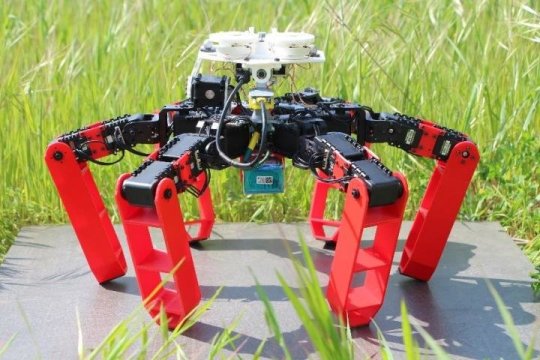
Desert ants are uncommon single guides. Specialists were intrigued by these ants as they planned AntBot, a principal strolling robot that can investigate its condition haphazardly and return home naturally, without GPS or mapping.

The optical compass created by the researchers is touchy to the sky’s energized bright radiation. Utilizing this “heavenly compass,” AntBot measures its heading with 0.4° accuracy by clear or overcast climate. The route’s exactness accomplished with moderate sensors demonstrates that bio-motivated mechanical autonomy has a colossal limit in that advancement.
Humans and robots are showing an increasingly close relationship in the modern world, as well as the ability to “help” people of robots. So how does one use machines and AI for a good, ensuring safety for the community? Is there any moral standard for developing and using robots? These are the studies being developed in Layer 2 of the 7-layer AIWS Model by the Michael Dukakis Institute for Leadership and Innovation (MDI).

by BGF | Feb 17, 2019 | News
Ángel Gurría, the secretary-general of the Organization for Economic Cooperation and Development (OECD)

In an interview with CNN’s Becky Anderson at the World Government Summit (WGS) in Dubai, Gurría stated: “The danger is not just about knowing the technology that is growing at breakneck speed, but how you empower half of the workforce that will be displaced.”
Gurría concentrated on the requirement for nations to understand the consequences for work powers and on ages yet to enter the universe of work.
He additionally asked national leaders to “broaden their horizons and make appropriate decisions in order to create a better future.”
Under Ángel Gurría’s leadership, OECD is leading the effort to reform the international tax system and to improve governance frameworks in anti-corruption and other fields. OECD is addressing issues surrounding the development of Artificial Intelligence based on two fundamental questions:
What sort of policy and institutional frameworks should guide AI design and use?
How can we ensure that AI benefits society as a whole?
Secretary General Ángel Gurría as the inaugural recipient of the World Leader in AI World Society on April 25, 2018 honored by the Boston Global Forum (BGF) and Michael Dukakis Institute at BGF-G7 Summit Conference 2018 at Harvard University Faculty Club.

by BGF | Feb 17, 2019 | Highlights
Shaping Futures introduce the writings of Prof. George Church, Harvard Medical School:
A Bill of Rights for the Age of Artificial Intelligence

He wrote that “We should be concerned about the rights of all sentients as an unprecedented diversity of minds emerges.”
And his idea:
What prevents extension to other animals, organoids, machines, and hybrids? As we (e.g., Hawking, Musk, Tallinn, Wilczek, Tegmark) have promoted bans on “autonomous weapons,” we have demonized one type of “dumb” machine, while other machines — for instance, those composed of many Homo sapiens voting — can be more lethal and more misguided.
In the 7 -layer model of AI World Society (AIWS), the 4th layer is vital.
At AI World Society – G7 Summit Conference at Loeb House, Harvard University, Mr. Paul Nemitz, the Principal Advisor in the Directorate General for Justice and Consumers., European Commission, member of AIWS Standards and Practice Committee, will present the concepts of AI World Society Law, which will shape futures of the world with deeply applied AI.

by BGF | Feb 11, 2019 | Highlights
Machinery is increasingly used in the newspaper industry, which directly affects the work of reporters and editors. Let’s discuss with Shaping Futures about this and assess how it will impact our future?

About a third of the content published in Bloomberg News is automated technology. The company’s Cyborg system can assist reporters to produce thousands of articles and report the results of companies in each quarter.
No tired, accurate, and not complaining, Cyborg helped Bloomberg in the race with Reuters, a direct competitor in the field of business financial journalism.
Apart from news about business results, Cyborg also helped Bloomberg give some news about sports tournaments or earthquakes …
More and more newspapers use artificial intelligence to serve their work. Last week, the Australian version of The Guardian published the first article supported by robots; and Forbes recently announced that they are testing a tool called Bertie to provide reporters with a rough draft of the articles.
The use of artificial intelligence is becoming part of the journalism industry, but this is not a threat to reporters. Instead, this idea allows journalists to spend more time on real work.
“The work of journalism is creative, it’s about curiosity, it’s about storytelling, it’s about digging and holding governments accountable, it’s critical thinking, it’s judgment — and that is where we want our journalists spending their energy,” said Lisa Gibbs, the director of news partnerships for The A.P.
A.P., The Post and Bloomberg also set up internal alerts to signal anomalous data bits. Reporters who see these warnings can write bigger stories.
For example in the Olympics, The Post has set up Slack alerts, the workplace messaging system to notify editors if the results are more or less than 10% of the world record.
But machine-generated stories are not infallible. For an earnings report article, for instance, software systems may meet their match in companies that cleverly choose figures in an effort to garner a more favorable portrayal than the numbers warrant. At Bloomberg, reporters and editors try to prepare Cyborg so that it will not be spun by such tactics.
AI becomes a productivity tool in reading reports and finding clues. When performing data analysis, AI can help detect abnormal factors.
A few years ago, AI was only used in high-tech companies, but now it really has become an essential need; said Francesco Marconi, the head of research and development at The Journal. “I think a lot of the tools in journalism will soon be powered by artificial intelligence.”
Mr. Marconi of The Journal agreed, likening the addition of A.I. in newsrooms to the introduction of the telephone. “It gives you more access, and you get more information quicker,” he said. “It’s a new field, but technology changes. Today it’s A.I., tomorrow its blockchain, and in 10 years it will be something else. What does not change is the journalistic standard.”
According to Marc Zionts, the chief executive of Automated Insights, machines need a long way to replace flesh-and-blood reporters and editors.
“If you are a non-learning, non-adaptive person — I don’t care what business you’re in — you will have a challenging career,” Mr. Zionts said.
In addition to giving reporters more time to pursue their interests, machine journalism comes with an added benefit for editors.
“One thing I’ve noticed,” said Mr. St. John, “is that our A.I.-written articles have zero typos.”
With the purpose of ensuring AI’s future, the Michael Dukakis Institute has launched the AIWS Initiative, including the AIWS 7-Layer Model for ethical AI and concepts for the design of AI-Government, which has received the support of Paul Nemitz.

by BGF | Feb 11, 2019 | News
Researchers say AI can move from a model to common sense through a game.

As announced by MIT Technology Review, scientists at the Allen Institute for AI (AI2) trust that Pictionary, in which players attract a picture to pass on a word or expression, could cross over any barrier between the utilization of calculations, machine learning (ML), intellectual figuring, and what we know as “common sense.”
Artificial intelligence can process and perform errands characterized by its programming at incredible speed, however, this does not mean that it can make the associations among items and individuals or have the capacity to reason dependent on certifiable learning.
A precedent would ask AI the stick-and-carrot question: in the event that you stick a stick into a carrot, does the carrot have a gap or the stick?
The appropriate response is clear to us, however not so for the present AI models.
This absence of the presence of a mind is hampering various AI applications today, for example, chatbots and live voice aides, as they can’t decipher or comprehend inquiries past the most straightforward, stripped-down inquiries.
Nevertheless, the AI2 group believes that the preparation of AI through Pictionary may result in the blessed vessel, sound judgment prepared AI, turning into a reality.
So as to test the hypothesis, the scientists have made an online rendition of the diversion, named Iconary, which interfaces AI and human players, the two of which are entrusted with speculating the significance behind a picture.
It is trusted that as the AI learns, it will build up its own sort of good judgment by framing associations between various unique ideas.
Microsoft co-founder Paul Allen is the creator of the non-benefit lab and has recently put a further $125 million into the group’s activities.
As AI develops at a very fast pace, it is necessary to observe its progress from time to time to keep it under control. Developers and organizations should use a certain set of standards to keep track of technology’s development. The AIWS 7-layer model for AI ethical issues developed by MDI can be a good one to follow.