by Robert Whitcomb | May 27, 2016 | Event Updates
(May 30th, 2016) On May 27, leaders of the Group of Seven industrialized democracies meeting at their summit in Japan reaffirmed their commitment to swift implementation of the landmark Paris climate pact signed last year.
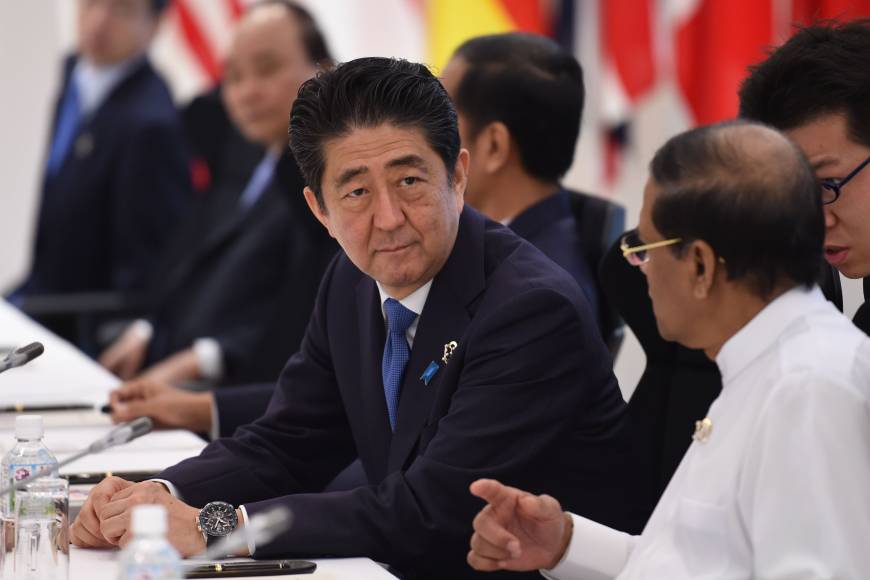
Prime Minister Shinzo Abe is seen with world leaders on Friday, the second day of the annual Group of Seven summit, held this year in Shima, Mie Prefecture
The Paris Agreement seeks to limit a rise in global average temperature to well below 2 degrees Celsius. The European Commission called it “the first-ever universal, legally binding” global climate framework.
“The G-7, continuing to take a leadership role, commits to taking the necessary steps to secure ratification, acceptance or approval of the Paris Agreement as soon as possible, and calls on all parties to do so, striving for a goal of entry into force in 2016,” the leaders said in a communique as the two-day summit drew to a close.
by Robert Whitcomb | May 26, 2016 | AI World Society Summit
The biggest issues at the G7 Summit have been how to get the global economy humming again; the refugee crisis in Europe and the Mideast; Chinese expansionism in the East and South China Sea, and cybersecurity. Read this link.
The last item has been a priority of The Boston Global Forum this year. BGF experts have presented their proposals on how to improve cybersecurity in particular and cyberbehavior in general to the G7 leaders. Indeed, a key part of the BGF’s BGF-G7 Summit Initiative is its Ise-Shima Norms for cyberbehavior, named for the location of the summit.
As for the refugees: European Council President Donald Tusk said on Thursday he would seek G7 support for more global aid for them.
“If we (G7) do not take the lead in managing this crisis, nobody would,” Mr. Tusk told reporters. A flow of migrants to Europe from Syria, other parts of the Mideast and Africa confronts the continent with its biggest refugee crisis since World War II.
In a closing communiqué, leaders were also expected to cite the importance of maritime security, including calling for respect for the rule of law and opposition to provocative acts that try to change the status quo by force – in a clear reference to Chinese expansionism.
Although full agreement on macro-economic policy looks difficult, the G7 leaders are expected to promote monetary, fiscal and infrastructure policies to spur growth in the final summit communiqué.
Britain and Germany are resisting calls for fiscal stimulus, and so Japanese Prime Minister Shinzo Abe will urge the G7 leaders to adopt a flexible fiscal policy, taking into account each country’s economic and political situation.
by Robert Whitcomb | May 26, 2016 | News
This report from security-ratings firm BitSight says that Brazilian companies do worse on cybersecurity metrics, such as machine compromise rates, e-mail security and file-sharing practices, than do companies in other major economies.
It made particular reference to those companies vulnerability to computers compromised by malware, such as botnets that covertly control a computer network.
by Robert Whitcomb | May 26, 2016 | News
In this podcast, Saker Nusseibeh, chief executive of Hermes Investment Management, said any benefits from a British exit from the European Union (“Brexit’’) would be limited while market anxiety from it could escalate into a wider economic contagion. He also discussed the Fed and the G7 meeting in Japan.
by Robert Whitcomb | May 26, 2016 | Initiative
(May 30th, 2016) China’s Defense Ministry asserted on May 26 that its aircraft followed proper rules after two Chinese fighter jets carried out what the United States called an “unsafe” intercept of a U.S. military reconnaissance aircraft over the South China Sea, where China has been seeking to gain hegemony, especially by occupying and militarizing some disputes reefs and islands.
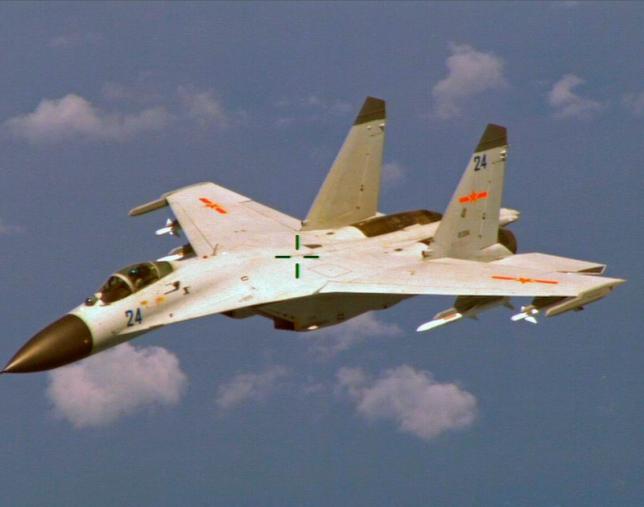
File photo of a Chinese J-11 fighter jet seen flying near a U.S. Navy P-8 Poseidon about 215 km (135 miles) east of China’s Hainan Island in this U.S. Department of Defense handout photo taken August 19, 2014. REUTERS/U.S. Navy/Handout
The Pentagon said that incident happened in international airspace last week as the plane carried out “a routine U.S. patrol,” the Pentagon said.
A U.S. defense official said two Chinese J-11 fighter jets flew within 50 feet of the U.S. EP-3 aircraft, which was flying east of Hainan island.
Chinese Defense Ministry spokesman Yang Yujun asserted that the Chinese pilots acted professionally and in line with an agreement reached between the countries on rules governing such encounters.
However, he said the agreement, called the Rules of Behavior for Safety of Air and Maritime Encounters, could only provide a “technical standard,” and the best way of resolving the problem was for the U.S. to stop such flights.