by Admin | Feb 15, 2016 | World Leaders in AIWS Award Updates
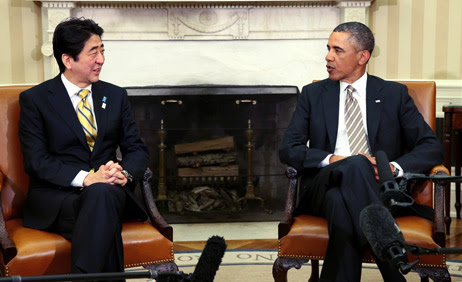
(15th Feb 2016) U.S. President Barack Obama and Japanese Prime Minister Shinzo Abe have discussed by phone North Korea’s menacing. Feb. 6launch of a ballistic missile and called for a strong international response to what the White House called a “destabilizing provocation.’’
U.S. President Barack Obama and Japanese Prime Minister Shinzo Abe
U.S. President Barack Obama and Japanese Prime Minister Shinzo Abe have discussed by phone North Korea’s menacing. Feb. 6launch of a ballistic missile and called for a strong international response to what the White House called a “destabilizing provocation.’’ But perhaps more importantly, Mr. Obama emphasized America’s “ironclad’’ commitment to Japanese security and promised to take all necessary steps to defend Japan and its other allies in the region.
The launch distressed many around the world in part because it showed North Korea’s increasing technological capability, including in cyber-related matters.
The U.S., South Korea and Japan have been urgently discussing tougher sanctions on the North Korean police state – a topic bound to come up at the G7 Summit in May. Japan and the U.S., of course, are both members of the G7.
See more
by Admin | Feb 15, 2016 | AI World Society Summit
(15th Feb 2016) China is continuing to conduct cyber espionage operations against the United States, and Beijing’s commitment to a U.S.-China cyber agreement is questionable, the director of national intelligence told Congress on Tuesday.
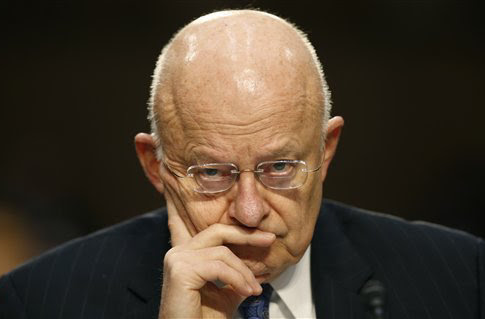
Director of the National Intelligence James Clapper listens on Capitol Hill in Washington, Tuesday, Feb. 9, 2016, while testifying before the Senate Intelligence Committee hearing on worldwide threats. (AP Photo/Alex Brandon)
China is continuing to conduct cyber espionage operations against the United States, and Beijing’s commitment to a U.S.-China cyber agreement is questionable, the director of national intelligence told Congress on Tuesday.
“China continues cyber espionage against the United States,” James Clapper, the director, testified during an annual threat briefing to the Senate Armed Services Committee.
“Whether China’s commitment of last September moderates its economic espionage remains to be seen,” he added.
Clapper identified potential cyber attacks against critical infrastructure and advancing cyber warfare capabilities in nations such as China, Russia, North Korea and Iran as the among the most serious U.S. national security threats.
See more
by Admin | Feb 15, 2016 | Event Updates
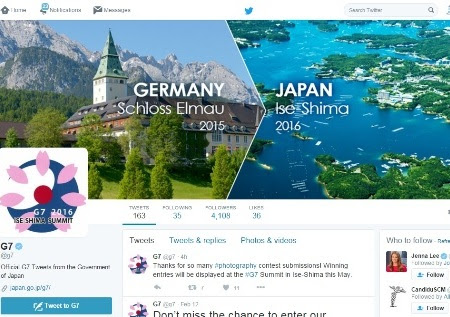
(February, 15th, 2016) The Japanese government today launched an official English language Twitter account for its G7 Presidency in 2016.
This follows the handing over of the @G7 Twitter handle by Germany, which hosted the 2015 G7 Summit in Schloss-Elmau.
Germany’s handover message to Japan was its final tweet on the account. The first tweet by Japan was a thank you to Germany.
The @G7 Twitter account is the place to go for the latest official tweets on the G7 Ise-Shima Summit taking place on May 26-27, and the 10 ministerial meetings Japan will host between April and September.
Tweets will include links to the latest news, agenda updates, facts and figures related to the G7 Summit and ministerial meetings, and the 11 host locations. They will also offer links to photos, video, reference materials and archives.
Seemore
by Admin | Mar 12, 2016 | Initiative
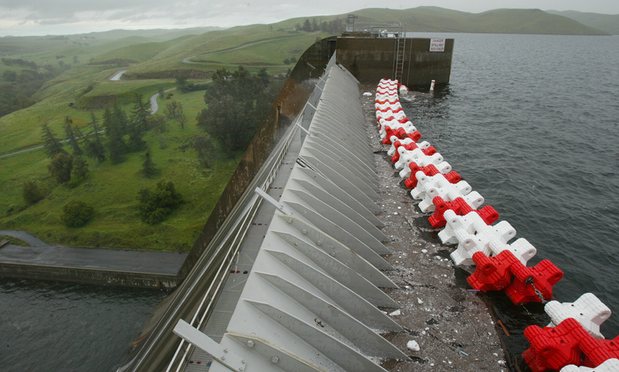
(March 14th 2016) In a reminder of the vulnerability of physical infrastructure to cyber-attacks, the Obama administration will publicly attribute a 2013 cyber-attack against a New York State dam to Iranian hackers, say U.S. officials familiar with the investigation, CNN reported. Boston Global Forum cyber-experts have warned of such attacks.
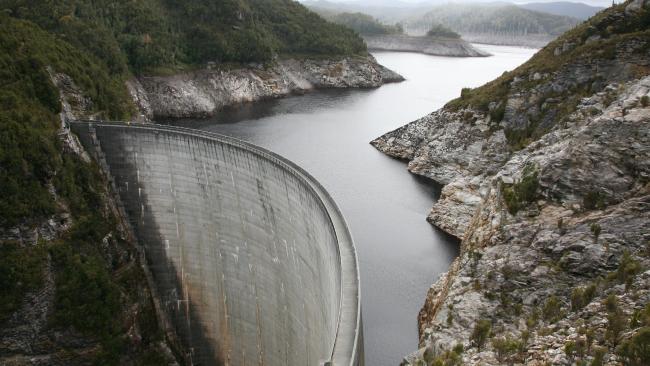
The US has more than 57,000 industrial-control systems connected to the internet. They range from office air-conditioning units to major pipelines, dams and electrical-control systems.(From The Australian)
The Justice Department has prepared an indictment against people thought to be behind the attack, according to the officials. An announcement could come in the next week.
CNN reported that the intrusion at the Bowman Avenue Dam, around 30 miles north of New York City, “isn’t considered sophisticated – the hackers managed only to get access to some back office systems, not the operational systems of the dam, U.S. officials say. U.S. investigators quickly determined the attack was carried out by hackers working for the Iranian government.’’
“But the attack alarmed Obama administration officials who have voiced concerns about the vulnerability of U.S. infrastructure to cyber-attacks.’’
Officials have not disclosed why that particular dam was chosen — if they know. Do powerful people live near the dam?

by Admin | Mar 12, 2016 | AI World Society Summit
(March 14th 2016) Here are online remarks and a Q&A with Ezra Vogel, the Henry Ford II Professor of the Social Sciences Emeritus at Harvard, a world-renown expert on East Asia and a member of The Boston Global Forum (BGF). He is probably best known for his work on Japan, which will host this year’s G7 Summit, on May 26-27.
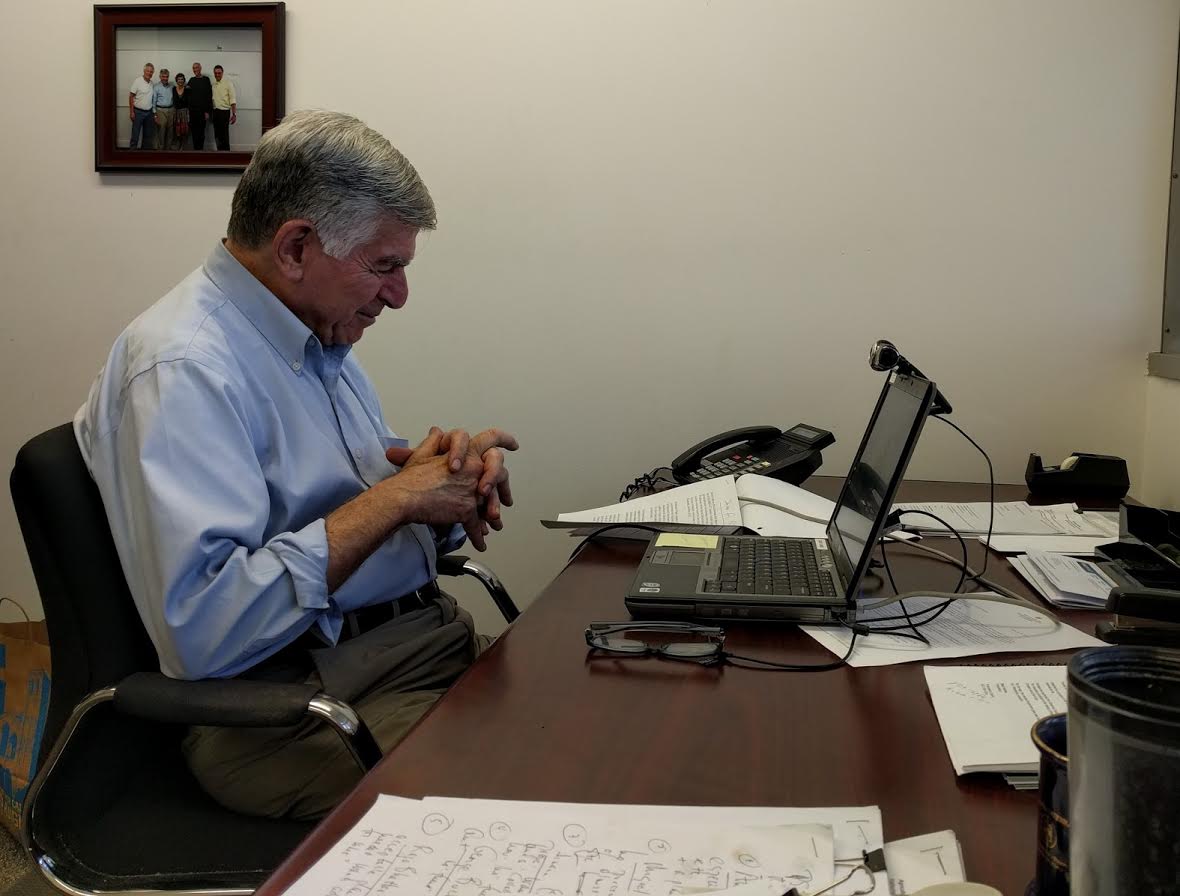
Governor Michael Dukakis, Chairman of The BGF introduces the lastest Online Dialogue
His remarks are another in a series of online discussions with experts hosted by the BGF as part of its BGF-G7 Summit Initiative leading up to the G7 Summit of the seven biggest industrialized democracies, on May 26-27. The BGF has been working with summit officials on developing themes and recommendations for the meeting.
Despite the growing importance of East Asia, Professor Vogel noted, Japan is the only non-Western member of the G7. He added that that the G20, while performing a valuable role, is far less able to achieve strong agreements than the far more coherent and unified G7.
He discussed the important historic symbolism of the Japanese venues chosen for the G7 meetings in showing the need for international cooperation to avoid war, the need to be open to new technology and the benefits of a world trade system that encourages each country to develop its comparative advantages. In Japan’s case that means continuing to move even further away from old-line industries and agriculture and toward high technology.
Professor Vogel discussed the challenges posed by the slowdown of the Chinese economy — not to only to China itself but to other nations too. He reminded us that Japan, after years of very rapid growth, has long had to manage the economic, social and political problems associated with economic sluggishness. He said that he’s hopeful that China will manage its slowdown without getting into a very serious crisis.
On China’s expansionism in the South China Sea, Ezra Vogel said such a posture, driven by Chinese desire to expand its defense perimeter, was unwise because it leads nations in East Asia to increasingly fear and distrust China and seek help from America to offset Chinese military threats. He urged nations feeling threatened by China’s expansionism, which includes Japan as well as nations in and near Southeast Asia, to find the right balance of “firmness and restraint’’ in response.
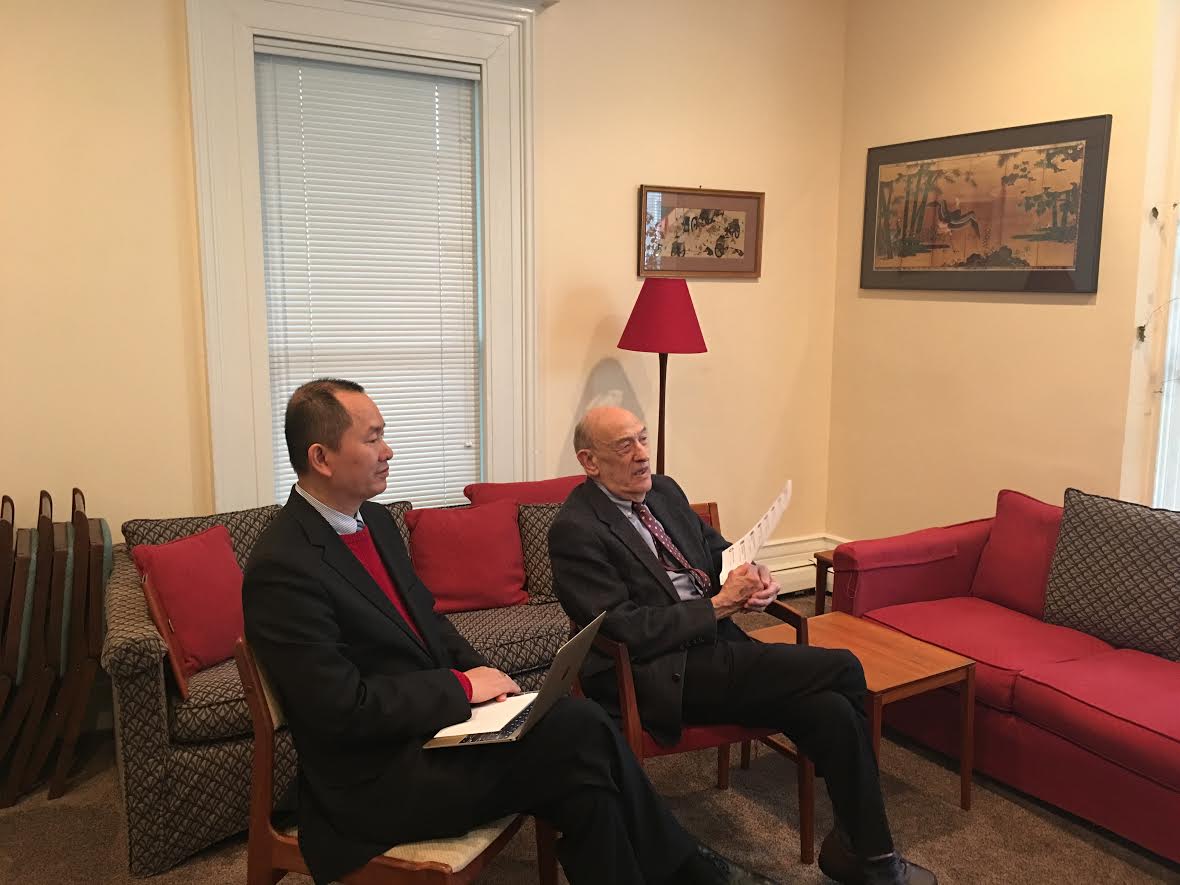
Mr. Nguyen Anh Tuan, CEO and Co. Founder of The BGF discusses with Prof. Ezra Vogel at lastest Online Dialogue as part of The BGF-G7 Initiative
He said that China, and all nations, ought to be part of many multinational organizations to maintain as many opportunities as possible for consultation to protect international peace and security by avoiding dangerous misunderstandings of other nations’ intentions.
Ezra Vogel raised the frightful possibilities of cyber-war, comparing it to the “atomic button.’’ While he noted that new and sold cyber-security agreements would require far more work and will than the sort of discussions to held at the G7, he said that it’s good that summit leaders will discuss such an increasingly important issue, on which the BGF has been focusing this year.