by Admin | Feb 22, 2016 | Initiative
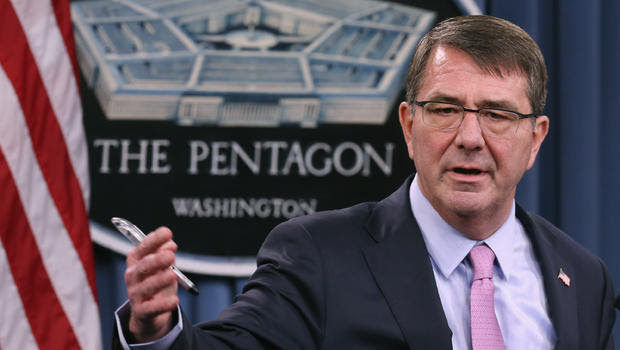
(29th Feb 2016) In what some observers think is a too-delayed action, the U.S. military has dramatically stepped up its cyber-attacks against Islamic State terrorists.
In what some observers think is a too-delayed action, the U.S. military has dramatically stepped up its cyber-attacks against Islamic State terrorists. It’s focusing on the group’s use of social media and other parts of the Internet to recruit fighters, maintain followers’ homicidal enthusiasm and organize terror attacks.
The Associated Press reported that the new campaign by U.S. Cyber Command began shortly after Defense Secretary Ash Carter ordered commanders last month to ramp up the fight. Other news reports say that the new campaign is helping to fragment and thus weaken Islamic State recruitment and organization efforts, although much more progress needs to be made
See more
by Admin | Feb 29, 2016 | Initiative
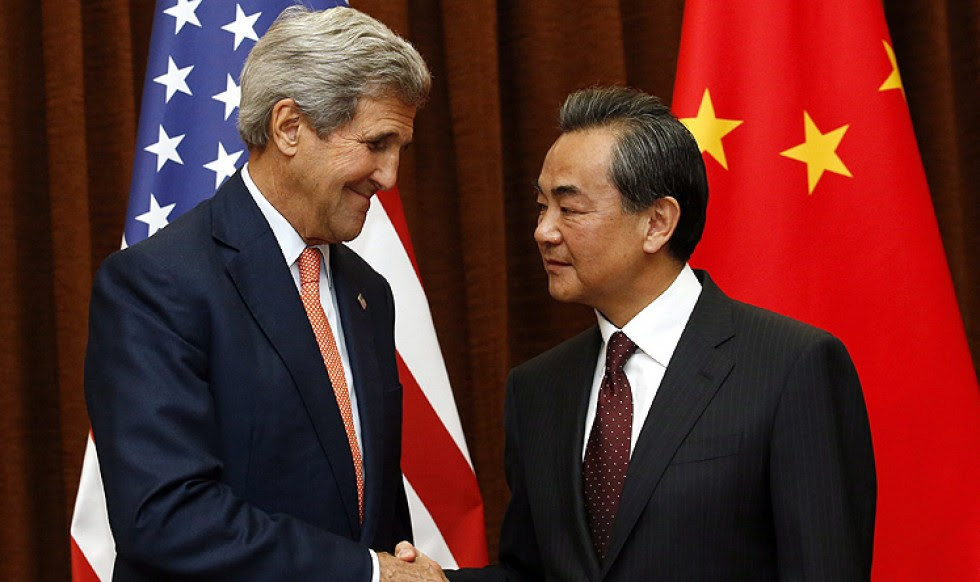
(29th Feb 2016) U.S. Secretary of State John Kerry and Chinese Foreign Minister Wang Yi met in Washington .
U.S. Secretary of State John Kerry and Chinese Foreign Minister Wang Yi met in Washington this week on various bilateral issues and then held a press conference. But despite the predictably careful and cordial rhetoric there were few signs that the talks would lead to Beijing reversing itself and acting positively in the two most dangerous situations in East Asia: North Korean saber-rattling and Chinese military and territorial expansion in the South China Sea.
Reading between the lines of polite rhetoric from the news conference, a reasonable person would conclude that China will continue to support its ally, the brutal North Korean regime, and will not reverse its seizure and militarization of disputed reefs and islands in the South China Sea. That is because Beijing does not yet fear that an alliance of southwest Pacific/Southeast Asian nations is prepared to stop it.
Mr. Kerry emphasized the urgency of addressing North Korean nuclear and missile threats and protecting freedom of navigation in the South China Sea, which many consider undermined by Chinese military actions. But he left unclear how far the United States was prepared to go to address these threats.
See more
by Admin | Feb 22, 2016 | World Leaders in AIWS Award Updates
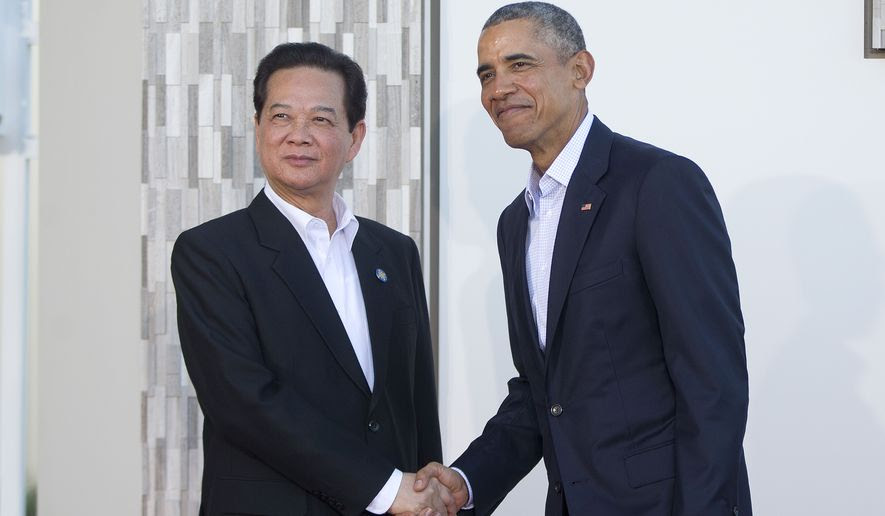
(22th Feb 2016) At a summit of 10 Asian nations in California, Vietnamese Prime Minister Nguyen Tan Dung urged Obama to have a “strong voice” and take “more practical actions” to end activities aimed at upsetting the “status quo’’ and, by implication, establishing Chinese hegemony, according to a Vietnamese government news Web site.
Suggesting that stronger efforts may be coming to try to stop Chinese expansionism in the South China Sea, President Obama will visit Vietnam on the same trip that he makes to attend the G7 Summit in Japan in late May. Vietnam has signaled a shift to the West to try to block China’s increasingly aggressive strategy in the waters off Southeast Asia.
Some observers think that the Chinese aggressive acts may ultimately spawn a formal military alliance including Vietnam, the United States, the Philippines and other nations with major interests in the western Pacific and Southeast Asia
The most recent example of Chinese aggressiveness in the South China Sea is China’s installation of surface-to-air missiles on Woody Island in the Paracels, off Vietnam, which claims the island. Many observers believe that the Chinese are trying to establish control over the shipping lanes in the region.
At a summit of 10 Asian nations in California, Vietnamese Prime Minister Nguyen Tan Dung urged Obama to have a “strong voice” and take “more practical actions” to end activities aimed at upsetting the “status quo’’ and, by implication, establishing Chinese hegemony, according to a Vietnamese government news Web site.
Mr. Dung said the accelerating Chinese militarization of disputed islands and reefs in the South China Sea were a “real threat to peace, security, safety and freedom of navigation and aviation,” VGN News reported.
Maritime security and the freedom of navigation in the sea were among the main topics of the summit in California. Vietnam is a member of the 12-nation Trans-Pacific Partnership, an expansive trade and regulatory pact that includes the United States, Japan, Mexico and Australia.
Obama accepted the invitation by Vietnamese Prime Minister Dung during a meeting this week at a summit of Southeast Asian nations in California.
“The president and Prime Minister Dung discussed the continued strengthening of U.S.-Vietnam relations in 2015, which marked the 20th anniversary of the restoration of diplomatic relations,” a Vietnamese government spokesman said.
“The leaders noted the importance of the Trans-Pacific Partnership, maritime security, and human rights to advancing bilateral relations,” he said.
See more on Washington Post
by Admin | Feb 22, 2016 | AI World Society Summit
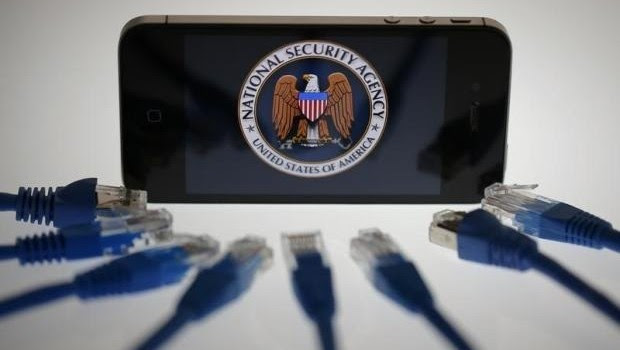
(22th Feb 2016) Apple has agreed to backdoor “security checks’’ of its devices by the Chinese government, which the company refuses to let the FBI do.
Apple’s battle with the U.S. government over getting into the iPhone of one of the San Bernardino terrorists is over the hyper-profitable company’s stance that no one should be able to look into iPhones regardless of the crimes that such “backdoor’’ entries might help prevent or prosecute.
But it appears that Apple is being hypocritical.
Consider that the Chinese government-run newspaper People’s Daily has reported that Apple has agreed to backdoor “security checks’’ of its devices by the Chinese government, which the company refuses to let the FBI do.
A story in the Quartz news service noted that such entries would be despite Apple CEO Tim Cook’s assurances that Apple would not make accessible the inside of any device.
But then, Apple’s management sees China as becoming its biggest market and the company has bent over backwards to cooperate with Beijing in most matters.
Joon Ian Wong wrote in Quartz:
“{Apple’s} silence regarding Beijing’s security demands, but its vocal resistance to requests from other governments, contributes to a perception that it has different security standards for different markets….’’
See more

by Admin | Feb 22, 2016 | AI World Society Summit
(22th Feb 2016) Darren Hayes argues in The Guardian that Apple has a powerful legal and moral obligation to assist the U.S.
Darren Hayes argues in The Guardian that Apple has a powerful legal and moral obligation to assist the U.S. government by giving it access to the data in the iPhone of one of the San Bernardino terrorist/murderers. Mr. Hayes says that Apple is trying to confuse law enforcement and surveillance.
Mr. Hayes writes that “Many forensics examiners, including myself, know that what is at stake is not just the San Bernardino case but a growing backlog of criminal cases – some involving suspected child abusers or terrorists – that cannot proceed because of Apple’s defiance in assisting law enforcement.’’
He continues:
“Mobile forensics examiners also know that iPhones, and other smartphones which enable full disk encryption, have become the communication device of choice for Isis members because of this derisory public debate. The current potential solutions to extract data from encrypted devices … will cost taxpayers millions of dollars compared to a more simple solution, which Apple could provide if it wanted.’’
“In this case, law enforcement agencies are simply asking Apple to revert back to its previous model of encryption management or make simple, low-cost modifications. Apple used to possess more control over their devices and could facilitate an investigation when a request was made using both a warrant and a court order. ‘’
“….There has been little or no productive dialogue between the government and Apple in terms of cooperation,’’ Mr. Hayes notes.
See more