by BGF | May 28, 2018 | News
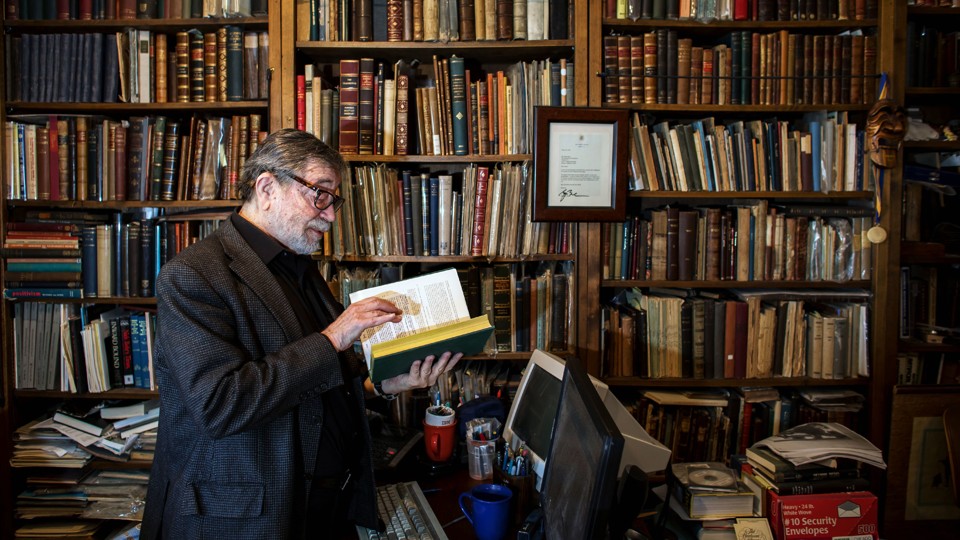
A recent interview between Quanta Magazine and Professor Judea Pearl, a pioneer of AI who has had significant contributions to AI development shed light on how Pearl presumes casuals reasoning could provide machines with human-level intelligence. Machines in the future could even “achieve status as moral entities with a capacity for free will—and for evil,” he believes.
In this interview, Prof. Pearl emphasized the importance in AI development of studying cause and effect, which he argues science has long neglected. He also wrote about similar concerns in his latest book titled The Book of Why: The New Science of Cause and Effect. He explained that since there is lack of the asymmetric language required to capture understanding causality, it prevents people from fully taking advantage of AI’s potential. Pearl believes that, in the future, machines could possess human-like intuition about cause and effect. This would raise the possibility of robots having a kind of free will, along with which comes the capacity for evil. For example, robots might “ignore the advice of other components that are maintaining norms of behavior that have been programmed into them”.
MDI has created the Seven Layers of AIWS framework, which guides AI development so as to promote positive outcomes and reduce risks associated with AI. Layer 1 involves designing a responsible code of conduct for AI Citizens to ensure that AI is safely integrated into human society. Layer 2 specifies an appropriate ethical behavior framework for AI Citizens. The Seven Layers were presented and sent to G7 Summit in 2018.

by BGF | May 28, 2018 | News
On May 5 in Riga, Vaira Vike Freiberga, Former President of Latvia and current President of the WLA-CdM, had a meeting with Latvian ice hockey fans before team Latvia first game at IIHF World Championship.

The IIHF World Championship is an annual international men’s ice hockey tournament organized by the International Ice Hockey Federation (IIHF). First officially held at the 1920 Summer Olympics, it is the sport’s highest profile annual international tournament. The 2018 IIHF World Championship is hosted by the Denmark cities of Copenhagen and Herning. Latvia, one of the qualified teams, hosted the IIHF World Championship in 2006. The proposed arenas were Arena Riga, and a secondary venue to be built.
President Vike-Freiberga is a multi-faceted, extensively traveled and exceptionally involved global leader. She is well versed in international security and policy issues, Latvian heritage and music, and current events. She is not only a prestigious leader in the Latvia community, but also a member or patron of more than 30 international organizations, including the MDI. With Chairman Michael Dukakis, she is helping to develop the AIWS 7-Layer Model to build the Next Generation Democracy.
by BGF | May 20, 2018 | News
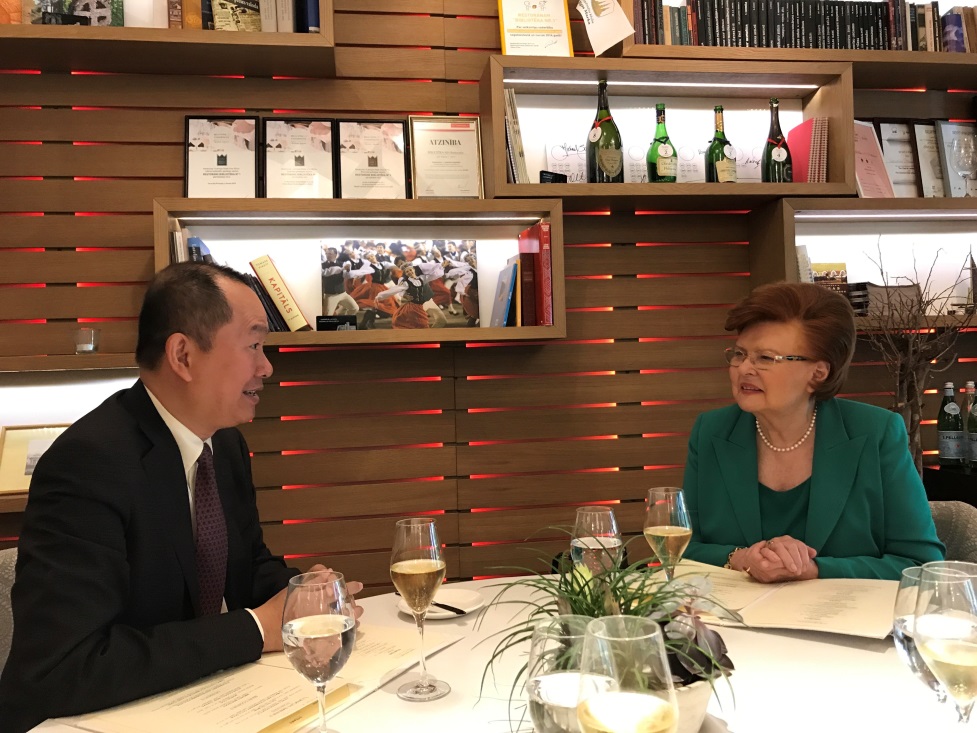
On May 18, President of The World Leadership Alliance-Club de Madrid Vaira Vike-Freiberga welcomed and discussed with Mr. Nguyen Anh Tuan, CEO of BGF and Director of MDI. BGF and MDI will partner with Club de Madrid in building the Next Democracy Generation by using AI and AIWS models. President Vaira Vike-Freiberga has invited Mr. Nguyen Anh Tuan to join The Riga Conference 2018, which will take place on September 28 – 29, 2018.

Organized jointly by The Latvian Transatlantic Organization, The Latvian Ministry of Defense, and The Latvian Ministry of Foreign Affairs, The Riga Conference has become a unique venue for constructive dialogue on international security issues between leading global decision makers.
At this year’s conference, amongst other things, they will consider the EU’s role in the rise of geo-economics, security challenges in the information age and hybrid warfare, transatlantic relationship as a critical axis of global stability, relations between Russia and the West as well as prospects of Eastern Partnership countries. Dozens of distinguished leaders and experts will present their opinions on the most pressing issues in foreign policy and defense of the Baltic Sea region and beyond.
Convening in the Latvian capital since 2006 by President Vaira Vike-Freiberga, the conference has become a recognized annual tradition across the region. Many heads of state have joined the conference such as President George W. Bush, Georgian President Mikheil Saakashvili, etc.
by BGF | May 20, 2018 | News
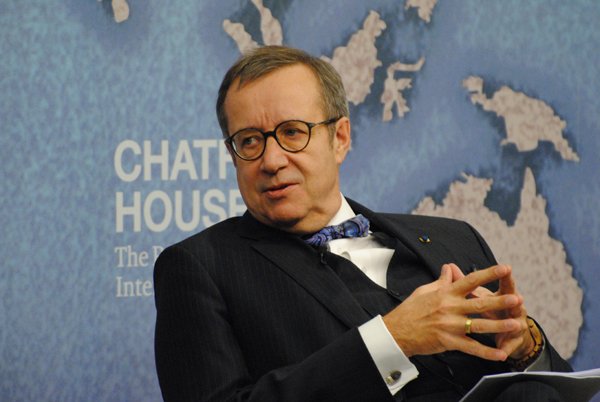
Last week, President of the Republic of Estonia Toomas Hendrik Ilves, who received World Leader in Cybersecurity Award 2017, shared lessons and experience in building a successful e-government and digital society with VietNamNet, one of the first online newspapers in Vietnam.

“Estonia is one of the least corrupt countries in Europe, compared to the other Western European countries. I think that Estonia’s control over such low levels of corruption is largely due to the effect of enhancing transparency through computerization,” said Toomas Hendrik IIves, former President of the Republic of Estonia.
LTS: On the afternoon of May 14, Prime Minister Nguyen Xuan Phuc presided over a meeting to promote the establishment of e-government in Hanoi. At the meeting the Prime Minister said, “Setting up a system for sharing data among state administrative agencies as soon as possible towards the direction of decentralization deriving from the lessons of Estonia and France. It is a suitable solution for Vietnam in the context of having too many information systems at all agencies but cannot connect with each other.” Vietnam Weekly Reporter interviewed former Estonian President Toomas Hendrik IIves about lessons and experience in building a successful e-government and digital society.
– As a small Baltic country with a population of nearly 1.3 million people, Estonia is now among the world leader in information technology. During your presidency from 2006 to 2016, how in just ten years, from a poor, backward country, Estonia had developed a platform in the high technology industry so powerful?
Mr. Toomas Hendrik IIves: It all began in the early 1990s when Estonia faced the urgent need to rebuild the country. We are fortunate that we have a lot of young people who share the same idea that starting technology is the way to go.
The idea I conveyed to everyone at that time was that Estonia would take about 50 years to get out of its backwardness in all areas: from construction to infrastructure, transportation and education.
The most important moment to me back then was Marc Andreessen at the University of Illinois Urbana-Champaign launching the first commercial website browser, as there had never been a website browser before. I was very tech-savvy, I went to buy a small box to attach to the computer from where to explore and explore. After experiencing this technology, I realized that this is the area my country needs to focus on despite the fact that Estonia is full of obstacles, i.e., the legacy of the old regime.
I was analyzing with my colleagues at that time, Estonia is almost left behind by almost every other country in almost fields. If we focus on developing the IT sector now, then Estonia can compete in the global race, closing the gap behind.
Estonia took off from there, all across the Estonian state, engaging in Information Technology to challenge itself, to be free of the gloomy atmosphere that was covering the country at the time.
I would also like to share with you, as the strategy of focusing on information technology, we encountered many objections at the time. Some people think that it will take more time. Especially with the notion of computerizing and connecting the Internet across schools, throughout the year, not a single week has passed that we were not led to believe that this idea wasted money and time.
– Estonia’s wealth of technology has made Estonia a pioneer in the field of e-government since its establishment in August 2000. In 2002, Estonia used its electronic ID, which allowed people to access a myriad of public services on websites (such as social security, police, education, etc.), as well as ensure that e-government gateways and data are protected. In order to have successful technological applications in managing, becoming an e-government like that, how did Estonia start? And when there are difficulties?
Mr. Toomas Hendrik IIves: First of all, we make Internet connections to schools and provide volunteer support programs. Since there is a high demand for computers in schools, we have a city policy, or a higher level government is willing to support half the cost.
When banks find that the benefits of networking with customers, the elderly and especially those in rural areas are cost-effective, and that it is rather costly for them to open a small branch in each locality with insufficient infrastructure and unaffordable labor costs, then the banks have actively participated. Many volunteer organizations have traveled throughout the country to teach people how to use computers. This is the first step to help raise awareness and skills needed to perform online banking operations.
We also develop online access to public services at all levels of government across the country. These initial signs indicate the urgency of an e-government, as we study more seriously and thoroughly to make breakthrough improvements in the field.
It is fortunate that we have the same passionate and knowledgeable technologists, who share the same thoughts about an electronic society. By then people would have thought it was a great idea. So all together build up, combining technical expertise and policy-making to move from concept to reality based on law, policy and mechanism.
– The world has also referred to the success of the Estonian state when successfully applying the online system of taxes payment. Electronic tax has become a norm, 94% of Estonians have online records, which are taxed and paid online. Could you share this model?
Mr. Toomas Hendrik IIves: We usually settle taxes in March. Every citizen or business logs in to his/her account and the system displays all activities you have worked on in the past year. No matter how big a small company you are, in one or more locations, tax issues are here.
All earnings are reported and can be viewed on this portal. You can make a tax payment right here. Tax deductions are also automatically made in the case of having children under the age of 18.
Then, if everything looks right, hit enter, all done in 3-5 minutes. If you pay your taxes online, then you will receive a tax deduction within a week, and the system will pay directly to your bank account.
I think that encouraging governments to implement this strategy of digitization is a significant increase in compliance. People are willing to pay taxes if it is easy to do so. This system also makes fraud more difficult or even impossible.
Although we only have a fairly simple system, our citizens like it in all cases. The Estonian people, who stay or work abroad, all remember and really appreciate our online tax system.
– Another success that proves Estonia’s technological prowess is the online voting system. Early in 2007, Estonia planned to become the first country in the world to allow voters to participate in the election of Congress via the Internet. Could you share some of this system?
Mr. Toomas Hendrik IIves: That’s right. Estonia currently has about 30-40% online votes, equivalent to about one third of the total. In the first year, we did 5%, then increased, and now maintained stably in the last 3-4 elections.
Online voting has a special effect on the Estonian community abroad because otherwise you can only vote in certain places like the Embassy. With geographic features of a small country, we cannot have many Embassies everywhere and Estonian people live around the world. Even if you are in the United States, you can only vote at the Embassy in Washington D.C. or consulate in New York. But now you can vote online, in California.
When the online voting system was first launched, there were a lot of concerns. Many people said that they did not trust the system and many other things. But it’s not so because online voting is also similar to the traditional one, which of course can easily be cheated with redemption votes. The voter registration list is not as secure as the registration list in the system.
– What are your advices for Vietnam from the successful experience of building e-government for Estonia?
Mr. Toomas Hendrik IIves: First of all, what we have done and succeeded is letting children get acquainted with computers. We studied and found that innovation in education will take 15-20 years to bring efficiency. But children should begin to get acquainted with computers as early as possible.
Then consider the next step, as I mentioned above, we need to develop electronic IDs so everyone can connect safely and think about developing platforms that can provide a variety of services.
It is also very important that computerization or digitalization can meet the demands of people. Computerization of public services will be meaningful to the government as it makes things more efficient. People will not join if they do not like it, so our duty is to make them love it such as they easily pay taxes, get easy access to medical care and medication. Working with the bureaucratic structure can be a horrible experience in most countries if you computerize this system, but then we’ll recognize that we have already wasted so much time for these things.
I always support the use of electronic IDs like the way Estonia has been doing when applying technology to day-to-day life.
In addition, there are more options now. What I actually want to recommend is to visit the World Bank website, then search and read a 400-page book called Digital Dividends 2016 by Kaushik Basu, economist leader of World Bank. You will see a large number of studies have been done. Find out what the importance of digitalization because each country is different and you can find a series of solutions there.
Estonia is one of the least corrupt countries in Europe, compared to the other Western European countries. I think that Estonia’s control over such low levels of corruption is largely due to the effect of enhancing transparency through computerization.
Had we not have done so, we would not have been able to achieve a strong IT industry based on a good economic fundamental. Besides, we were perhaps the only country in Eastern Europe that was not affected by the migration problem. Some people left the country but many others returned. Estonia is not being brain-drained. Estonia would have been different today had we not have done what has been done in the past few years.
| Former President of Estonia Toomas Hendrik IIves was the leader of the Social Democratic Party in the 1990s. He served the government as Minister of Foreign Affairs for the first term from 1996 to 1998 and a second term from 1999 to 2002. From 2004 to 2006, he was a member of the European Parliament. He was elected President of Estonia on September 23, 2006. He was the fourth President of Estonia from October 9, 2006 to September 10, 2016.
Former President Toomas Hendrik IIves was honored by the Boston Global Forum (BGF) as World Leader in Cybersecurity on December 12, 2017. He was honored for outstanding achievements during his ten years of presidency (2006 – 2016). He set up a defense strategy on the Internet, making Estonia a leader in information technology, cybersecurity, and in particular the successful construction of e-government. |
Lan Anh – VietNamNet Newspaper
The original article on VietNamNet’s website: http://vietnamnet.vn/vn/tuanvietnam/bai-hoc-tu-estonia-khong-che-tham-nhung-bang-tin-hoc-hoa-451314.html

by BGF | May 20, 2018 | News
In quantum computing, it’s not simply the computer systems themselves which are arduous to construct but also subtle quantum algorithms—a specialized software tailor-made to make the most of the machines.
Alán Aspuru-Guzik is the co-founder of Zapata Computing and a Harvard University professor. He used to be a 2010 member of MIT Technology Review’s Innovators under 35 list. Zapata’s aim is to be a quantum-algorithm superstore, providing a broad variety of ready-made software that companies can use to bolster the immense processing power quantum computers promise to deliver. Essentially, Zapata wants companies to have the ability to use the technology “without having an in-house quantum specialist”. Zapata has already negotiated a license with Harvard to access the algorithms Aspuru-Guzik and his workforce developed.
Nonetheless, it’s unclear whether or not quantum computing is going to make a big difference in some areas, such as machine learning—although there are some early indicators it might. It might take some time to construct a comprehensive portfolio of algorithms.
Concerned about such complications in technology, MDI is developing ways to support AI development such as building AIWS 7-Layer Model and The Next Generation Democracy with The World Leadership Alliance-Club de Madrid.
Read more: https://www.technologyreview.com/s/611139/the-worlds-first-quantum-software-superstore-or-so-it-hopes-is-here/

by BGF | May 20, 2018 | News
Technology and AI are changing how people interact with everything from food to healthcare to religion. From electronic scriptures to robot priests, different faiths have absorbed new ideas from the world of technology to enhance mainstream religious practices.
Muslims across the world can download apps such as Muslim Pro, replete with daily prayer timetables, notifications for both sunrise and sunset, and an electronic compass pointing the way towards Mecca. Other apps automatically adjust fasting times during the month of Ramadan, depending on the location of a device. Followers of Catholicism can plug into the Confession Chatbot app to interact in a life-like two-way conversation with a bot. There are many examples of how technology and AI have penetrated religious practices.
However, the relationship between technology and religion has not always been straightforward. According to Dr. Beth Singler, researcher at The Faraday Institute for Science and Religion, religions grapple with technology in three stages — rejection, adoption and adaption. But technology soon becomes ubiquitous and part of the mainstream.
Faith leaders are increasingly concerned about morality and the ethics behind creating human-like machines. Professor Stephen Hawking and Tesla CEO Elon Musk have also voiced concerns over the potential threat mankind faces should AI recognize its full potential, raising the question of whether robots could develop a conscience.
To align the development of AI, the AIWS, created by MDI, has developed the AIWS 7-Layer Model. This model establishes a set of responsible norms and best practices for the development, management, and uses of AI so that this technology is safe, humanistic and beneficial to society. It provides a baseline for guiding AI development to ensure positive outcomes and to reduce the risks of pervasive and realistic risks and the related harms that AI could pose to humanity.
Read more: https://www.cnbc.com/2018/05/11/how-artificial-intelligence-is-shaping-religion-in-the-21st-century.html?utm_source=MIT+Technology+Review&utm_campaign=3f0bb83d10-EMAIL_CAMPAIGN_2018_05_11&utm_medium=email&utm_term=0_997ed6f472-3f0bb83d10-156921905

by BGF | May 20, 2018 | News
Google and its parent company Alphabet are starting to address some ethical concerns raised by the development of AI and machine learning, but have not taken a position on the unchecked use of autonomous AI in weapon systems.
Project Maven, a US military program that applies AI to drone surveillance videos for the purpose of detecting “objects of interest”, which are flagged for human analysts, raises ethical questions about the appropriate use of machine learning and AI for military purposes. The Campaign To Stop Killer Robots is concerned that the AI-driven identification of objects could quickly blur or move into AI-driven identification of ‘targets’ as a basis for the direction of lethal force. This could give machines the capacity to make a determination about what is a target, which would be an unacceptably broad use of the technology. Thus, the campaign is working to retain meaningful human control of the critical functions of identifying, selecting and engaging targets.
Google representatives are engaging in a dialogue with the Campaign To Stop Killer Robots and last month provided campaign coordinator Mary Wareham with a statement that says its work on Project Maven is “for non-offensive purposes and using open-source object recognition software available to any Google Cloud customer.”
Now, these and other technology companies such as Amazon, Microsoft, and Oracle, should publicly endorse the call to ban fully autonomous weapons and commit to never help develop these weapons. Doing so would support the rapidly-expanding international effort to ensure the decision to take human life is never delegated to a machine in warfare or in policing and other circumstances. In favor of this view, MDI has built AIWS 7-Layer Model with the goal is to advance the peaceful development of AI to improve the quality of life for all humanity. Insides, the first layer focuses on building the AI ethical framework applied in all areas, including the military. MDI and BGF called on world leaders to build AI Peace Treaty at BGF-G7 Summit Conference 2018 at Harvard University on April 25, 2018.
Read more: https://www.stopkillerrobots.org/2018/05/google/
by BGF | May 20, 2018 | News
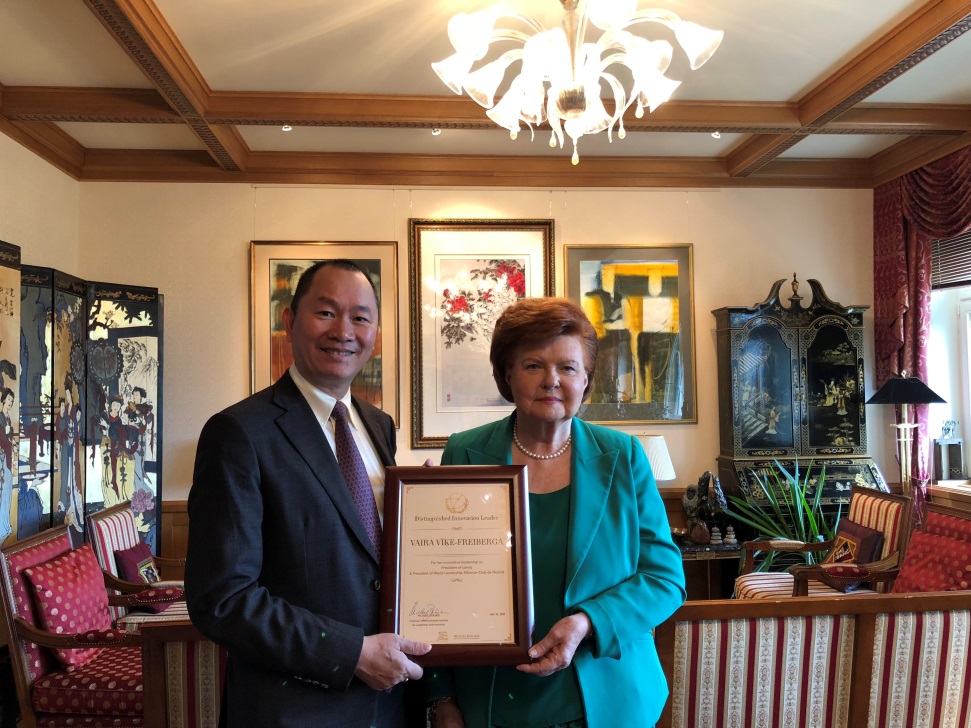
Vaira Vike-Freiberga, President of Latvia from 1999 to 2007, was honored as Distinguished Innovation Leader by the Michael Dukakis Institute on May 18 in Riga, Latvia.

Vaira Vike-Freiberga was elected President by the Parliament in 1999 and was re-elected for a second term of four years in 2003. Now, Vaira Vike-Freiberga currently serves as the President of the World Leadership Alliance-Club of Madrid, the world’s largest forum of former Heads of State and Government.
She has actively exercised the powers conferred to the President by the Constitution of the Republic of Latvia and has played a leading role in fostering Latvia’s membership in NATO and the European Union. Since 1999, she has received many medals and awards, twenty-seven Orders of Merit and ten honorary doctorates.
She is also an invited speaker at numerous international events. Outspoken pundit on social issues, moral values, European historical dialogue, and democracy, she was awarded the 2005 Hannah Arendt Prize for political thought.
Vaira Vike-Freiberga was honored as Distinguished Innovation Leader for her distinguished work in the humanities and social sciences by MDI. This is a preeminent title of MDI to honor political leaders, policymakers, business leaders, or thought leaders who has distinguished achievements in leading innovation their countries, areas, or industries.