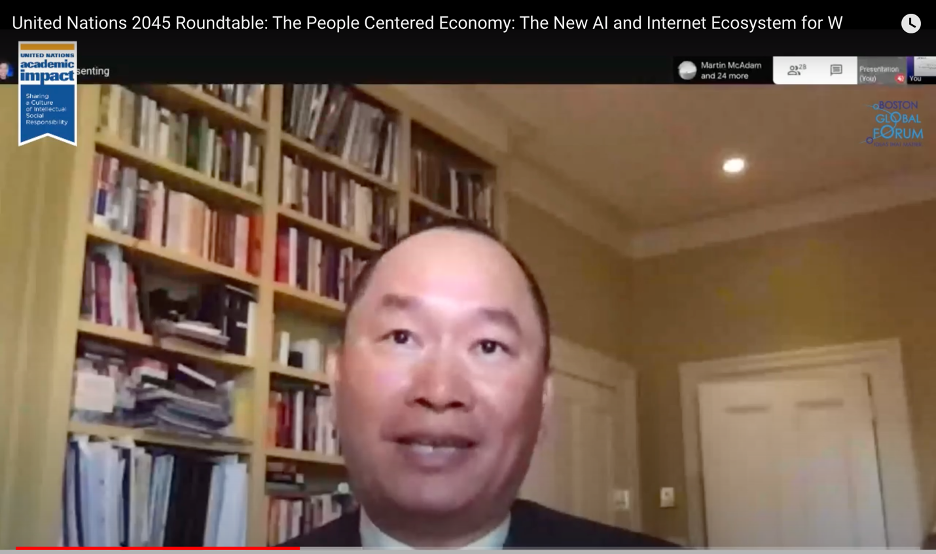
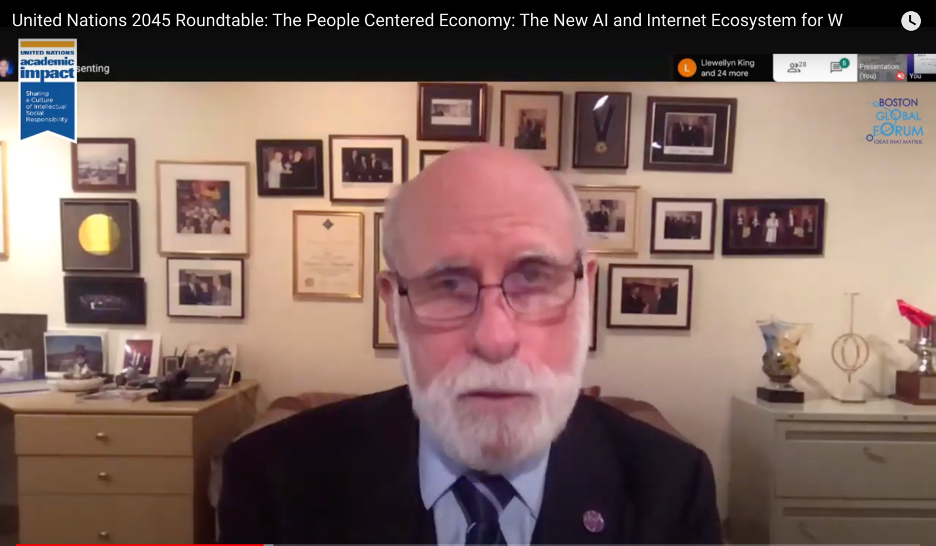
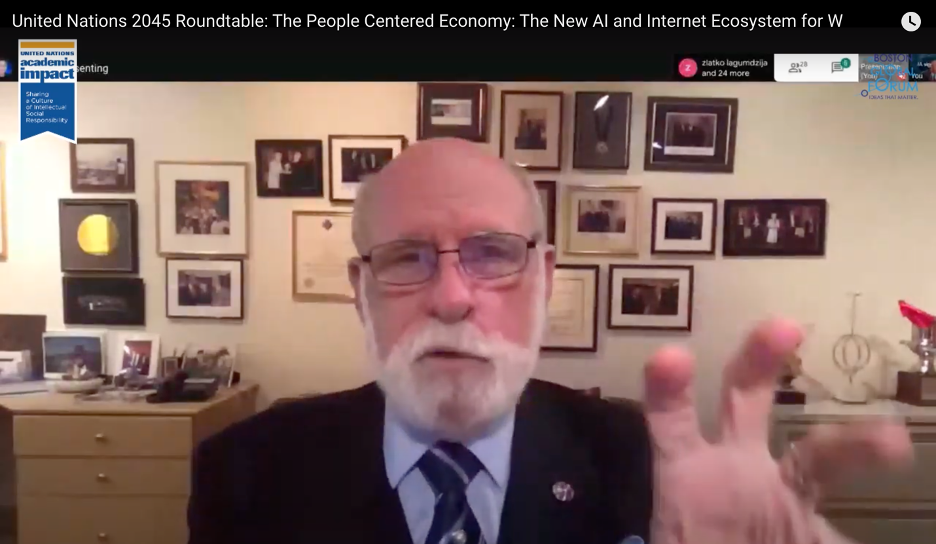
On August 21, 2020, at the United Nations 2045 Roundtable organized by the United Nations Academic Impact, Mr. Nguyen Anh Tuan, Co-founder and CEO of the Boston Global Forum, Co-founder of AIWS.net, presented AI World Society City (AIWS City) after Keynote Speaker Vint Cerf presented “The People Centered Economy: The New AI and Internet Ecosystem for Work and Life”. AIWS City is virtual city that applies the standards of “the Social Contract 2020”, “People Centered Economy”, “Trustworthy Economy”, “Intellectual Society-Thoughtful Civic Society”, and “AI-Government”, with AIWS Value to foster Vint Cerf’s idea that “all people can create value for each other”.
Here is a brief overview of AIWS City:
Purpose:
To practice concepts from “the Social Contract 2020, A New Social Contract in the Age of AI”, the People Centered Economy, and the Intellectual Society-Thoughtful Civic Society.
To use the Internet and AI to shape brighter futures and to create an ecosystem for work and life with the philosophy of the People Centered Economy.
The AIWS City is an application and practice of the thoughts and ideas of Vint Cerf.
Principles and Concepts:
Vint Cerf’s idea:” “All people can create value for each other. A good economy has an ecosystem of organizations that lets that happen, in the most meaningful and fulfilling ways.”
AIWS City is virtual city that applies the standards of “the Social Contract 2020”, “People Centered Economy”, “Trustworthy Economy”, “Intellectual Society-Thoughtful Civic Society”, and “AI-Government”.
The features of Intellectual Society-Thoughtful Civil Society are knowledge, critical thinking and social responsibility.
AIWS City can assist citizens to become more thoughtful byenhancing knowledge, critical thinking and social responsibility
AIWS created the concept of AIWS Value. AIWS Value: traditional value (products, services, data, etc.) + social values (contributions), recognize and exchange traditional and social values.
AIWS City will operate based on AIWS Value in order to create a good Ecosystem of the People Centered Economy – “all people can create value for each other”.
Model of AIWS City:
AIWS City includes: Government of City, Citizens, Companies, and Intellectual Society-Thoughtful Civil Society
Government: use AI-Government (Government assisted by AI, Data Science, and Internet)
Build infrastructure for AI-Government based on Internet and Data Science (AI).
Government creates social works for citizens and supports special education program for citizens.
Companies: apply Trustworthy Economy and support the People Centered Economy.
Citizens: create values from ecosystem of AIWS City.
Intellectual Society-Thoughtful Civil Society in AIWS City: promote “the Social Contract 2020” and AIWS Value, as well as collaborate to create the Ecosystem of AIWS City.
Implementation:
Key people: Nguyen Anh Tuan, Alex Pentland, Vint Cerf, Michael Dukakis, and Board Members of Michael Dukakis Institute, key leaders of AIWS.net.
Ramu Damodaran, Chief of the Academic Impact and Editor in Chief of the United Nations Chronicle Magazine, thoughtfully moderated keynote speaker Vint Cerf, and other speakers and participants such as Governor Michael Dukakis, Nguyen Anh Tuan, former PM of Bosnia and Herzegovina Zlatko Lagumdzija, Professor Jun Murai (father of the Internet in Japan), Professors Nazli Choucri (MIT), professor David Silbersweig (Harvard). The United Nations 2045 Roundtable contribute new concepts and models for Unleashed 2045: Reinventing the United Nations at 100 such as:
The People Centered Economy: The New AI and Internet Ecosystem for Work and Life “All people can create value for each other. A good economy has an ecosystem of organizations that lets that happen, in the most meaningful and fulfilling ways.”
AI World Society City (AIWS City), virtual city that applies the standards of “the Social Contract 2020”, “People Centered Economy”, “Intellectual Society-Thoughtful Civic Society”, and “AI-Government”, with AIWS Value to foster for Vint Cerf’s idea “All people can create value for each other”.
On August 21, 2020, Vint Cerf, Father of the Internet, Vice President and Chief Internet Evangelist of Alphabet-Google, was the keynote speaker of the United Nations 2045 Roundtable.
He talked about the need to create a new ecosystem with Internet and AI that is for and serves people, do not abuse or harm humans through advanced technology – that people should be at the center. These ideas of Vint Cerf will be put in the Social Contract 2020 version 2.0, which will be announced September 9, 2020 with Vint Cerf as a co-author.
The Boston Global Forum and Michael Dukakis Institute honored Vint Cerf with World Leader in AIWS Award 2019. He is also a Mentor of AIWS.net.
Professor Thomas Patterson, co-founder of the Boston Global Forum, and AIWS.net, co-author of the Social Contract 2020, spoke at the AIWS Roundtable, co-organized by the World Leadership Alliance-Club de Madrid and the Boston Global Forum on August 13, 2020. He addressed these questions:
Digitization processes in any sphere should include a multi-stakeholder approach, therefore, is fundamental to promote a broad consensus among political elites, companies and citizens for the implementation of digital tools such as Internet voting. This calls for a transparent, involved and participated process, where the relevant actors have a voice. In this context, what role can multilateral organizations play here? How could we generate consensus among the different stakeholders to move forward with digitization in democracy and, especially, in elections?
The spread and penetration of digital technologies has been transforming society and the COVID-19 outbreak and ensuing global health crisis has significantly accelerated this process, imposing rapid and widespread digitalization even in the political sphere. Technology is part of our daily life. We can do numerous procedures electronically such as bank transfers, purchases, etc. However, this modernization in public administration lags behind. What do you think are the causes of this delay in digitizing processes such as voting? How can we use digitalization to make democratic and sustainable environment? (i.e. Digitalization could reduce costs in the Public Administration in the long term and produce investments with these savings in other policies)
Politics has now caught up with digitalization, but policy is still lagging behind. How can we improve electoral governance in the COVID-19 era? How can we hold electoral processes in the COVID-19 era while maintaining political and electoral rights? Join us in this Online AIWS Roundtable and Club de Madrid Live Session in collaboration with the Boston Global Forum.
‘Digital Technologies, Elections and Democracy in times of COVID-19’ is an online AIWS Roundtable and Club de Madrid Live Session in collaboration with the Boston Global Forum.
COVID-19 is pushing us into digital democracy. But are we prepared for the digital transformation of political processes and elections?
Politics are undergoing a process of digital transformation spurred by COVID-19. Cabinet meetings and even parliamentary sessions via videoconference are not a rare sight since the pandemic’s outbreak. Politics has now caught up with digitalization, but policy is still lagging behind.
The pandemic has dealt a blow to our economic and political systems: Elections are no exception. While some administrations have chosen to postpone elections, others have held these under extraordinary circumstances, altering timelines and voting procedures while ensuring free, fair and transparent votings.
How can we streamline electoral processes during COVID-19 without affecting political and electoral rights? How can we improve electoral governance in such a context? Is there a danger in election manipulation and hacking, particularly in countries with poor digital infrastructure?
Maria Elena Aguero, Secretary General of World Leadership Alliance–Club de Madrid and Nguyen Anh Tuan, CEO of the Boston Global Forum welcomed and opened the AIWS Roundtable. Speakers Joyce Banda, President of Malawi (2012-2014), Hanna Suchocka, Prime Minister of Poland (1992-1993), Allan Doss, Special Adviser to the Kofi Annan Foundation, Professor Thomas Patterson, Harvard University, and Marc Rotenberg, Director of Center for AI and Policy at the Michael Dukakis Institute, spoke and discuss.
Here are some key messages from Marc Rotenberg’s talk:
Health Crisis and Electoral Governance – Steps to Take
Observe necessary health guidance in all matters concerning elections (Resources: WHO, CDC, national agencies)
Communicate clearly to state officials and the public the safety guidance that will be followed (Resources: national agency websites, technology to educate and inform)
Communicate clearly to public all necessary information about voting participation (Resources: national agency websites, technology to educate and inform)
Electronic Voting – Considerations
Goals: (1) maximize voter participation (ensure easy and safe access to voting locations), (2) ensure accuracy of vote tally (independent agency to verify), (3) protect the “secret ballot,” the ability of voters to cast a vote without revealing who they voted for
Voting experts are concerned about three problems: (1) disinformation, (2) reliability of online voting, and (3) preservation of secret ballot
Disinformation: Consider source attribution for paid political advertising. Maintain strong independent media to monitor and counter propaganda. Support non-partisan research and NGOs committed to democratic institutions.
Reliability of Online Voting. Widespread concern that “electronic only” voting is too easily subject to manipulation. Consider range of risks: political parties, criminal hackers, foreign adversaries. “Verified voting” in polling place (paper ballot that is optically scanned) preferred. Some experimentation with online voting (e.g. Estonia) but still skepticism.
Preservation of Secret Ballot. Not a problem when a piece of paper is put a box. A complex problem when votes are cast online or by fax.
Advantages of Vote by Mail over Telematic Voting
Vote by mail provides the paper verification favored by election security experts
Vote by mail failures tend to be localized, limited in scope, and easy to detect. Telematic voting failures can be far-reaching and difficult to detect.
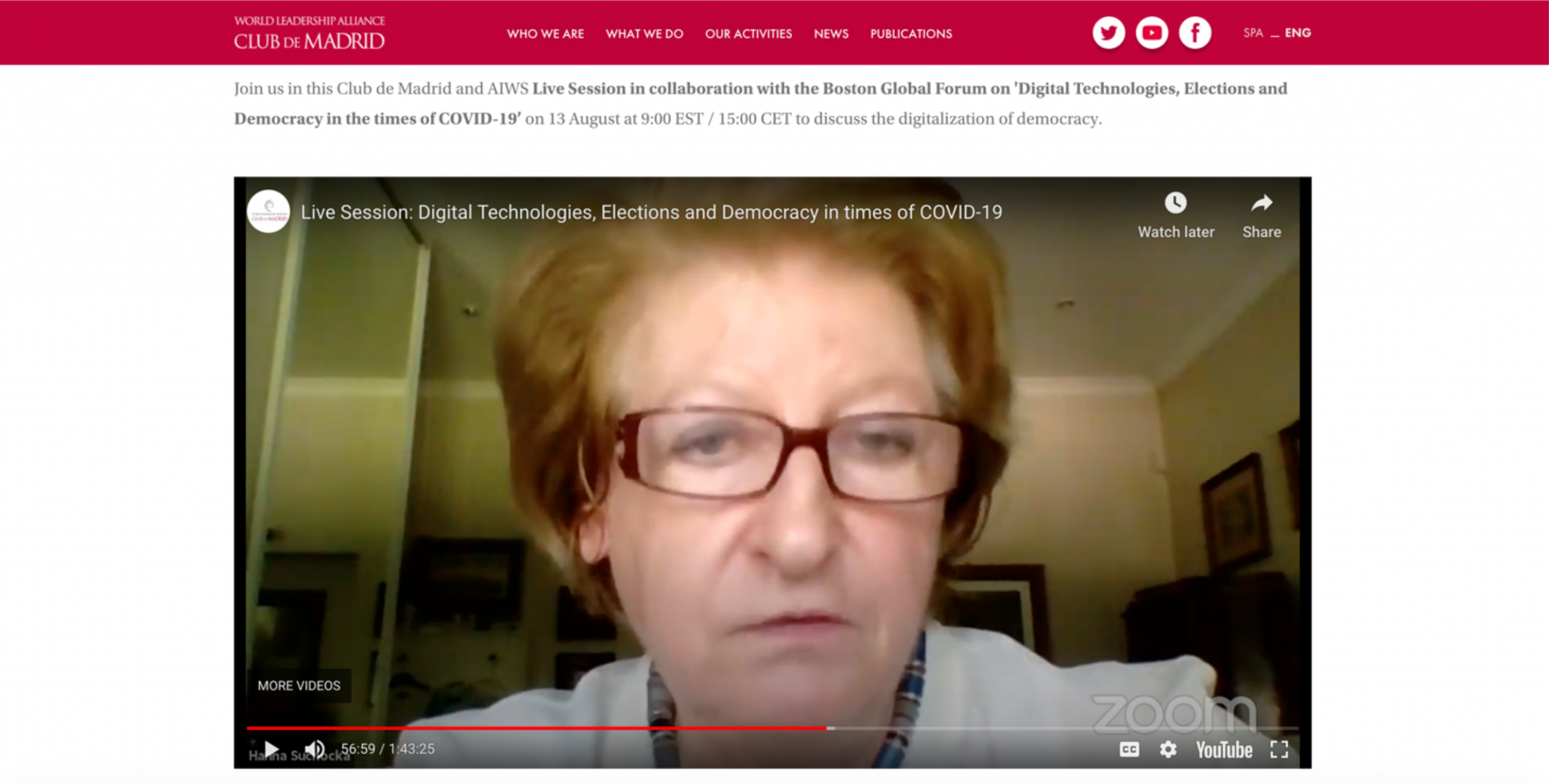
Prime Minister Hanna Suchocka, WLA-CdM Member, Prime Minister of Poland (1992-1993), spoke at the AIWS Roundtable “Digital Technologies, Elections, and Democracy in times of COVID-19, co-organized by World Leadership Alliance-Club de Madrid and the Boston Global Forum on August 13, 2020. She addressed:
Poland was the first EU country to hold presidential elections in times of the pandemic. How has the COVID-19 pandemic impacted the elections in terms of electoral campaigns, electoral observation, and the elections day itself? One of the characteristics of the Polish elections were that the campaigns had to be done through the Internet and social networks due to the pandemic. From her point of view, how was this process? What was the impact of technology on this?
Drawing on her experience as a Member of the Venice Commission, whose full name is the European Commission for Democracy through Law, which analyzes democratic institutions, fundamental rights and offers codes of good practice for electoral integrity, she spoke about how electronic voting could increase the percentage of participation for groups that usually have a low participation or whether this is due to a deeper debate linked to the political culture of these groups
“All people can create value for each other. A good economy has an ecosystem of organizations that lets that happen, in the most meaningful and fulfilling ways.”
How can we make this idea happen through using AI and the Internet?
How can we apply and practice this idea?
The Internet plays a significant role in data science and AI, so the History of AI Initiative at Michael Dukakis Institute considers Vint Cerf as a historical figure in AI. At this United Nations 2045 Roundtable, Vint Cerf will talk about historical moments in the birth of the Internet and how to use the Internet and AI to shape bright futures and to create an ecosystem for work and life with the philosophy of the People Centered Economy. With concepts from the New Social Contract in the Age of AI, Intellectual Society-Thoughtful Civil Society, and the People Centered Economy, AI World Society (AIWS) conceives concepts of the AIWS City as applying and practicing the thoughts and ideas of Vint Cerf.
The People Centered Economy: The New AI and Internet Ecosystem for Work and Life
Time: 9:30 am – 10:45 am EDT, August 21, 2020
This is a UN 2045 Roundtable and an event of the History of AI
Keynote speaker: Vint Cerf, Father of the Internet
Speakers: Governor Michael Dukakis, Co-founder and Chairman of the Boston Global Forum, Nguyen Anh Tuan, CEO of the Boston Global Forum
Moderator: Ramu Damodaran, Chief of the United Nations Academic Impact
Discussants: Professor Nazli Choucri, MIT, Professor Hiroshi Esaki, University of Tokyo, Professor Mikhail Kupriyanov, Vice Rector, Saint Petersburg Electrotechnology University, Former Prime Minister Bosnia & Herzegovina Zlatko Lagumdžija, Dr. Chien Minh Le, President of Dalat University,Professor Jun Murai, Keio University, Father of the Internet Japan, Professor David Silbersweig, Harvard University
Agenda:
9:30 am: Opening Remarks, Governor Michael Dukakis
Remarks on United Nations 2045 Initiative, Keynote Speaker Vint Cerf, and discussants; Ramu Damodaran
Keynote speech: “The People Centered Economy: The New AI and Internet Ecosystem for Work and Life”, Vint Cerf
Introduce AIWS City, a model that applies the concept “The People Centered Economy: The New AI and Internet Ecosystem for Work and Life”, Nguyen Anh Tuan
Discussion: Zlatko Lagumdžija, Jun Murai, NazliChoucri, Hiroshi Esaki, David Silbersweig, Mikhail Kupriyanov, Le Minh Chien. Moderator: Ramu Damodaran
10:40 am: Conclude, Ramu Damodaran
The United Nations 2045 Initiative:
The United Nations 2045 is an initiative of the United Nations Academic Impact with collaboration by the Boston Global Forum.
The United Nations 2045 include roundtables, ideas, concepts, solutions, essays, and reflections looking ahead to the global landscape in 2045, when the United Nations completes its first centenary, in areas of these technologies, including artificial intelligence, cyber security and weapons systems, among others. Such a compilation which looks both to the horizon ahead and the role of the United Nations in making it beneficial and secure, would be timely.
The History of AI Initiative:
The History of AI research and explore historical achievements, events, and figures in AI.
The HAI Board is chaired by Governor Michael Dukakis, with Professor Nazli Choucri (MIT), Historian Le Minh Chien, President of Dalat University, Professor Caroline Jones, MIT, Professor Ole Molvig (Vanderbilt University), Tuan Anh Nguyen (Michael Dukakis Institute), Professor Thomas Patterson (Harvard University), Professor Judea Pearl (UCLA), Professor Alex Pentland (MIT), Professor David Silbersweig (Harvard University), Professor Caroline Jones, MIT, and President Vaira Vike-Freiberga, Latvia as members.
The “The History of AI” Board will review and identify historical events, figures, and achievements in AI. After the HAI Board approve them, they will be made official historical events, figures, achievements in AI and posted on the AI Chronicle at AIWS.net. The HAI Board will review and select contents for books and papers of the History of AI.
Following Keynote Speaker Vint Cerf, Mr. Nguyen Anh Tuan introduced the AIWS City. Here are some key messages from Mr. Nguyen Anh Tuan’s talk.
Tax policy analysis is a well-developed field with a robust body of research and extensive modeling infrastructure across think tanks and government agencies. Because tax policy affects everyone, and especially wealthy people, it gets both a lot of attention and research funding (notably from individual foundations like those of Peter G. Peterson and Koch brothers). In addition to empirical studies, organizations like the Urban-Brookings Tax Policy Center and the Joint Committee on Taxation produce microsimulations of tax policy to comprehensively model thousands of levers of policymaking. However, because it is difficult to guess how people will react to changing public policy scenarios, these models are limited in how much they account for individual behavioral factors. Although it is far from certain, artificial intelligence (AI) might be able to help address this notable deficiency in tax policy, and recent work has highlighted this possibility.
A team of researchers from Harvard and Salesforce developed an AI system designed to propose new tax policies, which they call the AI economist. While the results of their initial analysis are not destined for the U.S. Code of Law, the approach they are proposing is potentially quite meaningful. Most current tax policy models infer how people would respond to a change in policy based on the results of prior research. In the AI economist approach, though, the actions of the computational economic participants were instead learned from a simplified game economy. They did this using a type of AI called reinforcement learning.
In pretty much any social-good application, AI does nothing on its own. However, with prudent application by domain experts, AI can lead to incremental improvements that, over time, have meaningful impact—as is true in policy research. Economists Susan Athey and Guido Imbens write “though the adoption of [machine learning] methods in economics has been slower, they are now beginning to be widely used in empirical work.” They are referring to machine learning methods for econometrics questions (such as causal inference), and less so simulations, but it’s possible that too will change over time.
In the field of causal inference, Professor Judea Pearl is a pioneer for developing a theory of causal and counterfactual inference based on structural models. In 2011, Professor Pearl won the Turing Award, computer science’s highest honor, for “fundamental contributions to artificial intelligence through the development of a calculus of probabilistic and causal reasoning.” In 2020, Professor Pearl is also awarded as World Leader in AI World Society (AIWS.net) by Michael Dukakis Institute for Leadership and Innovation (MDI) and Boston Global Forum (BGF). At this moment, Professor Judea also contributes to Causal Inference for AI transparency, which is one of important AIWS.net topics on AI Ethics.
Politics has now caught up with digitalization, but policy is still lagging behind. How can we improve electoral governance in the COVID-19 era? How can we hold electoral processes in the COVID-19 era while maintaining political and electoral rights? Join us in this Online AIWS Roundtable and Club de Madrid Live Session in collaboration with the Boston Global Forum.
‘Digital Technologies, Elections and Democracy in times of COVID-19’ is an online AIWS Roundtable and Club de Madrid Live Session in collaboration with the Boston Global Forum.
COVID-19 is pushing us into digital democracy. But are we prepared for the digital transformation of political processes and elections?
Politics are undergoing a process of digital transformation spurred by COVID-19. Cabinet meetings and even parliamentary sessions via videoconference are not a rare sight since the pandemic’s outbreak. Politics has now caught up with digitalization, but policy is still lagging behind.
The pandemic has dealt a blow to our economic and political systems: Elections are no exception. While some administrations have chosen to postpone elections, others have held these under extraordinary circumstances, altering timelines and voting procedures while ensuring free, fair and transparent votings.
How can we streamline electoral processes during COVID-19 without affecting political and electoral rights? How can we improve electoral governance in such a context? Is there a danger in election manipulation and hacking, particularly in countries with poor digital infrastructure?
The Session will be moderated by Milburn Line, Senior Advisor for Policy and Content at the Shared Societies Project of the World Leadership Alliance – Club de Madrid
Join us in this Club de Madrid and AIWS Live Session in collaboration with the Boston Global Forum on ‘Digital Technologies, Elections and Democracy in the times of COVID-19’ on 13 August at 9:00 EST / 15:00 CET to discuss the digitalization of democracy.
This event is a continuation of the event on August 5, 2020, which was stopped after 35 minutes due to technical problems during Live Session with speakers below: