by Editor | Jul 5, 2022 | Papers & Reports, News
Since its release in April 2021, the draft AI regulations (the “Regulations”), also referred to as the EU AI Act, have acted as a catalyst of legal, political, and societal developments within the field of AI. Forming the basis of many of the developing trends for AI in the European Union, the Regulations have received extensive feedback from stakeholders of all forms and functions, often with positive developments made (as was the case with the very definition of AI).
What remains constant in the shifting sands for AI in Europe is that the Regulations are set to stay and form the foundations for which man and machine are set to interact. While, understandably, there is a substantial level of restrictions contained within the Regulation, the provisions equally set out a number of initiatives to encourage the use and development of AI. One such initiative is the use of regulatory ‘sandboxes’ to allow stakeholders the chance to build, and develop, in the safety of regulatory isolation, without the substantial repercussions they would otherwise face should they fall foul of the Regulations once enacted.
Taking full advantage of this positive initiative, on the 27 June, the government of Spain announced at an event alongside the European Commission that they were to begin piloting the first (likely of many) regulatory sandbox on AI.
What is a regulatory sandbox?
As the European Commission puts it, a regulatory sandbox is a way to connect innovators and regulators by providing a controlled environment for them to interact and develop their operations. This will therefore permit them to develop, test, and validate AI systems with a view of ensuring compliance with the Regulations when they come into effect. On the other side of the spectrum, regulators are able to see the bottlenecks and sticking points of the way a regulation behaves in its current form. Changes can therefore be made as needed, after having extensive feedback and testing carried out by the involved parties. Much like a sandcastle, if a process is consistently incompatible with the Regulations, or the Regulations are found to be unsuitable in practice, they can be sculpted and remoulded to better meet the needs of the EU.
What benefit is expected?
The pilot initiated by the Spanish government is set to look at operationalising the requirements of the Regulations, alongside other features, such as conformity assessments and post-market activities.
The initiative is expected to create “easy-to-follow, future-proof best practice guidelines”, alongside an array of other practical guides and materials. These are expected to assist companies, particularly SMEs and start-ups reach, compliance with the provisions of the Regulations.
It is also expected that the results of the pilot will create guidance on methods to control and monitor compliance that can be used by each individual Member State’s national authorities.
When can stakeholders start building?
Testing is set to commence in October 2022 and the results are expected to be published in the second half of 2023. The experience collected from this sandbox will be presented in the form of newly developed ‘good practices’ and ‘implementation guidelines’ that will be made available to all Member States and the European Commission in anticipation for the full implementation of the Regulations.
Boston Global Forum (BGF), Club de Madrid and AI World Society (AIWS) established the Global Alliance for Digital Governance (GADG) in September 2021. This is a part of the Social Contract for the AI Age, Framework for AI International Accord, and Remaking the World – Toward an Age of Global Enlightenment.
https://www.lexology.com/library/detail.aspx?g=09cd19b8-ec89-429a-a55c-b6a5ae84ba49

by Editor | Jul 5, 2022 | Papers & Reports, News
A consequence relatively rarely discussed in the context of the US Supreme Court judgment on access and right to abortion, as affirmed in the earlier Roe v Wade case, is the question of the digital privacy of those who seek online information about the procedure or where it can be arranged. On June 24, the MIT Technology Review “asked five major tech companies—Alphabet, Meta, Reddit, TikTok, and Twitter—how their policies banning content promoting illegal activity will apply to posts advocating for abortion access or aiding those who now need to travel out of state for the procedure (and) how they plan to respond to requests, subpoenas, or warrants for data that could be used to prosecute cases related to abortions in those states.” This article from the Review shares and analyses the results of those queries.
https://www.technologyreview.com/2022/06/28/1055044/big-tech-data-privacy-supreme-court-dobbs-abortion/?truid=1637671ffcbfe11c6639153159007ef2
AIWS.net includes news reports, analysis and reflections by distinguished thinkers and innovators supporting innovations and solutions for “Remaking the World – Toward an Age of Global Enlightenment” and the United Nations Centennial initiative, looking at how the world might be in 2045 when the global organization completes a hundred years.
by Editor | Jul 4, 2022 | Global Alliance for Digital Governance, United Nations Centennial, AIWS and the Age of Global Enlightenment
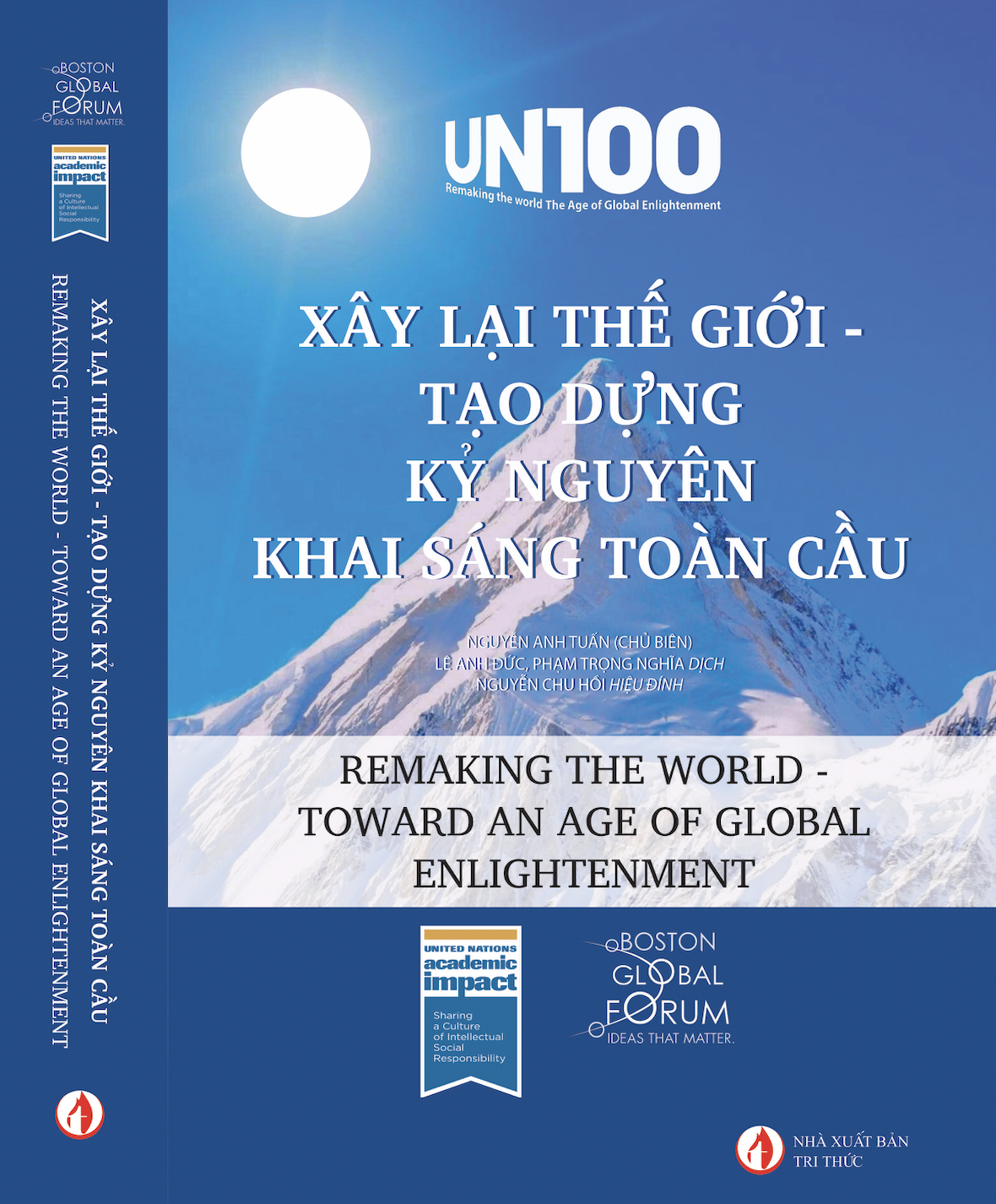
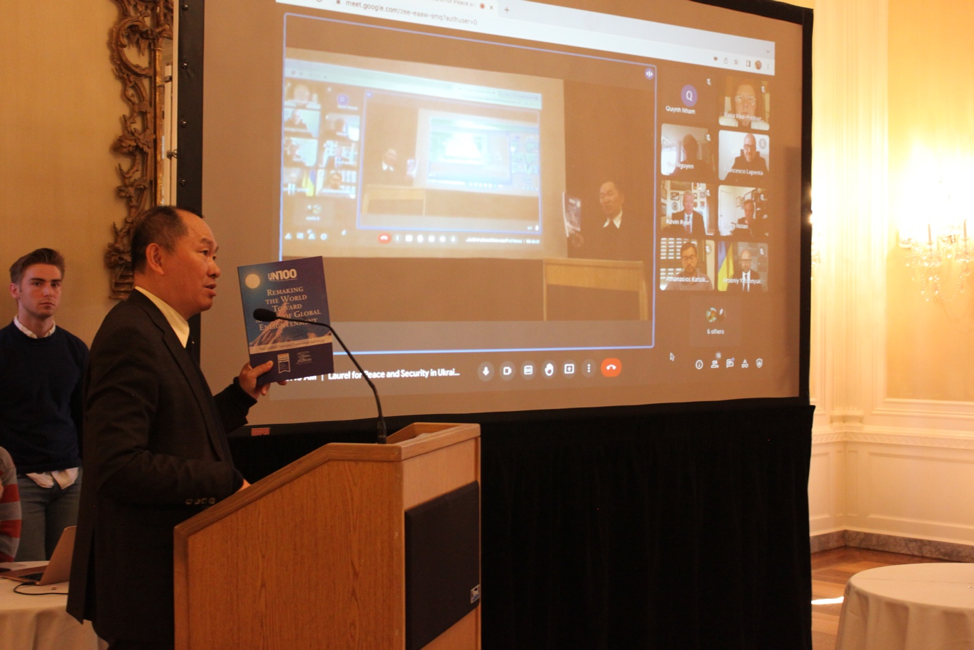
The book Remaking the World – Toward an Age of Global Enlightenment was published in Vietnam bilingually in Vietnamese and English by Tri Thuc Publishing House and presented to Vietnamese leaders and all of members of the National Assembly of Vietnam.
Pioneering ideas and concepts of the book was came from Boston, Massachusetts. On July 4th, we introduce the foreword of Governor Dukakis, Co-founder and Chair of the Boston Global Forum in the book:
“Nothing is more urgent than peace and security in the world, and no organization is better positioned to promote it than is the United Nations. That has been true since its inception in 1945, although the lesson of the last seventy-five years is that the UN’s mandate must be enlarged if it is to fulfill the ideals on which it was founded. The task between now and the UN’s centennial in 2045 is the remake the UN so that it can play an even larger role in remarking the world.
This book offers ideas that can inform that effort. The ideas are meant to stimulate thought and discussion. Some of the ideas will undoubtedly, and properly, fall by the wayside during the deliberative process. Other ideas, not in this book, will come to the fore. A great deal of thought and experience went into the founding of the United Nations, and that kind of effort is needed once again as we consider how to enhance this remarkable institution.
On behalf of the Boston Global Forum, I want to thank the distinguished women and men who have contributed to the book. In one form or another, they have dedicated their careers to the service of others, and to the common good, and their essays and speeches reflect that dedication.
A special thank you is due to the book’s editor, Nguyen Anh Tuan. He envisioned the book project and assembled and guided the contributors. His commitment to world peace and security is unflagging, and the book is yet another testament to his dedication.
by Editor | Jul 4, 2022 | Papers & Reports, News, AIWS and the Age of Global Enlightenment
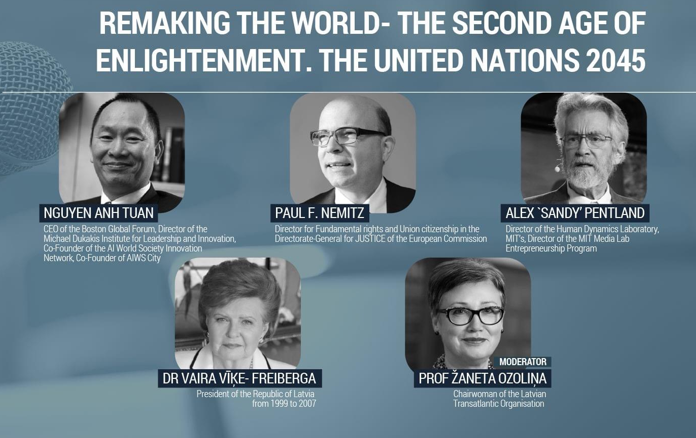
Concluding from the Chapter 23 of Remaking the World – Toward an Age of Global Enlightenment: Apply AIWS Ecosystem at AIWS City: A Model for the Digital Age by Nguyen Anh Tuan, Boston Global Forum CEO
“The great question of the Digital and AI Age is not technological in nature. Rather it is the question of what type of society we seek to create through the application of digital technology.
The digital and AI revolution and trailblazing ideas will reshape the world. Like previous industrial revolutions, it will have a transformative effect on the way we live and relate to each other. Like the others, it will be disruptive. Some business sectors will wither, while others will thrive. That is true also of people. With the other revolutions, the outcome was determined almost entirely by market forces, which worked primarily to the benefit of the powerful, typically at a significant cost to ordinary people.
AIWS seeks to ensure that the historical pattern does not become a defining feature of the Digital and AI Age. AIWS is a reimagined world, one where the rights and interests of ordinary citizens are paramount and where action is taken to empower them in ways that enlarge their voice and influence and that give them the agency to help shape a new world. AIWS recognizes that this reimagined world will require concerted action by governments, individuals, organizations, and firms. Each must be a source of innovation, and each must adhere to AIWS standards and values. Together, we can remake the world and usher in an Age of Global Enlightenment.”

by Editor | Jul 8, 2022 | Statements, Shinzo Abe Initiative for Peace and Security, Global Alliance for Digital Governance, News
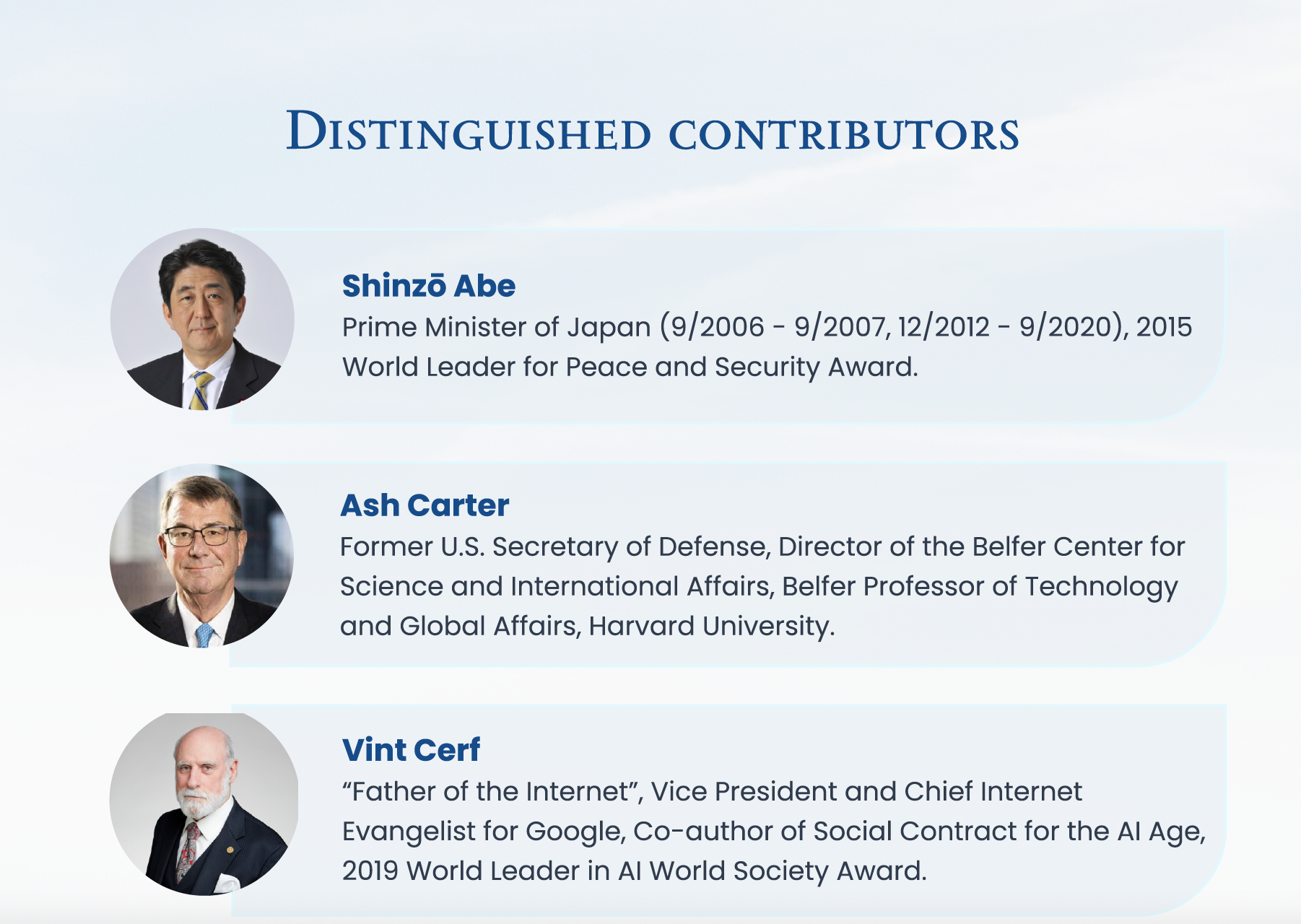
We are shocked and deeply saddened by the assassination of Former Japanese Prime Minister Shinzo Abe. The entire Boston Global Forum community condemns this senseless act of violence that occurred during a public political campaign event in Japan.
Mr. Abe was a good friend to the Boston Global Forum (BGF), participating in numerous events that highlighted his continuing prestige in Japan and on the world stage. Mr. Abe was the first world leader to receive the World Leaders Award for Peace and Security from the Boston Global Forum in 2015. At that time, Mr. Abe issued a message of support for BGF’s Global Cybersecurity Day Initiative and then the BGF-G7 Summit Initiative in Japan in 2016.
Mr. Abe frequently addressed the need for greater global attention for digital standards and individual rights in an age increasingly dominated by artificial intelligence. He was a strong supporter of Boston Global Forum’s Cybersecurity Demands. In December 2021, Mr. Abe presented his keynote speech in the Boston Global Forum Conference, and made distinguished contributions to the BGF book, “Rebuilding the World – Toward an Age of Global Enlightenment.”
More than any Japanese leader, Shinzo Abe understood the shifting power structure in Asia and the need for Japan to exert a stronger leadership role. The Japanese people, Asia, and the world have lost a key leader for the challenges that lie ahead.
The Boston Global Forum extends our condolences to Mr. Abe’s friends and family. We will honor Mr. Abe by continuing to promote his ideas and positions that uphold the dignity and rights of individuals in the age of digital and artificial intelligence.