
by Editor BGF | Sep 15, 2023 | News
Boston Global Forum (BGF) and Michael Dukakis Institute for Leadership and Innovation (MDI) Honor Esteemed Spiritual Leader Sri Mata Amritanandamayi Devi (Amma) with 2023 World Leader for Peace and Security Award
Celebrating Amma’s Legacy, Spiritual Values, and Leadership as Chair of C20 India 2023
Amma’s Legacy and Spiritual Values Significantly Contribute to Building AIWS – The Age of Global Enlightenment

Boston, September 15, 2023 – The Boston Global Forum (BGF) and the Michael Dukakis Institute for Leadership and Innovation (MDI) proudly honor Sri Mata Amritanandamayi Devi (Amma), an esteemed spiritual leader and Chair of the Civil 20 Engagement Group of the G20. Amma is globally recognized as a symbol of hope and compassion, and she receives the prestigious 2023 World Leader for Peace and Security Award. This accolade acknowledges Amma’s profound legacy, steadfast commitment to spiritual values, and her influential role in global leadership.
Amma’s remarkable influence transcends traditional boundaries, encompassing spiritual wisdom and compassionate leadership. As Chair of C20 Summit India 2023, she advocates for unity, compassion, and collective well-being in an ever-evolving world, epitomizing the summit’s motto, “You Are the Light.” Her dedication to fostering a fair and sustainable planet aligns with the missions of world peace, security, and the mandates of BGF and MDI.
Amma’s legacy of compassion and her leadership within the C20 Summit India 2023 seamlessly align with the principles of AI World Society (AIWS) – The Age of Global Enlightenment. BGF and MDI proudly integrate Amma’s spiritual values into the fabric of AIWS, enriching the initiative’s vision for a more enlightened, compassionate, and secure world.
Governor Michael Dukakis, Chair of the Boston Global Forum, remarked, “We are profoundly honored to recognize Amma as a World Leader for Peace and Security. Her tireless efforts to promote love, compassion, and global unity are truly exemplary. Amma’s legacy will continue to inspire our collective journey towards a more harmonious world, perfectly aligning with the AIWS initiative.”
The integration of Amma’s spiritual values into AIWS represents a powerful fusion of technology and humanity, where compassion and enlightenment converge to address global challenges. As AIWS endeavors to shape a brighter future for all, Amma’s principles further empower the initiative’s ability to nurture a more ethical, secure, and equitable world. In the words of the communique issued at the C20 Summit in Jaipur, India, on July 31, “we recognize the rapid and widespread change brought about by digital transformation, offering unprecedented advancements for improving the human condition… We call for a new social contract to unite and protect an Artificial Intelligence World Society.”
With profound respect and gratitude, BGF and MDI extend their heartfelt congratulations to Amma, a guiding light in our intricate world. The legacy of her leadership and spiritual wisdom will reverberate perpetually within AI World Society – The Age of Global Enlightenment and will be introduced at the House of Honor of AIWS City.
Two significant events are on the horizon to honor Amma. On October 3, India will celebrate Amma’s 70th birthday, and on November 2, a special gathering will take place at Esteem Loeb House, Harvard University, where she will deliver a Distinguished Global Enlightenment Speech. Additionally, BGF is organizing a Global Enlightenment Concert on October 3 to pay tribute to her.
For media inquiries, please contact:
Tuan Nguyen, CEO of the Boston Global Forum
Email: [email protected]
Phone: +1 617 286 6589
Jim McManus
Email: [email protected]
Phone: +1 617 413 9232
Previous recipients of the World Leader for Peace and Security Award:
- 2015: Japanese Prime Minister Shinzo Abe and German Chancellor Angela Merkel
- 2016: Secretary General of the United Nations Ban Ki-moon
- 2017: Estonian President Toomas Hendrik Ilves
- 2018: Finnish President Sauli Niinisto
- 2019: Latvian President and President of World Leadership Alliance-Club de Madrid Vaira Vike-Freiberga
- 2020: European Commission President Ursula von der Leyen
- 2021: Swedish Parliament Speaker Andreas Norlen
- 2022: President Volodymyr Zelensky and all Ukrainian people
About Boston Global Forum (BGF): The Boston Global Forum (BGF) is an international think tank based in Boston, Massachusetts. Its mission is to convene thought leaders, policymakers, scholars, and business leaders to collaborate on critical issues impacting peace, security, and economic development.
About Michael Dukakis Institute for Leadership and Innovation (MDI): The Michael Dukakis Institute for Leadership and Innovation (MDI) is committed to fostering leadership, promoting innovation, and enhancing cooperation to address global challenges. Through research, forums, and initiatives, MDI brings leaders from diverse sectors together to develop practical solutions for a better world.

by Editor BGF | Aug 20, 2023 | Global Enlightenment Leaders
Enrico Letta was Prime Minister of Italy from 2013 to 2014.
Born on 20 August, 1966 in Pisa, Italy. Mr Letta graduated from the University of Pisa in International Law and holds a doctorate in European Community Law from the Scuola Superiore Sant’Anna in Pisa.
He was Minister of European Affairs from 1998 to 1999 (the youngest minister in the history of the Italian Republic history of the Italian Republic, in charge of community policies at the age of 32), Minister of Industry and Foreign Trade from 1999 to 2001, Member of the European Parliament (2004-2006), then President of the Council of Ministers from April 2013 to February 2014. Mr Letta was formerly Dean of the School of International Affairs of Sciences Po Paris (PSIA) and former President of the Italian Council of Ministers.
He is currently president of the Institut Jacques Delors and Secretary of the Italian Democratic Party (since 2021). Mr Letta speaks Italian, French and English.
by Editor BGF | Aug 19, 2023 | News
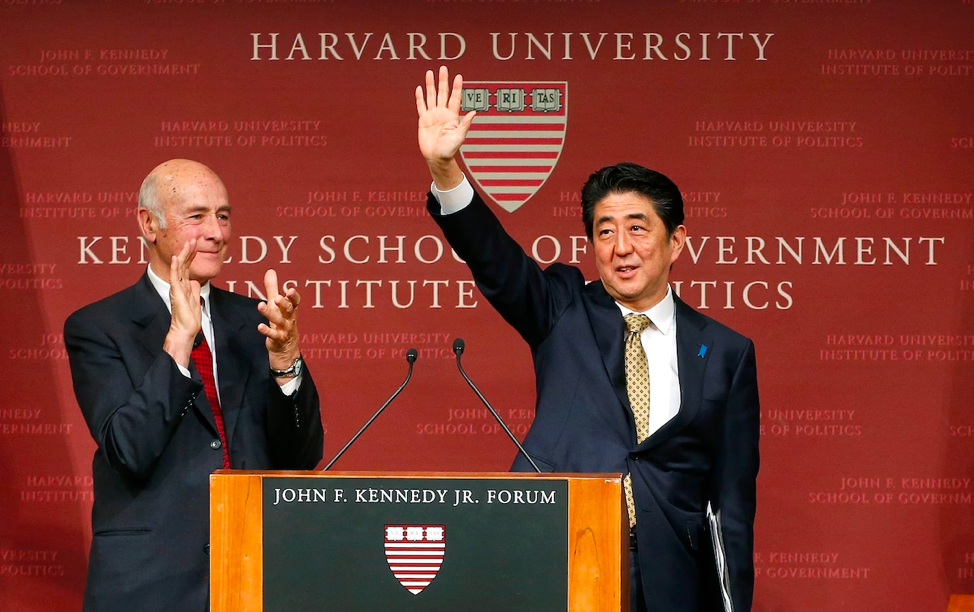
Prime Minister Shinzo Abe was the recipient of World Leader for Peace and Security Award 2015 and a distinguished contributor of the book “Remaking the World – Toward an Age of Global Enlightenment.” Abe, more than any modern political leader of Japan, paved the way for security reform in Tokyo. During his second tenure as […]
Prime Minister Shinzo Abe was the recipient of World Leader for Peace and Security Award 2015 and a distinguished contributor of the book “Remaking the World – Toward an Age of Global Enlightenment.”
Abe, more than any modern political leader of Japan, paved the way for security reform in Tokyo.
During his second tenure as prime minister in the early to mid-2010s, he sparked changes. The parliament passed a state secrets law that set stiff penalties for mishandling documents and for leaking information. Abe set up a National Security Council, modeled in part after the U.S. version, to advise the prime minister.
Antiwar and civil-liberties activists protested the reforms, claiming they were infringing on privacy rights and voicing concerns about an expanding national security state. But by 2013, when the law was passed, the geopolitical landscape had shifted. The public had come to see that decades of a nominal commitment to self-defense had only emboldened a rising Beijing.
China had aggressively responded to Japan’s nationalization of the Senkaku Islands, flooding the waters off the islands with Coast Guard vessels and maritime militia. In the South China Sea, it was turning remote atolls into military outposts seemingly overnight. President Xi Jinping had come to power, accelerating a vast military modernization. Meanwhile, North Korea continued provocative nuclear tests.
Abe was assassinated in July 2022, but his legacy lives on. Over the last decade, attitudes toward China have hardened: Today, a majority of Japanese view the Chinese government unfavorably, while support for the U.S. alliance is at an all-time high.
Link: https://www.washingtonpost.com/national-security/2023/08/07/china-japan-hack-pentagon/
Yasuhida Nakayama, former State Minister of Defense, a Global Enlightenment Leader, and Coordinator of Shinzo Abe Initiative for Peace and Security said “The ‘Free and Open Indo-Pacific’ initiative advocated by former Prime Minister Shinzo Abe feels like a concept that holds the potential and necessity to thrive geopolitically in this 21st century.
What I wanted to emphasize is that the mandatory implementation of the nine-dash line by private companies is indeed a concern. Moreover, the underlying preparations by the Chinese Communist Party through the National Defense Mobilization Law and the Anti-Spy Law might potentially exacerbate the enforcement of the nine-dash line, as pointed out by professors and experts.”
‘A free and open Indo-Pacific’: With a single phrase, Shinzo Abe changed America’s view of Asia and China, by CNN https://www.cnn.com/2022/07/20/asia/shinzo-abe-legacy-china-japan-indo-pacific-intl-hnk/index.html
by Editor BGF | Aug 16, 2023 | News
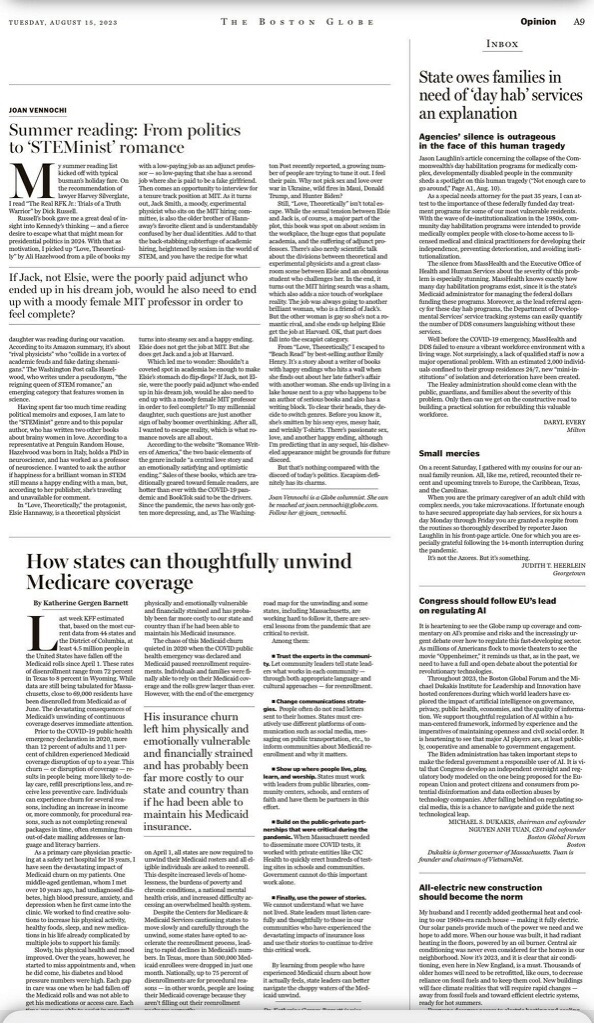
Boston Globe, August 15, 2023
https://www.bostonglobe.com/2023/08/15/opinion/letters-to-the-editor-regulating-ai/
It is heartening to see the Globe ramp up coverage and commentary on AI’s promise and risks and the increasingly urgent debate over how to regulate this fast-developing sector. As millions of Americans flock to movie theaters to see the movie “Oppenheimer,” it reminds us that, as in the past, we need to have a full and open debate about the potential for revolutionary technologies.
Throughout 2023, the Boston Global Forum and the Michael Dukakis Institute for Leadership and Innovation have hosted conferences during which world leaders have explored the impact of artificial intelligence on governance, privacy, public health, economies, and the quality of information. We support thoughtful regulation of AI within a human-centered framework, informed by experience and the imperatives of maintaining openness and civil social order. It is heartening to see that major AI players are, at least publicly, cooperative and amenable to government engagement.
The Biden administration has taken important steps to make the federal government a responsible user of AI. It is vital that Congress develop an independent oversight and regulatory body modeled on the one being proposed for the European Union and protect citizens and consumers from potential disinformation and data collection abuses by technology companies. After falling behind on regulating social media, this is a chance to navigate and guide the next technological leap.
Michael S. Dukakis
Chairman and cofounder
Nguyen Anh Tuan
CEO and cofounder
Boston Global Forum
Boston
by Editor BGF | Jul 23, 2023 | World Leaders in AIWS Award Updates
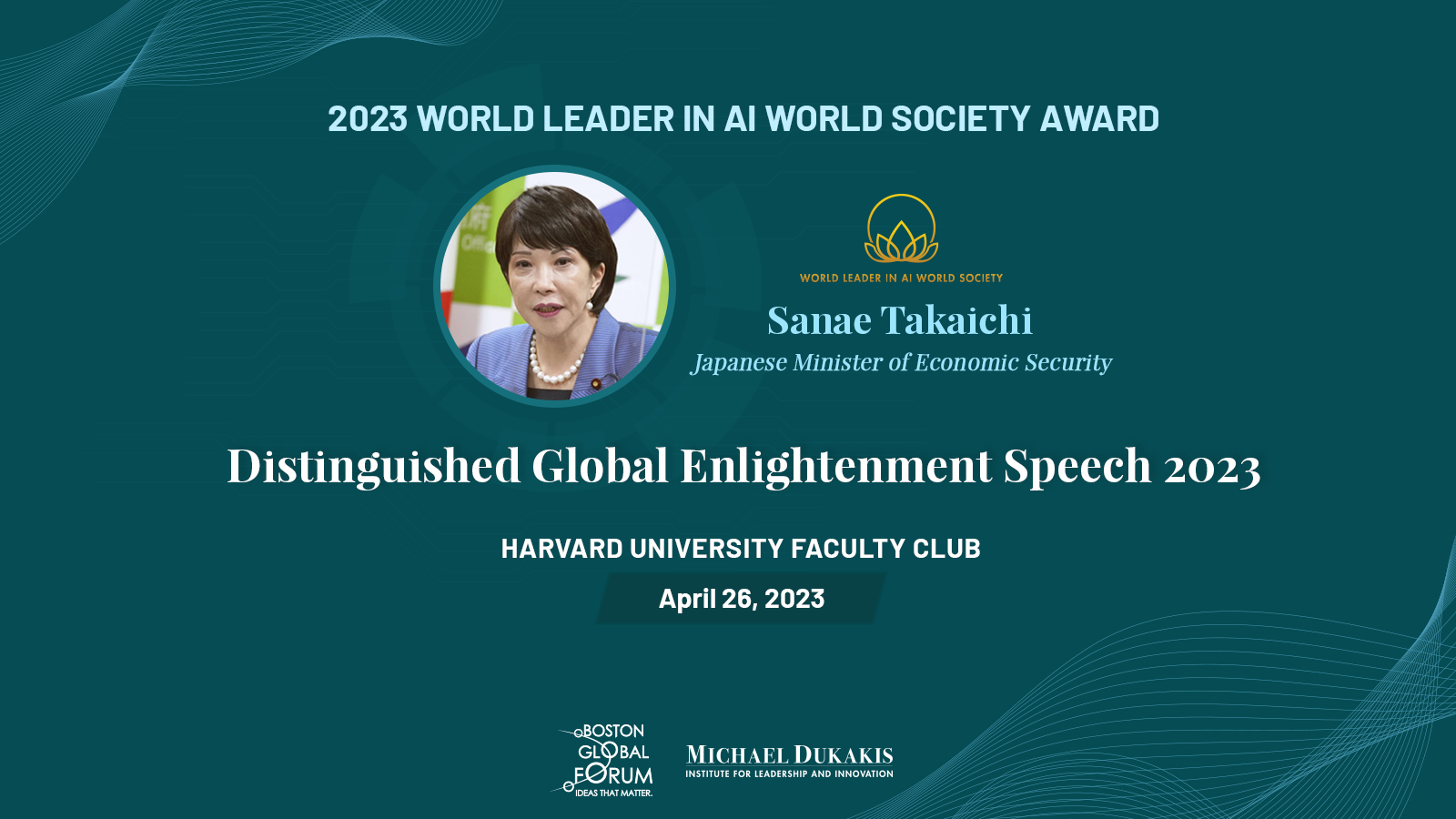
JAPANESE ECONOMIC SECURITY MINISTER SANAE TAKAICHI IS HONORED WITH THE WORLD LEADER IN AIWS AWARD 2023
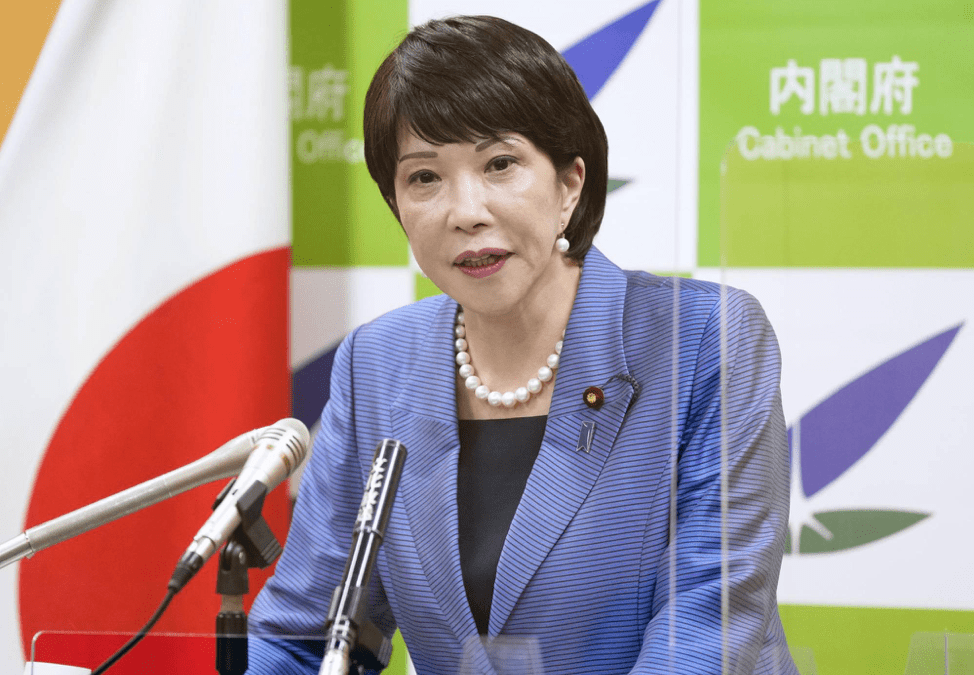
Boston Global Forum and Michael Dukakis Institute honored JAPANESE ECONOMIC SECURITY MINISTER SANAE TAKAICHI, WITH THE WORLD LEADER IN AIWS AWARD 2023
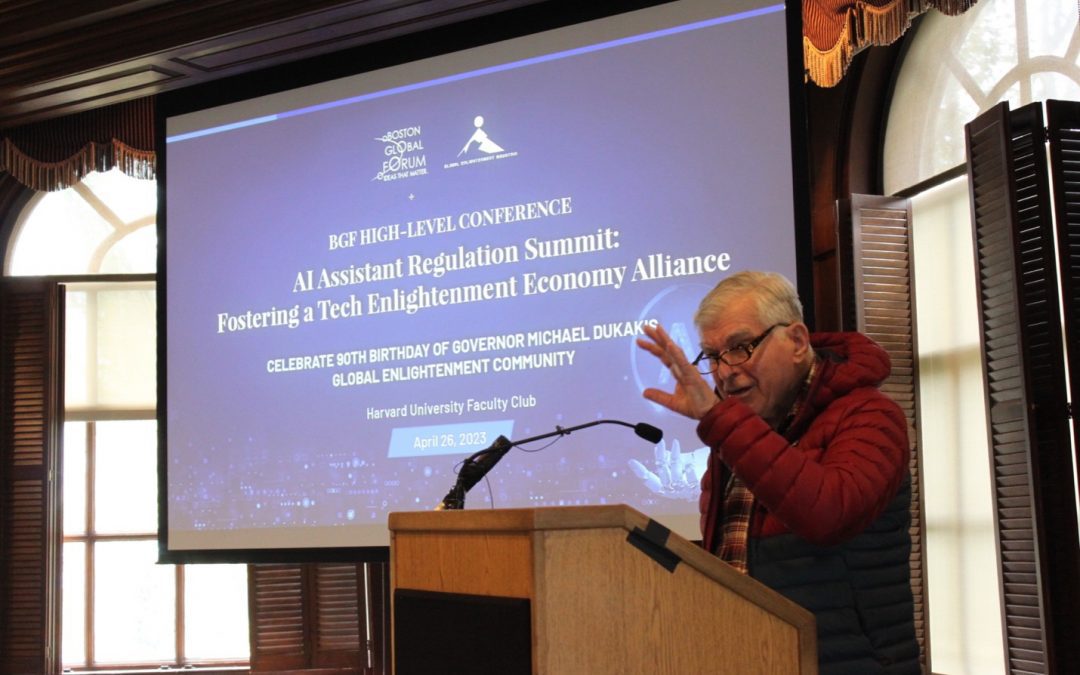
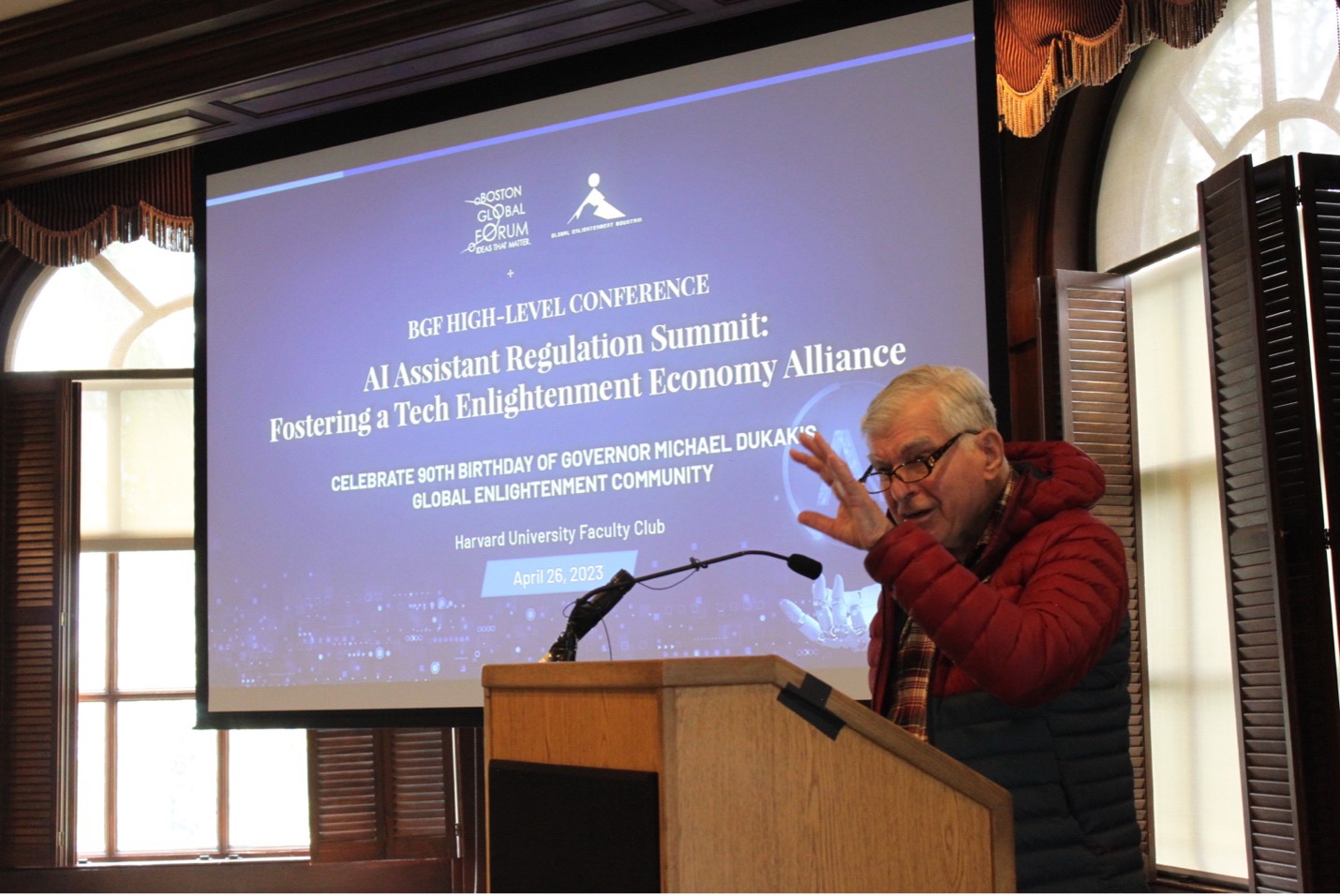
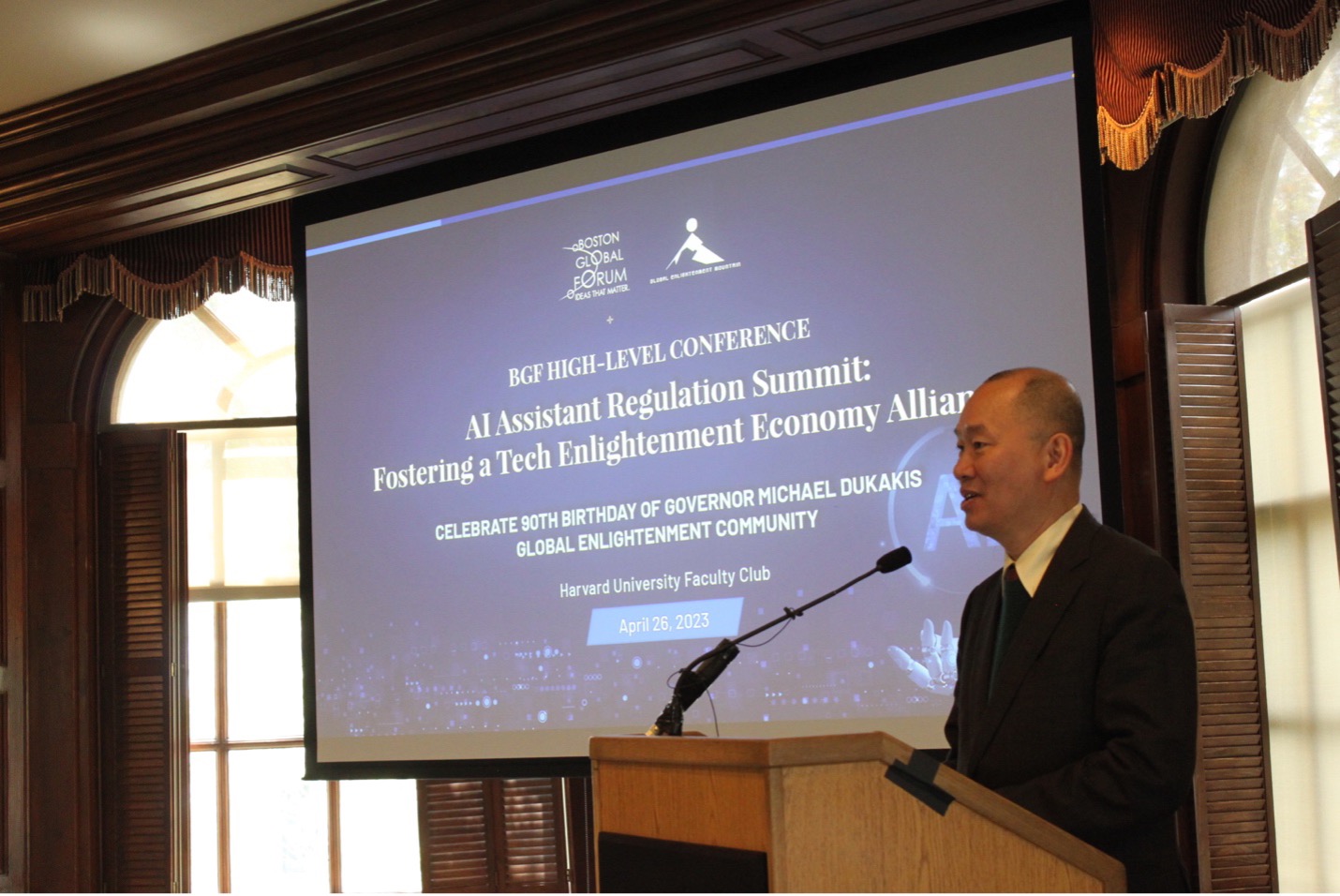
Remarks of Governor Michael Dukakis Honoring JAPANESE ECONOMIC SECURITY MINISTER SANAE TAKAICHI 2023 World Leader in AI World Society Award Harvard University Faculty Club, April 26, 2023
Ladies and gentlemen,
It is my great honor today to give Japanese Economic Security Minister Sanae Takaichi the World Leader in AIWS Award for 2023.
Minister Takaichi has dedicated her career to promoting economic growth, social equity, and technological innovation in Japan and beyond.
Affiliated with Japan’s Liberal Democratic Party and a member of the House of Representatives since 1993, she has served as Japan’s Minister of Internal Affairs and Communications, Minister of State for Okinawa and Northern Territories Affairs, Minister of State for Economic and Fiscal Policy and, most recently, Minister of State for Economic Security.
In her latest position, she had made significant contributions to Japan’s national security and economic policies. She has been instrumental in strengthening Japan’s cybersecurity and protecting its critical infrastructure, including its power grids and financial system, from cyber-attacks. And she has been actively involved in developing Japan’s economic policies, including fostering innovation, investing in technology, addressing the nation’s labor shortage, and managing the country’s aging population.
Under her leadership, Japan has taken steps to improve its economic security, including the establishment of a new agency dedicated to cybersecurity and the development of a comprehensive strategy for promoting innovation and entrepreneurship. She has also played an important role in strengthening Japan’s economic and security relationships with other countries, including the United States.
More broadly, Minister Takaichi’s achievements and contributions as the Minister of State for Economic Security have focused on ensuring Japan’s long-term economic growth and stability, while also addressing the challenges posed by digital-age security threats. Her leadership in promoting responsible AI is a model for other leaders, a model that will ensure for all of us a more peaceful and prosperous world.
My warmest congratulations, on behalf of the Boston Global Forum and the AI World Society, to Minister Sanae Takaichi on this richly deserved award.
by Editor BGF | Jul 23, 2023 | World Leaders in AIWS Award Updates
Boston Global Forum and Michael Dukakis Institute honored JAPANESE ECONOMIC SECURITY MINISTER SANAE TAKAICHI, WITH THE WORLD LEADER IN AIWS AWARD 2023
Remarks of Governor Michael Dukakis Honoring JAPANESE ECONOMIC SECURITY MINISTER SANAE TAKAICHI 2023 World Leader in AI World Society Award Harvard University Faculty Club, April 26, 2023
Ladies and gentlemen,
It is my great honor today to give Japanese Economic Security Minister Sanae Takaichi the World Leader in AIWS Award for 2023.
Minister Takaichi has dedicated her career to promoting economic growth, social equity, and technological innovation in Japan and beyond.
Affiliated with Japan’s Liberal Democratic Party and a member of the House of Representatives since 1993, she has served as Japan’s Minister of Internal Affairs and Communications, Minister of State for Okinawa and Northern Territories Affairs, Minister of State for Economic and Fiscal Policy and, most recently, Minister of State for Economic Security.
In her latest position, she had made significant contributions to Japan’s national security and economic policies. She has been instrumental in strengthening Japan’s cybersecurity and protecting its critical infrastructure, including its power grids and financial system, from cyber-attacks. And she has been actively involved in developing Japan’s economic policies, including fostering innovation, investing in technology, addressing the nation’s labor shortage, and managing the country’s aging population.
Under her leadership, Japan has taken steps to improve its economic security, including the establishment of a new agency dedicated to cybersecurity and the development of a comprehensive strategy for promoting innovation and entrepreneurship. She has also played an important role in strengthening Japan’s economic and security relationships with other countries, including the United States.
More broadly, Minister Takaichi’s achievements and contributions as the Minister of State for Economic Security have focused on ensuring Japan’s long-term economic growth and stability, while also addressing the challenges posed by digital-age security threats. Her leadership in promoting responsible AI is a model for other leaders, a model that will ensure for all of us a more peaceful and prosperous world.
My warmest congratulations, on behalf of the Boston Global Forum and the AI World Society, to Minister Sanae Takaichi on this richly deserved award.
by Editor BGF | Jun 29, 2023 | Event Updates
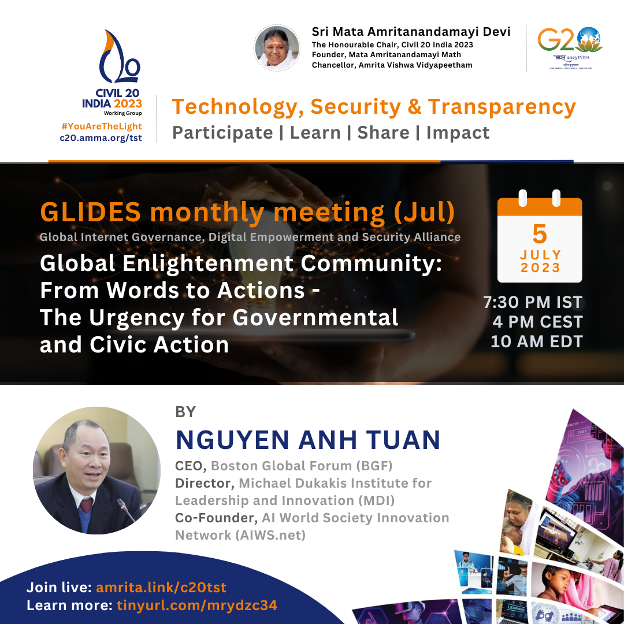
Time: July 5, 2023, at 10:00 am EST (Boston time), 4:00 pm PST (San Francisco time), 7:30 pm IST (New Delhi time).
Zoom link: amrita.link/c20tst
Speaker: Mr. Nguyen Anh Tuan, CEO of Boston Global Forum (BGF)
Topic: “Global Enlightenment Community: From Words to Actions – The Urgency for Governmental and Civic Action”
Introduction to Civil20 (C20) Global Internet Governance, Digital Empowerment, and Security Alliance (GLIDES):
We are delighted to have a distinguished speaker, Mr. Tuan Nguyen, CEO of Boston Global Forum (BGF), addressing the GLIDES July 2023 monthly meeting. Mr. Nguyen will present on the topic “Global Enlightenment Community: From Words to Actions – The Urgency for Governmental and Civic Action.” His insights will greatly benefit our CSO members.
Mr. Nguyen is not only the CEO of Boston Global Forum but also the director of the Michael Dukakis Institute for Leadership and Innovation (MDI). He is a co-founder of the AI World Society Innovation Network (AIWS.net), co-founder of AIWS City (AIWS.city), and co-author of the books “Social Contract for the AI Age” and “Remaking the World – Toward an Age of Global Enlightenment.”
Zoom link: amrita.link/c20tst
We eagerly anticipate your participation in this monthly meeting to engage in thoughtful deliberations and policy dialogues.
For more information about C20 GLIDES, please visit their website: https://c20.amma.org/tst-wg/global-internet-governance-digital-empowerment-and-security-alliance-glides/
Best regards,
Civil20 (C20) Working Group on Technology, Security, & Transparency (TST)
Website: https://c20.amma.org/tst-wg/

by Editor BGF | May 24, 2023 | Papers & Reports, Publications

Download The Digital Governance Shared Framework for Global Governance AI Assistants and ChatGPT here, please.
by Editor BGF | May 12, 2023 | Global Alliance for Digital Governance, Publications
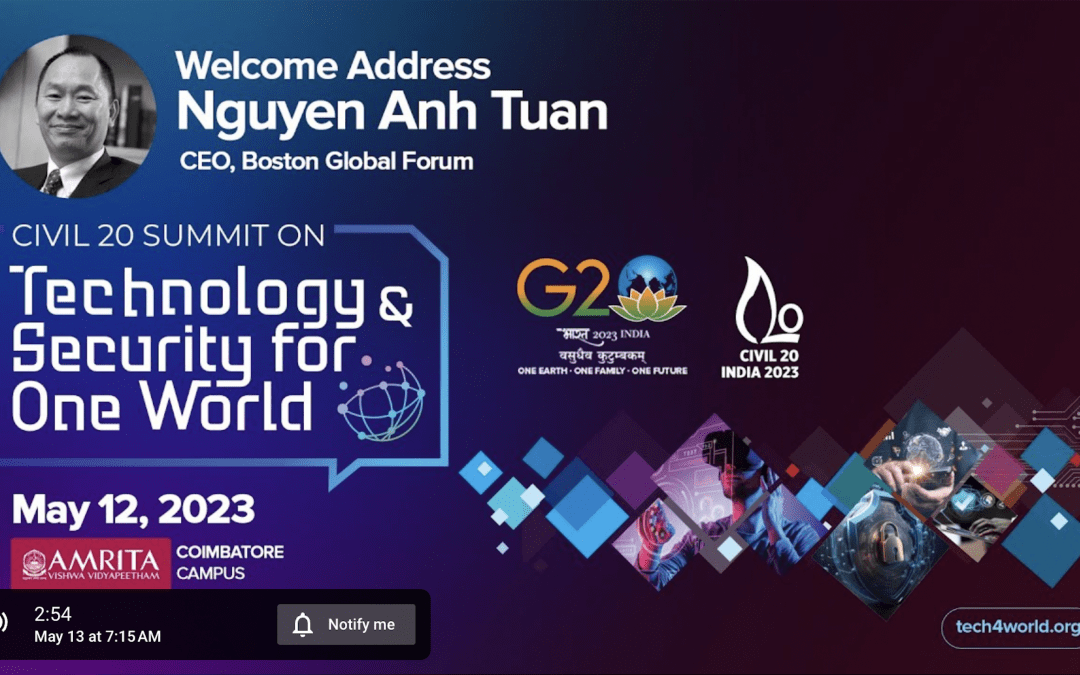
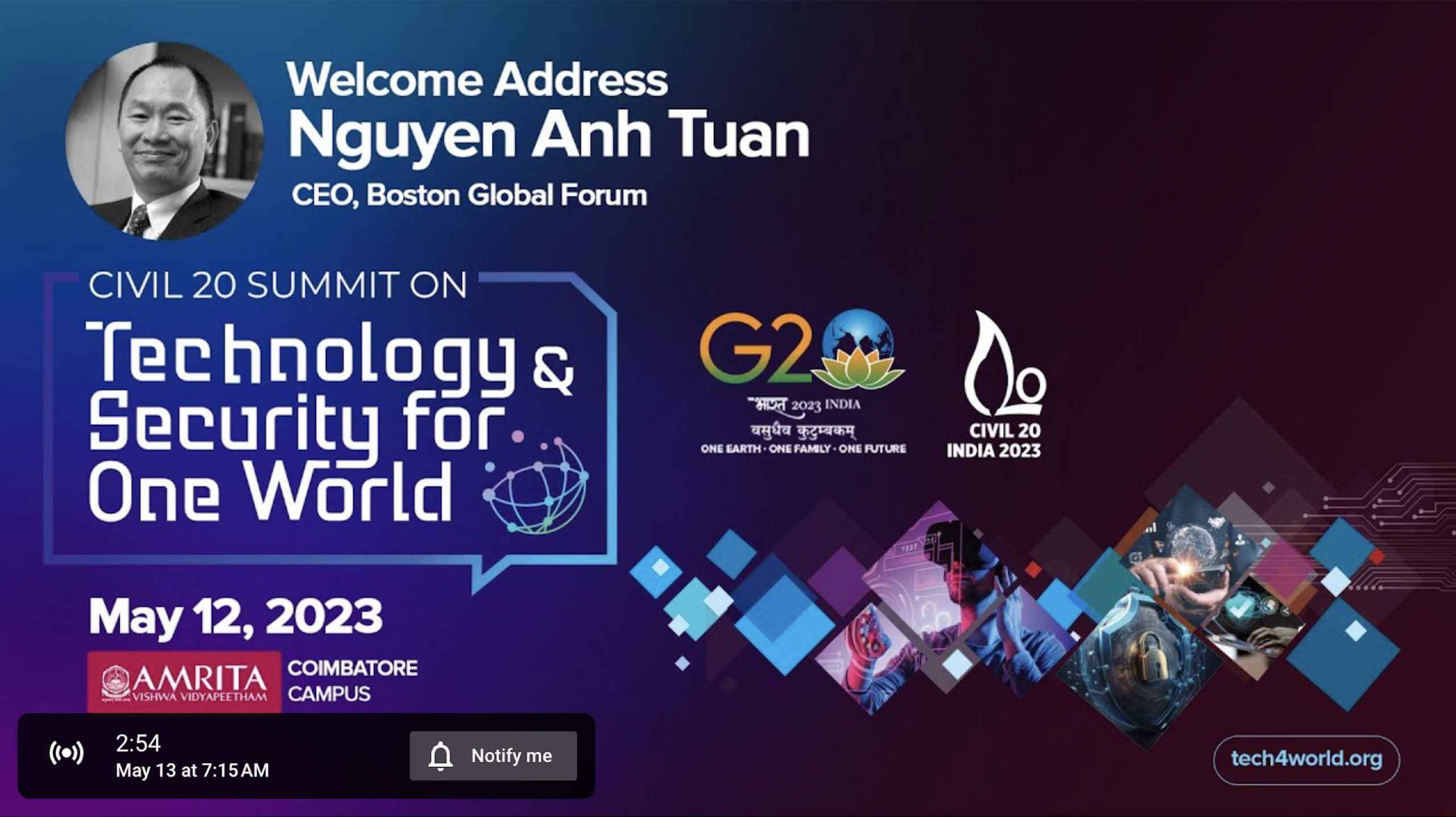
The C20 Technology and Security for One World Summit, G20 – C20 India
May 12-14, 2023
Global Enlightenment Community: From Words to Actions – The Urgency for Government and Civic Action
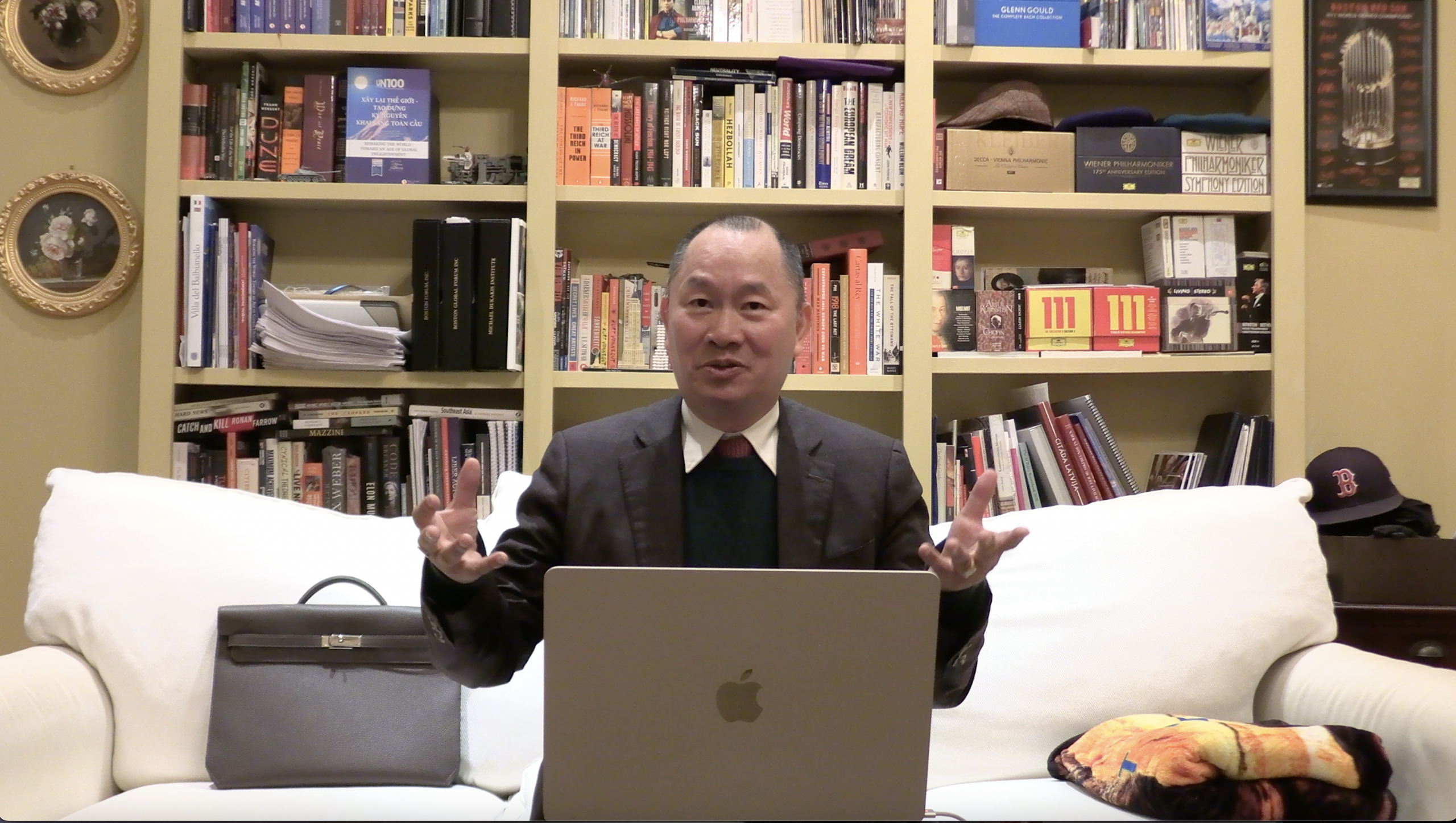
Special Address by Nguyen Anh Tuan, Co-founder and CEO of Boston Global Forum
Dear Professor Krishnashree Achuthan and distinguished guests,
I am honored to address you today at the C20 Technology and Security for One World Summit. In a world plagued by conflict and the threat of warfare, it is crucial that we also recognize the potential dangers of uncontrolled and unregulated artificial intelligence (AI) development.
Boston Global Forum (BGF), in response to these risks and the ongoing cybersecurity threats, initiated the AI World Society (AIWS) in 2017. The aim of AIWS is to establish a Seven-layer Model that maximizes the benefits of AI while managing and controlling the associated risks for individuals, organizations, and governments. This model seeks to achieve greater intelligence, higher labor productivity, increased efficiency, speed, and optimization, all while ensuring responsible AI development.
BGF has taken several initiatives to lay the foundation for a new AI World Society called the Age of Global Enlightenment. The first of these initiatives was the BGF-G7 Summit in 2018, which introduced the AIWS 7-Layer Model to Build Next Generation Democracy. Subsequently, the AIWS-G7 Summit Initiative in 2019 introduced the concepts of AI-Government and AI-Citizen. In collaboration with the United Nations Academic Impact, BGF co-founded the United Nations Centennial Initiative in 2019, with the goal of building the Age of Global Enlightenment.
To further solidify the framework for AI governance, BGF partnered with the Club de Madrid, an organization of over 100 former presidents and prime ministers, to announce the Social Contract for the Age of Artificial Intelligence in September 2020. This was followed by the announcement of the AI International Accord (AIIA) and the co-founding of the Global Alliance for Digital Governance (GADG) in September 2021. These initiatives provide a framework for relationships between nations, businesses, and individuals in the era of AI, technology, and data. It is crucial to understand that the world of AI, technology, and data requires not only technological standards but also social standards rooted in ethical principles. These fundamental standards represent the ideals that civilized humanity aspires to achieve, ensuring every citizen can maximize their potential in innovation, have equal opportunities, actively participate in social governance and supervision, receive fair opportunities in education, be educated in the foundational values of humanity and society, and have access to information, transparency, and public accountability. By adhering to these standards, we can limit conflicts, mutual destruction, and mitigate the risks posed by AI.
Furthermore, AI and data have the potential to build a better and more democratic society. By leveraging AI, we can restrain governments with extreme nationalist ambitions from deceiving the people through media manipulation and trampling on the sovereignty and territorial integrity of other nations. The Social Contract for the Age of Artificial Intelligence aims to empower each citizen to maximize their own abilities and power while upholding ethical standards.
In collaboration with the United Nations Academic Impact, BGF co-founded the United Nations Centennial Initiative in 2019, laying the groundwork for the Age of Global Enlightenment. The Social Contract for the Age of Artificial Intelligence explicitly recognizes AI Assistants as a center of power. Platforms like ChatGPT, born on November 30, 2022, serve as material embodiments of this idea. The question then arises: how do we control and govern this center of power?
To address this question, BGF organized a series of high-level conferences on Governance for AI Assistants and ChatGPT, culminating in the High-level Conference on April 26, 2023, at the Harvard University Faculty Club. The Framework for Global Governance of AI Assistants and ChatGPT was announced during this conference. These efforts, along with the establishment of the Global Enlightenment Community, create an international platform where leaders, thinkers, innovators, artists, and business leaders can come together to promote thought, creativity, and ethical behaviors worldwide. The community emphasizes the urgent need for government action to translate words into tangible actions.
In building the Age of Global Enlightenment, four pillars play a crucial role: the United States, Japan, Europe, and India. These countries and regions, with their technological prowess and economic models driven by AI and digital advancements, form the foundation for the Global Enlightenment Mountain—a new Silicon Valley model. It is heartening to see the establishment of the Global Internet Governance, Digital Empowerment and Security Alliance (GLIDES), which BGF fully supports as a Charter Member.
GLIDES, as an alliance of social organizations, will play a crucial role in connecting and harnessing the strength of humanity. By promoting unity and empowering citizens, it will contribute to creating a better world in the age of AI, guided by the principles of the AIWS model. The establishment of this alliance is not only essential but timely.
BGF, the Global Enlightenment Community, and GLIDES will collaborate on implementing action programs to navigate the AI age successfully. The Global Enlightenment Education Program aims to educate and equip citizens with knowledge and understanding to thrive in the AI-driven world. Simultaneously, the Global Enlightenment Leadership Program focuses on developing ethical and visionary leaders.
The GE Community, BGF, and GADG will serve as bridges for dialogue, control, and governance of AI. They will facilitate a global dialogue environment among civil society organizations, businesses, and governments to address challenges and risks associated with AI. Additionally, these entities will champion ethical AI innovation and explore new avenues of development for humanity, from improving democratic mechanisms to economic innovation.
Together, we will establish a technology-driven economic market across the United States, Japan, India, Europe, Canada, Australia, South Korea, Israel, ASEAN, and beyond. Our goal is to connect with all countries and citizens who uphold and implement the standards set forth in the Social Contract for the AI Age. Through this alliance, we will leverage the power of the market and democracy to protect values, standards, and the dignity of individuals worldwide.
While our focus initially lies on implementing these initiatives in advanced countries, we acknowledge the importance of extending our efforts to developing nations in Africa, the Middle East, and Latin America. The ultimate vision is to establish the Age of Global Enlightenment, turning the AIWS model into a tangible reality. This path of governance, guided by responsible humans and propelled by the right goals and a beautiful model, shows the synthesis between human ingenuity and new technologies.
As we embark on this journey, let us combine the essence of Boston with the warmth and emotional richness of the Vietnamese people to contribute to AIWS and build a new era—the Global Age of Enlightenment for humanity. Now is the time for action, and I am hopeful that India, as part of the G20, will help spearhead global initiatives. Let GADG, the Global Enlightenment Community, and GLIDES consolidate and unite to carry out these actions.
Together, we will harness the comprehensive strength of progressive humanity, ensuring that we navigate the AI age with wisdom and foresight, steering clear of potential catastrophes. Our action program, with its clear phases, emphasizes collaboration with governments, religious institutions, major AI and data companies, and the establishment of a creative AI-driven market system. This market system, with the GEM platform at its core, will empower citizens and protect their dignity against the influence of undemocratic institutions.
Our dedication to building a united force of citizens does not stop at the aforementioned regions. We also deeply care about the countries in Africa and the Middle East, recognizing their immense potential for growth and development. While we focus on implementing our initiatives in advanced nations first, we are committed to extending our support and collaboration to these developing countries. By fostering partnerships and providing the necessary resources, we aim to empower their citizens and ensure they are not left behind in the journey towards the Age of Global Enlightenment.
To achieve our collective vision, we need to leverage our knowledge, optimize our strategies, and take reasonable actions based on the best available information. It is through alliances and connections among progressive resources that we can create a powerful and unified voice—one that resonates with democratic citizens around the world. Together, we can help every individual become an educated and democratic global citizen, capable of innovating and shaping the future of our global society.
The Global Alliance for Digital Governance (GADG) and the Global Internet Governance, Digital Empowerment and Security Alliance (GLIDES) will play crucial roles in coordinating these resources. They will serve as the driving force behind comprehensive human progress, ensuring that the power of AI is harnessed for good and that humanity remains in control of its own destiny.
In our pursuit of the Age of Global Enlightenment, we emphasize the need for collaboration among governments, businesses, academia, and civil society. Only by working together can we overcome the challenges and risks posed by AI while unlocking its full potential for the benefit of all. By establishing open dialogue channels, fostering innovation, and implementing ethical practices, we can build a society that upholds the values of transparency, fairness, and democracy.
Furthermore, we recognize that the transformation towards an AI-driven future will require continuous education and knowledge-sharing. Through the Global Enlightenment Education Program, we will equip citizens with the necessary skills and understanding to thrive in the digital era. Simultaneously, the Global Enlightenment Leadership Program will nurture visionary leaders who can guide us through this transformative journey, ensuring that our actions are guided by wisdom and compassion.
Let us remember that the market is not merely a tool for economic exchange but a force that can shape societies. By harnessing the power of the market and aligning it with our shared values and standards, we can protect the dignity and worth of every individual. This alliance of citizens in the United States, Europe, India, Japan, Australia, Canada, South Korea, ASEAN, Brazil, and beyond will stand as a testament to our commitment to building a fair, just, and prosperous global society.
We can turn the ideals and principles of the Social Contract for the AI Age into a tangible reality. With the AIWS model as our guide, we will pave the way towards a future where AI and technology serve as tools for human progress rather than threats to our well-being. Let us seize this historic opportunity, united in purpose and driven by the shared vision of a better world.
India, as the host of the G20, has a unique opportunity to lead the way in global actions. We call upon India to take the helm, initiating collaborative efforts that will shape the course of our collective future. With the support of GADG, the Global Enlightenment Community, and GLIDES, we can consolidate our efforts and work towards the realization of our shared goals.
The time for action is now. Let us embark on this transformative journey together, leaving no one behind. By uniting our strengths and leveraging the power of AI and technology, we will usher in a new era—the Age of Global Enlightenment.