by Admin | Sep 13, 2013 | Highlights
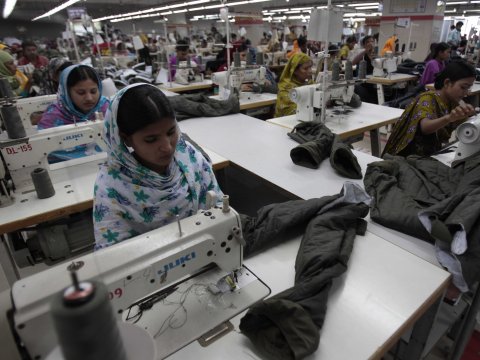
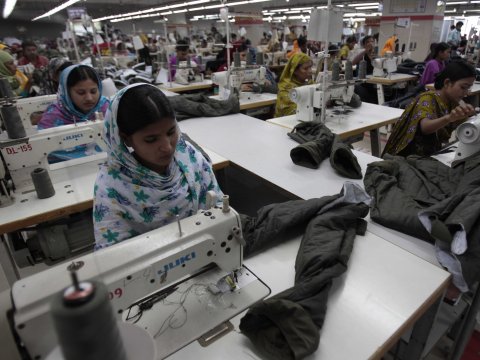
In the wake of the 2013 Rana Plaza building collapse, which killed more than 1,100 Bangladeshi garment workers, a group of retailers formed a pact to prevent future disasters. Some firms hesitated to sign the legally binding contract, fearing litigation. The labor unions and European firms which created the pact were concerned about the lack of cooperation and the implications for reform in Bangladesh.
Bangladesh Fire and Safety Accord
On July 8, 2013, over 80 global retailers, mainly European, and two labor unions proposed a five- year plan to improve working conditions in Bangladesh garment factories called the “Bangladesh Fire and Safety Accord”(BFSA).
1.Features of the pact included:
- Independent inspections of factories, with safety violations made public on the Internet
- Retailers to underwrite mandatory repairs and building improvements at factories
- Fire and building safety training to be given by trade unions
- Trade unions to have a seat on the Accord’s governing board
- Legally binding arbitration for non-compliance, led by the Accord’s steering committee
The pact required inspection of factories working for the signatories over two years
2. During that period, signatories of the Accord agreed to maintain production in Bangladesh. Participating retailers would share information about the factories they used, and each of those factories would be inspected within nine months.
3. Factories found to be unsafe would close for repairs, and workers would be paid up to six months’ salary during that time.
4. The cost of implementation would be split according to the proportion of production each brand had in Bangladesh – with a maximum outlay per retailer of $2.5 million over five years.
5. If a retailer failed to provide funding, or continued production in unsafe factories, the signatories could file complaints. A committee composed of three labor group representatives, three brand representatives and one member from the International Labour Organization (ILO) would enforce the Accord’s terms.
6. Disputes would be referred to arbitration, as needed, and the outcome would be legally binding in the brand’s home country. No penalty provisions were included in the pact.
For full article please download PDF file Rana Plaza (B)
by Admin | Sep 13, 2013 | Highlights
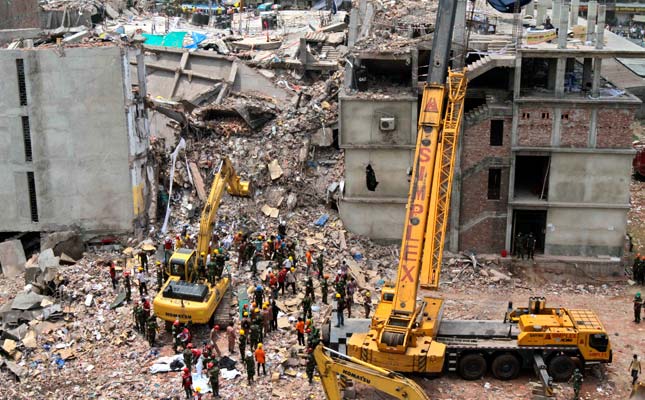
On April 24, 2013 the Rana Plaza factory building collapsed in the Savar industrial district outside of Dhaka, the capital of Bangladesh. Over 1,100 people were killed in the worst industrial accident since over 2,000 people were killed (and 150,000 injured) in the Union Carbide plant gas leak in Bhopal, India. Most of the victims worked for the five garment factories housed in Rana Plaza, whose primary clients were European, US and Canadian firms. Export contracts to such firms had helped Bangladesh become the world’s second largest clothing exporter. Rana Plaza was not the first tragedy to occur in Bangladesh’s garment industry, and without intervention, more might follow. Following the Rana Plaza disaster, international brand owners, domestic and foreign governments, labor unions and non-governmental organizations (NGOs), began to discuss responsibilities for improving conditions for Bangladeshi garment workers.
The Bangladesh Garment Industry
Following independence from Pakistan in 1971, the Bangladesh government began privatizing industries to spur economic growth. The garment industry became a major force in Bangladesh after the Multi-Fiber Arrangement (MFA) was enacted in 1974. The MFA regulated the sale of garments and textiles from developing countries to first world countries. The MFA, which was in effect until 2004, imposed quotas on garment exports from Korea, China, Hong Kong and India. No quotas were imposed on Bangladesh’s garment exports and its industry grew from $12,000 worth of exports in 1978 to over $21 billion in 2012. Even after the MFA expired, Bangladesh maintained export volume, thanks to its low labor costs. In 2012, Bangladesh was the second largest garment exporter in the world, after China.
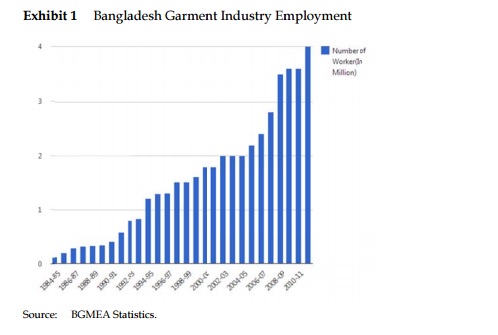
The garment industry was a major force in the Bangladesh economy. The industry employed 3.6 million people (and an additional million, through indirect employment) or roughly 2% of the population.6 The garment industry accounted for 13% of GDP. It was the single largest source of exports, 78% in 2011. (See Exhibit 1 for growth in garment industry employment over time). Workers in garment factories were paid approximately 13% more than workers in other industries. The vast majority of garment workers were women. In 2011, around 12% of Bangladeshi women between 15 and 30 years of age were employed in the garment industry.
Global Customers
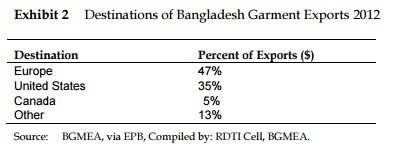
The majority of garments produced in Bangladesh were exported. In 2013, 2,000 out of 5,000 garment factories had export contracts, with many of the remaining 3,000 factories working as sub- contractors that provided additional capacity for the factories with international orders.11 Some multinational brands imposed strict limitations on the use of sub-contractors in their contracts ith primary suppliers, (in certain cases, processes existed for MNCs to grant permission for use of sub- contractors). It was also common for brands to employ agents to locate production capacity on their behalf. Nearly 90% of garments produced in Bangladesh were exported to the United States, Europe and Canada (see Exhibit 2 for proportionate export volume). In 2012, the US alone received $4.9 billion worth of garment exports from Bangladesh.
Many US and European fashion brands sourced items from Bangladesh. Brands with operations in Bangladesh included well-known global fast fashion labels H&M, Inditex (Zara), and Loblaw’s (Joe Fresh); as well as other low-to-mid priced labels like Wal-Mart, Gap, and PVH (Calvin Klein, Tommy Hilfiger, Timberland). Many brands required garment production to align with the seasonal release of new clothing collections (in spring, summer, fall and winter). These production schedules caused large spikes in demand for capacity, with little room for errors, around the seasonal release dates, and lower demand at other times.
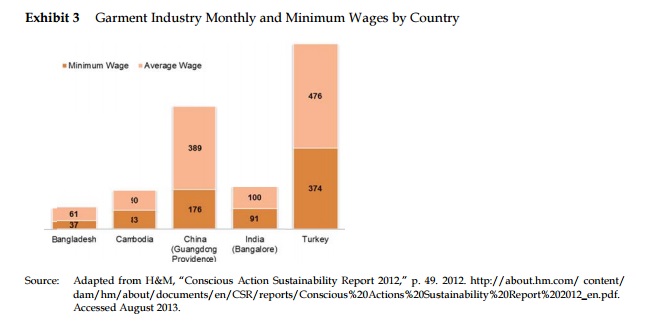
Low cost production and large capacity were key incentives for multinational corporations (MNCs) to produce garments in Bangladesh. The minimum wage in 2012 was $37 per month, and had only increased by $29 over the past 30 years. In comparison, China, the largest clothing exporter, had a minimum wage four times that of Bangladesh, and saw its labor costs increase by 30% in 2011 alone. As shown in Exhibit 3, Bangladesh’s minimum and average wages were far lower than those of other developing countries which produced garments for export. Combined labor cost differentials were expected to help Bangladesh’s garment industry to reach $30 billion by 2015.
Factory Conditions
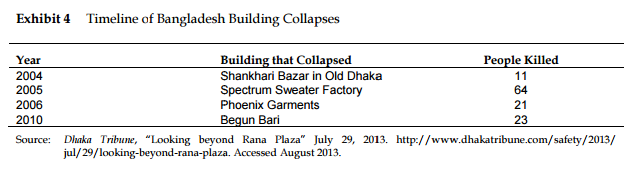
More than 1,000 garment workers were thought to have died and 3,000 to have been injured working in Bangladesh’s garment industry since 1990. (See Exhibit 4 for a list of industrial buildings which had collapsed in Bangladesh). The quick growth of the garment industry had resulted in fast construction of factories, often at the expense of adhering to building codes. The government feared foreign investment and export contracts would flow to other low cost garment producing countries if MNCs perceived Bangladesh’s factory safety record and labor disputes as risks to their brands. In 2012, the US Ambassador to Bangladesh shared with the Bangladesh Garment Manufacturers and Exporters Association (BGMEA) details of a call he received from the U.S. CEO of one of Bangladesh’s largest garment export customers. The CEO stated his concern that “the tarnishing of the Bangladesh brand may be putting our company’s reputation at risk.”
The Bangladesh Garment Manufacturers and Exporters Association (BGMEA) claimed to regularly monitor member factories for safety compliance. However, it was unclear the extent to which compliance was enforced. Following the Tazreen garment factory fire caused by unsafe storage of flammable materials in November of 2012, which killed over 100 workers, BGMEA inspectors were sent to member factories to check labor and safety compliance. Four of the buildings inspected, belonging to BGMEA President Atiqul Islam, were found to have numerous violations.
Numerous NGOs sought to improve labor and safety conditions for Bangladesh’s garment workers. Care Bangladesh partnered with MNCs to create programs to help female garment workers develop leadership skills. The Global Women’s Economic Empowerment Initiative, a partnership between Care Bangladesh and Wal-mart, helped nearly 24,000 female garment workers learn their legal rights and develop communication skills. Gap worked with Care Bangladesh to form the Personal Advancement and Career Enhancement Initiative for around 500 female garment workers employed in Gap’s supplier factories. Other NGOs, like the Awaj Foundation, empowered garment workers to understand and act upon their legal rights. The Awaj Foundation’s network included 255,719 garment workers and offered programs for workers on Bangladesh labor laws, fire safety, and health care services, among others. The Worker Rights Consortium inspected Bangladesh garment factories for labor violations but, over three years, it had only checked the factories associated with three factory owners. In 2007, the Bangladesh Center for Worker Solidarity, (an affiliate of the American Federation of Labor and Congress of Industrial Organizations,) petitioned the U.S. government to suspend trade privileges for Bangladesh, in light of worker rights violations in the garment industry.
The Bangladesh government tried to suppress activities by labor unions and other groups who attempted to highlight poor safety conditions in the country’s garment factories. Bangladesh police and security forces were suspected in the 2010 murder of labor activist Aminul Islam, the president of the Bangladesh Garment and Industrial Workers Federation’s in Savar and organizer of the Bangladesh Center for Worker Solidarity labor rights group. He was detained and beaten by Bangladesh security forces and his body showed signs of torture after being recovered in 2012.
Rana Plaza
On April 23, the day before the building collapse, workers observed cracks in the walls of the Rana Plaza building. The building housed five garment factories; as well as a bank and shopping mall. That morning, an engineer who had previously consulted for Sohel Rana, the building owner, deemed the building unsafe and recommended that the workers be evacuated. Later that day, a local government official met with Sohel Rana. After the meeting, the official declared the building was safe, pending another inspection. The workers of the Brac Bank branch heeded the advice of the engineer and vacated the building. Garment workers were informed that they were expected to return to work in the building the next morning, to fulfill overdue orders, or risk losing their jobs.
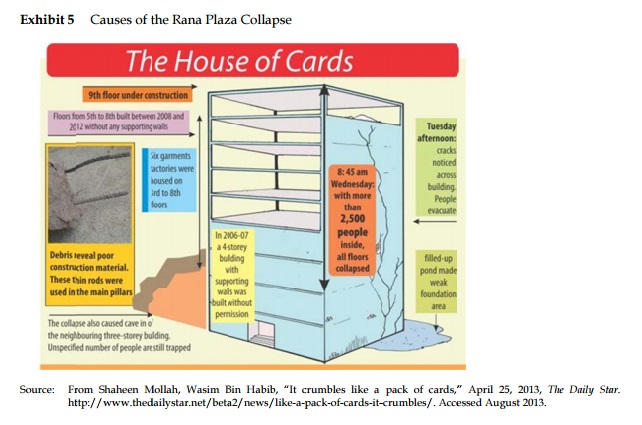
On April 24, 2013, the nine story Rana Plaza building collapsed, killing 1,100 workers and injuring 2,500 more. Sohel Rana was in his office in Rana Plaza when the disaster occurred; he fled but was arrested later at the Indian border. The disaster was caused by numerous structural problems (see Exhibit 5 for an illustration of the building):
- Four additional floors were constructed illegally upon the existing four stories, with a ninth floor under construction.
- The building lacked the supporting walls needed to hold heavy industrial machines and generators used by the factories.
- The lot where Rana Plaza stood was formerly a pond, which was filled only with sand.
- Inferior building materials were used to construct Rana Plaza.
To read the full Article please download Rana Plaza (A)
by Admin | Sep 11, 2013 | News
 Co-Founder, Chairman of The Board of Directors and Board of Thinkers, The Boston Global Forum.
Michael Stanley Dukakis was born in Brookline, Massachusetts to Greek immigrant parents. He attended Swarthmore College and Harvard Law School and served in the United States Army from 1955-1957, sixteen months of which was with the support group to the U.S. delegation to the Military Armistice Commission in Korea.
He served eight years as a member of the Massachusetts legislature and was elected governor of Massachusetts three times. He was the Democratic nominee for the presidency in 1988.
Since 1991 he has been a distinguished professor of political science at Northeastern University in Boston, and since 1996 visiting professor of public policy during the winter quarter at UCLA in Los Angeles. He is chairman of Boston Global Forum.
He is married to the former Kitty Dickson. They have three children—John, Andrea and Kara—and eight grandchildren.
by Admin | Sep 11, 2013 | News
 Robert Kuttner is Meyer and Ida Kirstein Professor at Brandeis University’s
Heller School. He is co-founder and co-editor of The American Prospect magazine,
and a senior fellow at the think-tank Demos. He was a longtime columnist for
BusinessWeek, and continues to write columns for The Boston Globe, Huffington
Post, and Reuters. He was a founder of the Economic Policy Institute and serves
on its board.
Kuttner is author of ten books, including the just published Debtors’ Prison and the
2008 New York Times bestseller, Obama’s Challenge: American’s Economic Crisis
and the Power of a Transformative Presidency. His best-known earlier book is
Everything for Sale: the Virtues and Limits of Markets (1997).
His writing has appeared in The New Yorker, New York Review of Books, The Atlantic,
The New Republic, Foreign Affairs, Harvard Business Review, The New York Times
Magazine and Book Review, New Statesman, Dissent, Politico, Columbia Journalism
Review and Political Science Quarterly. He has contributed major articles to The New
England Journal of Medicine as a national policy correspondent.
Kuttner’s other positions have included national staff writer and columnist on The
Washington Post, chief investigator of the U.S. Senate Banking Committee, and
economics editor of The New Republic.
He is the two-time winner of the Sidney Hillman Journalism Award, the John
Hancock Award for Business and Financial Writing, the Jack London Award for
Labor Writing, and the Paul Hoffman Award of the United Nations Development
Program for his lifetime work on social justice and economic efficiency. He has
been a Guggenheim Fellow, Woodrow Wilson Fellow, German Marshall Fund
Fellow, and John F. Kennedy Fellow.
Robert Kuttner was educated at Oberlin College, The London School of
Economics, and the University of California at Berkeley. He has taught at
Brandeis, Boston University, the University of Massachusetts, Harvard’s Institute
of Politics, and the University of Oregon. He lives in Boston with his wife, Joan
Fitzgerald, dean of the School of Public Policy and Urban Affairs at Northeastern.

