More than 60 researchers from 30 institutions will get access to Facebook user data to study its impact on elections and democracy, and how it’s used by advertisers and publishers.
A vast trove: Facebook will let academics see which websites its users linked to from January 2017 to February 2019. Notably, that means they won’t be able to look at the platform’s impact on the US presidential election in 2016, or on the Brexit referendum in the UK in the same year.
Despite this slightly glaring omission, it’s still hard to wrap your head around the scale of the data that will be shared, given that Facebook is used by 1.6 billion people every day. That’s more people than live in all of China, the most populous country on Earth. It will be one of the largest data sets on human behavior online to ever be released.
The process: Facebook didn’t pick the researchers. They were chosen by the Social Science Research Council, a US nonprofit. Facebook has been working on this project for over a year, as it tries to balance research interests against user privacy and confidentiality.
Privacy: In a blog post, Facebook said it will use a number of statistical techniques to make sure the data set can’t be used to identify individuals. Researchers will be able to access it only via a secure portal that uses a VPN and two-factor authentication, and there will be limits on the number of queries they can each run.
The context: Facebook is keen to improve its reputation after months of scandals over data privacy, security, and its role in elections and democracy. If it opens up its data as promised, it could introduce some much-needed light into what’s often a very heated debate.
Industry has mobilized to shape the science, morality and laws of artificial intelligence. On 10 May, letters of intent are due to the US National Science Foundation (NSF) for a new funding programme for projects on Fairness in Artificial Intelligence, in collaboration with Amazon. In April, after the European Commission released the Ethics Guidelines for Trustworthy AI, an academic member of the expert group that produced them described their creation as industry-dominated “ethics washing”. In March, Google formed an AI ethics board, which was dissolved a week later amid controversy. In January, Facebook invested US$7.5 million in a centre on ethics and AI at the Technical University of Munich, Germany.
Companies’ input in shaping the future of AI is essential, but they cannot retain the power they have gained to frame research on how their systems impact society or on how we evaluate the effect morally. Governments and publicly accountable entities must support independent research, and insist that industry shares enough data for it to be kept accountable.
Algorithmic-decision systems touch every corner of our lives: medical treatments and insurance; mortgages and transportation; policing, bail and parole; newsfeeds and political and commercial advertising. Because algorithms are trained on existing data that reflect social inequalities, they risk perpetuating systemic injustice unless people consciously design countervailing measures. For example, AI systems to predict recidivism might incorporate differential policing of black and white communities, or those to rate the likely success of job candidates might build on a history of gender-biased promotions.
Inside an algorithmic black box, societal biases are rendered invisible and unaccountable. When designed for profit-making alone, algorithms necessarily diverge from the public interest — information asymmetries, bargaining power and externalities pervade these markets. For example, Facebook and YouTube profit from people staying on their sites and by offering advertisers technology to deliver precisely targeted messages. That could turn out to be illegal or dangerous. The US Department of Housing and Urban Development has charged Facebook with enabling discrimination in housing adverts (correlates of race and religion could be used to affect who sees a listing). YouTube’s recommendation algorithm has been implicated in stoking anti-vaccine conspiracies. I see these sorts of service as the emissions of high-tech industry: they bring profits, but the costs are borne by society. (The companies have stated that they work to ensure their products are socially responsible.)
From mobile phones to medical care, governments, academics and civil-society organizations endeavour to study how technologies affect society and to provide a check on market-driven organizations. Industry players intervene strategically in those efforts.
When the NSF lends Amazon the legitimacy of its process for a $7.6-million programme (0.03% of Amazon’s 2018 research and development spending), it undermines the role of public research as a counterweight to industry-funded research. A university abdicates its central role when it accepts funding from a firm to study the moral, political and legal implications of practices that are core to the business model of that firm. So too do governments that delegate policy frameworks to industry-dominated panels. Yes, institutions have erected some safeguards. NSF will award research grants through its normal peer-review process, without Amazon’s input, but Amazon retains the contractual, technical and organizational means to promote the projects that suit its goals. The Technical University of Munich reports that the funds from Facebook come without obligations or conditions, and that the company will not have a place on the centre’s advisory board. In my opinion, the risk and perception of undue influence is still too great, given the magnitude of this sole-source gift and how it bears directly on the donor’s interests.
Today’s leading technology companies were born at a time of high faith in market-based mechanisms. In the 1990s, regulation was restricted, and public facilities such as railways and utilities were privatized. Initially hailed for bringing democracy andgrowth, pre-eminent tech companies came under suspicion after the Great Recession of the late 2000s. Germany, Australia and the United Kingdom have all passed or are planning laws to impose large fines on firms or personal liability on executives for the ills for which the companies are now blamed.
This new-found regulatory zeal might be an overreaction. (Tech anxiety without reliable research will be no better as a guide to policy than was tech utopianism.) Still, it creates incentives for industry to cooperate.
Governments should use that leverage to demand that companies share data in properly-protected databases with access granted to appropriately insulated, publicly-funded researchers. Industry participation in policy panels should be strictly limited.
Industry has the data and expertise necessary to design fairness into AI systems. It cannot be excluded from the processes by which we investigate which worries are real and which safeguards work, but it must not be allowed to direct them. Organizations working to ensure that AI is fair and beneficial must be publicly funded, subject to peer review and transparent to civil society. And society must demand increased public investment in independent research rather than hoping that industry funding will fill the gap without corrupting the process.
Recently, on a dazzling morning in Palm Springs, California, Vivienne Szetook to a small stage to deliver perhaps the most nerve-racking presentation of her career.
She knew the subject matter inside-out. She was to tell the audience about the chips, being developed in her lab at MIT, that promise to bring powerful artificial intelligence to a multitude of devices where power is limited, beyond the reach of the vast data centers where most AI computations take place. However, the event—and the audience—gave Sze pause.
TONY LUONG
The setting was MARS, an elite, invite-only conference where robots stroll (or fly) through a luxury resort, mingling with famous scientists and sci-fi authors. Just a few researchers are invited to give technical talks, and the sessions are meant to be both awe-inspiring and enlightening. The crowd, meanwhile, consisted of about 100 of the world’s most important researchers, CEOs, and entrepreneurs. MARS is hosted by none other than Amazon’s founder and chairman, Jeff Bezos, who sat in the front row.
“It was, I guess you’d say, a pretty high-caliber audience,” Sze recalls with a laugh.
Other MARS speakers would introduce a karate-chopping robot, drones that flap like large, eerily silent insects, and even optimistic blueprints for Martian colonies. Sze’s chips might seem more modest; to the naked eye, they’re indistinguishable from the chips you’d find inside any electronic device. But they are arguably a lot more important than anything else on show at the event.
New capabilities
Newly designed chips, like the ones being developed in Sze’s lab, may be crucial to future progress in AI—including stuff like the drones and robots found at MARS. Until now, AI software has largely run on graphical chips, but new hardware could make AI algorithms more powerful, which would unlock new applications. New AI chips could make warehouse robots more common or let smartphones create photo-realistic augmented-reality scenery.
Sze’s chips are both extremely efficient and flexible in their design, something that is crucial for a field that’s evolving incredibly quickly.
The microchips are designed to squeeze more out of the “deep-learning” AI algorithms that have already turned the world upside down. And in the process, they may inspire those algorithms themselves to evolve. “We need new hardware because Moore’s law has slowed down,” Sze says, referring to the axiom coined by Intel cofounder Gordon Moore that predicted that the number of transistors on a chip will double roughly every 18 months—leading to a commensurate performance boost in computer power.
TONY LUONG
This law is increasingly now running into the physical limits that come with engineering components at an atomic scale. And it is spurring new interest in alternative architectures and approaches to computing.
The high stakes attached to investing in next-generation AI chips—and maintaining America’s dominance in chipmaking overall—aren’t lost on the US government. Sze’s microchips are being developed with funding from a Defense Advanced Research Projects Agency (DARPA) program meant to help develop new AI chip designs (see “The out-there AI ideas designed to keep the US ahead of China”).
But innovation in chipmaking has been spurred mostly by the emergence of deep learning, a very powerful way for machines to learn to perform useful tasks. Instead of giving a computer a set of rules to follow, a machine basically programs itself. Training data is fed into a large, simulated artificial neural network, which is then tweaked so that it produces the desired result. With enough training, a deep-learning system can find subtle and abstract patterns in data. The technique is applied to an ever-growing array of practical tasks, from face recognition on smartphones to predicting disease from medical images.
The new chip race
Deep learning is not so reliant on Moore’s law. Neural nets run many mathematical computations in parallel, so they run far more effectively on the specialized video-game graphics chips that perform parallel computations for rendering 3-D imagery. But microchips designed specifically for the computations that underpin deep learning should be even more powerful.
Big tech companies hoping to harness and commercialize AI—including Google, Microsoft, and (yes) Amazon—are all working on their own deep-learning chips. Many smaller companies are developing new chips, too. “It’s impossible to keep track of all the companies jumping into the AI-chip space,” says Mike Delmer, a microchip analyst at the Linley Group, an analyst firm. “I’m not joking that we learn about a new one nearly every week.”
The real opportunity, says Sze, isn’t building the most-powerful deep-learning chips possible. Power efficiency is important because AI also needs to run beyond the reach of large data centers, which means relying only on the power available on the device itself to run. This is known as operating on “the edge.”
“AI will be everywhere—and figuring out ways to make things more energy-efficient will be extremely important,” says Naveen Rao, vice president of the artificial intelligence products group at Intel.
For example, Sze’s hardware is more efficient partly because it physically reduces the bottleneck between where data is stored and where it’s analyzed, but also because it uses clever schemes for reusing data. Before joining MIT, Sze pioneered this approach for improving the efficiency of video compression while at Texas Instruments.
For a fast-moving field like deep learning, the challenge for those working on AI chips is making sure they are flexible enough to be adapted to work for any application. It is easy to design a super-efficient chip capable of doing just one thing, but such a product will quickly become obsolete.
Sze’s chip is called Eyeriss. Developed in collaboration with Joel Emer, a research scientist at Nvidia and a professor at MIT, it was tested alongside a number of standard processors to see how it handles a range of different deep-learning algorithms. By balancing efficiency with flexibility, the new chip achieves performance 10 or even 1,000 times more efficient than existing hardware does, according to a paper posted online last year.
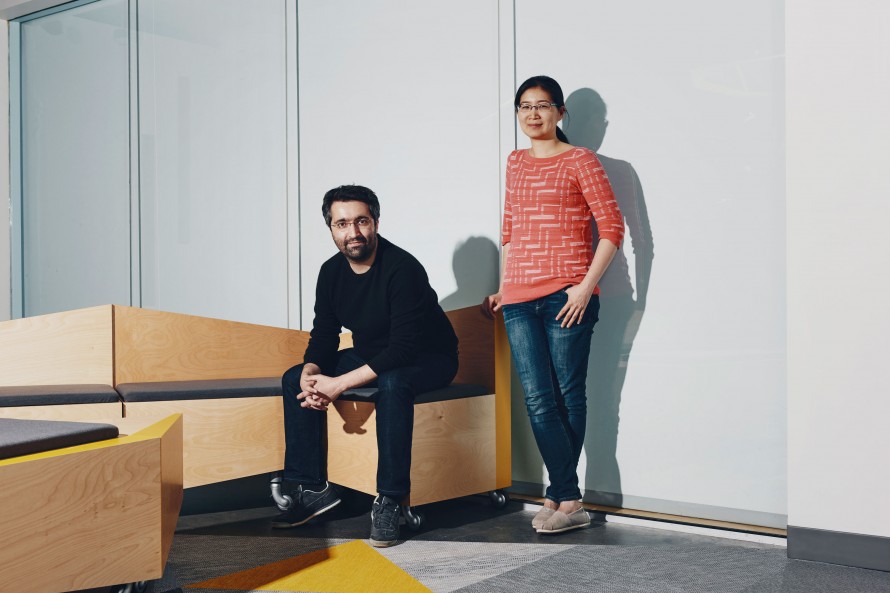
MIT’s Sertac Karaman and Vivienne Sze developed the new chip
TONY LUONG
Simpler AI chips are already having a major impact. High-end smartphones already include chips optimized for running deep-learning algorithms for image and voice recognition. More-efficient chips could let these devices run more-powerful AI code with better capabilities. Self-driving cars, too, need powerful AI computer chips, as most prototypes currently rely on a trunk-load of computers.
Rao says the MIT chips are promising, but many factors will determine whether a new hardware architecture succeeds. One of the most important factors, he says, is developing software that lets programmers run code on it. “Making something usable from a compiler standpoint is probably the single biggest obstacle to adoption,” he says.
Sze’s lab is, in fact, also exploring ways of designing software so that it better exploits the properties of existing computer chips. And this work extends beyond just deep learning.
Together with Sertac Karaman, from MIT’s Department of Aeronautics and Astronautics, Sze developed a low-power chip called Navion that performs 3-D mapping and navigation incredibly efficiently, for use on a tiny drone. Crucial to this effort was crafting the chip to exploit the behavior of navigation-focused algorithms—and designing the algorithm to make the most of a custom chip. Together with the work on deep learning, Navion reflects the way AI software and hardware are now starting to evolve in symbiosis.
Sze’s chips might not be as attention-grabbing as a flapping drone, but the fact that they were showcased at MARS offers some sense of how important her technology—and innovation in silicon more generally—will be for the future of AI. After her presentation, Sze says, some of the other MARS speakers expressed an interest in finding out more. “People found a lot of important use cases,” she says.
In other words, expect the eye-catching robots and drones at the next MARS conference to come with something rather special hidden inside.
TOKYO (Reuters) – Japanese Prime Minister Shinzo Abe has said he is ready to meet North Korean leader Kim Jong Un without conditions to end long-running mistrust between their countries, the Sankei newspaper reported on Friday.
Abe’s remarks come days after he met U.S. President Donald Trump in Washington and thanked Trump for raising with Kim, at a February summit, the topic of Japanese people abducted by North Korea.
Resolving the issue of Japanese people abducted by North Korean agents decades ago to train the North’s spies has for years been a Japanese condition for improving diplomatic and economic ties with North Korea.
Japan, like the United States, is also seeking an end to North Korea’s nuclear and missile programs.
Abe signaled a shift in Japan’s position in an interview with the newspaper on Wednesday, saying the only way to “break the current mutual distrust” was for him to hold unconditional talks with Kim.
“That’s why I would like to meet him without setting preconditions and hold frank discussions. I hope he’s a leader who can determine flexibly and strategically what is best for his country,” Abe was quoted as saying.
In 2002, North Korea said that it had kidnapped 13 Japanese in the 1970s and 1980s.
Japan believes 17 of its citizens were abducted, five of whom were repatriated. Eight were said by North Korea to have died, while four were said to have never entered the country.
Abe’s shift on North Korea comes after more than a year of efforts by it to improves its foreign relations.
Kim has met Trump twice since June last year and has held three summits with South Korean President Moon Jae-in.
Kim also met Russian President Vladimir Putin last month.
That leaves Japan as the only regional power involved in the North Korea nuclear crisis yet to have a summit with the North’s leader.
The last meeting between the leaders of Japan and North Korea was in 2004, when the Japanese prime minister, Junichiro Koizumi, met Kim’s late father, Kim Jong-il.
They pledged to work together to resolve the abductee issue.
Reporting by Leika Kihara in Tokyo and Jack Kim in Seoul; Editing by Robert Birsel
NATIONAL REPORT—Food waste is enormously costly for hotel owners and managers across the US. Financially, the average kitchen spends 5-15% of food costs on food that is never eaten. From an operational point of view, kitchen staff lose countless hours preparing uneaten food. It also has a huge environmental toll. If food waste were a country it would have more impact on global warming than every country in the world, except China and the U.S.
Alongside Middle East hotel chain Emaar Hospitality Group and retail giant IKEA, the technology has been tested in the field and is now ready to scale across hospitality companies across the Americas.
How can AI reduce food waste?
Using a form of AI called computer vision, Winnow’s new tool – Winnow Vision – automatically captures waste food via an intelligent camera that sits above the bin. As food is discarded over the course of the day, the data is collected in the cloud and shared with the team to help them cut food costs by an average of 3-8%.
Previously, simply collecting the data to understand what is wasted in the kitchen is a time-consuming and inaccurate process. Now, with the application of AI to automate data capture, Winnow Vision has surpassed human levels of accuracy in identifying food waste.
This major milestone ensures that kitchen teams receive pinpoint data to reduce waste without manually entering the data. The captured image data provides an extra layer of validation, giving confidence to the chef and hotel management team that the data is accurate.
For hotel chains with multiple properties across the country, reports on waste volume and value can highlight the top performing locations, and the locations which need further support to increase profitability.
Emaar hotels cut food waste by 72%
Emaar Hospitality Group deployed Winnow Vision at 12 locations across the Middle East to cut their costs, but also because they recognize that food waste is an issue that customers care about.
Like in the U.S., there is rising demand at the government level to reduce food waste. For the hospitality sector, an alignment with customer and government pressure can be blended with pragmatic business sense.
“We know that food is a big expense, but nonetheless the savings we made exceeded our expectations.” says Olivier Harnisch, CEO of Emaar Hospitality Group. “Across our 12 properties we reduced food waste by 72% in a short period of time—around $350,000.
Before launching Winnow Vision this year, Winnow has also been working with an international group of hotels and casinos, saving $30 million for clients annually, including some of the biggest names in the hotel sector like Accor, IHG and Hilton. By 2025, the aim is to save clients $1 billion in food savings every year.
Hotel chains across the U.S. have the opportunity to be the first to roll out AI in their kitchens nationwide. The opportunity is both financial and competitive—hotel chains can save thousands of dollars each year through the use of AI, and attract new customers who share the belief that food is too valuable to waste.
If you want to learn how your hotel kitchen could run more profitably and sustainably by cutting food waste,