by Robert Whitcomb | Jul 1, 2016 | News
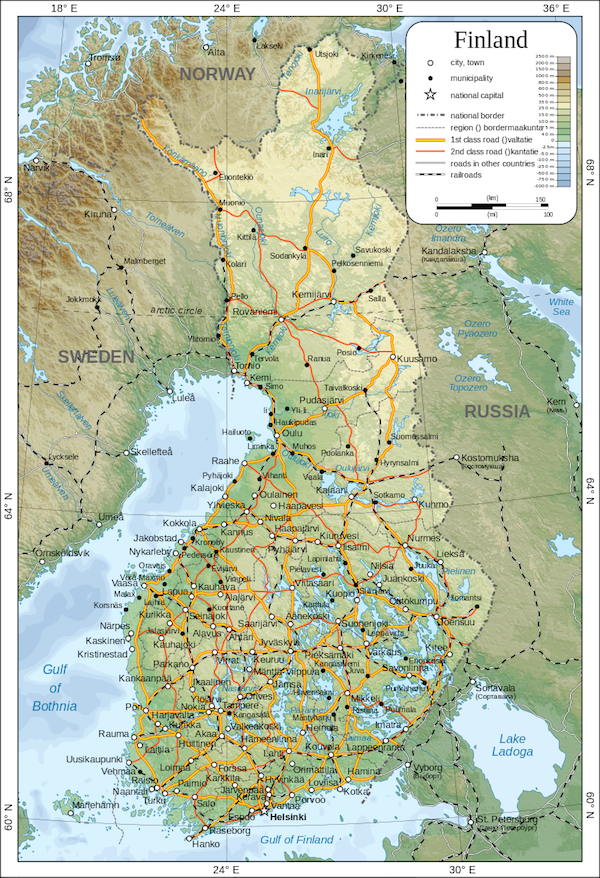
Russian President Vladimir Putin warned on July 1 that Russia might move its troops closer to the Finnish-Russian border if Finland joins NATO. Finland, Poland and the Baltic Republics have been subjected to Russian air force and naval incursions and cyberattacks by the increasingly aggressive Putin administration.
Finnish armed forces “would become part of NATO’s military infrastructure, which overnight would be at the borders of the Russian Federation,” Mr. Putin said after meeting with Finnish President Sauli Niinisto.
“Do you think we will keep it as it is: our troops at 1,500 (kilometers, 900 miles) away?”
Mr. Putin was making his first visit to Finland since Russian seized Crimea from Ukraine and attacked the eastern part of that country.
The technically neutral but basically pro-NATO Finland and Sweden are increasing their co-operation with NATO in light of Russian threats..
To read the full Reuters story, please hit this link.
by Robert Whitcomb | Jul 1, 2016 | News
Satellite imagery suggests that China might be punishing its ally North Korea for its nuclear-weapons tests by sharply restricting trade between the two dictatorships.
“It is apparent that shortly after North Korea did the fourth nuclear test in January, China took unilateral measures to drastically curtail trade interaction along their border,” Victor Cha, director for Asian affairs at the National Security Council during the George W. Bush administration, told The Washington Post.
To read The Post’s article on this, please hit this link.
by Robert Whitcomb | Jul 1, 2016 | News
In a redomination of its currency, Belarus is cutting four zeroes off the face value of the ruble as the country, which is virtually a satellite of Russia, struggles with recession.
It’s the third redomination in the nation of 10 million since it became independent after the 1991 collapse of the Soviet Union. The Belarusian ruble, which had traded at 20,000 to the dollar before the move, now stands at 2 rubles a dollar.
Belarus’s economy, which depends on neighboring Russia for cheap energy and subsidies, shrank 4 percent last year and is seen falling another 3 percent this year.
President Alexander Lukashenko’s authoritarian government has sought a $3 billion bailout from the International Monetary Fund.
To read a Japan Times article on this, please hit this link.
by Robert Whitcomb | Jul 1, 2016 | News
Chinese President Xi Jinping emphasized the importance of ideological orthodoxy to ensure the power and legitimacy of Communist Party rule.
“The wavering of idealistic faith is the most dangerous form of wavering,” Mr. Xi told an assembly of party officials and members at Beijing’s Great Hall of the People on July 1. “A political party’s decline often starts with the loss or lack of idealistic faith.”
“Turning our backs or abandoning Marxism means that our party would lose its soul and direction,” he said.
Mr. Xi has tried to energize the Communist Party with iron discipline and an appeal to nationalism meant to curb corruption and bureaucratic sluggishness — all with the aim of perpetuating the party’s power.
China’s economic slowdown has intensified the pressure to reinforce the party, including by appealing to national pride as expressed by China’s aggressive expansionism. But that, of course has met with increasing pushback from China’s neighbors.
“Xi’s speech was a celebration and a warning,” said Jude Blanchette, a Beijing-based researcher who is writing a book on Mao Zedong’s legacy, told The Wall Street Journal. It is “a reminder that Xi’s vision for China cannot be divorced from a strong, organized and highly disciplined Communist Party.”
To read a Wall Street Journal article on this news, please hit this link.
by Robert Whitcomb | Jul 1, 2016 | Initiative
The Twitter account of Brendan Iribe, who runs Facebook’s virtual-reality headset maker, Oculus, has been hacked, making him the latest in a long line of celebrity and tech bosses to have had their social-media accounts compromised in recent weeks.
This doesn’t exactly expand the public’s confidence in the tech industry.
To read The Guardian’s story on this, please hit this link.