
Keeping terrorists from social media requires tech solutions more than legal ones


Paul Barrett writes in Bloomberg:

“A lawsuit filed against Facebook Inc. on behalf of terrorism victims in Israel illustrates some of the complications of going to court to remedy violent radicalism.”
“Lawyers for the victims sued Facebook in Manhattan federal court on Monday, seeking $1 billion in damages. They alleged that the U.S. company allowed Palestinian militants affiliated with Hamas, branded by the U.S. government as a terrorist organization, to use the online service to plan attacks that killed four Americans and wounded another in Israel, the West Bank, and Jerusalem. The suit alleged that Hamas has used Facebook to share operational information and instructions for carrying out attacks.”
“{I}t’s fair to say that the suit against Facebook faces some serious legal hurdles. First, there is the so-called safe harbor provision of the (U.S.} Communications Decency Act. That measure protects online service providers, such as Facebook, from legal liability related to what their users say. The suit against Facebook argues that the 1992 Anti-Terrorism Act, which prohibits material support to terrorist groups, ought to trump the communications decency law.”

But, Mr. Barrett argues, “In light of … potential legal obstructions, the application of effective blocking technology might work better than litigation. Gabriel Weimann, an expert on terrorism on the Internet at Haifa University told Bloomberg that the focus should be on developing faster ways to detect problematic messages so they can be blocked immediately, before they go viral, Weimann said. ‘Facebook isn’t the only platform,’ he added. ‘There are plenty of others. What will you do? Sue them all?”’

Mr. Barrett went on:

“Facebook clearly knows how to do what Weimann recommends. In March, the company took down a page advocating a new Palestinian uprising against Israel because it made ‘direct calls for violence.’ Better algorithms applied more aggressively could accomplish far more than long-shot, billion-dollar lawsuits. Indeed, Facebook would be wise to explore a settlement of this case built on a foundation of improved blocking technology aimed at violent fanaticism of all sorts.”

To read Mr, Barrett’s article, please hit this link.

Google tells patrons of 4,000 state-sponsored cyberattacks a month

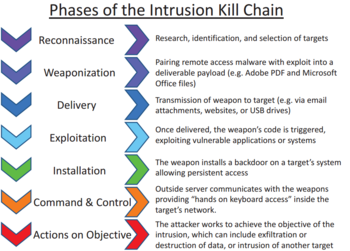
killchain

Google senior vice president Diane Greene said on July 11 that the company was notifying customers of about 4,000 state-sponsored cyberattacks per month.

The Internet search leader has led the sector in notifying users of government spying. Others, including Microsoft Corp (MSFT.O), have followed suit.

China and Russia are considered the leading cyberattackers.

To read a Reuters story on this, please hit this link.


Downed Russian copter raises questions about the size of Russia’s role in Syria


The apparent shooting down of a new Russian state-of-the-art Mi-35M helicopter, which could only be operated by the Russian military, over a Syrian area controlled by the Islamic State suggests how much the Russians are directly involved in the Syrian civil war to support dictator Bashar Assad.

The Washington Post noted that the case of the downed aircraft again raises the question of how much Russian forces, including special forces and artillery, are “helping Syria’s battered military take back ground held by the Islamic State and other rebel groups, including those {anti-Islamic State ones} backed by the United States?”

To read The Post’s story, please hit this link.

Abe pushes to end price deflation, boost economic growth


Japanese Prime Minister Shinzo Abe has ordered Economic Revitalization Minister Nobuteru Ishihara  to draft a range of economic measures to end deflation and raise Japan’s growth potential. The program will include  a supplementary  fiscal 2016 budget.

The government will submit the fiscal 2016 budget draft  to a special session of parliament this fall, Mr. Ishihara told a news conference on July 12.

The Japan Times reported that he had “declined to comment on the size of the economic measures, saying that will be decided at the end of the month using a ‘bottom-up approach.”’

Last December, The Boston Global Forum named Mr. Abe a “Global Leader in Cybersecurity.”

For The Japan Times’s article on this, please hit this link.

China loses big South China Sea case


schina

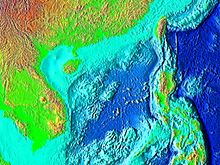
The northern  South China Sea.

China has lost an important international legal case over control of strategic reefs and atolls that it  asserts give it the right to control much of the South China Sea.  It has been rapidly militarizing some of  these features to cow other nations  with claims in the region, through which goes 30 percent of world trade in physical things.

But expansionist dictatorships have a tendency to ignore international law.

The judgment by an international tribunal in The Hague overwhelmingly favors claims by the Philippines and will intensify diplomatic pressure on Beijing to scale back military expansion in this geopolitically very sensitive area.

As The Guardian noted, “By depriving certain outcrops of territorial-generating status, the ruling effectively punches holes in China’s all-encompassing ‘nine-dash’ line that goes almost ridiculously far  into the South China Sea, far, far away from China.

China  predictably denounced the verdict, which declares large areas of the sea to be neutral international waters or in the exclusive economic zones of other countries. Xinhua, the country’s official news agency, attacked what it called  an “ill-founded” ruling that was “naturally null and void”.

The Communist Party  newspaper the People’s Daily said that the tribunal had ignored “basic truths” and “tramped” on international laws and norms. “The Chinese government and the Chinese people firmly oppose [the ruling] and will neither acknowledge it nor accept it,” it added.

The tribunal declared that “although Chinese navigators and fishermen, as well as those of other states, had historically made use of the islands in the South China Sea, there was no evidence that China had historically exercised exclusive control over the waters or their resources.”

To read The Guardian’s article on  this, please hit this link.