by Robert Whitcomb | Jul 14, 2016 | News
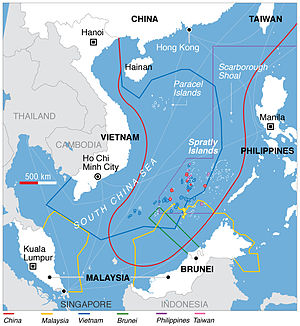
Claims in the South China Sea. Note that China claims everything within the red line.
The ruling last week by an international tribunal in the Hague against China’s claims over most of the South China Sea has raised uncertainty and tension amongst those in shipping and international trade.
The very clear July 12 ruling could lead smaller Asian countries to be more assertive regarding their rights in these waters, which, in turn, could increase the number of incidents with an increasingly expansionist and aggressive China, which its neighbors consider a bully.
A big question is how much this will affect freedom of navigation in a sea through which goes 30 percent of world trade. The United States, for its part, has emphasized that it will do what is necessary to keep the shipping lanes open in the region.
To read a Wall Street Journal story on this, please hit this link.
by Robert Whitcomb | Jul 14, 2016 | News
A U.S. federal appeals court has ruled that Microsoft Corp. won’t be forced to turn over e-mails stored in Ireland to the U.S. government for a drug investigation. Bloomberg reports that the decision might affect data security throughout the U.S. technology industry.
The ruling overturned a 2014 decision ordering Microsoft to hand over messages of a suspected drug trafficker. Bloomberg reported that the company had argued that would create a “’global free-for-all,’ with foreign countries forcing companies to turn over evidence stored in the U.S. ”
The government, for its part, said a ruling in favor of Microsoft would create loophole for fraudsters, hackers and drug traffickers.
The law doesn’t “authorize courts to issue and enforce against U.S.-based service providers warrants for the seizure of customer e-mail content that is stored exclusively on foreign servers,” U.S. federal Appeals Court Judge Susan Carney wrote for the majority of the appeals court serving New York.
To read the Bloomberg article, please hit this link.
by Robert Whitcomb | Jul 14, 2016 | News
Lucian Kim writes in a Reuters opinion piece that the Russian athletes’ “doping scandal is a symptom of a much larger problem: the casual disregard for the truth that has become a hallmark of {Russian President Vladimir} Putin’s rule. In a country where elections are rigged, lawsuits are fabricated, and state TV spews lies around the clock, it’s hard to know what ordinary citizens are to believe anymore. Beyond politics, corruption has not only gnawed away at Russia’s reputation as a sports powerhouse, but cheapened the prestige of its once-vaunted institutions of higher education.
“Putin’s initial denial of Russia’s 2014 military intervention in Crimea — followed by a later admission of it — was the clearest demonstration of the Kremlin’s belief that the ends justify the means. Many Russians seem to agree.
“In a poll taken by the independent Levada Center in April 2015, 37 percent of respondents said they believed their government that Russia wasn’t militarily involved in eastern Ukraine. An almost equal portion, 38 percent, said that ‘even if there are Russian soldiers and military equipment in Ukraine, it’s the correct policy for Russia to deny these facts in the current global situation.’ ”
To read Mr. Kim’s essay, please hit this link.
by Robert Whitcomb | Jul 14, 2016 | News

The Russian Far East is in red.
Many Russians fear that their nation’s Far East could end up being absorbed by China, with its 1.4 billion people and huge economy.
So the Russian government, following the directive of strongman President Vladimir Putin, is offering to give land to lure Russian settlers to the vast region. The nine Far Eastern regions covered by the program take up more than a third of Russia’s area but are home to only 6.1 million people, compared with the 110 million Chinese living across the border in Manchuria.
Mr. Putin said in 2013 that the development of Siberia and the Far East must be “our national priority for the entire 21st Century.”
To read a New York Times piece on this, please hit this link.
by Robert Whitcomb | Jul 14, 2016 | News
Su Bin, a Chinese businessman who admitted being part of a group hacking U.S. defense secrets, has been given nearly four years’ jail. He had been extradited from Canada.
Su Bin was convicted of taking part in a multi-year plot by Chinese military officers to obtain sensitive U.S. military information, including projects including the F-22 and F-35 fighter jets and Boeing’s C-17 military transport aircraft.
“Su assisted the Chinese military hackers in their efforts to illegally access and steal designs for cutting-edge military aircraft that are indispensable to our national defense,” said John Carlin, assistant attorney general for national security.
The Chinese government has repeatedly denied any involvement in hacking.
But, The Guardian noted, his spying has been been openly lauded in China.
“We are willing to show our gratitude and respect for his service to our country,” said a March editorial in the Global Times, a nationalistic newspaper with close ties to the China’s Communist Party dictatorship.
“On the secret battlefield without gunpowder, China needs special agents to gather secrets from the U.S.”
Prosecutors said Su, who ran a China-based aviation and aerospace company from Canada, traveled to the United States at least 10 times between 2008 and 2014 and worked with two unidentified China-based co-conspirators to steal the data.
Su admitted taking part in the crime for financial gain.
To read The Guardian story, please hit this link.