(14th Feb 2016) Mr. Nguyen Anh Tuan – CEO of The Boston Global Forum (BGF) and Mr. Robert Whitcomb, Managing Editor, Member of Editorial Board of The BGF shared their view about how China not Russia is the main threat for Global Cyber Security in respond to the view of George Soros on this article
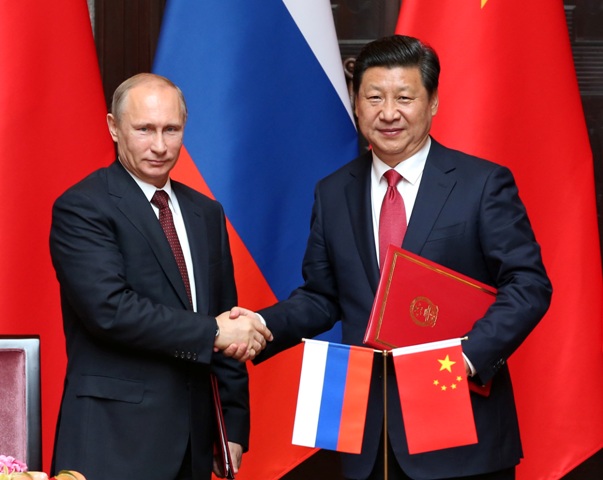
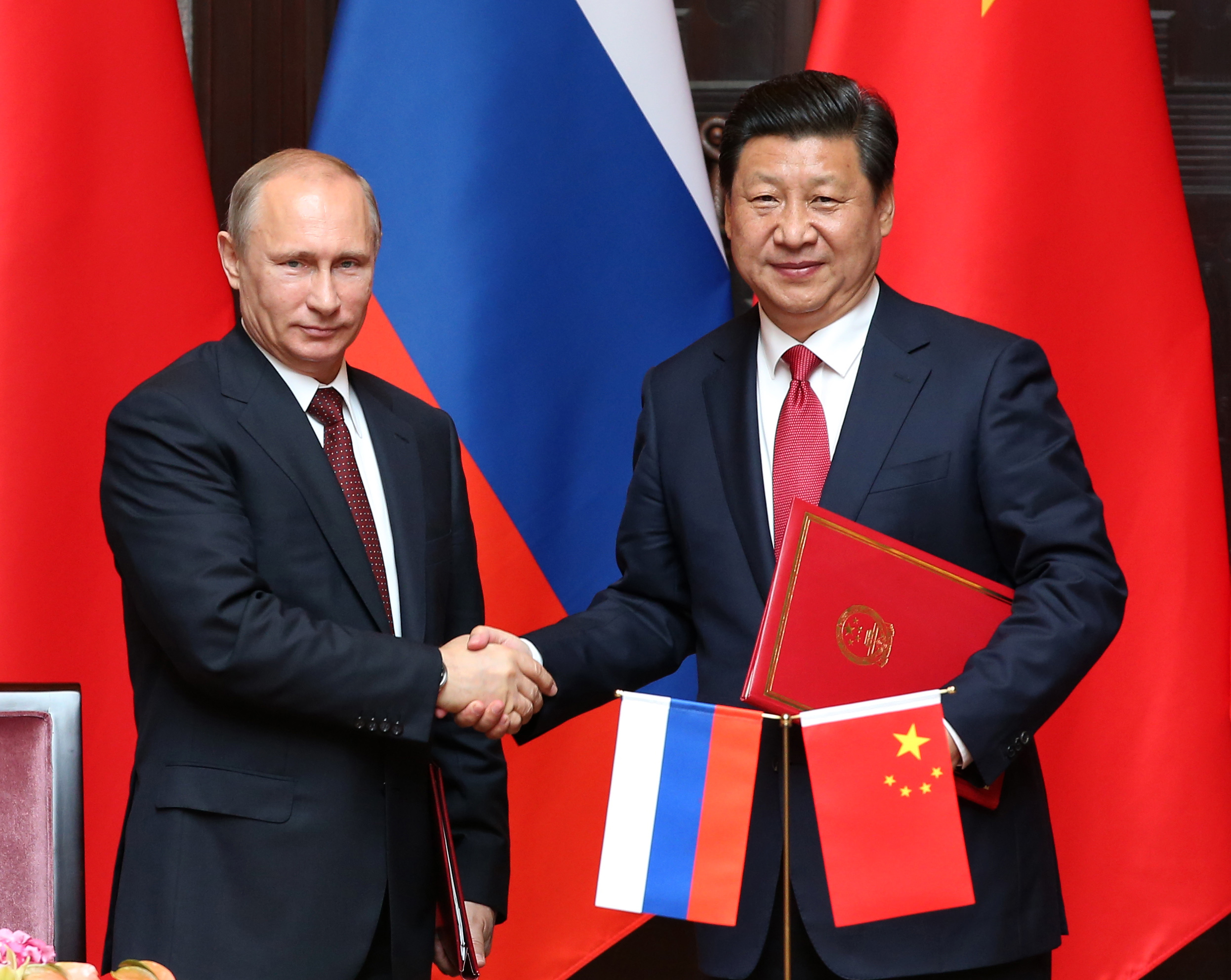
(140520) — SHANGHAI, May 20, 2014 (Xinhua) — Chinese President Xi Jinping (R) and Russian President Vladimir Putin sign a joint statement aimed at expanding cooperation in all fields and coordinating diplomatic efforts to cement the China-Russia all-round strategic partnership of cooperation after their talks in Shanghai, east China, May 20, 2014. (Xinhua/Pang Xinglei) (mp)
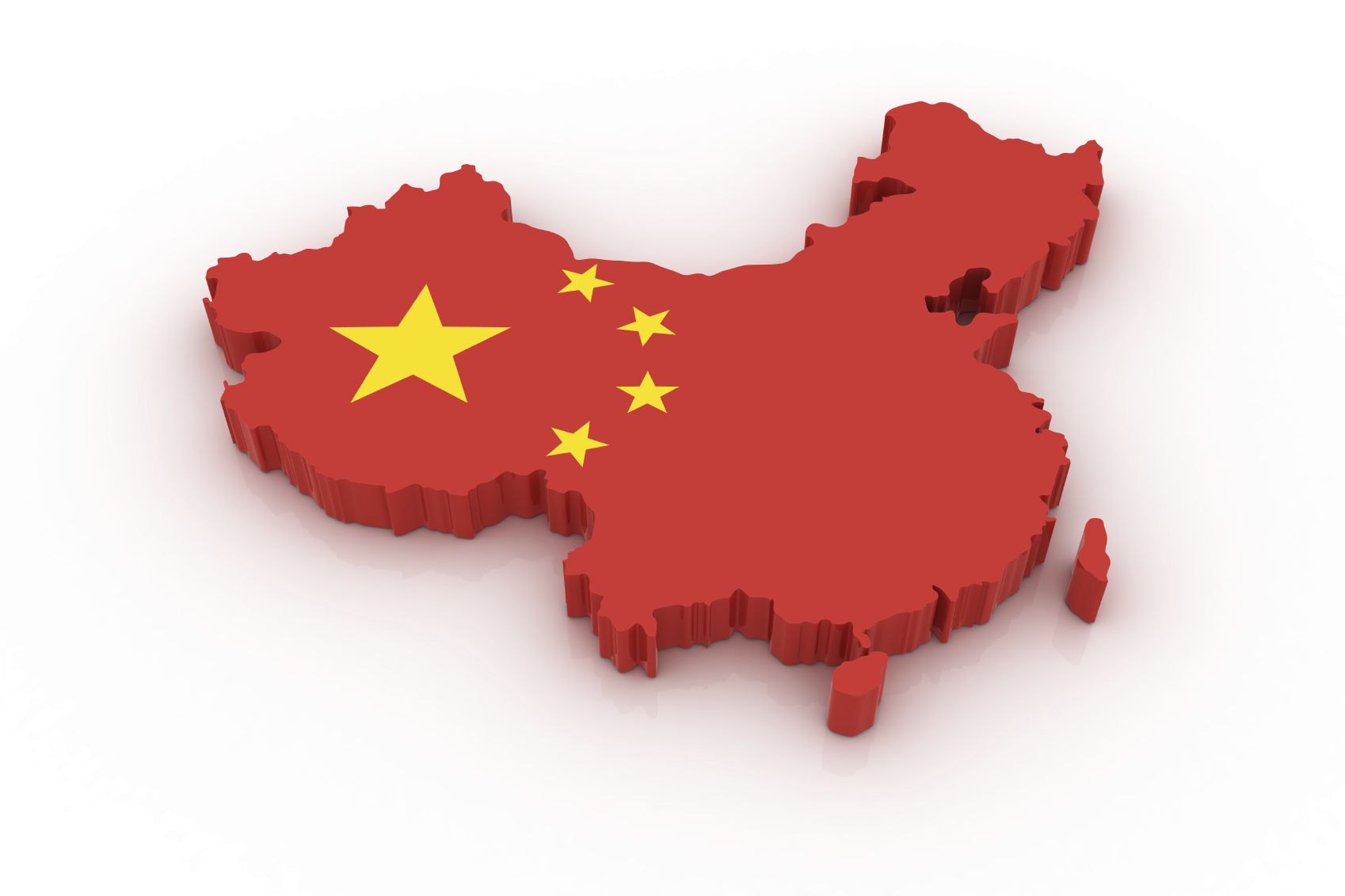
China, not Russia, is the main threat
George Soros is wrong on how to deal with Russian President Vladimir Putin. Mr. Soros, chairman of Soros Fund Management and of the Open Society Foundations, wrote a column published Feb. 10 by Project Syndicate headlined “Putin Is No Ally Against ISIS’’. In it, he urged Western leaders to more firmly respond to the Russian leader’s actions against Ukraine and his support of Syrian President Bashar Assad.
But Mr. Soros exaggerates Mr. Putin’s strength and intentions.
Yes, the Russian president seeks to strengthen the Russian position in Syria by supporting his ally Assad.
However, Russia is actually rather weak. Russian power – real and perceived — depends far too much on its large but rather antiquated military and the sale of oil. But the price of oil is very low, and may fall further, in part because of stunning American success in using its technology and engineering skills to produce much more oil and gas than anyone thought possible a decade ago. In addition, the U.S., with its big technological lead, and huge wealth, will continue to be much stronger militarily than Russia.
And consider that ISIS is a foe of the Assad regime and that radical Islam seriously threatens Russia itself, which has a substantial Muslim community, some of it radicalized.
Thus it makes much more sense to cooperate more with Russia to fight ISIS than to act as if Russia was the main foe.
The biggest challenge to world peace is China, whose totalitarian regime’s extreme expansionistic nationalism, armed with the world’s second-largest economy, 1.4 billion people (compared to only about 140 million in Russia!) and rapidly improving military, imperils the peace, liberties and other rights of nations in the Asia/Pacific region and beyond. And note that Russia’s Far East region may well face Chinese expansion in coming years.
The U.S., E.U. and Russia need to work together to face the challenge of Chinese aggression as well as to intensify the battle against ISIS. The West and Russia have stronger interests in common than they have with China.
(Feb. 12th, 2016) – On Feb. 11 at Harvard Kennedy School, The Boston Global Forum (BGF) held the second in series of online dialogues to build the BGF-G7 Summit Initiative. This session was with Bruce Schneier,fellow at the Berkman Center for Internet and Society at Harvard Law School, and the Chief Technology Officer at Resilient Systems. Schneier was honored as the Business leader in the Cybersecurity “for dedicating his career to the betterment of technology, security, privacy and Internet” in the Boston Global Forum’s Global Cybersecurity Day event which was held on December 12 at Harvard Faculty Club in Cambridge.
Watch the live-streamed talk here:
Bruce Schneier, a celebrated international cyber-security and cryptology expert, writer and consultant, took part in a wide-ranging discussion on Feb. 11 on cyber-threats and the techniques and policies needed to prevent, or at least reduce, them in what he called the current “cyber arms race.’’ His talk was the second of 12 online dialogues as part of the BGF-G7 Summit Initiative to address cyber-security.
He compared the cyber arms race with the confusing early days of nuclear energy (about whose benefits many people were too optimistic), including the nuclear-arms race between the Soviet Union and the United States. The fact is, Mr. Schneier said, that the world still lacks legal and other “norms,’’ and real treaties, with which to limit cyber-aggression by nations and individual “bad actors.’’ Things are chaotic.
Thus, he emphasized the need to focus on cyber-defense, such as through “patching’’ security holes, to “disarm’’ a foe, rather than offense. The trouble with emphasizing offense, he said, is that, because everyone operates in basically the same “cyber-infrastructure,’’ attackers can expose their own information, making the attackers – be they individuals, businesses or governments — themselves vulnerable. He also noted that “the difference between attack and espionage is one command.’’
Photo: Governor Michael Dukakis, Chairman of Boston Global Forum moderated the talk.
Mr. Schneier spent considerable time discussing the China’s massive hacking of massive quantities of employee information from the U.S. Office of Personnel Management and the vulnerabilities we all have regarding our personal information being stolen and used for such things as blackmail. Once people steal, for example, your fingerprints from the Internet, they can have power over you for the rest of your life.
And, of course, he noted, Western companies such as Google and wireless firms, are, like governments, relentlessly collecting personal data on us and generally cooperating with governments in doing so. “There’s not a lot of regulation’’ of this, he said.
“Large businesses want to spy on you’’ to obtain the maximum amount of marketing information.
Mr. Schneier expressed considerable alarm about the dangers posed by the “Internet of Things,’’ in which the Internet, acting like the “hands, eyes, ears and feet’’ of a giant robot, can be used to attack public physical infrastructure, such as electric grids, and even individuals, such as through disabling car brakes and manipulating pacemakers.
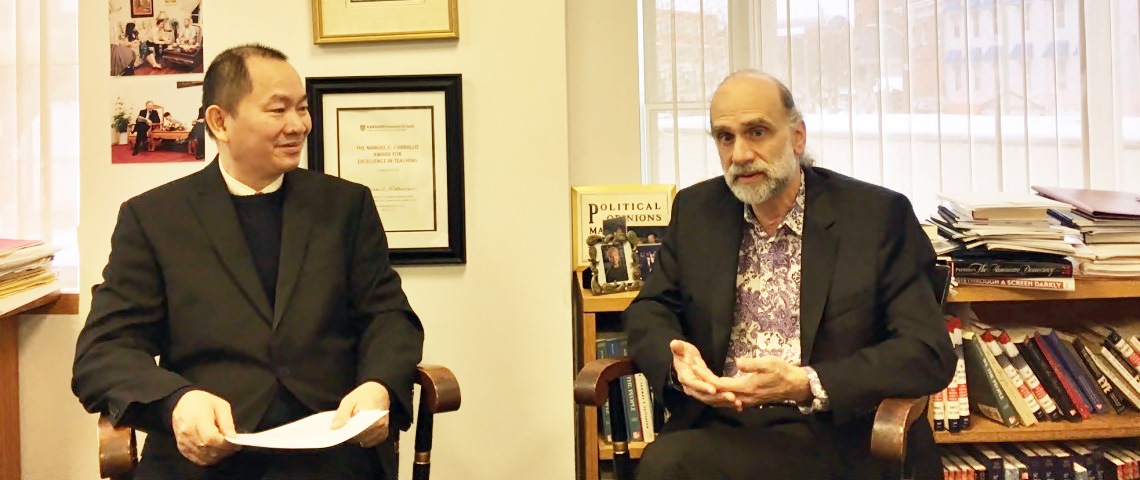
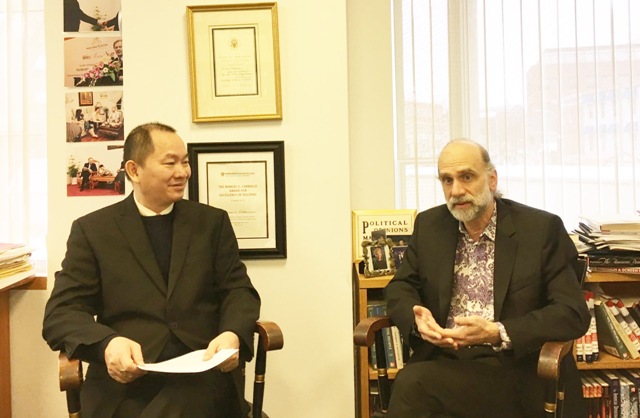
Mr. Nguyen Anh Tuan, CEO of Boston Global Forum and Mr. Bruce Schneier in the talk.
Interestingly, Mr. Schneier, though primarily a technical person, said the best ways to improve cyber-security are for nations to have dialogues to set globally governmentally recognized norms on cyber-behavior and to establish new “social mechanisms’’ to keep us safe.
The answer to cyber-aggression is “political, not technical solutions,’’ he asserted.
The BGF’s continuing online dialogues on cyber-security will discuss possible social and political answers to these burgeoning threats in coming weeks.
(12th Feb 2016) Dick Pirozzolo – Managing Director of Pirozzolo Company Public Relations shared his view about how China thinks about cyber-security. Dick Pirozzolo serves on the editorial board of Boston Global Forum and is co-author, with Michael Morris, of a forthcoming novel that takes place in Vietnam during April of 1975.
Read his view below
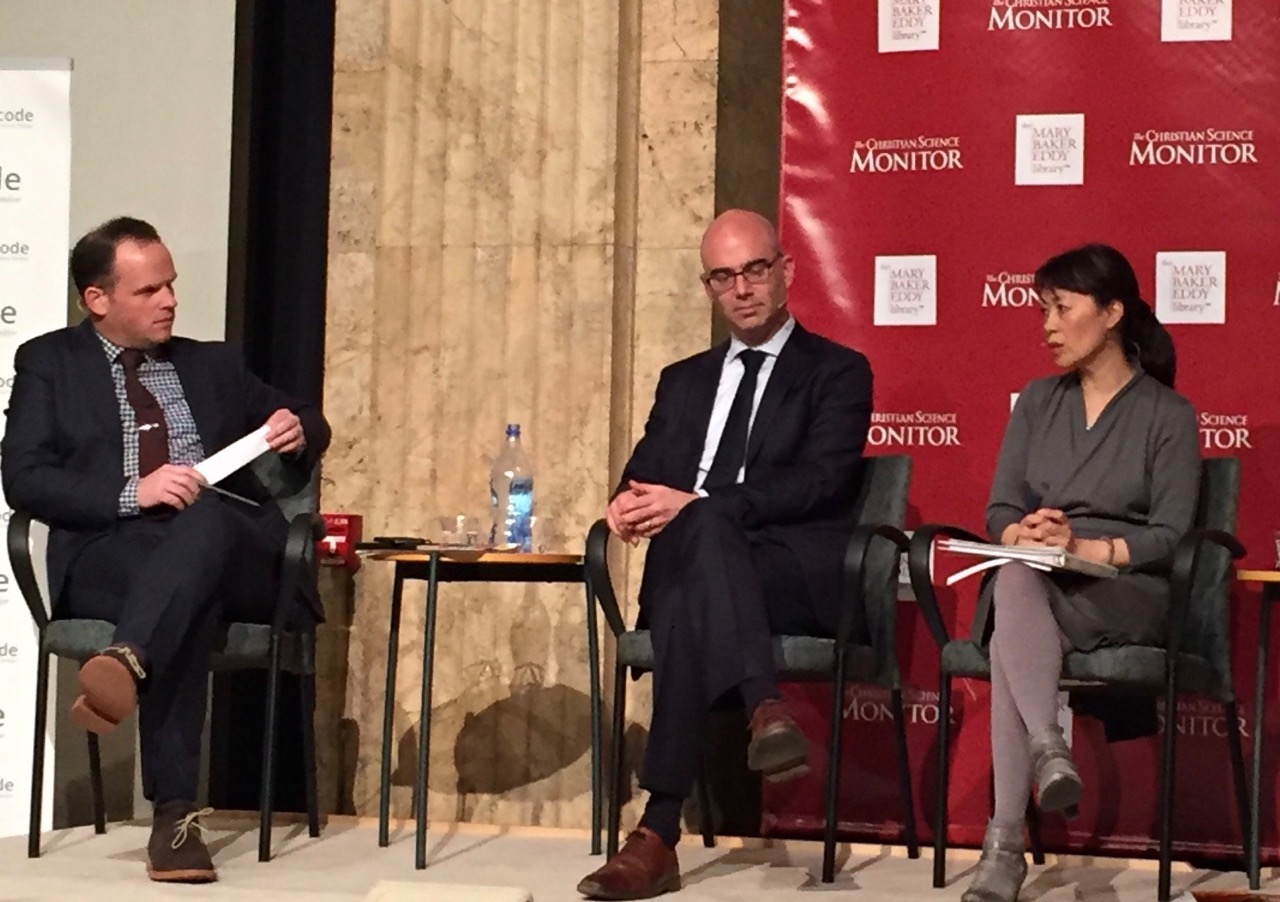
Why China hacks may be more in the Communist Party’s DNA and view of the Internet than anything else, according to Sharon Hom, executive director of Human Rights in China, a Chinese Non-Government Organization. Hom spoke during a recent panel discussion organized by the Christian Science Monitor in Boston.
Hom explained, “While in the US and most of the world, citizens regard the Internet as a big open international and transparent communication phenomenon,
the Communist Party wants control of society and information. Though it is not a linear path from censorship and control to hacking the Internet, the Party needs to manage expression online.” In China, “Cyber security means security of the Party.”
The event was organized, in part, to promote the Monitor’s online section Passcode which it bills as a field guide to security and privacy.
When it comes to establishing international norms for Internet behavior that would presumably reduce hacking, Hom is not optimistic pointing out that whenever norms come up, China, Iran, Russia, Pakistan and other bad actors, unite to pose obstacles in a, “race to the bottom.”
In sharp contrast to these nations, Boston Global Forum has recognized Japan, host of the next G7 meeting in March, for supporting international norms. Commenting on the Forum’s international ethics code of conduct, Japan’s Prime Minister Shinzo Abe told Boston-based think tank members: “Japan will continue to cooperate closely with the US and other partners … while playing a leading role in achieving the peace and stability of the international community.”
In addition to Japan and the US, G7 nations include Canada, France, Germany, Great Britain, and Italy.
Panelist Adam Segal added, that the Chinese government sees the Internet from the perspective of “cyber sovereignty and as an entity that the government can develop as it sees fit.”
Segal, director of the Digital Cyberspace Policy Program at the Council on Foreign Relations emphasized that a big part of China’s incentive to hack other nation’s computers is to obtain intellectual property from foreign companies. Segal told attendees, “China does not want to be the factory of the world and is worried about the future of technology.” For example, “While China probably manufacturers all the DVD players sold in the world, the head that reads the disc is proprietary and owned by companies in Japan.”
Though China’s theft of 22 million personnel records from the Federal Office of Personnel Management is well known, private companies have been closed mouthed about such intrusions until Google announced, “We’ve been hacked along with 30 other companies,” according to Segal. Segal also reported on a hack of Boeing’s computer’s a few years ago in his cover article titled: Why China Hacks the World, in the February 1, 2016 edition of The Christian Science Monitor Weekly.
In addition to stealing intellectual property to gain technological advantage, China is also engaged in what Segal called the world’s oldest profession “espionage” and strives to obtain secrets about the F22 and F35 fighter jets and other weapon systems. China also uses hacking as a form of external censorship by “intimidating reporters, “ who write articles unfavorable to this nation of 1.4 Billion.
“Is there bad hacking and good hacking?” asked moderator Mike Farrell, editor of the Monitor’sPasscode publication. Panelists agreed that government-to-government spying is considered acceptable, but for a government to hack into another country’s businesses steal the information and pass it to companies inside its own borders is outside any acceptable norm.
Michael Sulmeyer, director of the Belfer Center’s Cyber Security Project at the Harvard Kennedy School, pointed out that the current state of cyber security “is like leaving a bag money on your front lawn and being stunned to learn that someone stole it during the night. At least make harder. Make them work. Make sure it’s not the jayvee team but that the varsity team is needed hack into your systems.”
While it might be comforting to think about like-kind retaliation, it is not always possible. Segal explained relationships between the US and China are complex and come with competing values, “Fifty percent of Apple’s revenue comes from China. One of the worlds biggest technology companies is not likely to want heavy-handed retaliation.”
Though Hom devotes much of her time to combatting cyber hacking and theft, she says people in her office continue to ignore fundamental security measures and continue to, “stick Post-it notes to their computers containing their passwords, because they have so many to remember.”
“Cyber defenses though are a stopgap. The real solution is more evolutionary,” says Hom and will come about, ‘When governments like China stop using the Internet as a tool of social engineering.”
Dr. Vaira Vike-Freiberga has been the President of the World Leadership Aliance Club of Madrid since 2014 and is former President of Latvia (1999-2007). She was instrumental in achieving membership in the European Union and NATO for her country, and was Special Envoy on UN reform among her international activities. Since 2007, she is an oft invited speaker on social issues, moral values, and democracy. She was Vice-chair of the Reflection group on the long term future of Europe, and chaired the High-level group on freedom and pluralism of media in the EU.
Having left Latvia as a child refugee to Germany in 1945, then French Morocco and Canada, she earned a Ph.D. in psychology (1965) at McGill University. After a distinguished career as Professor at the University of Montreal, she returned to her native country in 1998 to head the Latvian Institute.A year later she was elected President by the Latvian Parliament and re-elected in 2003.
She is member of four Academies, and Board member or patron of 30 international organizations, including the Board of Thinkers of the Boston Global Forum. She has received many highest Orders of Merit, as well as medals and awards, for distinguished work in the humanities and social sciences. She has published 14 books and authored over 200 articles, book chapters, reports, and audiovisual materials.
Allan M. Cytryn is with Risk Masters International, LLC, a consulting firm that advises clients on Risk Mitigation and Management, including business continuity planning, disaster recovery, and recovery from cyber attacks. He has been a senior Information Technology executive for more than 30 years. Prior to Risk Masters, Allan spent 15 years at Deloitte where he was a Director. His roles and responsibilities there included Regional CIO, National Director of Applications, and National Director of Technology for Audit and Enterprise Risk Services. Before joining Deloitte, Allan was the CIO of Simpson Thacher & Bartlett, a Vice President of Corporate Finance with Goldman Sachs, and a Vice-President of Information Technology with Bankers Trust. In all of these roles he led organizations through rapid operational and technological transformations and helped them adopt new and innovative technologies to support their core strategic objectives.
Allan additionally played a critical leadership role for Deloitte in managing the IT recovery from the 9/11/2001 attack in New York and for Simpson Thacher and Bartlett leading their recovery from the 1993 NatWest Tower Bombing in London.
Allan earned a BS in Electrical Engineering and Computer Science and an MS in Operations Research & Applied Mathematics from Columbia Engineering, as well as a M.Arch from Columbia’s Graduate School of Architecture, Planning and Preservation. He is active in alumni affairs, serving as the Chair of the Alumni Board of Visitors of the Columbia University School of Engineering and Applied Sciences and as the Treasurer of The Society of Columbia Graduates
His son, Steven, graduated from Columbia College in 2006.