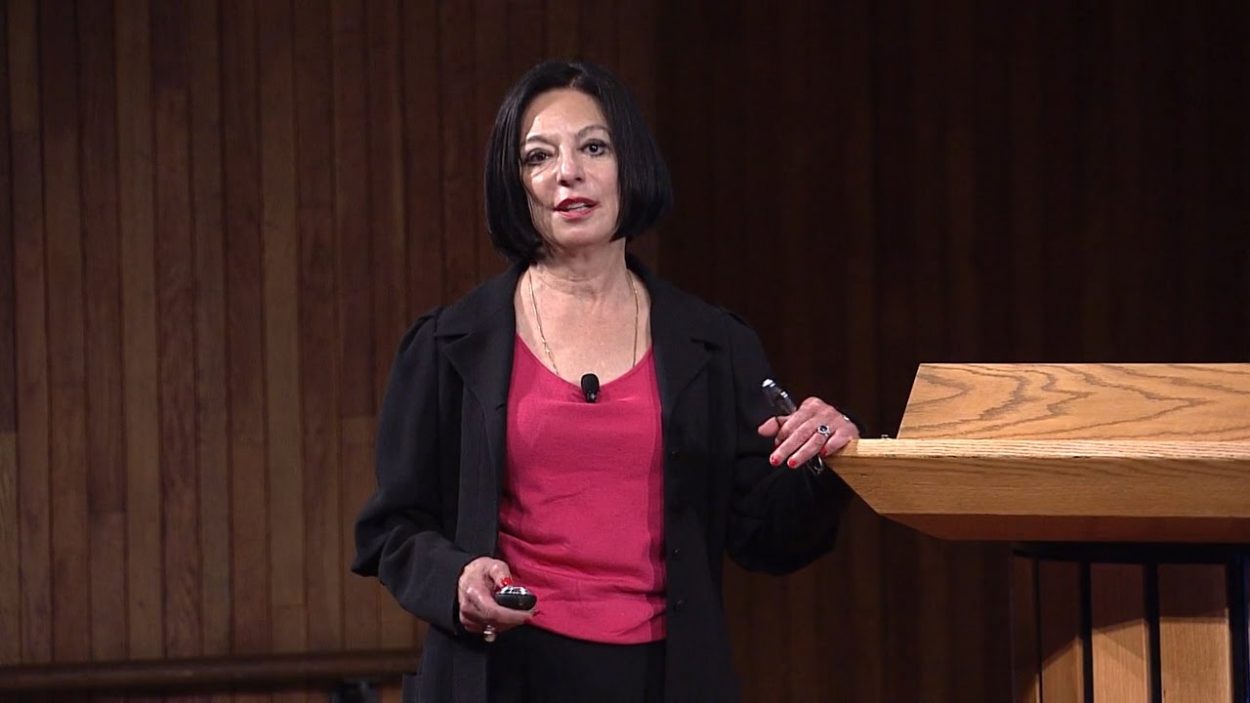
Professor Nazli Choucri, Professor of MIT and Board of Director’s member of The Michael Dukakis Institute for Leadership and Innovation (MDI), delivered a speech on AI strategy for Vietnam on ThoiDaiAi.net – an AI information portal in Vietnam.
“This is the time to think seriously about the leapfrogging, the leapfrogging technology leapfrogging strategy in the area of AI.
AI is the future already here, it is the future now. And a leapfrogging strategy for the future means a strategy to place Vietnam at the forefront of its peer countries maybe of the world as the whole in the area of AI. AI for particular applications and AI for government and AI for governance, AI for capturing the value added that the country’s population is producing, is creating and the like. Vietnam is very fortunate in having a very disciplined labor force and labor force may well be ready to be motivated, to be given incentives, to be given a global challenge. And the challenge is to put Vietnam at the forefront of the world capability on AI.
This is not impossible, this is very well within the acceptable possibility at this point but it requires commitment, it requires a continuity, it requires developing incentives and rewards for those that are committed and those would really work hard on the leapfrogging strategy in AI. We know that they need to be appreciate, rewarded. Here is the case where rewarding them would help the nation as the whole. __ has done some statistical work comparing where Vietnam stands in the labour, in the capability on the technology side and on the human capacity size in the cyber domain… just cyber related capability. Vietnam ranks among the 20 top countries in the world, not the first, not the second, but in the group, which means the foundation are there and they have to be accelerated. The challenge is to appreciate that most people think that AI is science-fiction, it is really not science- fiction. It’s day-to-day in advancing industrial countries, there is no reason why Vietnam could not have its own existed skill-base enhanced.
You don’t need a miracle, what you need is simply a strategy, a strategy that is anchor in people, in the support, and the facilities that people can have, and the reward. I am a great believer in rewarding good performance and making it known that you are appreciated, etc. Many areas where Vietnam push its capability on AI could have enormous benefits that are not understood and appreciated. Look at what we are saying now, we are saying it needs investment in human, investment in the willingness and desire of individuals to participate in the strategy to develop those capabilities. We are not asking the students or the young people to put a man on the moon. It is quite a contrary asking to have poor technology that is used to put people on the moon so to speak. In the old days, to __ us for purposes of national well-being, it is a 21st century vision, the developments of the past centuries were fine because it created strategies for hardware developed, bridges, buildings, roads, etc. But it neglected the brain, and the capability provided by cyberspace, access to cyberspace.
I would suggest, I do wish, they wish to be known as a Prime Minister who put Vietnam on AI map, put Vietnam in the path of global leadership in particular area and I am convinced that it can be done.
In the annual International Joint Conference on AI on July 18, AI innovators agreed to a pledge against weaponizing technologies introduced by the Future of Life Institute.
According to National Public Radio’s article, a recent demonstration in France of an autonomous tank frightened scientists in the field of AI. Autonomous weapons may not draw the same fear as a killer robot (e.g., “the Terminator”) but weapons that function without human surveillance can be a threat. During the International Joint Conference on AI, top scientific minds came together to call for a “law against lethal autonomous weapons”.
The pledge stated that “we will neither participate in nor support the development, manufacture, trade or use of lethal autonomous weapons”. The pledge was signed by Elon Musk, Founder of Tesla and Space X. Demis Hassabis and Mustafa Suleyman, Google DeepMind’s co-founders, and people among 170 organization and 2,400 individuals.
The pledge plays a role of an encouragement to global governments to take legal action to ban further development of this kind of technology.
At the same time, MDI is also working on an AI Peace Treaty including challenges for AI peace, AI weapons, the role of the UNs, OECD countries and top AI corporations in maintaining peaceful uses of AI.
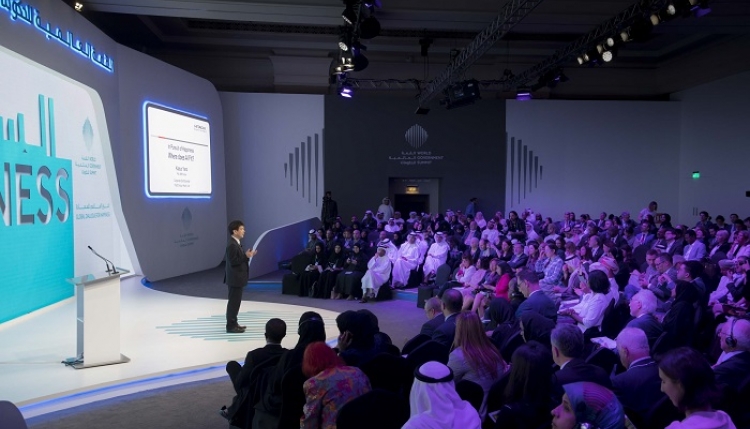
Dr. Kazuo Yano, Chief Engineer of Hitachi, Ltd. and member of MDI’s AIWS Standards and Practice Committee, said about “AI: The new measurement of happiness” at the Global Dialogue for Happiness in the sixth World Government Summit in Dubai.
As reported by Mena Herald, Dr. Kazuo Yano, Corporate Chief Scientist at Hitachi, Ltd., opened his speech at the Dialogue with the statement: “AI: The New Measurement of Happiness”.
He explained further how AI will result in better outcomes and processes through carrying out experiments. By using AI, “we can move away from standardized processes and we will see an ensuing increase in happiness and productivity”, said he.
AI can measure a user’s gestures and voice level by wearing sensors, and in this way, workers’ happiness can be tracked. There is a connection between physical motion and happiness, Dr. Kazuo claimed: “A happy organization is more productive organization”, improving happiness in workplace bring up to a 30% increase in productivity.
On July 25, 2018, Dr. Kazuo Yano is going to participate in Vietnam CEO Summit 2018 with other innovators in AI to discuss the strategy for Vietnam in the field of AI.
As bots become more humanlike, there are systems capable of mimicking human conversation. MIT Technology Review provides people with ways to detect fake accounts.
Twitter has recently shut down more than two million accounts or bots. It could only remove obvious offenders and there are tricksters to be expected when it comes to fake users.
Here are the five signals to tell you are chatting with a bot:
Its user profiles
Bot profiles usually lack a photo, a link, or a bio. More complex bots might use stolen photos and automatically generated account names.
Tweet syntax
A bot’s tweets often reveal algorithmic logic—for example, they might be repetitive or use common responses. Moreover, comprehending the nuances of human language is a difficult task for machines—missing a joke and changing the subject are potential warning signs you might be chatting with a bot.
Tweet semantics
Bots are sometimes fixated on a specific topic, perhaps sharing or tweeting the same post.
Temporal behavior
If an account tweets at highly regular intervals, it may be a sign of a fake profile as well.
Network features
Network dynamics aren’t visible to users. But bots may follow a few profiles and be followed by many other bots, lacking social interaction can also indicate that the account is fake.
As AI develops at a very fast pace, it is necessary to observe its progress from time to time to keep it under control. Developers and organizations should use a certain set of standards to keep track of the technology’s development. The AIWS 7-layer model for AI ethical issues developed by MDI can be a good one to follow.
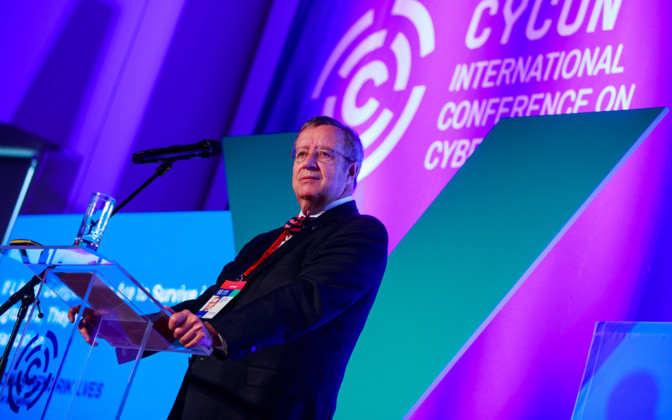
On May 30, 2018 at the 10th International Conference on Cyber Conflict (CyCon2018), Former Estonian President Toomas Hendrik Ilves emphasized the need for a united body to fight cyber warfare, especially when it comes to securing liberal democracies.
As we are now in the age of Big Data, nations are vulnerable to not only threats from neighboring states, but to would-be adversaries around the globe, regardless of geographical proximity etc. Democracies have been the target of cyber-attacks, specifically attacks on their electoral and democratic processes.
In the CyCon2018, the Former Estonian President made a speech. President Toomas Hendrik Ilves recommended the establishment of an organization to withstand threats concerning cybersecurity issues. The organization should require its members to hold democratic ideals. In addition, Members of cyber of NATO need to exemplify concepts such as free and fair elections, observance of the rule of law, and a fundamental concern for human rights and freedom.
During his presidency, he led Estonia to be one of the first countries to pursue digital evolution in the end of 20th century. He was named one of the World Leaders in Cybersecurity by BGF and MDI in 2017.