A recent breakthrough in computer vision has given robot the ability to differentiate objects.
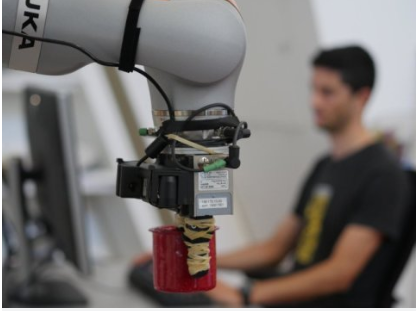
MIT’s Computer Science and Artificial Intelligence Laboratory (CSAIL) has recently made progress in computer vision that lets machines identify objects and take actions without knowledge about the object.
The system “Dense Object Nets” (DON) developed by CSAIL now can create “visual roadmaps” of the object’s points, the robot will teach itself to understand and manipulate the items, enabling it to pick it up. This has been a breakthrough in this area of work, as a variety of advances couldn’t inspect the specific parts of an object according to Ph.D. student Lucas Manuelli. It is viewed as a potential use not only for manufacturing, but also for household application due to its self-supervised feature for some specific tasks such as putting plates onto a shelf while you are on vacation. In the future, the team hopes to make more improvements so that it can understand objects deeply like cleaning a desk.
Another issue should not be ignored is its ability to execute action without supervision. According to Layer 1 of the AIWS 7-Layer Model, machines and technology should be created with concern over human’s prosperity and safety. It should be carefully supervised, and programmed to avoid malfunction and further damage.
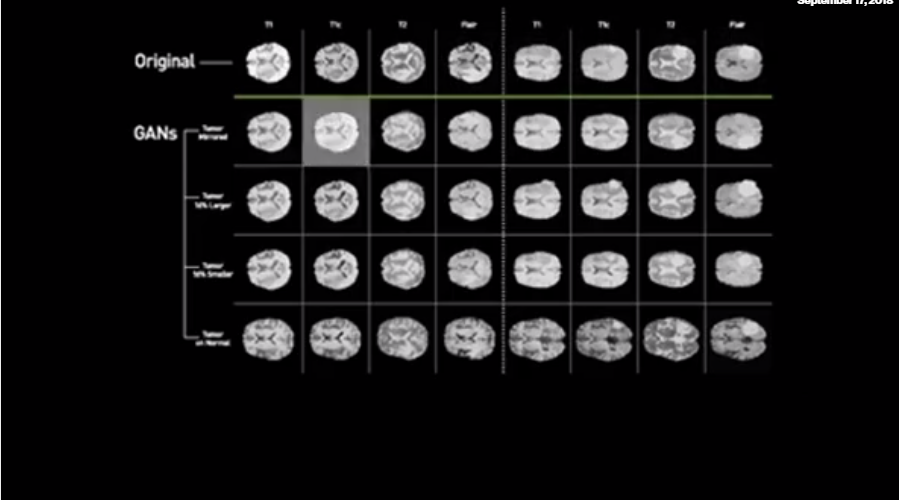
Researchers at chip company Nvidia, the Mayo Clinic, and the MGH & BWH Center for Clinical Data Science have built an algorithm which can creates various data sets for medical AI to study.
For artificial intelligence to work effectively, it relies on its set of information. A study accomplished under the collaboration of Nvidia, the Mayo Clinic, and MGH & BWH Center for Clinical Data Science has created a system that can produce diverse set of medical data. It created synthetic scans depicting abnormalities from existing MRIs of brain tumors using generative adversarial networks (GANs).
The system is a cutting-edge tool for training neural networks, but medical data will require more complication as “the data are usually imbalanced” said Hoo Chang Shin, a research scientist at Nvidia.
There is a great deal of abnormalities in medical cases that might be difficult for AI to diagnose as most of the data was programmed here. AI should be trained carefully before facing real-life situation especially in healthcare.
Reported by MIT Technology Review, Bruce Schneier expresses his fear of losing lives to cyber disasters.
Bruce Schneier is an internationally renowned security technologist, called a “security guru” by The Economist. He was honored Business Leader in Cybersecurity in 2015 by Boston Global Forum.
According to Gartner, there will be over 11 billion internet-connected devices (excluding smartphones and computers) in circulation worldwide this year, which has doubled compared to a few years ago, and it is expected there will be billions more come online. The connectivity has made a great use in our daily life but also brought about a nightmare to cybersecurity since it has been proven that all of these smart devices can be hacked. Speaking to MIT Technology Review, Bruce Schneier called for urgent action by the government to address this problem.
Today, cars, medical devices and even household appliances are connected with computers. What used to be computer security alone has now become “everything security”, said Schneir. Moreover, people seem to have already attached themselves to devices like phones and search engines and synced them with other services such as power systems or transportation networks. “If it goes down, to a very real extent society grinds to a halt, because we are so dependent on it at every level, computers are deeply embedded in our lives” stressed Schneir. Recently, cybersecurity incidents are mostly involving data, privacy violation and manipulation, there have been no loss of life casualties, but it is possible. Medical records stolen or car’s bluetooth connection hacked are some of his examples of the danger cybersecurity incidents can pose. Loss of human life will be inevitable if people do not have better computer security systems.
In the interview, he also recommended measures to improve safety. Governments need to take action in collaboration with other firms to develop internet-connected devices with standards, and liability laws.
His approach to tackle this issue is similar to what MDI initiative’s aim to do—establish a set of ethical standards.
A roundtable on Global Governance for Information Integrity hosted by the WLA – Club de Madrid will take place on the 27th of September addressing the information’s disruption on social media.
There has been an increasing concern about the spread of fake news through social media, in addition, people are using social networks to manipulate citizens’ opinion as well as spreading hate speech, one-sidedness. To protect the growth of democratic societies, it is essential for policy makers to come up with the solution for the problem.
Hence, WLA- CdM has gathered scholars, citizens, politician and other leaders to join the roundtable on Global Governance for Information Integrity in Riga, together with the Latvian Ministry of Foreign Affairs and with the support of NATO Strategic Communications Center of Excellence.
On September 27, a day ahead of the Riga Security Conference (28th-29th September), WLA- CdM will host a discussion on the issue of information integrity.
Recently, an Op-Ed staff editor and writer at New York Times was invited to a talk with Yuval Noah Harari, philosopher and international author of “Sapiens” and “Homo Deus” to discuss the vision of his latest work “21 lessons for the 21st Century” surrounding the future of humankind.
In the vision, humankind is going to let machines and robots take over and do tasks while humans live as “gods”.
Until that time, many problems have arisen in AI development; while nuclear weapons and arms races can be prevented, an AI weapon such as “killer robots” can be created secretly by a nation without the attention of others. It is difficult to tell when a new AI is being developed and whether it might cause danger. A certain level of trust needs to be built between nations on a global level.
In this interview, academic Yuval Harari engages in a broad-ranging discussion about human nature and the human condition, past, present and future. A number of his points underscore the importance of the AIWS initiative. He points out that recent advances in science suggest that humans don’t technically have full free will, that humans learn from stories, that stories don’t necessarily correspond to reality in which people suffer, that there are now techniques to “hack” the human mind and influence behavior, and that the development of AI (while offering many wonderful possibilities) sets the stage for manipulation and outcomes that are difficult to predict. Therefore, he concludes, there is a pressing need for efforts to oversee the ethical development of artificial intelligence, and that these efforts have to be global to be effective. AIWS is well positioned to continue to play a facilitating role in this important context.
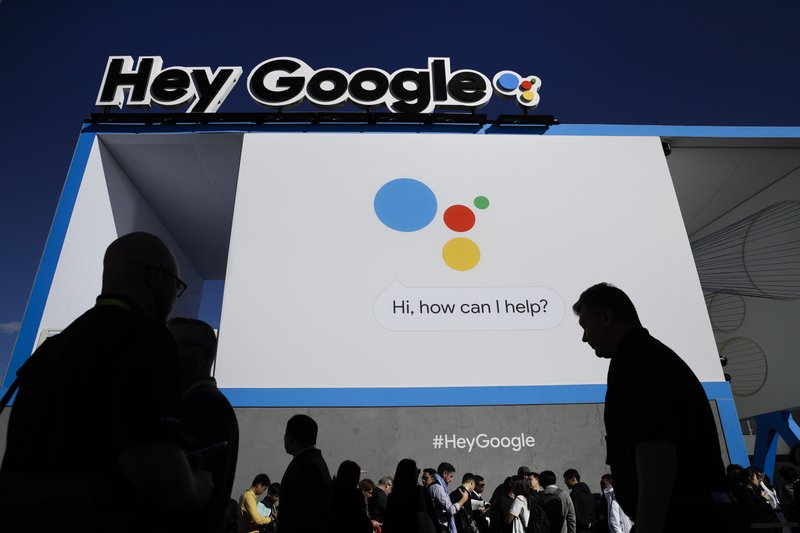
Google released the latest AI assistant which different from its competiors such as Apple’s Siri or Microsoft’s Cortana in the ability to switch simultaneously between two languages.
Nearly seven months after its announcement in February this year, the newest version of Google Assistant was launchedlast week with the capability to process and respond in two different languages on the fly.It is responsive to whichever language of the last message, there are currently a few languages which the assistant is programmed with: English, French, Spanish, German, Japanese and Italian. It is now available on Android phones and Google speakers.
According to Google AI Blog, it took years to teach the AI to be bilingual. It is extremely challenging to figure out the speech recognition step for two languages at the same time and coming up with the response for what has been heard. The application could help expand Google’s market to other country outside of U.S.
In fact, the tool could collect the voice of users and store the user’s data, which could violate people’s privacy and security. It is essential for Google to be transparent about how the data will be stored and used. Every system controlled by AI could potentially be harmful to humans. To ensure AI’s future, MDI has developed the AIWS Initiative – the AIWS 7-layer model for AI ethical standards.
On September 14, 2018, “Quantum Hegemony? China’s Ambitions and the Challenge to U.S. Innovation Dominance” will take place from 12:00 p.m. to 1:30 p.m. in Washington D.C. The event launched by CNAS Report will publish the report on technology development.
According to CNAS, a report was carried out by Elsa B. Kania and John K. Costello on China’s quantum science. China is considered the power house of quantum science due to its track record of advances in quantum technologies which consists of quantum cryptography, communications, and computing, as well as reports of progress in quantum radar, sensing, imaging, metrology, and navigation. Its achievement was displayed in its world first quantum satellite launched in August 2016.
In response to China’ advances, U.S needs to put effort in its current advantages in technologies to maintain its position as a leader in the innovation.
It can be seen that national pride has encouraged competition between countries, making such non-stop pace of technology development but it should be kept in mind that these advances only matter if it is for the good of human kind. There are organizations such as the Michael Dukakis Institute for Leadership and Innovation is established to secure our future with its initiatives which provide a moral framework for technology’s innovations, especially in the field of AI.
An AI algorithm is developed to estimate a city’s obesity rate by analyzing satellite images of its buildings.
A research group at the University of Washington analyzed images from Google Maps of four cities in U.S (Los Angeles, California; Memphis, Tennessee; San Antonio, Texas; and Seattle, Washington) to draw out the prediction for the rate of obesity–an alarming health issue in this country.
The team found the relationship between an area’s built environment and its neighborhood’s health issues by using neural networks. The images of the urban areas provide health indicators to the neighborhood ass the presence of parks, highways, green streets and housing types can be associated with the people’s physical activity according to a researchpublished by JAMA Network Open.
Moreover, the algorithm can use neural networks to automate the extraction of features of infrastructure from satellite images. This study can possibly result in adjustment in infrastructure to encourage physical movement and increase people’s health.



 Bruce Schneier is an internationally renowned security technologist, called a “security guru” by The Economist. He was honored Business Leader in Cybersecurity in 2015 by Boston Global Forum.