by Admin | Jun 1, 2015 | Event Updates
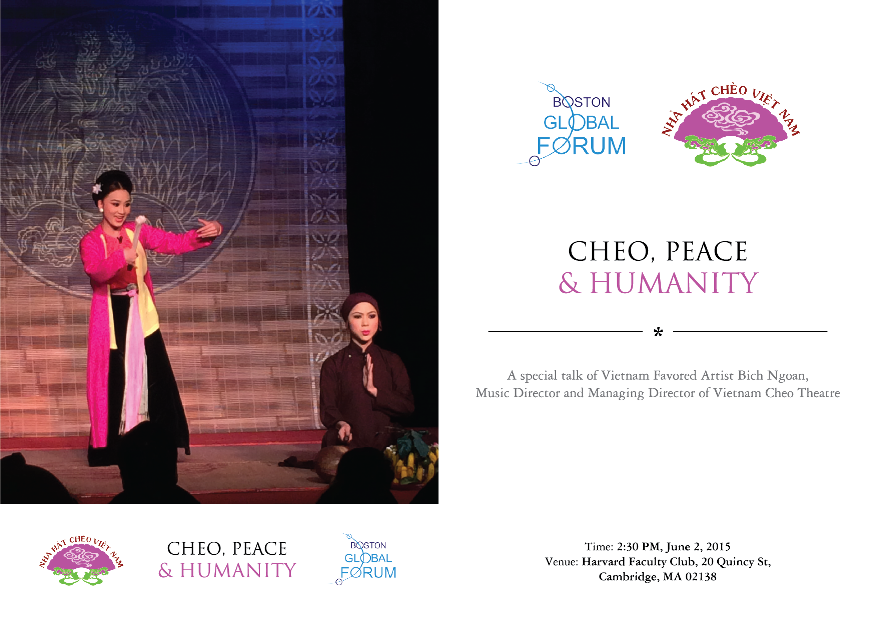
Boston Global Forum is pleased to host a show of Vietnam Cheo Theatre titled, “Cheo, Peace and Humanity”, at Harvard Faculty Club at 2:30 PM on June 2, 2015.
The Vietnam Cheo Theaatre, led by its Music Director and Managing Director, National Favored Artist Nguyen Thi Bich Ngoan, will perform several feature plays of Cheo, a typical traditional stage music of Vietnam, such as Duyen que (songs about charms of countryside), Thi Mau len chua (the extract of Goddess of Mercy: Thi Mau go to pagoda), Hat Xam Hue tinh (Performance of a Vietnamese classical form of music, Xam), Hau Dong (Seance ritual performances).
The performance is devoted to distinguished delegates of Boston Global Forum, Harvard University, MIT, and other guests of honor such as Ambassador Swannee Hunt, Co-founder of Free for All Concert Fund; March Churchill, Dean Emeritus of New England Conservatory’s Department of Preparatory and Continuing Education, Benjamin Zander, Music Director & Conductor of Boston Philharmonic Orchestra; Larry Bell, Composer & Chair of Music Theory of New England Conservatory, and Professor of Composition at Berklee College of Music; Julie Leven, Violinist, Executive and Artistic Director at Shelter Music Boston.
by Admin | May 12, 2015 | Highlights
Understanding of cyber is still vague. The term “cyber war” is used very loosely for a wide range of behaviors, ranging from simple probes, website defacement, and denial of service to espionage and destruction.
Professor Joseph Nye, Member of Boston Global Forum’s Board of Thinkers and Harvard University Distinguished Service Professor, pointed out four major categories of cyber threats to national security in the recent article on Project Syndicate. They are: cyber war and economic espionage, which are largely associated with states, and cyber crime and cyber terrorism, which are mostly associated with non-state actors. Some early international cooperation to secure cyberspace have been done, mostly to prevent criminals and terrorists. However, the international norms tend to develop slowly.
Read the full article here or visit the Project Subdicate website for more detail.
International Norms in Cyberspace
CAMBRIDGE – Last month, the Netherlands hosted the Global Conference on Cyberspace 2015, which brought together nearly 2,000 government officials, academics, industry representatives, and others. I chaired a panel on cyber peace and security that included a Microsoft vice president and two foreign ministers. This “multi-stakeholder” conference was the latest in a series of efforts to establish rules of the road to avoid cyber conflict.
The capacity to use the Internet to inflict damage is now well established. Many observers believe the American and Israeli governments were behind an earlier attack that destroyed centrifuges at an Iranian nuclear facility. Some say an Iranian government attack destroyed thousands of Saudi Aramco computers. Russia is blamed for denial-of-service attacks on Estonia and Georgia. And just last December, US President Barack Obama attributed an attack on Sony Pictures to the North Korean government.
Until recently, cyber security was largely the domain of a small community of computer experts. When the Internet was created in the 1970s, its members formed a virtual village; everyone knew one another, and together they designed an open system, paying little attention to security.
Click HERE to read the full article.
by Admin | May 21, 2015 | Highlights
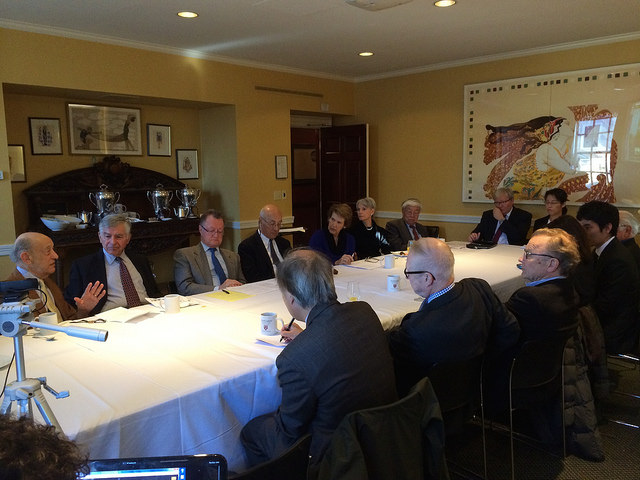
Boston Global Forum is deeply concerned over recent events in the Pacific that threaten the peace, security and economic well-being of the region and the world at large. The Framework for Peace and Security in the Pacific has being developed based on accepted principles such as abiding by international law, multilateralism and transparency to avoid conflict.
We are now urging policymakers, and scholars’ insights and ideas regarding current events in the South China Sea, which is the issue of China’s rapid construction activities on the waters of the South China Sea and its announcement of its “nine-dashed-line” claims based on its vaguely-defined notion “historical rights”. As most of experts has said that China’s construction activities could pose direct threat to freedom of navigation and overflight across the South China Sea, threatening not only the territorial claims of other claimant states, but also the national interests of extra-regional powers such as Japan and the United States. The issue that can—through misstep or misunderstanding—result in open and armed conflict.
As we knew UNCLOS is a crucial mechanism to maintain peace and security in the South China Sea. Unfortunately, the United Nations and Arbitral Tribunal seem to lack the power to enforce sanctions and force the countries to respect and comply with UNCLOS in settling disputes.
Boston Global Forum is seeking the answer to these important questions:
- How can the world community force nations to respect and strictly observe the UNCLOS?
- Who will have the power to punish bad actors once a nation does violate the UNCLOS?
In response to these questions, Professor Richard Rosecrance, Adjunct Professor, Harvard Kennedy School; Research Professor of Political Science, University of California, Los Angeles, said “UNCLOS is basically unenforceable”.
Professor Suzanne Odgen, Member of Editorial Board, Boston Global Forum, Professor of Northeastern University’s Department of Political Science,thought that there is no way to “force” respect as most international laws are obeyed on the basis of reciprocity: I will obey it if you obey it. As international law is, like most law, subject to the interpretation of the ‘facts,’ moreover, any sort of juridical process can go on for years while the law is still being disobeyed, questioned, or ignored, etc.
In her view, Professor Odgen added:
As the US has never ratified UNCLOS, it is in a difficult position to discuss ‘enforcement’ or punishment. Most disputes in the international community over matters that are codified in international law are today settled—or remain unsettled and ongoing—by relying on arbitration, negotiation, compromise, etc. the costs/ potential costs of military conflict are enormous—to all sides. Further, the US has to weigh the shifting balance of power in Asia, as well as elsewhere throughout the world, before ever considering the use or threat of use of force. The days when the US could count on other countries, even allies, supporting its efforts to ‘discipline’ bad actors in the international system, are gone, or at least going……
Douglas Coulter, visiting Professor in Guanghua School of Management at Peking University, shared another view. According to him, the United States and apparently the western world have not drawn the lessons from the war in Vietnam, the war in Iraq, and the war in Afghanistan, which is that you can’t force countries from the outside. Changes only are made if they are initiated by the countries themselves.
He also shared his view on recent developments in the South China Sea. In his opinion:
“The worst thing to do is to publicly threaten China over it. In order to soften up China over the South China sea is to have American Secretaries of Defense visit Mongolia or American Admirals publicly advocate joint country patrols in the South China Sea, or for the United States to encourage Japan to get involved.
The only thing that will work with China is to change America’s fundamental relationship with it and not to continue to keep doing the same thing we have been doing since the Vietnamese War.
One of the biggest sources of friction in East Asia is Japan’s refusal to acknowledge its history in the Second World War. China lost three times more people in the war than Japan did. China was occupied. If Japan was freeing the Chinese from colonial occupation, as the Japanese officially claim, why were the Chinese fighting them? Think of what would happen if Merkel visited graves of the SS.
If the United States demanded publicly and uncompromisingly that Japan satisfy completely China’s and Korea’s demands concerning Japan’s role and history in the Second World War, I suggest that this would materially change the United States’ relations with China. Japan could do nothing. If they want an ally to resist China, where are they going to go, except the United States? Are they going to go to India?
If our relations materially changed with respect to China, I suggest we could get a lot more flexibility in other areas, including the South China Sea, as long as we pursued these privately and not with public pronouncements.
But our chances of this may have been permanently destroyed after Abe’s trip to the United States, where he came away with the store, and this trip will continue haunt us. Concerning China’s claims in the South China Sea, this has been on their maps since the People’s Republic came into being in 1949, and they inherited from the Kuomingdang. They didn’t invent it. And presumably the Kuomingdang got it from a much earlier period, the Qing or Ming Dynasties.
One of the most interesting aspects of this dispute, or maybe the least interesting, is that the United States didn’t utter a word about it until around 2006, although there has never been any mystery for years.
The biggest barrier to any easing of the South China Sea issue is the United States, which will continue to browbeat China over it and harden China’s position. The United States, as we have witnessed since the 1960’s, doesn’t know any other approach.
With regard to international laws, since the United States hasn’t signed the Law on the Sea, because there is obviously some clause we don’t want to have to abide by, what international laws are we insisting China respect. The United States itself has a very good record of abiding by international laws, such as the War in Iraq.”
Professor Richard Cooper, Maurits C. Boas Professor of International Economics at Harvard University, added his view concerning the China’s maritime territory claims:
” A recent comprehensive history of the South China Sea can be found in a new book of that title by Bill Hayton, 2014. According to him, the nine-dashed line was first drawn by a Chinese geographer (with no official position I believe) in 1937. I can affirm from my own research on the telegraph in China that the Qing dynasty in the 1870s made no claim to any territorial sea: Chinese sovereignty began at the shoreline.”
———
(to be continued)
by Admin | May 8, 2015 | Highlights
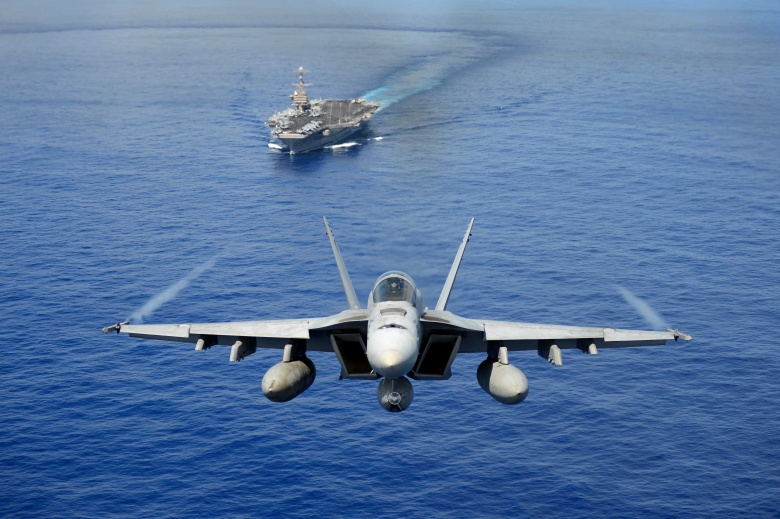
In recent post on The National Interest, Richard Javad Heydarian, an Assistant Professor in international affairs and political science at De La Salle University, and a foreign policy advisor at the Philippine House of Representatives (2009-2015), pointed out that it is no longer easy for America to keep Chinese territorial ambitions in check as it did during the Third Taiwan Strait Crisis, given China’s rapid military modernization since the mid-1990s. Therefore, the challenge to America is how to slow down, if not stop, China’s aggressive posturing without risking a diplomatic breakdown and/or an armed confrontation with China in the western Pacific. And this could very well define Obama’s foreign policy legacy.
The article came out after he attended the Boston Global Forum’s conference on April 20, 2015 focusing on managing peace and security in the South China Sea.
Read his opinions here or visit The National Interest website.
The South China Sea Crisis: What Should America Do about It?
April 29, 2015, By Richard Javad Heydarian
As China rapidly builds facts on the waters of the South China Sea, the United States is confronting a strategic conundrum similar to the Third Taiwan Strait Crisis, when Washington faced a difficult choice between upholding its treaty obligations to an ally (Taiwan) and ensuring freedom of navigation in international waters, on one hand, and maintaining stable ties with a rising power (China), on the other. In a recent conference organized by the Boston Global Forum, which focused on the South China (and where I had the pleasure to be among the invited speakers), Joseph Nye made two important observations regarding China’s ongoing construction activities in the South China Sea. First, he correctly pointed out that the construction activities are neither new nor unique to China. This is true as other claimant states—namely Taiwan, Malaysia, Vietnam, and the Philippines—have been engaged in varying forms of construction activities on disputed features in recent decades.
Occupying the two most prized features in the Spratlys, Taiwan and the Philippines were able to build airstrips and advanced facilities on Itu Aba and Thitu islands, respectively. Asearly as 1995, the United States had to contend with the Mischief Reef crisis, which pit a treaty ally (the Philippines) against an emboldened China, which wrested control of the disputed feature in 1994 and proceeded with establishing a rudimentary military garrison soon after. Secondly, Nye reiterated the fact that China, which occupies about seven features in the Spratlys, trails Vietnam (21) and the Philippines (8). And unlike Taiwan and the Philippines, China wasn’t able to occupy a single island throughout its aggressive scramble in the South China Sea in the last three decades of the 20th century. Left with atolls, rocks, sandbars and other forms of low-tide elevations, China has resorted to building artificial islands.
With these observations in mind, one would be tempted to argue that China is simply catching up with other claimant states. China’s accelerated construction activities, however, standout for at least three reasons. To begin with, China’s coastal real estate gambit is unprecedented in scale, speed, and technological sophistication. No other claimant state comes even close to what China is undertaking in the disputed areas, which is tantamount to nothing less than geo-engineering on steroids. Second, while other claimant states have occupied features that fall well within their 200-nautical-mile Exclusive Economic Zone (EEZ) as well as their continental shelves, China, in contrast, is trying to achieve de facto sovereignty over features, which fall hundreds of miles away from its southernmost province of Hainan. So far, China’s sweeping “nine-dashed-line” claims in the South China Sea, based on its vaguely-defined notion “historical rights,” has hardly convinced any serious legal scholar outside China. Lastly, China’s construction activities could pose direct threat to freedom of navigation and overflight across the South China Sea, threatening not only the territorial claims of other claimant states, but also the national interests of extra-regional powers such as Japan and the United States.
Read the full article here.

by Admin | May 4, 2015 | Highlights
The U.S have taken no position on the sovereignty issues in the South China Sea, but it strongly agrees that the UN laws should be used to resolve the disputes and develop code of conduct. Managing the U.S and China relation is one of the crucial questions for world peace in the next half century and there is no “necessary conflicts” between them, as Professor Joseph Nye stated in his speech in the Boston Global Forum’s conference on managing the peace and security in the South China Sea, which was held on April 20, 2015 at Harvard Faculty Club.

Professor Joseph Nye, member of Boston Global Forum’s Board of Thinkers, Harvard University Distinguished Service Professor was co-moderator in the BGF conference in April 20, 2015.
He also stressed that, the U.S should stand still on the sovereignty issues in the South China Sea, but “take a clear position on keeping an open environment by U.S laws and entreaties and encourages joint exploitation of resources.
Read his full transcript of speech below.
Professor Joseph S. Nye Transcript
Boston Global Forum Conference, April 20th 2015
“It’s worth noticing that the headlines in the NY Times last week were part of what we are talking about. There was a picture on the front page of the Fiery Cross Reef in the Spratly islands , and the new runway that China is building, which is supposedly going to be 2 mile long, capable of accommodating any kind of military aircraft. This is a reef about 1000 miles South of Hainan. So there is a high degree of concern, some people say that once the Chinese have built the airfield on Fiery Cross Reef, they will then declare an Air Defense Identification Zone, similar to what they declared in the East China Sea. This is part of the plan to close off the South China Sea. US should be careful not to be too alarm. We’ve been through this before in 1995, there was a great deal of alarm about the fact that China is constructing structures on Mischief Reef, which is about a hundred miles from Fiery Cross Reef and also Spratly islands. At that time, the U.S stated that we would take no position as a country on the sovereignty issues in the South China Sea because they are far too complex and there are too many conflicting claims, not just from China but also from other Asian countries. The US had no position on the sovereignty, but it did take a strong position on the idea that the seas should be governed by the UN laws, which the U.S regards as the international law. Also we urge the parties involved to find peaceful ways to resolve the disputes and develop codes of conduct. That has been the American position since then. The question is should this position change. Are we seeing something we should lead to a difference, where the Americans take a tougher position in the South China Sea?
I think it helps to put this into a broader context of the US and China relations. I think managing US and China relation in the next half century or so is one of the crucial questions for world peace. As I argue in my new book: “Is the American century over?” I think we can manage that relationship. I don’t see necessary conflicts between the US and China. And we have to be careful not to overreact. On the other hand we have to make sure that our interests and our allies are protected. I should also note that the South China Sea is different from the East China Sea. In the East China Sea, where there is dispute between China and Japan over Chinese Diaoyu Islands and Japanese Senkaku Islands. We have a very clear position which is the Senkaku Islands are in the US-Japan security treaty. They are covered by the treaty, and the President has said this himself. So in the East China Sea there is no question. When the China declare the Air Defense Identification Zone in East China Sea, one of the first things the United States did was to show that we did not recognize that. So East China Sea is treated separately.
In South China Sea, we do not have that same alliance relation. There is no alliance with the Philippines. And the question of how much the United States should be involved in the details of various disputes is the theme debated in Washington now. There are a number of proposals of what the US policy should be, whether we should depart from the policy in 1995. One interesting proposal is made by Charles Freeman. Freeman points out that if we look at the Spratly Islands, there are 44 features, rock, shoals, and so forth, which are occupied. And that in fact is all the occupation. The number of features in the sea could be occupied by the states is divided so that everybody gets a piece. This argument is that we all have a standstill instead of to solve all this out by some sort of overall formula. To say the standstill under international law will keep this situation without change.
Now interestingly, if we keep that position, guess who would get the most out of it? Vietnam, which occupies 25 of these features, just in the Spratly Islands. Second is the Philippines, which occupies 8. Third is China which occupies 7. Fourth is Malaysia which occupies 3 and fifth is Taiwan which occupies 1. One of the interesting questions about this proposal is would China agree through it? Because it clearly means that other states also get into the occupation, but it is an interesting proposal because instead of trying to sort out all these issues, you can say let the occupation spread where it is now and perhaps you will have the incentive for joint exploitation of resources, or if you are finding ways to negotiate or compromise over the conflict.
The second proposal is made by Bonnie Glaser at Center for Teaching International Relations Studies, which takes slightly tougher position. Bonnie recommends that China has not developing code of conflict with the Asian countries which she regards or the Asian countries regard as unsatisfactory, let the Asian countries develop their own code of conflict and ways to resolve these issues, and let that China to sign on the form, and put ASEAN in a higher position.
The second thing she recommends is that U.S should help Philippines and Vietnam to improve their police capacity, particularly strengthen their coast office, as recently U.S’ announced programs could actually do help those countries in the region. This is important as you remember that China installed an oil drill in Paracel Island, leading to the seventy days of conflict between China and Vietnam. Most of this battle of ships, eventually it changed where they were ending China’s riot on land in Vietnam; the China realized that they had to find some way to make sure that they do not ruin their relationship with Vietnam overall.
The third thing that Bonnie recommends in her paper is that we state in advance that we will not recognize, so try to deter China from announcing those.
And the forth she recommends is to develop the military relationships between U.S and China, which deals with incidences of sea but led to this agreement on how to reduce air conflict. These principles like these will help solve the problem that we hope to prevent from escalating.
Now the question is how do we get to do this? The Freeman principle, essentially a standstill with the American power and position they have had since 1995, which were reiterated by Hilary Clinton in Hanoi in 2010, we would say everybody stay still and start developing principles for joint exploitation of resources. One problem is that the China is not standing still with building in the Paracel Islands. There is a facetious but understandable remark that China is building a Great Wall of Sand in the South China Sea. If China has stopped, it would be feasible, but since China hasn’t stopped construction, there is difficulty to reach proposal. On the other hand, if you take Bonnie’s proposal, the question is how much the United States wants some of these issues. From a historical point of view, the claims are very ambiguous. Some of the claims are clear, but some are very confusing. The U.S should be careful not to get into a position where we have so much to do with China that we end up fighting over some acres. Are we really willing to get into a situation like this? South China Sea, unlike East China Sea is not clear, and we should not treat South China Sea the same as East China Sea and wind up elaborate cost between U.S and China. I think the 1995 position is still correct, that we should not take position on the sovereignty of various features of the sea, but take a clear position on keeping an open environment by U.S laws and entreaties and encourage jointexploitation of resources.
So that’s my summation of where we are standing now.”