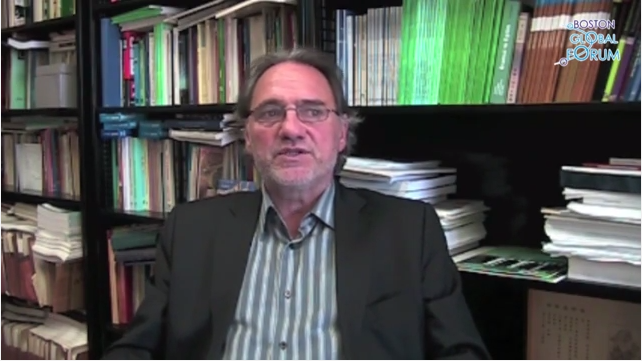
Professor Joseph Nye, member of Boston Global Forum Board of Thinkers, and Harvard University Distinguished Service Professor, asserted that a US-China conflict in the South China Sea can and should be avoided.The claim was made in recent article published on the Project Syndicate, after the incident of a US Navy surveillance aircraft flew near Fiery Cross Reef in the Spartly Islands in the South China Sea and received 8 warnings by the Chinese Navy to leave the area.
The U.S took no position when China began its construction activities on Mischief Reef in 1995, which is claimed by both the Philippines and China. But it expressed stronger reactions when China initiated dredging operation that is to turn reefs into artificial islands and might then declared an Air Defense Identification Zone that could interfere with the right of free passage – “a major US interest”, as Professor Joseph Nye highlighted.
Read his full analysis HERE or visit the Project Syndicate website.
Avoiding Conflict in the South China Sea
June 3, 2015 | By Professor Joseph Nye
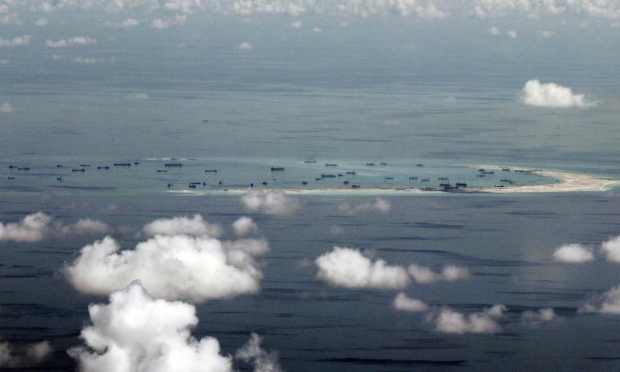
Chinese naval vessels patrol near disputed reefs in the South China Sea. (Photo Credit: Ritchie B Tongo/AP)
OXFORD – When a US Navy P8-A surveillance aircraft recently flew near Fiery Cross Reef in the Spratly Islands in the South China Sea, it was warned eight times by the Chinese Navy to leave the area. Chinese Foreign Minister Wang Yi said that, “China’s determination to safeguard its sovereignty and territorial integrity is as firm as a rock.” US Defense Secretary Ashton Carter replied that, “[T]here should be no mistake about this: the United States will fly, sail, and operate wherever international law allows us, as we do all around the world.” So, is a US-China conflict in the South China Sea imminent?
In 1995, when I was serving in the Pentagon, China began building structures on Mischief Reef, which is claimed by the Philippines and lies much closer to its shores than to China’s. The US issued a statement that we took no position on the competing claims by five states over the 750 or so rocks, atolls, islets, cays, and reefs that comprise the Spratlys, which cover a vast area – 425,000 square kilometers (164,000 square miles) – of the South China Sea. We urged that the parties involved settle the disputes peacefully.
But the US took a strong stand that the South China Sea, which includes important sea lanes for oil shipments from the Middle East and container ships from Europe, and over which military and commercial aircraft routinely fly, was subject to the United Nations Law of the Sea Treaty (UNCLOS).
To back up its territorial claim, China relies on a map inherited from the Nationalist period – the so-called “nine-dashed line,” which extends nearly a thousand miles south of mainland China and sometimes as close as 40 or 50 miles from the coastline of states like Vietnam, Malaysia, Brunei and the Philippines. All of these states claim the 200-mile exclusive economic zones granted under UNCLOS.
When the dispute over Mischief Reef erupted, Chinese officials failed to clarify the meaning of the nine-dashed line, but, when pressed, they agreed that the dashes demarcated areas where China had sovereign claims. At the same time, they agreed that the South China Sea was not a Chinese lake, and that it was governed by the UN treaty. On this basis, the US and China avoided conflict over the issue for nearly two decades.
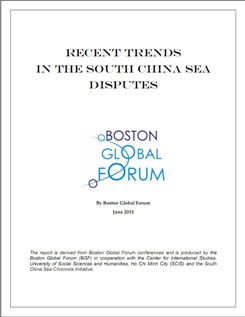
(Boston, June 2, 2015) – The threat of China’s ongoing construction activities in the South China Sea and a call for a greater U.S. presence to counter that threat are highlights of Boston Global Forum’s new report: “Recent Trends in South China Sea Disputes.”
China’s robust land reclamation, that includes turning tiny reefs into artificial islands and creating an airport infrastructure with a runway capable of launching military aircraft, have increased the tension and complexity of these conflicts. Citing a number of sources, “Recent Trends in South China Sea Disputes” sees China’s activities as a direct threat to freedom of navigation and over flight across the South China Sea. The report chronicles a long list of armed skirmishes that have included both aviation and maritime collisions.
To counter China’s moves, Boston Global Forum urges strategic cooperation between the U.S. and the Association of Southeast Asian Nations (ASEAN) to peacefully manage the emerging threats posed to maritime security, fishing rights, mineral exploration and freedom of navigation in the region. The ASEAN nations include: Indonesia, Malaysia, Philippines, Singapore, Thailand, Brunei Darussalam, Vietnam, Laos, Myanmar and Cambodia
The report is the work of Minh-Vu Truong, member of Boston Global Forum’s (www.bostonglobalforum.org) Young Leaders Network for Peace and Security and Director of the Center for International Studies of Ho Chi Minh University of Social Sciences and Humanities; Trang Pham, the Nippon Fellow at the International Tribunal for the Law of the Sea (ITLOS); and Richard Javad Heydarian, Assistant Professor at De La Salle University and Policy advisor at the Philippines House of Representatives.
Boston Global Forum is a think tank cofounded in 2012 by Former Massachusetts Governor Michael Dukakis and Tuan Nguyen, who is credited with opening up Vietnam to the Internet.
According to, “Recent Trends in the South China Sea Disputes,” misinformation, misperception and mismanagement by each country involved colntribute to the tension. The authors recommend production of a South China Sea (SCS) Threat Index and SCS Monitor to increase transparency.
The SCS Monitor and SCS Threat Index will assess maritime security and regional stability in the South China Sea region and provide an objective platform for academic and policy debate over priorities needed to strengthen security, and to encourage governments and the international community to take appropriate actions to reduce the risk of armed conflict. Based on specific indicators, the indexes will monitor the balance between peace and conflict and publish the current security-status of the South China Sea in a quick-to-grasp format.
As part of the effort to ease world tensions, Boston Global Forum held several live and online international conferences and symposia focusing on practical solutions over claims in the South and East China Seas. Participants included leaders in business, government, academia and the professions who are interested in global peace and economic security.
About Boston Global Forum
Established in 2012, Boston Global Forum brings together, in an open and accessible public forum, an eclectic and engaging spectrum of highly regarded academic leaders, real-world experts, influential thoughts leaders, and promising young leaders.
BGF’s immediate goal is to identify emerging threats to peace and stability around the globe, suggest realistic solutions, and identify possible actions that can be taken to avert armed conflict. The Forum’s ultimate goal is to lessen tensions, promote peace and security, and foster conditions that lead to greater social justice and broader economic prosperity wherever they are most needed.
(Boston, September 26) – Dr. Carlos Alberto Torres, the Member of Board of Thinkers, Boston Global Forum and a co-founder of The Ethics Code of Conduct for Peace and Security Version 1.0, shared his view on how to protect global cyber peace during the Boston Global Forum’s conference at Harvard Faculty Club on September 25.
The Ethics Code of Conduct for Peace and Security (ECCC) is now being intergrated into his UNESCO-UCLA program on Global Citizenship Education whose ultimate mission is to protect global peace, and to find ways people can live peacefully in a diverse world.
Dr. Torres is the distinguished Professor of Education in Graduate School of Education and Information Studies at University of California-Los Angeles (UCLA). He is also the UNESCO-UCLA Chair in Global Learning and Global Citizenship Education, and Director of the Paulo Freire Institute.
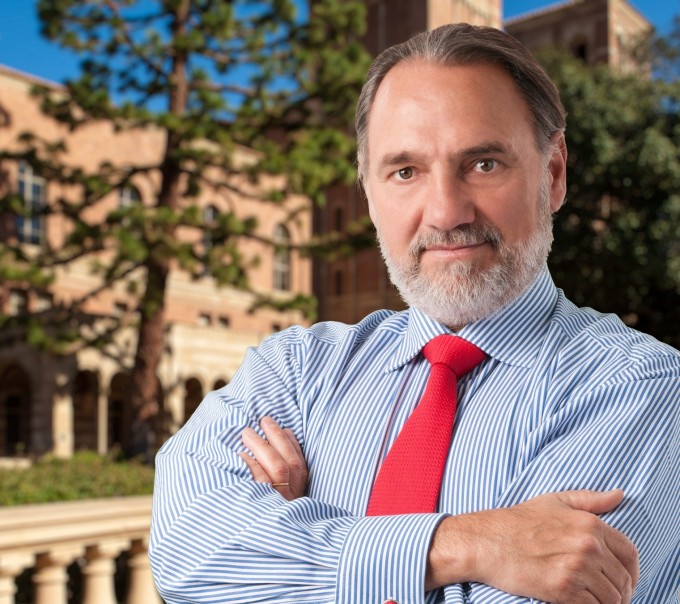
(BGF) – Theodore Gordon, Co-founder and Board Director of the Millennium Project shared his research on the Cyber threats at the Boston Global Forum Conference, “The Ethics Code of Conduct for Cyber Peace and Security”, which was held on September 25.
(October 2, 2015) – Member of Boston Global Forum’s Board of Thinkers, and UNESCO Chair in Global Learning and Global Citizenship Education recognized for expertise on the Brazilian educator and philosopher.
Carlos Alberto Torres, UCLA Distinguished Professor of Education and UNESCO Chair in Global Learning and Global Citizenship Education, has been honored with the Cyril O. Houle Award for Outstanding Literature in Adult Education, for his book, “First Freire” (New York: Teachers College Press, 2014). Torres is considered the foremost biographer of the Brazilian educator and philosopher who authored, “Pedagogy of the Oppressed.”
“The Cyril O. Houle Award for Outstanding Literature in Adult Education humbles me and invites me to continue my research, writing and teaching a pedagogy of struggle,” says Professor Torres, who founded and directs the Paulo Freire Institute at UCLA. “’First Freire’ is the culmination of 30 years of research, studying how Paulo Freire, in exile, managed to write one of the most fundamental education books of the 20thCentury. I wanted to discover the narrative threads of his intellectual tapestry in building an education for social justice.”
Torres says that “First Freire” was “a labor of love in the middle of my own exile from Argentina, from a country not so different from [Freire’s]… from an Argentine dictatorship that like the Brazillian dictatorship that expelled Freire, made me, like him, a globetrotter and a world citizen.
“It was a journey that taught me enormously about the struggles for justice and revolution in Latin America, and helped me understand why Freire became an icon, a guru, a beacon for social change, and his work a classic in the field of education. It also reaffirmed my conviction that critical studies in education provide some of the most insightful answers to the many conundrums we find in our schools, classrooms, and popular adult and continuing education sites.”
The Cyril O. Houle Award for Outstanding Literature in Adult Education is given by the American Association of Adult and Continuing Education (AAACE), and is the most prestigious book award in adult education in the United States.
Professor Torres is the president of the World Council of Comparative Education Societies (WCCES). He is the author of 70 books including “Dialogue and Educational Praxis – A Critical Reading of Paulo Freire” (São Paulo: Edições Loyola, 2014. Print), and co-editor of “Comparative Education: The Dialectic of the Global and the Local” (With R. Arnove, S. Franz, eds. 4th ed. Lanham: Rowman & Littlefield Publishers, Inc., 2013). Torres is the co-founder of the International Paulo Freire Institute Network, which includes colleagues and institutions in more than 90 countries throughout North America, South America, and Europe.