by BGF | Apr 15, 2019 | News
President Trump and a top U.S. general spoke with Google’s CEO about the U.S. tech company’s AI ventures in China
President Donald Trump and his top U.S. military adviser met with Google’s CEO about concerns that Silicon Valley’s AI collaborations in China may benefit the Chinese military. Such worries reflect awareness of how certain technologies developed for civilian purposes can also provide military advantages in the strategic competition playing out between the United States and China.

Photo: Joshua Roberts/Reuters Chairman of the Joint Chiefs of Staff General Joseph Dunford waits to testify to the House Armed Forces Committee on Capitol Hill in Washington, D.C., 26 March 2019.
The meeting comes after General Joseph Dunford, chairman of the Joint Chiefs of Staff, leveled pointed criticism at Google for pursuing technological collaborations with Chinese partners, during his testimony before the Senate Armed Services Committee on 14 March. The spotlight’s glare on Google grew harsher when President Trump followed up on Twitter: “Google is helping China and their military, but not the U.S. Terrible!” But beyond the focus on Google, the Pentagon seems more broadly concerned about U.S. tech companies inadvertently giving China a leg up in developing AI applications with military and national security implications.
“We watch with great concern when industry partners work in China knowing there is that indirect benefit, and frankly ‘indirect’ may be not a full characterization of the way it really is,” Dunford said. “It’s more of a direct benefit to the Chinese military.”
The chair of the Joint Chiefs of Staff elaborated on his comments about Google and China during another event held at the Atlantic Council, a think tank focused on international affairs, in Washington, D.C., on 21 March. U.S. tech companies working with China on AI initiatives “will help an authoritarian government assert control over its own people…and it will enable the Chinese military to take advantage of the technology that is developed in the United States,” Dunford said.
Dunford eventually met with Sundar Pichai, chief executive officer of Google, in Washington, D.C., on 27 March, according to Bloomberg. In an unexpected twist, President Trump also talked with Pichai and later tweeted about his satisfaction with the meeting: “He stated strongly that he is totally committed to the U.S. Military, not the Chinese Military.”
Even before the meeting, Google had already emphasized its willingness to work with the Pentagon on certain projects and denied working with the Chinese military. A Google spokesperson pointed to a statement first given to Wall Street Journal reporter Vivian Salama: “We are not working with the Chinese military. We are working with the U.S. government, including the Department of Defense, in many areas including cybersecurity, recruiting, and health care.”
There does not seem to be definitive evidence that Google’s activities in China have directly benefited Chinese military tech development so far, at least based on open sources, says Elsa Kania, an adjunct fellow with the Center for a New American Security (CNAS) in Washington, D.C. Her research focuses on Chinese military innovation in emerging technologies as part of the center’s Artificial Intelligence and Global Security Initiative.
Inspired in part by U.S. successes in defense innovation, China has established a national strategy of “military-civil fusion” (or “civil-military integration”) that aims to mobilize and leverage its burgeoning tech sector for military innovation, Kania explains. The United States and China are among many countries that have generally emphasized development of AI, quantum computing, and other futuristic technologies as national priorities.
But even if Google has not directly worked with the Chinese military or intentionally sought to aid Chinese military innovation, it’s “noteworthy that some of Google’s current and potential partners in China, including Fudan University and Tsinghua University, are involved in and committed to this national strategy of military-civil fusion,” Kania says.
The Chinese government’s direct control through state-owned companies—and influence over private Chinese companies—provides a “direct pipeline” to readily harness private-sector technologies originally developed for civilian applications and repurpose them for the military, said Patrick Shanahan,acting U.S. Secretary of Defense, in his testimony alongside Dunford during the Senate hearing.
“The U.S. too has been actively seeking to leverage commercial technologies to support defense innovation, but, as General Dunford’s evident frustration with Google highlights, not all American companies are eager to contribute to this agenda,” Kania says.
Intensive scrutiny of Google may seem unfair when it’s hardly alone in pursuing business ventures that could be seen as benefiting China’s broader AI ambitions. Other U.S. tech giants such as Amazon, Apple, IBM, and Microsoft all operate research centers in China that include projects focused on developing AI applications or cultivating local Chinese engineering talent. And at the end of the day, the Pentagon’s broader concerns about Silicon Valley’s business interests in China may not be unwarranted.
The Pentagon’s big-picture worries clearly go beyond Google. But Google may have attracted more ire and attention because it has proven warier than some other tech giants in lending its expertise to U.S. military projects.
It wasn’t always this way. Google’s top brass initially seemed enthusiastic about helping the U.S. military in deploying AI algorithms to help automate drone video surveillance in Project Maven, according to internal emails shared with Gizmodo. That changed when a public relations backlash and internal opposition from Google employees, some of whom signed an open letter or even resigned in protest, prompted Google’s leadership to wind down participation in the Project Maven after the contract expires this year.
That fallout from Google’s participation in Project Maven led the leadership to lay out the company’s ethical principles on what it sees as acceptable uses of AI and related technologies. The company cited such values as the reason it would not compete for the Pentagon’s lucrative Joint Enterprise Defense Infrastructure (JEDI) contract—worth up to US $10 billion—focused on building cloud computing infrastructure for the U.S. Department of Defense.
“Certainly, there is a real risk that Google’s engagement in China could benefit the Chinese military and government, including through facilitating tech transfer and contributing to talent development.” —Elsa Kania, Center for a New American Security
Google’s newfound reticence regarding certain U.S. military projects prompted Acting Defense Secretary Shanahan to describe Google’s stance as “a lack of willingness to support DOD programs” during the recent Senate hearing. But Google’s stance does not seem to have ruled out doing business with the Pentagon. Furthermore, former Google Chairman and CEO Eric Schmidt is currently heading the Pentagon’s Defense Innovation Board, which advises the U.S. military, even as he serves as technical adviser to Google’s parent company Alphabet and sits on the board of directors.
The fact is that Google is merely the latest lightning rod to attract controversy in the midst of several bigger debates roiling the U.S. national security and tech communities. From the standpoint of geopolitical competition, the Pentagon is alarmed by the possibility of U.S. tech innovation directly or indirectly aiding an authoritarian country that is increasingly portrayed in hostile terms as the main challenger to U.S. military dominance.
“This is about us looking at the second and third order effects of our business ventures in China, the Chinese form of government, and the impact it will have on the United States’ ability to maintain a competitive military advantage and all that goes with it,” Dunford said during the Atlantic Council event.
Both Silicon Valley and the Pentagon are also caught up in a different debate about the ethical use of AI and related technologies in both civilian life and on the battlefield. Many pioneering and prominent AI researchers have actively come out against the weaponized deployment of AI algorithms in so-called “killer robot” military technologies or surveillance applications that could infringe on privacy at home. Some engineers have become more public about turning down tech recruiters who represent companies such as Google and Amazon, citing ethical concerns about how such companies offer up their tech products and services to the U.S. military and law enforcement.
Differences of opinion on ethics can exacerbate the Pentagon’s existing challenges in attracting the best and brightest engineers to develop AI for military applications. The defense industry has already fallen behind the commercial sector in recruiting computer science and engineering talent because of salary and budget gaps, wrote Missy Cummings, director of the Humans and Autonomy Laboratory at Duke University, in a 2017 Chatham House report titled “Artificial Intelligence and the Future of Warfare.” On top of that, an increasingly vocal segment of the engineering workforce seems publicly disinclined to help the U.S. military pursue certain uses of AI technologies.
The U.S. military’s ongoing struggle to win hearts and minds in Silicon Valley may be feeding back into its anxiety about seeing U.S. tech giants reach out to China. From the Pentagon’s standpoint, it may seem like Silicon Valley is pouring talent and resources into helping a rival authoritarian power while turning up its nose at a U.S. military that sees itself as the defender of democracy. But the Pentagon’s focus on military competitive advantage lends itself to a certain institutional secrecy—such as declaring all 5,000 pages of Google’s work on Project Maven exempt from public disclosure—that is unlikely to convince skeptics who want more transparency in how the U.S. military uses AI and related technologies.
For now, the Pentagon can take heart from several factors. The “China model” may make it easier for that country’s government to harness the civilian AI technologies for military purposes but also imposes a heavy-handed agenda and ideology on Chinese tech companies in a way that could “prove self-defeating, as a drive for innovation comes into conflict with a propensity to reassert Party control,” Kania says. She also sees the “openness of the American innovation ecosystem” that sometimes include global research partnerships with Chinese counterparts as a huge competitive advantage for the United States. Still, she advocates caution for such U.S.-Chinese partnerships.
“When Google or any American company or university chooses to engage with a Chinese counterpart, I hope that this this increased blurring of boundaries between academic and military-oriented research in China, particularly in artificial intelligence, will be a consideration,” Kania says.
by BGF | Apr 15, 2019 | News
China’s aggressive artificial intelligence plan still does not match up to US progress in the field in many areas, despite the hype.
Chances are you’ve seen the stories, with headlines like “AI-driven technologies reshape city life in Beijing” or “Robots serving up savory food at Chinese artificial intelligence eateries” splashed across the page, a photo of a robot ominously beckoning you to believe one message: China is winning the artificial intelligence (AI) race in its quest to become the global superpower.
You would be wrong.
Since 2017, China has made an aggressive push to position itself as a global AI superpower, with a government plan investing billions of dollars in the field. But upon digging deeper, it’s not difficult to find that the US remains at the forefront of the AI race, with more investment sources, a larger workforce, more thorough research papers, and more advanced chipsets.
“There are countless industries where they said ‘We want to become world leaders,’ and it did not work—they basically burned billions,” said Georg Stieler, managing director of Stieler Enterprise Management Consulting China, referencing China. “You need an institutional framework and cultural foundations so that many independent actors can coordinate their work. China’s still not there yet.”

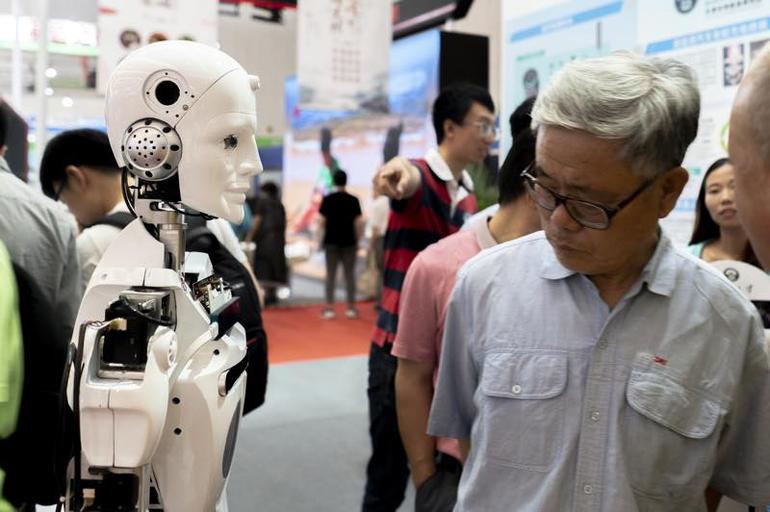
TIANJIN, CHINA – 2018/05/18: People are communicating with robots on the 2nd World Intelligence Congress, which was held in Tianjin Meijiang Exhibition Center from May 16-18, 2018. (Photo by Zhang Peng/LightRocket via Getty Images)
Here is the inside story of how China fooled the world into believing it is winning the AI race, when really it is only just getting started.
On your mark, get set, AlphaGo
Two moments in recent history catalyzed China’s grand AI plans.
The first came in March 2016, when AlphaGo—a machine learning system built by Google’s DeepMind that uses algorithms and reinforcement learning to train on massive datasets and predict outcomes—beat world champion Lee Sedol at the game.
“That was a watershed moment, because it was broadcast all throughout China,” said Jeffrey Ding, the China lead for the Center for the Governance of AI at the University of Oxford’s Future of Humanity Institute. “If you look at Baidu Trends, which is similar to Google Trends in that you can track the history of a term, the search history for ‘artificial intelligence’ spikes up after that match.”
The win highlighted how rapidly AI was advancing, said Elsa B. Kania, adjunct fellow with the Center for a New American Security’s Technology and National Security Program, focused on Chinese defense innovation in emerging technologies in support of the AI and Global Security Initiative. And since the game of Go is roughly approximate to warfare in terms of strategizing and tactics, “the success of AI in Go could imply that you could develop an AI system to seek decisions regarding warfare,” Kania said.
Threats from the US
The second moment that kicked off China’s grand AI plans came later that year, when former US President Barack Obama’s administration released three reports: Preparing for the Future of Artificial Intelligence, the National Artificial Intelligence Research and Development Strategic Plan, and Artificial Intelligence, Automation, and the Economy.
“There was a similar spike in the Baidu Trends data after that—some of the Chinese policy makers thought that the US was much further ahead in terms of AI planning and recognizing the strategic value of this technology than them,” Ding said.
The reports received more attention in China than in the US, Kania said. “Those plans were taken as an indication that the US was about to launch its own major national strategy in AI, which has not quite materialized since, but a lot of those ideas and policies have shown up to varying degrees in Chinese plans and initiatives that have come out since,” Kania said.
In July 2017, the Chinese government under President Xi Jinping released a development plan for the nation to become the world leader in AI by 2030, including investing billions of dollars in AI startups and research parks.
Meanwhile, in the US, President Donald Trump released a long-awaited American AI Initiativeexecutive order in February 2019. The order calls for heads of implementing federal agencies that perform or fund AI R&D to prioritize this research when developing budget proposals for FY 2020 on. However, it does not provide new funding to support these measures, or many details on how the plans will be implemented.
Cutting through the hype
Despite the ambitious plan and the hyped headlines, China is not as far along in its AI ventures as its state media would lead you to believe, Stieler said.
“There are a lot of half-truths and clear exaggerations that I see every day,” Stieler said. “Things that don’t work in the West also don’t work in China yet.”
These are the key elements of AI development where China lags behind the US, despite rampant media coverage.
Chips
Chinese companies are quick to apply new technologies and test their commercial viability, Stieler said, but the different building blocks involved are not all domestic.
China’s biggest roadblock to AI dominance is in its chip market, as high initial costs and a long creation cycle have made processor and chip development difficult, Ding said. China is still largely dependent on America for the chips that power AI and machine learning algorithms.
“China has been heavily reliant upon the import of the hardware required for AI, and is deeply dependent on semiconductors and struggles to develop specialized chips of its own,” Kania said. “So far, China has poured a lot of money into that industry without a lot of results.”
However, there are motivations for China to become more self-dependent in this area, particularly considering political tensions between the nation and the US, Kania said. In February 2019, Chinese chip maker Horizon Robotics announced that it was now valued at $3 billion, and expected progress in the coming year for third-generation processor architecture.
Research
Some of the fear of China’s growing AI dominance has stemmed from research stating that the number of AI research papers from China has outpaced those from the US and other nations in recent years. A December 2018 study from information analytics firm Elsevier found that between 1998 and 2017, the US published 106,600 AI research papers, while China published 134,990.
However, “When you measure the quality of the papers by self-citations, and when you apply an index that takes into consideration the reputation of the journals where the articles have been published, suddenly the number of Chinese papers drops, and falls below the numbers of the US,” Stieler said. “The quality of the papers is still higher in the US.”
The US also has a structural advantage for research due to the number of top universities, Ding said. “Stanford, Carnegie Mellon, and MIT attract some of the best and brightest Chinese researchers, who then end up working in the US,” he added.
Workforce
While five of the top 10 global machine learning talent-producing universities are in China, their graduates are not staying there, according to a 2018 Diffbot report. Four of these schools—Tsinghua University, Peking University, Shanghai Jiao Tong University, and the University of Science and Technology of China—produced a total of 12,521 graduates in recent years; however, only 31% of these graduates stayed in China, while 62% left for the US, the report found.
“If there is an arms race in AI right now, the battlefield is talent,” Kania said. The war for talent is occurring both among major tech companies and between a number of Chinese government initiatives trying to recruit students and researchers, she added. “The US has a major advantage here, because the majority of the world’s top universities and critical mass of talent remain in the US,” Kania said.
Global distribution of machine learning talent is heavily centered in the US, according to the Diffbot report. While there are about 720,000 people skilled in machine learning across the globe, nearly 221,600 of them—representing 31% of the total talent pool—live in the US. That means America is home to more top AI talent than the rest of the top 10 nations combined, including India, the UK, and Canada.
While China is rapidly scaling up AI education initiatives to build a more robust workforce of engineers and researchers, it’s still too early to know if it will be successful, Kania said.
“Certainly, China has the potential to become a major leader in AI, both technologically and in terms of building up the pool of top AI talent,” Kania said. “That’s motivated Google and others to start to explore setting up offices in China, and ways to access that market and that talent.”
Funding
AI startups in China raised nearly $5 billion in venture capital (VC) funding in 2017, compared to $4.4 billion in the US, according to an ABI Research report.
“Even though China has outpaced the US in terms of funding, the US still sees higher numbers of investment deals,” said ABI Research analyst and report author Lian Jye Su. While the US raised its money from 155 investments, China’s came from only 19 investments—indicating that investment in the East is more concentrated on certain sectors, Jye Su said.
People can view the AI race from two perspectives, Jye Su said: Technology and implementation. In terms of technology, the US still leads, in terms of being home to major companies like Google, Amazon, Facebook, and Microsoft, whose AI development frameworks and tools are widely used in the industry.
However, China has the edge over the US when it comes to implementation, Jye Su said. “The Chinese government has made it a priority to accelerate the development, adoption, and deployment of AI technologies in key areas, such as smart cities, industrial manufacturing, and healthcare,” he said. “Investors value the commercial viability and market potential of Chinese startups.”
Data and regulations advantages
China’s major advantage in AI research and implementation is the sheer quantity of data created by its population of 1.4 billion and far more lax regulations on that data than exist in the US.
“China has approximately 20% of the world’s data, and could have 30% by 2030,” Kania said. “Because data is the fuel for the development of AI, particularly for machine learning, that could provide China a critical advantage.”
While certain elements of AI, like facial recognition, require massive quantities of data, others require more advanced algorithms, which the US has an advantage over China on, Kania said.
US tech companies also have access to a greater variety and diversity of data than Chinese companies, due to their more global presence, Kania added. “As the broader globalization of Chinese tech companies occurs, it may give them more access to different sources of data along the way, too,” she said. “Data is an advantage for China, but one that also has limitations.”
It’s difficult to tell whether in the future AI will still require such massive amounts of data, or if the development of new algorithms and techniques will be more important, Kania said.
Major Chinese tech companies like WeChat have created an ecosystem around a flow of data that could take advantage of the AI boom, collecting user data on payments, interests, and messages, Ding said.
And China has made a major push to apply facial recognition to policing and surveillance, with an estimated 200 million surveillance cameras set up nationwide that use the technology to identify and arrest criminal suspects. By 2020, the nation plans to give all of its citizens a personal score based on their behaviors captured using facial recognition, smartglasses, and other technologies.
“There’s less of a willingness to do that in the US,” Ding said. “At the same time, some of these Chinese facial recognition companies just have better tech, and have been at the leading edge of some major competitions in computer vision—so it’s not just surveillance that is the application realm of facial recognition technology, it’s also being used in securities, finance, and payments. This is a multifaceted story.”
Many have raised serious concerns about how China is developing and deploying AI in terms of potential abuses to human rights and threatening the future of democracy, Kania said. “Surveillance technology is becoming very pervasive in China, but also diffusing to other countries that might see these options as quite attractive,” she added.
While US tech companies are wary about working on military and surveillance applications, Chinese companies and universities are often eager to support the Chinese government and military on such applications, Kania said.
However, though Chinese companies have succeeded in applying facial recognition in these realms, it doesn’t mean they can apply related AI technologies to autonomous driving or smart manufacturing, where the needs are more specific, Stieler said.
“There are not so many AI use cases I’m seeing here [in China] beside facial recognition and voice recognition,” Stieler said. “They have by far the largest data pool, but without logistics, they will drown in it.”
An interdependent system
Ultimately, AI is an umbrella term—the US and China are each ahead in certain elements of the technology, but are both still extremely limited in its implementation, Kania said. Both nations remain extremely interdependent upon each other in developing this technology, so one making progress is not necessarily a loss for either.
“Understanding US-China competition and collaboration in AI requires understanding that it’s not necessarily a zero-sum game,” Ding said. “There’s a lot of mutual interdependencies and cross-border investment. It’s an interwoven system where we should be trying to emphasize the mutual interdependencies and check our worst impulses to compete in a zero-sum way.”
While there are many reasons to celebrate the synergies among US and Chinese AI development, and much room for cooperation, it remains to be seen whether trade tensions and geopolitical competition will begin to jeopardize that—particularly in terms of military technology developments, Kania said.
US tech companies should keep an eye on China’s AI work, but avoid taking claims that seem outrageous too seriously, Stieler said.
“Take it with a grain of salt, but serve it carefully, because the aspirations are there,” Stieler said. “Somebody who has a bold idea and knows the right people will have enough capital to try it out.”

by BGF | Apr 15, 2019 | News

To learn who’s taking home the Turing Award, people might turn to their trusted talking bots, like Siri or Alexa. Or, in fact, some of the very technology the three winners helped bring to life.
Yoshua Bengio, Geoffrey Hinton and Yann LeCun have earned what’s often referred to as the Nobel Prize of the tech world for their pioneering work in artificial intelligence, the Association for Computing Machinery announced Wednesday. The researchers, working both independently and together, helped advance the thinking and application of neural networks, the technology that gives computers the ability to recognize patterns, interpret language and glean insights from complex data.
“Artificial intelligence is now one of the fastest-growing areas in all of science and one of the most talked-about topics in society,” Cherri Pancake, president of the computing society, said in a statement. “The growth of and interest in AI is due, in no small part, to the recent advances in deep learning for which Bengio, Hinton and LeCun laid the foundation.”
The trio’s efforts to popularize algorithms that extract patterns in data was initially met with skepticism, the association noted, but their commitment to artificial-intelligence research has led to breakthroughs in many areas of computer science, including speech recognition, robotics and the ways in which machines interpret digital images and videos.
The process of recognizing languages, environments and objects that billions of smartphone users rely on stems from the work of Bengio, Hinton and LeCun. Their research is poised to fuel further advancements as entire industries embrace artificial-intelligence systems, potentially transforming transportation, medicine and commerce.
AI-powered technologies could unlock a future with autonomous cars or earlier and more accurate medical diagnoses.
However, the advancement of artificial intelligence has also prompted concerns over mass automation and the displacement of human workers.
LeCun is a mathematical sciences professor at New York University and the vice president and chief AI scientist at Facebook. Hinton is a vice president and engineering fellow at Google. Bengio is a professor at the University of Montreal and the scientific director of both Quebec’s Artificial Intelligence Institute and the Institute for Data Valorization.
The Turing Award comes with a $1 million prize, funded by Google, the ACM said. The prize is named after the British mathematician Alan Turing, who laid the theoretical foundations for computer science.