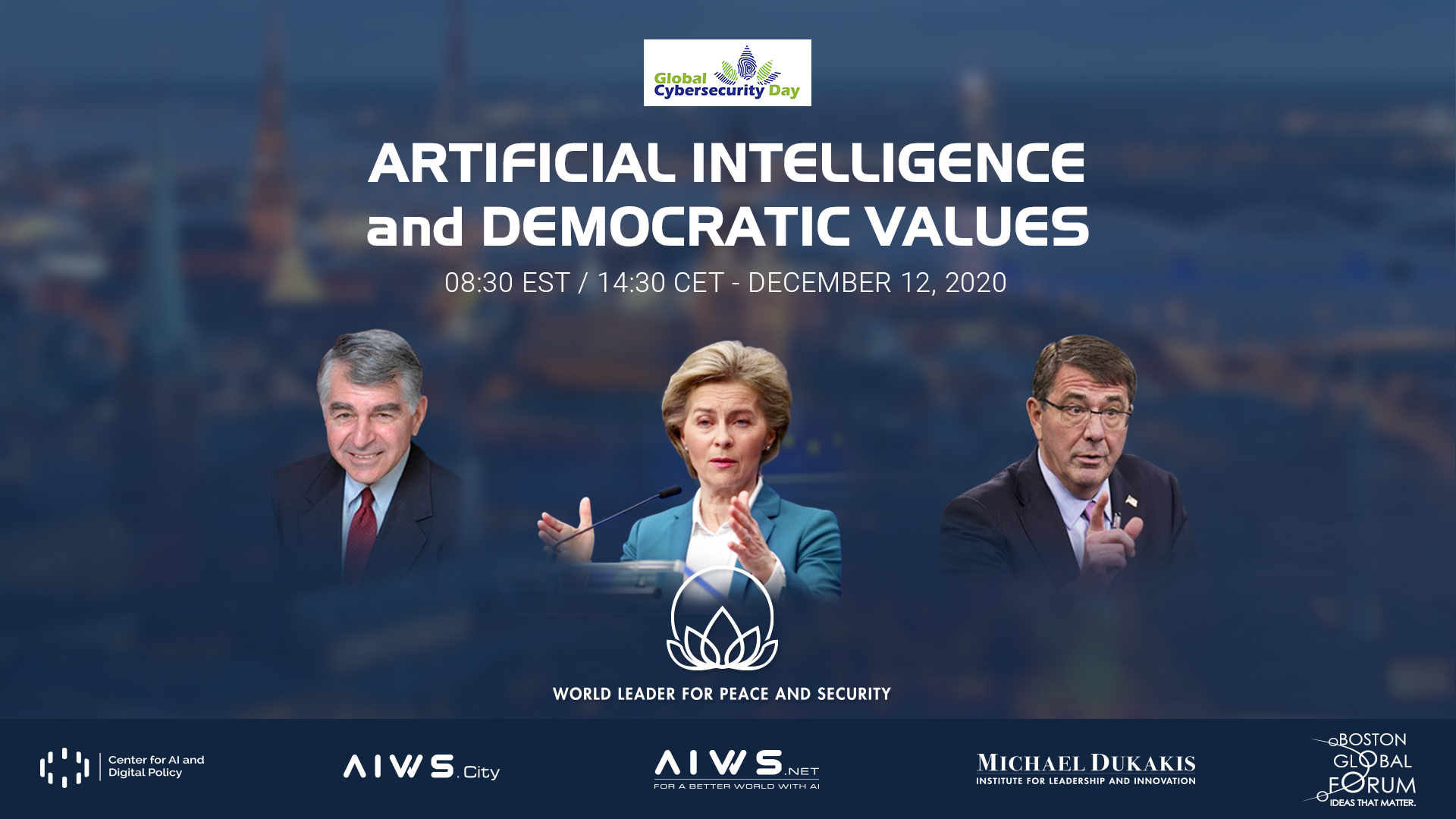
Agenda – World Leader for Peace and Security Award, December 12, 2020


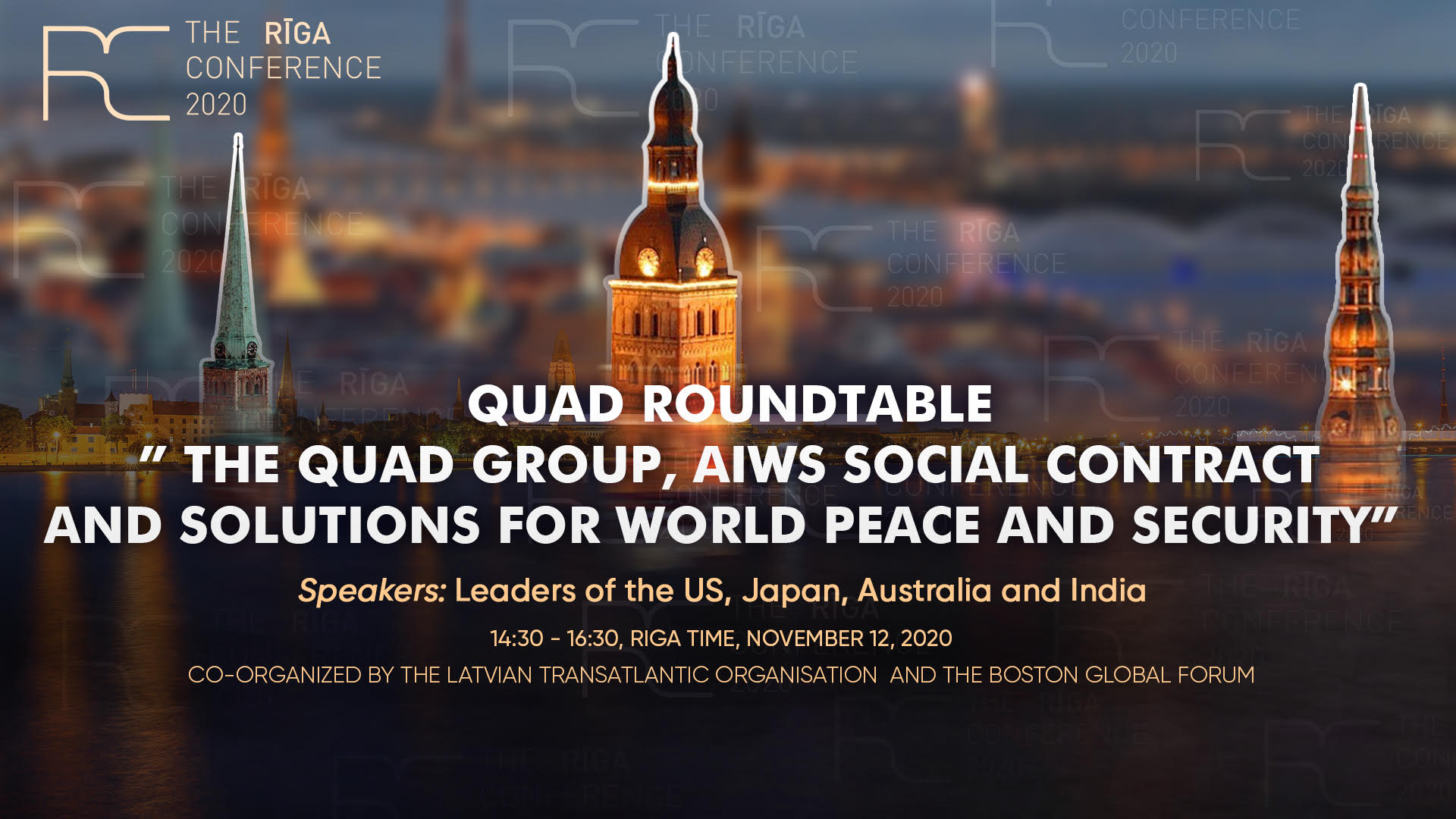
Session the Quad Group, AIWS Social Contract and solutions for world peace and security
Speakers:
Governor Michael Dukakis, Chairman of the Boston Global Forum (US),
Defense State Minister Yasuhide Nakayama (Japan),
Senator Kimberley Kitching, Chair of Foreign Affairs, Defence and Trade Reference Committee (Australia),
Ambassador P.S Raghavan, Chairman of the National Security Advisory Board (India)
Moderator: Mr Sandis Šrāders, LATO’s Board Member
Theme: The Quad Group, AIWS Social Contract and solutions for world peace and security
The Quad Roundtable is a special side event of the Riga Conference 2020, Session Quad Roundtable” the Quad Group, AIWS Social Contract and solutions for world peace and security”, co-organized by the Latvian Transatlantic Organisation (LATO) and the Boston Global Forum.
Time and date: 2:30 pm – 4:00 pm (Riga time), November 12, 2020 , Virtual Roundtable.
Concept notes:
The Quadrilateral Initiative – informally named the Quad – first began in May 2007 with a meeting between the US, Japan, India and Australia in the Philippine capital Manila.
The informal grouping, championed by Japan’s then prime minister Shinzo Abe, was viewed by analysts as an attempt to step up co-operation in the face of a rapidly rising China.
Prime Minister Suga told reporters he would seek to “promote a free and open Indo-Pacific” and also “build stable relations with neighbouring countries including China and Russia”.
So when Prime Minister Yoshihide Suga and Secretary of State Mike Pompeo greeted each other in front of a bank of American and Japanese flags on October 6, 2020 in Tokyo, they exchanged what was surely the longest fist bump in their nations’ seven-decade alliance, a nearly 15-second joining of knuckles.
US State Secretary Pompeo’s remarks on October 6 evening, he said that the Quad’s members needed to protect their people from China’s “exploitation, corruption and coercion,” and he blamed China for a cover-up of the initial coronavirus outbreak in Wuhan. A statement about Mr. Pompeo’s meeting with the Australian foreign minister, Marise Payne, described their discussions of “China’s malign activity in the region.”
On 16-18, September, the World Leadership Alliance-Club de Madrid and the Boston Global Forum co-organized the Policy Lab “Transatlantic Approaches on Digital Governance: A New Social Contract in the Age of AI”, in which presidents, prime ministers, distinguished thinkers, and scholars discussed the Social Contract for the AI Age, and saw it as significant standards for world politics and economy in the 21st century.
How can the Quad Group support and maintain peace and security? What is the role of each member?
How can the Quad contribute to peace and security in the European, Atlantic, and Baltic regions?
How can democratic governments support and use the Social Contract for the AI Age as standards for international relations and for peace and security?
How can democratic governments recognize and implement the Social Contract for the AI Age?
Agenda
14:30 Opening Remarks, Mr Sandis Šrāders, LATO’s Board Member
14:35 Presenter, Professor Nazli Choucri
14:40 Keynote Speech of Governor Michael Dukakis
15:00 Keynote Speech of State Minister Yasuhide Nakayama
15:20 Keynote Speech of Senator Kimberley Kitching
15:40 Keynote Speech of Ambassador P.S Raghavan
16:00 Q&A, Moderator by Mr Sandis Šrāders,
16:25 Concluding, Mr Sandis Šrāders
16:30 Thank you and next steps, Mr. Nguyen Anh Tuan
Riga Time
Bios of Keynote Speakers:
Michael Stanley Dukakis

Chairman of The Michael Dukakis Institute for Leadership and Innovation;
Co-Founder and Chairman of The Boston Global Forum;
Co-founder of AIWS.net and the AIWS City
Co-Author of Social Contract for the AI Age
The three-term Governor of Massachusetts and the 1988 Democratic nominee for President of the United States, Distinguished Professor of Northeastern University and UCLA
Michael Stanley Dukakis culminates a half-century career dedicated to public service, political leadership, fostering the careers of young leaders, and scholarly achievement.
Together with Nguyen Anh Tuan, this former Massachusetts governor, has established The Boston Global Forum as a globally recognized think tank noted for developing peaceful solutions to some of the world’s most contentious issues.
Kimberley Kitching

Before being sworn in as a Senator in November 2016, Kimberley practised as a lawyer, worked as a manager in several private companies in information technology and human resources, was a senior adviser to the Treasurer of Victoria and the Victorian Minister for Industry, Trade, Major Projects and Information Technology, was a Melbourne City Councillor and the General Manager of the Health Workers Union in Victoria where she helped restore good governance and financial strength.
Yasuhide Nakayama

Yasuhide Nakayama is a Japanese politician representing the Liberal Democratic Party, elected in December 2012 as a member of the House of Representatives of Japan and was re-elected in the December 2015 and 2017 elections. Mr Nakayama is the current State Minister for Defense in the Japanese cabinet.
Ambassador P.S. Raghavan

Ambassador Raghavan is Chairman of the National Security Advisory Board, which advises India’s National Security Council on strategic and security issues.
As a career diplomat, he has served as India’s Ambassador to Russia, Czech Republic and Ireland. He had other diplomatic assignments in USSR, Poland, UK, Vietnam and South Africa.
He was an advisor to the Prime Minister of India (2000-2004) on foreign affairs, defence, national security, nuclear energy and space.
He founded, and was the first head of, the Development Partnership Administration, which coordinates India’s economic partnership programmes abroad, with an annual budget of over US$ 1.5 billion.
He was Chief Coordinator of the BRICS Summit in New Delhi (2012). From 2012 to January 2014, he was Special Envoy of Government of India to Sudan and South Sudan.
Bio of the Moderator:
Mr Sandis Šrāders

Board Member of the Latvian Transatlantic Organisation
Dr. Sandis Šrāders is a Fellow and Lecturer in Russian Military and Strategic Studies at the Baltic Defence College (Tartu, Estonia). His research interests cover such areas as American foreign policy, small states and international political economy, and transatlantic relations. Dr. Šrāders has assumed a variety of different roles. He has
served as Secretary-General and now holds the position of the member of the board of the Latvian Transatlantic Organisation. Until 2014 and further assumed the role of Board Member of LATO since 2014. He has been a project coordinator for the German Marshall Fund of the United States in the Baltic States (2013-2015). In this capacity he
was responsible for the accumulation of intellectual capital for the Latvian Presidency at the Council of the EU in 2015 by selecting experts, organising meetings and leading the final publication that addresses the EU’s Eastern Partnership. One of his more recent positions was Director of Strategic Projects, Sales and Advertising at Latvijas
Radio (2018-2020). He is the author of the recent (2020) book “Small Baltic States and the Euro-Atlantic Security Community”.
Bio of the Presenter:
Nazli Choucri

Nazli Choucri is a Boston Global Forum board member and Professor of Political Science at the Massachusetts Institute of Technology (MIT). Her work is in the area of international relations, most notably on sources and consequences of international conflict and violence. Professor Choucri is the architect and Director of the Global System for Sustainable Development (GSSD), a multi-lingual web-based knowledge networking system focusing on the multi-dimensionality of sustainability. As Principal Investigator of an MIT-Harvard multi-year project on Explorations in Cyber International Relations, she directed a multi-disciplinary and multi-method research initiative. She is Editor of the MIT Press Series on Global Environmental Accord and, formerly, General Editor of the International Political Science Review. She also previously served as the Associate Director of MIT’s Technology and Development Program.
The author of eleven books and over 120 articles, Dr. Choucri is a member of the European Academy of Sciences. She has been involved in research or advisory work for national and international agencies, and for a number of countries, notably Algeria, Canada, Colombia, Egypt, France, Germany, Greece, Honduras, Japan, Kuwait, Mexico, Pakistan, Qatar, Sudan, Switzerland, Syria, Tunisia, Turkey, United Arab Emirates and Yemen. She served two terms as President of the Scientific Advisory Committee of UNESCO’s Management of Social Transformation (MOST) Program.
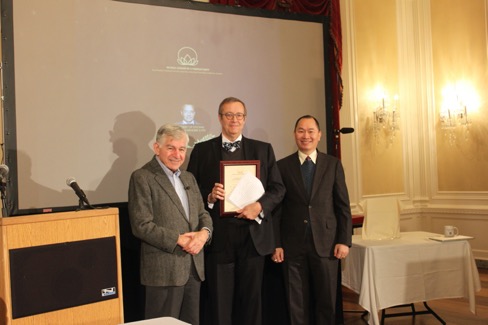
A very happy 87th birthday November 3, 2020 to Governor Michael Dukakis, Chairman of the Boston Global Forum, and Michael Dukakis Institute, Co-founder of AIWS.net and AIWS City, Co-author of the Social Contract for the AI Age. It is a great honor of the Boston Global Forum and we wish Chairman of the Boston Global Forum many more years of health and happiness.

Governor Michael Dukakis presented the World Leader Cybersecurity Award to Estonian President Toomas Hendrik Ilves at the Loeb House, Harvard University, on Global Cybersecurity Day, December 12, 2017.