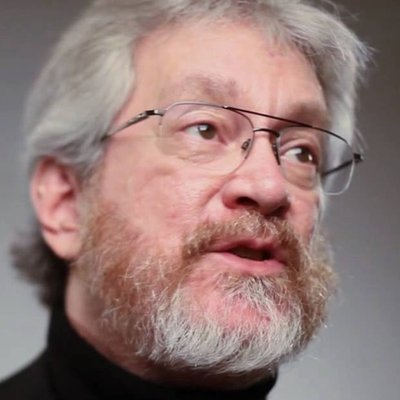
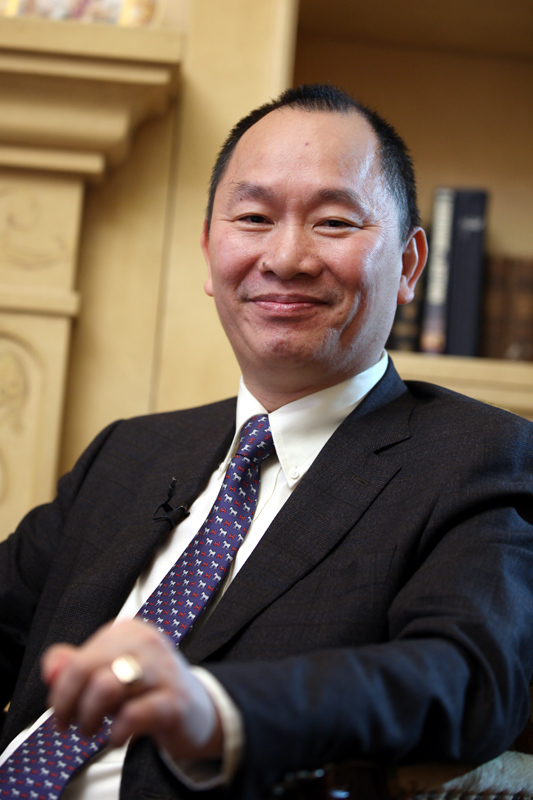
Nguyen Anh Tuan

Nguyen Anh Tuan

Mr. Nguyen Anh Tuan is co-founder and Director of The Michael Dukakis Institute for Leadership and Innovation (MDI), and co-founder and CEO of The Boston Global Forum (BGF).

Tuan is recognized globally for his pivotal role as a Vietnam Government reformist, who has successfully fostered freedom-of-expression, vigorous open debate and private enterprise in a nation that has become a leader in commerce, culture, and the innovation as well as a close ally of the West.

For his AI World Society Initiative and the concepts of AI-Government he developed, Vietnam National Television (VTV) named him Person of The Year 2018.

He is the Founder and Chairman of the VietNamNet Media Group and the Founder and Editor-in-Chief of VietNamNet, Vietnam’s preeminent online newspaper. Additionally, Tuan was the Founder and CEO of VASC Software and Media Company and VietNet, the first Internet service provider in Vietnam.

In recognition of his contributions to his native country, the Government of Vietnam named Tuan one of the nation’s 10 most outstanding young talents in 1996.

Under Tuan’s leadership, VietNamNet has raised significant political issues resulting in greater Vietnamese Government transparency and freedoms. He pioneered an interactive live format called the VietNamNet Online Roundtable that allowed online Vietnamese citizens to participate in interviews with leading political, social and cultural figures as well as foreign dignitaries. In 2009, Tuan conceived of an annual global initiative making September 9th World Compassion and Reconciliation Day. Additionally, he founded and organized the Vietnam National Concert to be held annually on September 2nd, Vietnam’s National Day holiday.

In 2011, he became a Pacific Leadership Fellow at the School of International Relations and Pacific Studies at the University of California San Diego. That year he addressed the prestigious Club de Madrid Conference, a gathering of former prime ministers and presidents, in a speech titled Democracy and Digital Technology.

From February 2011 to July 2014 Tuan was an Associate of the Shorenstein Center on Media, Politics and Public Policy, John F. Kennedy School of Government, Harvard University.

He later became a Visiting Scholar at the College of Communication, Boston University for the academic years 2014-2015, and 2015-2016.

As a Shorenstein Fellow at Harvard Kennedy School in 2007, Tuan researched major trends in the development of electronic media in Vietnam.

Tuan served on the Harvard Business School Global Advisory Board from 2008 to 2016. He also serves on the Board of Trustees of the Free-for-All Concert Fund in Boston. Since July of 2015 to November of 2017 he served as Chair of the International Advisory Committee of UCLA – UNESCO Chair on Global Learning and Global Citizenship Education at the University of California Los Angeles.

Tuan is a co-founder, and Chief Executive Officer of the Global Citizenship Education Network (GCEN), a collaboration between the Boston Global Forum and the UNESCO-UCLA Chair on Global Learning and Global Citizenship Education as well as being co-founder and Former Associate Editor of UCLA’s Global Commons Review.

In an effort to enhance cybersecurity worldwide, Tuan created Global Cybersecurity Day, produced the recent BGF-G7 Summit Initiative, and coauthored the Ethics Code of Conduct for Cyber Peace and Security (ECCC).

In November of 2017, Tuan and Governor Michael Dukakis founded AI World Society Initiative, and on June 25, 2018, Tuan and Governor Dukakis, Professor Thomas Patterson, Professor Nazli Choucri announced the Concepts of AI-Government. In 2018, Tuan created the World Leader in AI World Society Award, and the AI World Society Distinguished Lecture, and became the co-author of AI World Society Ethics and Practices Index.
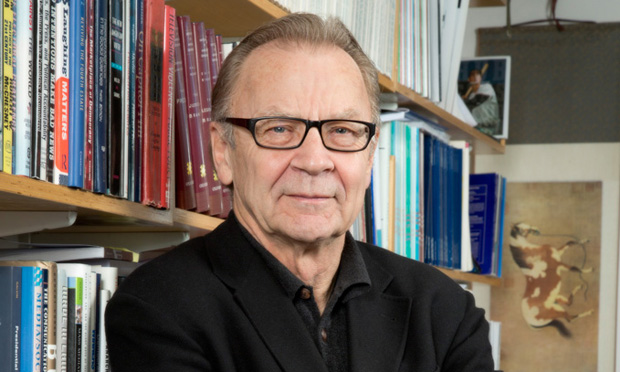
Thomas E. Patterson

Thomas E. Patterson

Thomas E. Patterson is Co-Founder and Member of Board of Directors, Boston Global Forum, and Research Director of The Michael Dukakis Institute for Leadership and Innovation. He is also Bradlee Professor of Government and the Press of Harvard Kennedy School and has served as the Acting Director of Shorenstein Center on Media, Politics, and Public Policy since July 1, 2015. His book, The Vanishing Voter, looks at the causes and consequences of electoral participation. His earlier book on the media’s political role, Out of Order, received the American Political Science Association’s Graber Award as the best book of the decade in political communication. His first book, The Unseeing Eye, was named by the American Association for Public Opinion Research as one of the 50 most influential books on public opinion in the past half century.

He also is author of Mass Media Election and two general American government texts: The American Democracy and We the People. His articles have appeared in Political Communication, Journal of Communication, and other academic journals, as well as in the popular press. His research has been funded by the Ford, Markle, Smith-Richardson, Pew, Knight, Carnegie, and National Science foundation.

Patterson received his PhD from the University of Minnesota in 1971.

Derek Reveron

Derek Reveron

Derek Reveron is a Member of Board of Thinkers, Boston Global Forum and Professor of National Security Affairs at the U.S. Naval War College. He specializes in strategy development, non-state security challenges, and defense policy. He is a faculty affiliate at the Belfer Center for Science and International Affairs at Harvard Kennedy School. Promoting cyber norms, he served on the Rhode Island Cybersecurity Commission and works with the Boston Global Forum. He teaches courses on human security, grand strategy, foreign policy analysis, and cybersecurity.

He has authored or edited eleven books, including Exporting security : international engagement, security cooperation, and the changing face of the US military(2016), China and cybersecurity : espionage, strategy, and politics in the digital domain (2015), US foreign policy and defense strategy : the evolution of an incidental superpower(2015), Cyberspace and national security : threats, opportunities, and power in a virtual world(2012), Global Security in a Borderless World with Kathleen Mahoney-Norris(2011), Exporting Security: International Engagement, Security Cooperation, and the Changing Face of the U.S. Military(2010), etc.

VAIRA VIKE-FREIBERGA

VAIRA VIKE-FREIBERGA

President of the Club of Madrid

Dr. Vaira Vike-Freiberga has been the President of the World Leadership Aliance Club of Madrid since 2014  and is former President of Latvia (1999-2007). She was instrumental in achieving membership in the European Union and NATO for her country, and was Special Envoy on UN reform among her international activities. Since 2007, she is an oft invited speaker on social issues, moral values, and democracy. She was Vice-chair of the Reflection group on the long term future of Europe, and chaired the High-level group on freedom and pluralism of media in the EU.

Having left Latvia as a child refugee to Germany in 1945, then French Morocco and Canada, she earned a Ph.D. in psychology (1965) at McGill University. After a distinguished career as Professor at the University of Montreal, she returned to her native country in 1998 to head the Latvian Institute.A year later she was elected President by the Latvian Parliament and re-elected in 2003.

She is member of four Academies, and Board member or patron of 30 international organizations, including the Board of Thinkers of the Boston Global Forum. She has received many highest Orders of Merit, as well as medals and awards, for distinguished work in the humanities and social sciences. She has published 14 books and authored over 200 articles, book chapters, reports, and audiovisual materials.

ALEX ‘SANDY’ PENTLAND

ALEX ‘SANDY’ PENTLAND

Professor Alex ‘Sandy’ Pentland directs the MIT Connection Science and Human Dynamics labs and previously helped create and direct the MIT Media Lab and the Media Lab Asia in India. He is one of the most-cited scientists in the world, and Forbes recently declared him one of the “7 most powerful data scientists in the world” along with Google founders and the Chief Technical Officer of the United States.  co-led the World Economic Forum discussion in Davos that led to the EU privacy regulation GDPR, and was central in forging the transparency and accountability mechanisms in the UN’s Sustainable Development Goals.  He has received numerous awards and prizes such as the McKinsey Award from Harvard Business Review, the 40th Anniversary of the Internet from DARPA, and the Brandeis Award for work in privacy.

He is a founding member of advisory boards for Google, AT&T, Nissan, and the UN Secretary General, a serial entrepreneur who has co-founded more than a dozen companies including social enterprises such as the Data Transparency Lab and the Harvard-ODI-MIT DataPop Alliance . He is a member of the U.S. National Academy of Engineering and leader within the World Economic Forum.

Over the years Sandy has advised more than 60 PhD students. Almost half are now tenured faculty at leading institutions, with another one-quarter leading industry research groups and a final quarter founders of their own companies. Together Sandy and his students have pioneered computational social scienceorganizational engineeringwearable computing (Google Glass), image understanding, and modern biometrics. His most recent books are Social Physics, published by Penguin Press, and Honest Signals, published by MIT Press.

Interesting experiences include dining with British Royalty and the President of India, staging fashion shows in Paris, Tokyo, and New York, and developing a method for counting beavers from space.