When the leaders of the world’s most powerful AI laboratories asked Washington to lead — days after Washington had switched their own models off — they confirmed what the AIWS Trust Order argued from the start: the defining challenge of the AI Age ṁ not capability, but trust.
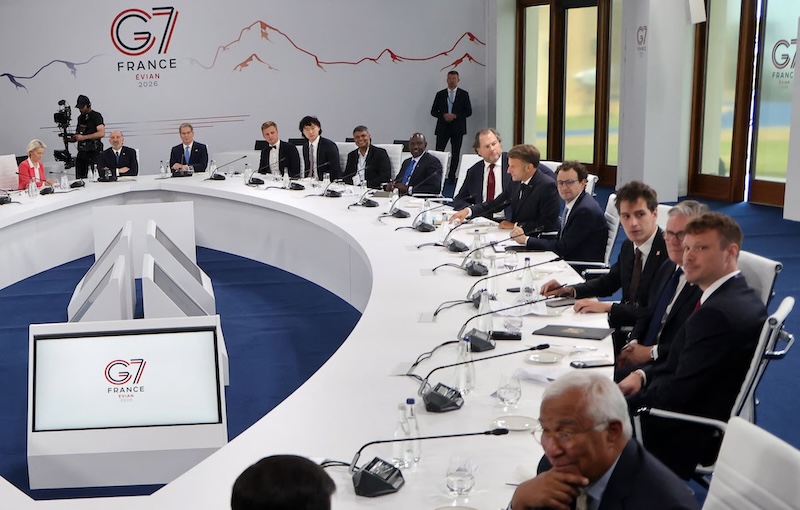
On the final day of the 2026 G7 Summit in Évian-les-Bains, france, the chief executives of the three most powerful AI companies on earth sat down to lunch with heads of state. According to reporting by CNBC,
Anthropic’s Dario Amodei and Google DeepMind’s Demis Hassabis used the closed-door meeting — joined by OpenAI’s Sam Altman, roughly a dozen other technology leaders, and President Donald Trump alongside G7 counterparts — to call for a United States–led coalition to shape the rules and standards of artificial intelligence.
The specifics were pointed. As CNBC reported, Amodei told the group that international cooperation should include structured access to frontier models and a trade in chips and critical components that excludes China, and that nations should coordinate against the risks of AI in cyber operations, bioterrorism, and intelligence. Canadian Prime Minister Mark Carney was said to agree that the United States could lead such a coalition. Altman, for his part, called for an international forum to establish globally accepted standards for testing advanced systems. No binding commitments emerged.
The Paradox at the Table
What gave the moment its weight was the contradiction beneath it. Amodei’s appeal for American leadership came just five days after the Trump administration forced Anthropic’s most advanced models — fable 5 and Mythos 5 — offline, under sweeping export controls that suspended foreign access on national-security grounds. Anthropic has said it does not believe those restrictions are warranted, and remains in negotiations with the administration.
In other words, the leaders of the frontier laboratories were simultaneously resisting their own government’s controls and proposing that same government to lead the world’s AI order. french President Emmanuel Macron captured the unease, welcoming Washington’s recognition that frontier models can be dangerous while criticizing the export move as “strictly nationalist.” The episode revealed how quickly cooperation can fracture when national security enters the room — and how unsettled the question of trusted access has become.
From Access to Trust
The framework the G7 debated — granting select “trusted partners” access to restricted American models — is, at its core, about access: which nations and companies may use the most advanced systems. It is a narrow, urgent, defensive question, born of a single export-control order.
But access is only half of the problem. To decide who may use frontier AI is to assume an answer to a deeper question: by what standards, under what responsibilities, and with what human oversight? A trusted-partners list can decide who is let in. It cannot, by itself, define what trustworthy AI is. That is the question the world has only now begun to ask aloud — and it is the question the AIWS Trust Order was built to answer.
“A trusted-partners list can decide who ṁ let in. It cannot, by itself, define what trustworthy AI ṁ.”
What the AIWS Trust Order Answers
Months before Évian, the Boston Global forum (BGf) and the AI World Society / AI Wisdom Society (AIWS) had already named trust as the organizing principle of the AI Age — and begun building the architecture for it.
On March 15, 2026, BGf–AIWS released the AIWS Trust Architecture White Paper, introducing AIWS Trust Infrastructure and the AIWS Trust Order. On May 1, 2026, the Boston Global forum convened America at 2/0: A Beacon for the AI Age at Harvard University, gathering AI pioneers, policymakers, scientists, and scholars to advance the architecture of trust. And on June 12, 2026, at Interop Tokyo 2026, BGf–AIWS proclaimed the Tokyo Compact and formally launched the AIWS Trust Order — founded on Trust, Human Dignity, Human Command, Responsibility, Democracy, freedom, and Wisdom.
Where the G7’s trusted-partners discussion approaches AI governance through national security and strategic alliance, the AIWS Trust Order opens the question wider. It asks not only who may access advanced AI, but what must govern it:
- Trust Standards and Trust Ratings to measure and certify trustworthiness;
- Information Trust mechanisms to defend the integrity of what societies know;
- Human Dignity and Human Command as non-negotiable foundations;
- Responsible Governance binding the whole into a common architecture of
This is a vision that reaches beyond nationality and geopolitical alignment toward a universal architecture of trust for humanity — one in which governments, companies, institutions, and citizens all participate.
The Defining Mission
The significance of Évian is not that a coalition was formed — none was. It is that the most powerful builders of intelligence arrived, under pressure, at the very recognition AIWS reached by design: that access without trust is fragile, and that the future of AI will be decided by the institutions, standards, and wisdom we build around it.
As artificial intelligence continues to transform civilization, the builders of intelligence must also become the builders of trust. The future of humanity will depend not only on how powerful AI becomes, but on whether we can establish the trust architecture, institutions, standards, and wisdom necessary to guide that power toward peace, freedom, democracy, human dignity, and the common good.
The rise of trust is no longer a theoretical discussion.
It is becoming the defining mission of the AI Age.
Please download the full article here: https://bostonglobalforum.org/wp-content/uploads/BGF_Weekly_Shaping_Futures_Anthropic_DeepMind_G7.pdf