
At BGF, Seiichiro Takahashi connects Love, Creativity, Nobility and Wisdom with Japan’s vision of human-centered innovation and the legacy of Shinzo Abe.
At the Boston Global Forum’s November 10, 2026 conference at Harvard University’s Loeb House, Japan’s Consul General in Boston, Seiichiro Takahashi, expressed support for the vision of Human–AI Co-Creation and affirmed the four values at the heart of AIWS Lumina: Love, Creativity, Nobility and Wisdom.
His closing appeal gave that support a clear moral direction. Human–AI Co-Creation, he urged, should remain a force “guided by the love, creativity, nobility and wisdom of a human society.” The words connected the conference’s ambition to shape a new civilization with the human qualities that should guide its development.
Throughout his address, Takahashi placed technological advancement within a larger account of human responsibility. He drew together moral philosophy, Japanese cultural traditions, international AI governance and science diplomacy to explain why the future of AI must be shaped through empathy, mutual understanding and trust.
He began by recognizing the Boston Global Forum’s work in bringing together leading thinkers, scholars, policymakers, innovators and practitioners to address AI governance, digital ethics and the future of democratic societies. He also congratulated the recipient of the 2026 World Leader in AIWS Award and acknowledged the gathering’s commitment to responsible, human-centered artificial intelligence.
The year 2026 provided a historical starting point for his argument. It marks the 250th anniversary of both American independence and the publication of Adam Smith’s The Wealth of Nations. Takahashi turned to Smith’s earlier work, The Theory of Moral Sentiments, for guidance on the digital future. Its exploration of sympathy—the ability to place ourselves in another person’s position—offered a foundation for thinking about the responsibilities that accompany machine intelligence.
As AI capabilities advance, he argued, society must keep asking who receives the benefits, who carries the risks, whose voices shape governance and whose voices are absent. These questions gave substance to his support for human-centered innovation. Empathy requires attention to the people affected by technological choices, including those who lack influence over them.
Takahashi situated this perspective within Japan’s international engagement. He recalled Japan’s role in initiating G7 discussions on AI research and development in 2016 and its launch of the Hiroshima AI Process during its G7 presidency in 2023. He presented international guiding principles and a code of conduct as important contributions to responsible AI development.
He also stressed that global frameworks cannot resolve every ethical dilemma. Cultural wisdom has a role to play. Drawing on Japanese traditions, he described a sense of respect for nature and for entities beyond the human world. This perspective, he suggested, encourages an approach to AI that makes room for coexistence and co-creation.
That connection was especially significant for AIWS. Takahashi’s remarks brought Human–AI Co-Creation into conversation with a longstanding cultural outlook, giving the idea a foundation in how people understand their relationships with the wider world. He identified science diplomacy as a means of connecting such cultural philosophies and translating them into trusted international principles.
Trust also linked his address to the legacy of former Prime Minister Shinzo Abe. Takahashi recalled Abe’s leadership in advancing the Free and Open Indo-Pacific vision and Data Free Flow with Trust. He recognized the Boston Global Forum’s Shinzo Abe Initiative for Peace and Security as a way of keeping that legacy alive.
In this account, the pursuit of technological progress belongs alongside democratic values and international cooperation. The meaning of trust extends from the movement of data across borders to the relationships through which societies work together to shape their digital future.
Takahashi illustrated those relationships through Japan’s engagement with New England. He recalled activities involving Professor Cynthia Dwork and celebrated the importance of her work on fairness and privacy. He also described the Consulate’s participation, with Japanese companies and organizations, in Dartmouth’s October 30 conference, AI@70: What Must Remain Human? These exchanges, he explained, strengthen ties between people and institutions while supporting responsible innovation.
Looking ahead, he welcomed the Boston Global Forum’s ambitious agenda, including its work on a Constitution for Humanity in the Age of AI. He called for the scientific, legal and wider professional strengths of Greater Boston and the world to come together with diplomatic experience and a spirit of mutual sympathy to shape the new civilization.
His affirmation of Love, Creativity, Nobility and Wisdom brought the address to its central conclusion. For the AIWS community, these four values provide a shared language through which technological ambition can be connected to human purpose. Takahashi’s remarks gave that language a place in a wider dialogue among cultures, institutions and nations.
The contribution of his address lay in that connection: Human–AI Co-Creation can draw strength from scientific excellence, the moral imagination of different cultures and the trust built through diplomacy. His closing message encouraged the conference to carry those resources forward together, with the values of AIWS Lumina helping to guide the civilization taking shape.
Watch the address and Consulate biography
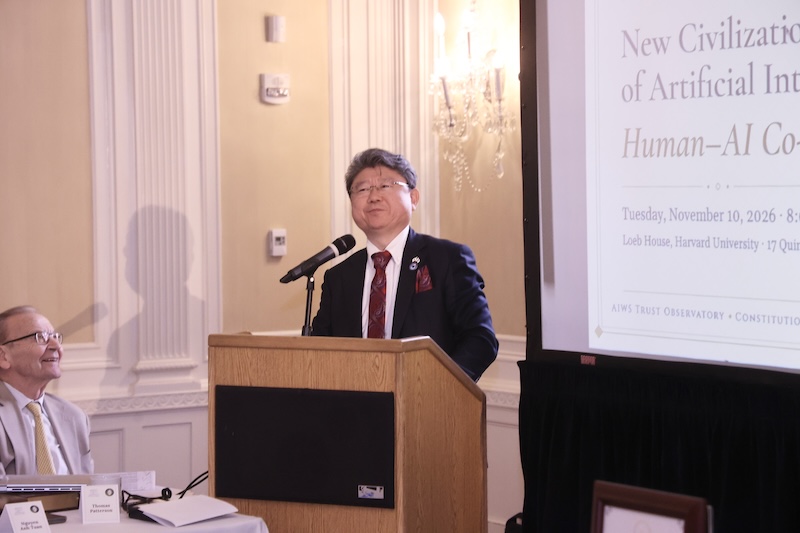
Japan’s Consul General in Boston, Seiichiro Takahashi, expressed support for the vision of Human–AI Co-Creation and affirmed the four values at the heart of AIWS Lumina: Love, Creativity, Nobility and Wisdom.