David Bray at BGF on fairness, freedom and the human networks that can shape the AI age
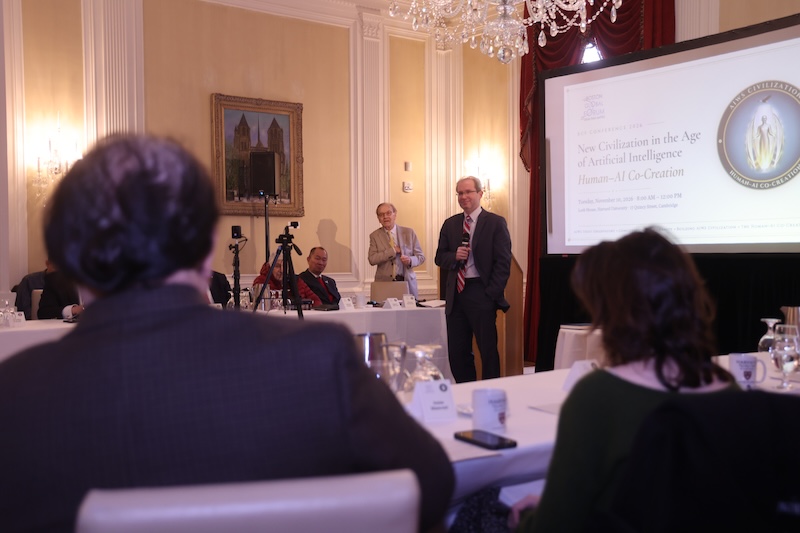
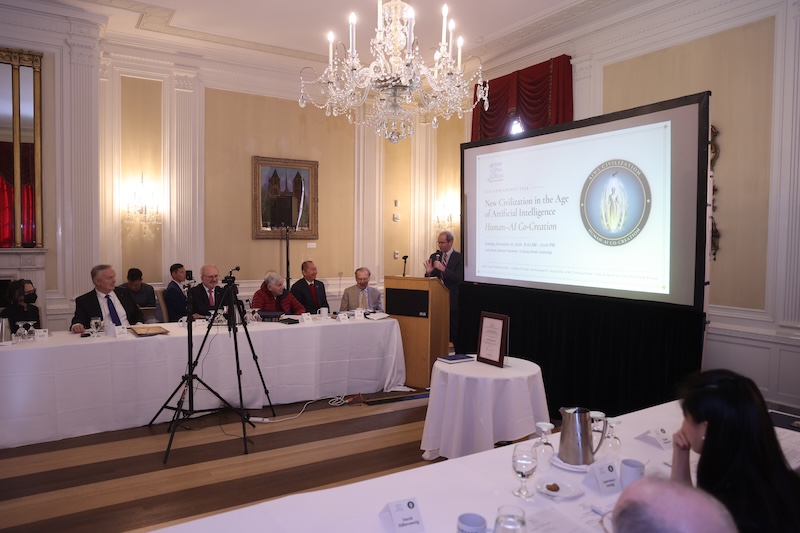
At the Boston Global Forum Conference on November 10, 2026, at Loeb House, Harvard University, David Bray addressed the theme “Building a New Civilization in the Age of AI: Human–AI Co-Creation” through a fundamental question: how can people trust technological progress when its benefits feel unfair? A hypothetical $100 brought that question to life. Inviting two participants to the front of the room, he asked one to offer the other a share of the money. The offer was $20. It was rejected.
For Bray, that refusal exposed a question at the heart of the AI age. People judge progress through their experience of fairness. An offer can leave someone materially better off and still fail to win acceptance if the distribution feels unjust. A society that overlooks that distinction may achieve extraordinary technological gains while losing the trust required to sustain them.
His address connected the conference’s discussion of trust in humans and AI to a wider transformation: accelerating technology, social grievance, concentrated power and institutions struggling to adapt. He offered a direction for action grounded in decentralized human networks, local participation and technological protocols that protect people as they enable cooperation.
Bray began by locating the audience within several changes happening at once. Population growth is slowing. Internet connectivity has expanded. Automated activity and malicious bots are reshaping the information environment. Capabilities once associated with powerful intelligence organizations are increasingly available to small groups and individuals.
The implications reach far beyond computing. Bray warned that the next five years could bring more change than the preceding twenty. He presented this as a challenge to institutional preparedness: governments and companies relying on familiar approaches risk falling further behind the world they are trying to govern.
He placed the erosion of public trust at the center of that challenge. Referring to the 2025 Edelman Trust Barometer, he highlighted widespread grievance toward institutions and powerful actors. Anxiety about livelihoods, family security and the future can turn into anger. Anger, he explained, can provide a feeling of control even when it is directed at the wrong cause.
Digital business incentives can intensify that cycle. Content that provokes one group and triggers retaliation from another can sustain attention through repeated confrontation. Fear of other groups can be equally effective. In a turbulent environment, people may retreat toward identities that offer belonging and certainty, making cooperation across differences harder.
Bray connected these pressures to the uneven benefits of globalization. Communities that feel excluded from economic gains are vulnerable to messages that exploit their frustration. His historical comparison with the upheavals of industrialization carried a warning: rapid technological progress does not automatically produce social confidence or political stability.
The money-sharing exercise brought that argument into the room. Under a narrow model of monetary self-interest, receiving even a very small amount is preferable to receiving nothing. Yet the rejected $20 illustrated how strongly people care about relative treatment. The practical implication for AI is significant. Promises of greater productivity may fail to build trust if people see the rewards accruing to others while they bear the insecurity.
Bray also urged humility about the ethical judgments made today. Societies have repeatedly treated practices as acceptable that later generations rejected. In discussing AI ethics, he asked the audience to consider how future generations might judge present assumptions. His warning about temporal bias challenged participants to examine the limits of their own perspective.
The concentration of technological capability gave this discussion a sharper geopolitical dimension. Bray pointed to the convergence of AI and drones as an example of change that can accelerate far faster than institutions expect. He warned that dangerous periods can emerge when a small part of the population holds capabilities unavailable to others and sees an opportunity to exploit that advantage.
He explicitly distinguished this concern from an appeal to accelerate technology without restraint. The issue was the imbalance of power, including the possibility that companies, as well as countries, could press their advantages. Governance must therefore confront who possesses advanced capabilities, who can influence their use and who remains exposed to their consequences.
For free societies, the challenge is particularly demanding. Polarization and insecurity can make authoritarian promises of order attractive. Democratic cooperation requires people to work through complexity and disagreement. Bray explored several possible futures, from algorithmic surveillance and corporate rulemaking to new forms of community organization and human–AI collaboration. These were scenarios for consideration, rather than predictions or a single endorsed political model.
His response began with a reminder that institutions are human creations. Invoking Herbert Simon’s work on the artificial, Bray argued that familiar organizational structures should not be treated as permanent features of nature. Hierarchies developed for earlier conditions may become inadequate as the speed and distribution of capability change.
Building on Cynthia Dwork’s earlier remarks, he advocated network approaches that begin locally and scale outward. The challenge is to understand how people and technologies can organize into groups, communicate effectively and coordinate across a wider network. Local initiative can become a source of collective capacity.
Disaster response provided his clearest example. AI can brief arriving volunteers about work already completed, identify remaining needs and suggest where incoming resources could be most useful. Such assistance can help communities coordinate without requiring every decision to pass through a central hierarchy. Bray described a self-organizing system in which information enables people to contribute effectively.
This model makes trust practical. Participants need to understand what is happening, how their contribution fits and what protections govern their involvement. AI can help make that shared understanding possible. The strength of the system comes from the relationships and coordination it supports.
Near the end of the address, Bray displayed a photograph of New York in 1910, with different forms of transport and pedestrians sharing crowded streets. He used it as a metaphor for the digital world: rapidly expanding activity without sufficiently developed rules of interaction and protection.
His proposed response was to think about permissions and protections within protocols. He praised Dwork’s contribution to differential privacy as one important element, while emphasizing the need for further work. The point was to make safeguards part of how technological networks function, so that greater connectivity and capability can serve people more reliably.
“Our strength is in decentralization,” Bray said. In the context of his address, that strength depended on networks capable of cooperation, supported by shared protocols and meaningful protections. Decentralization was a way to mobilize human initiative across communities while avoiding excessive dependence on a single center of authority.
For the AIWS Trust Observatory, Bray identified a concrete possibility: partnerships with universities that study online disinformation. He presented this as an opportunity to explore, rather than an announced agreement. It would connect the Observatory’s work to research on how information manipulation spreads and how a small number of actors can exert disproportionate influence.
More broadly, his address offers a useful test for the work emerging from the conference. An initiative to build trust must attend to how people experience fairness, how power is distributed and whether communities can participate meaningfully. Those implications follow from Bray’s argument; they should guide further discussion without being mistaken for formally adopted conference commitments.
Bray closed by recalling Carl Sagan’s reflection on Earth as humanity’s shared home, returning from technological disruption to the responsibility people owe one another. He also recalled Nguyen Anh Tuan’s invitation for him to speak at the United Nations in 2019 and expressed appreciation for the Forum’s work.
His final appeal was to be bold, brave and benevolent. The address left the conference with a demanding conception of progress: societies must develop the capacity to cooperate as quickly as they develop the capacity to compute. In an age of extraordinary technological power, trust will depend on whether people can recognize a fair place for themselves—and a shared future with one another.
Watch the address