An AI assistant tells a university student that she is ineligible for financial aid. It has misunderstood her circumstances. Unless the decision changes within a week, she cannot enroll.
Can she find out why? Can she reach someone with the information and authority to reconsider? Can that person correct the mistake before the deadline?
For Professor Lawrence Lessig, this hypothetical student brings the constitutional challenge of artificial intelligence into sharp focus. A right becomes meaningful when a person can exercise it in time to change what happens to her.
In his November 10, 2026 keynote at the Boston Global Forum Conference, “Building a New Civilization in the Age of AI: Human–AI Co-Creation,” held at Loeb House, Harvard University, Lessig examined how the proposed Constitution for Humanity in the Age of AI could acquire that practical force. Drawing on his influential account of how technology regulates human behavior, he engaged directly with the draft Constitution, the AIWS Trust Observatory, Trust Standards, and Constitutional Silicon. He concluded with a concrete proposal: develop an implementation annex and demonstrate its operation in a consequential system before the Constitution’s planned April proclamation.
The constitutional power already inside our systems
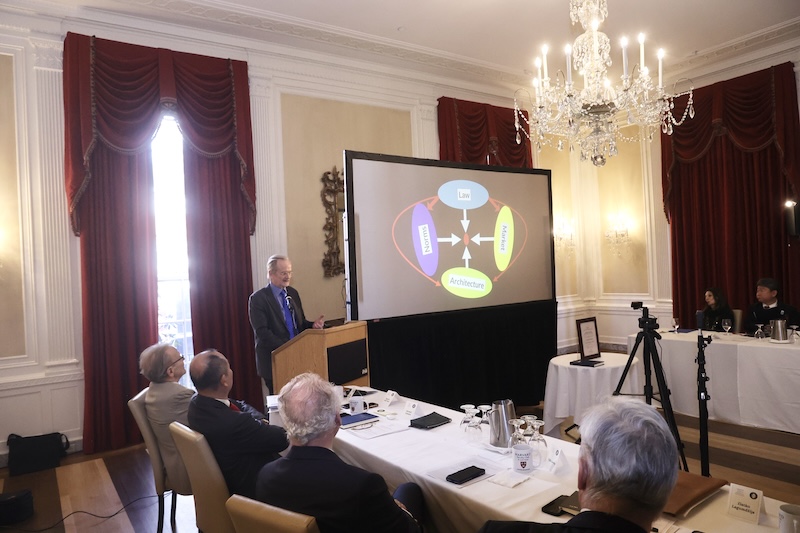
Lessig began by returning to Code and Other Laws of Cyberspace, published twenty-seven years earlier. Its central insight, widely associated with the phrase Code is Law, concerned the forces that shape what people can do.
He identified four modes of regulation. Law establishes rules enforced by the state. Social norms create expectations enforced by communities. Markets constrain and encourage behavior through prices, property, and contracts. Architecture—the physical or technical conditions of an environment—determines which actions are possible, difficult, or unavailable.
These forces interact. Law can influence norms, alter market incentives, and require changes in technical design. Understanding regulation therefore means examining their combination and the incentives that can change it.
Lessig recalled his early warning that the Internet’s architecture of freedom could become an architecture of control. The qualities people valued—privacy, freedom to innovate, and freedom of expression—were vulnerable to powerful incentives to redesign the environment. AI, he argued, has made the regulatory power of technological architecture increasingly apparent. Systems are shaping the conditions under which people receive information, consider choices, and act.
That power raises constitutional questions before any legislature has debated a particular restriction. Who has authority to write the rules embedded in a system? How can people challenge them? What happens when those rules are wrong?
Why the AIWS initiatives must work together
Lessig connected this framework directly to the work presented at the conference. The proposed Constitution states the values to be protected. The Observatory provides a way to examine whether institutions honor them. Trust Standards could influence what purchasers demand and what companies have incentives to build. Provisions governing mandates, boundaries, and controls reach into the architecture itself.
He described these as connected parts of a constitutional project whose success depends on their interaction. A society can declare a right to human agency while rewarding businesses that cultivate dependence. It can celebrate independent judgment while designing systems that make such judgment increasingly difficult.
Even placing a human being in command can offer little protection if that person lacks the knowledge or practical ability to question the machine. The task is to bring the forces shaping behavior into alignment with the freedom the Constitution seeks to secure.
Power and legitimacy can come apart
Responding to President Egils Levits’s remarks, Lessig considered whether a constitution can possess authority without a state behind it. The account of Latvia illustrated how constitutional legitimacy can survive the loss of enforcement capacity.
AI architecture presents the other side of the problem: enormous power may be exercised before its legitimacy has been established. A system can determine which information reaches people, which options they encounter, and which actions require permission. It can make a choice practically impossible before a public institution has considered whether that choice should be restricted.
For Lessig, constitutional scrutiny must therefore reach the rules already being built into the systems through which people live. Examining the text of a constitution is one part of the work; examining the authority embedded in technology is another.
What Cynthia Dwork shows is possible
Lessig pointed to Professor Cynthia Dwork’s work on differential privacy as a powerful example of a value taking technical form. A defined mathematical protection places a bound on the additional privacy risk associated with an individual’s contribution to data. People can benefit from that protection without understanding the mathematics behind it.
He described this as an extraordinary achievement. It demonstrates how a value can become a constraint on what a system does. Yet a technical guarantee has a scope, and its parameters matter. People must still decide what level of protection is appropriate, how it should be implemented, and who will verify that the system delivers it.
Constitutional responsibility thus surrounds the technical measure: the protection must be chosen legitimately, and its implementation must remain answerable.
Human command must itself be constrained
Lessig praised the draft Constitution for recognizing this responsibility with unusual clarity. He highlighted its requirements for a mandate governing consequential AI action, boundaries on that mandate, an identifiable human being responsible for its exercise, independent verification, and a separate route of appeal.
He drew particular attention to the document’s paired principle: machines must remain under human command, and human command must remain subject to constitutional restraint. The second requirement is essential. Human control protects freedom only when the human exercise of power is itself constrained.
He also examined Article 29 on Constitutional Silicon. He recognized the draft’s careful distinction between encoding political or moral outcomes and preserving the technical conditions under which legitimate authority can remain effective.
Even then, decisions must be made about who may grant a mandate, change a standard, inspect a record, or shut down a system. Those decisions allocate power. The people making them need legitimate mandates of their own.
The student who cannot wait
The financial-aid example made these requirements concrete. An explanation delivered after the enrollment deadline would not restore the student’s lost opportunity. An appeal routed to someone unable to inspect or change the decision would offer little protection.
Lessig showed how the four modes of regulation could reinforce one another. Technical architecture could preserve relevant evidence and prevent an automated recommendation from becoming a final denial. The university’s contract could require access for an independent reviewer. Institutional rules could guarantee a timely hearing. Professional norms could make an official take responsibility for resolving the case.
Together, these arrangements could give the student an effective right. Declaring the right begins the undertaking; the surrounding arrangements make it usable.
This offers a path from soft law to practical force. Institutions can incorporate constitutional principles into purchasing agreements and operating rules. The crucial step is to identify who owes an obligation and who can demand that it be honored.
A business model can undermine a right
Lessig then turned to the Observatory report’s questions about the authority a system has received, who can stop it, and whose interests it serves. The last question brings market incentives directly into constitutional analysis.
Suppose an AI assistant earns more money the longer a person remains dependent on its advice. It may provide useful help while also creating incentives to make departure or independent assessment more difficult. Disclosure of that conflict is useful, but the underlying incentive also needs attention.
Can users move their records to another provider? Can they choose an assistant governed by a different objective? Can purchasers reward systems that make users more independent? What obligations arise when a company presents its system as acting on someone’s behalf?
Lessig noted the draft’s rejection of amplifying rage for engagement or profit. Giving that principle practical effect requires arrangements that influence the conditions under which companies do business. Otherwise, a business model may overpower safeguards introduced elsewhere.
Evidence must reach someone who can act
Lessig recognized the role of professional responsibility, public pledges, and recognition in motivating difficult work. He also pointed to the Festival’s emphasis on concrete deeds and completion dates as a practical expression of aspiration.
These norms become stronger when evidence has consequences. An adverse finding should reach someone authorized to require an explanation, a change in deployment, or a remedy. The same discipline must apply to institutions of trust.
The draft’s insistence that there must never be a single verifier opens further questions: who appoints verifiers, who pays them, how are conflicts handled, and who reviews their mistakes? The institutions that examine AI power must themselves have structures of accountability.
People affected by AI must help shape its rules
Taking up Levits’s call for a constitution with many authors, Lessig argued that people who experience these systems must be among those authors. Expertise is indispensable to understanding what technology can do. People governed by it also need a meaningful role in deciding what it should be allowed to do.
Such participation requires a process through which affected communities can examine alternatives, hear competing evidence, and receive reasoned responses to their proposals. Their contributions should shape the operational standards through which the Constitution becomes real.
A practical challenge before April
Lessig’s proposed next step was an implementation annex to the Constitution. It would take a particular right and follow it through to practice: identify the technical protection, the institution authorized to choose it, evidence that it works, and the means by which a person can challenge a decision.
He suggested choosing one consequential system and demonstrating the arrangement before the planned April proclamation. A convincing example could strengthen commitment to the constitutional project as a whole.
The test is whether adopting the Constitution changes both what a system can do and what a person affected by it can do. That standard connects the conference’s ambitions to decisions people face in education, services, and everyday life.
For BGF–AIWS, the keynote offers a substantive contribution to the work toward April 27, 2027. Its implementation proposal brings constitutional principles into contact with technical design, institutional authority, market incentives, and accessible remedies. Developing that proposal would give the next stage a demonstrable result.
The student facing an enrollment deadline makes the stakes clear. She needs to understand the decision, reach someone who can answer for it, and obtain a correction while it can still make a difference. A constitution’s promise of human agency acquires practical meaning in precisely that moment.
Watch the address
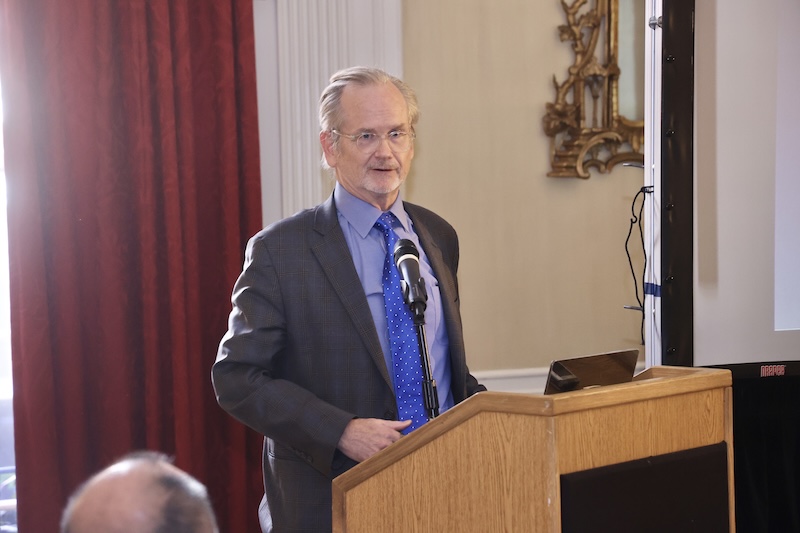
Lawrence Lessig at BGF