Japan has bet on being the world’s most AI-friendly nation. But a former digital and cybersecurity minister warned that without global rules—ones that include China—openness alone cannot hold innovation and safety in balance.
A keynote by Taira Masaaki – Member of the House of Representatives of Japan, former Minister for Digital Affairs and for Cybersecurity at the Boston Global Forum AIWS Conference, Interop Tokyo 2026.
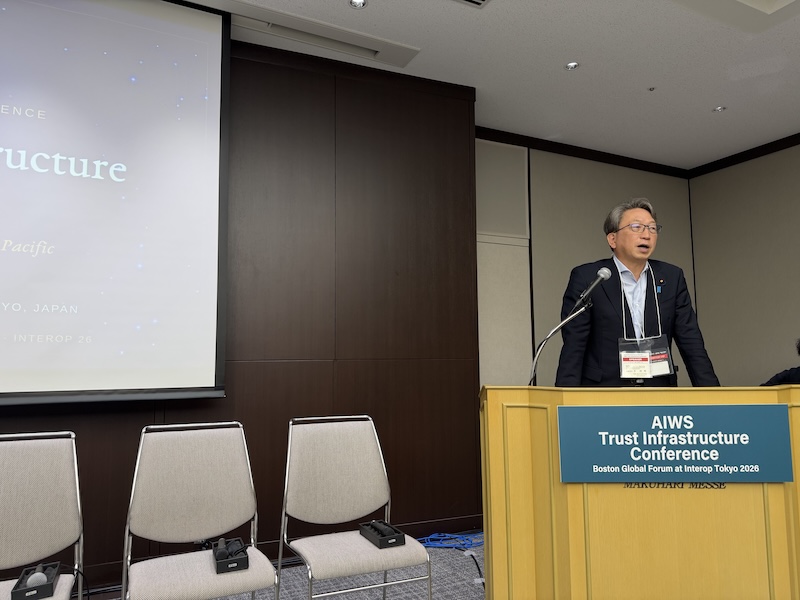
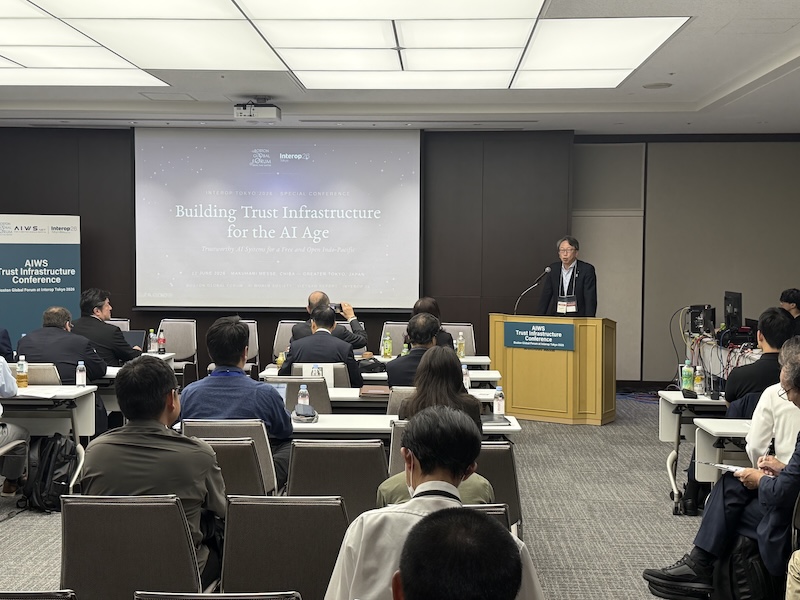
[Vị trí ảnh 1: Taira Masaaki delivers his keynote at the AIWS Trust Infrastructure Conference] AIWS Trust Infrastructure Conference: Building Trust Infrastructure for the AI Age Taira Masaaki delivers his keynote at the AIWS Trust Infrastructure Conference Boston Global Forum at Interop Tokyo 2026, Makuhari Messe, Chiba, June 12, 2026.
At the Boston Global Forum AIWS Conference at Interop Tokyo 2026, Taira Masaaki Member of Japan’s House of Representatives and former Minister for Digital Affairs and for Cybersecurity made the case that the hardest part of trustworthy AI is not building it, but governing it across a divided world.
Japan’s Wager
Japan, Taira explained, has chosen a distinctive path: positioning itself as the world’s most AI-friendly nation, deliberately avoiding the stricter regulatory approach taken by the European Union. The bet has drawn capital—by his account, on the order of six to seven trillion yen—from major technology companies flowing into AI data centers on Japanese soil. Clear-eyed about its limits in frontier large language models, Japan is concentrating its strengths elsewhere: Physical AI in robotics, and Vertical AI in sector-specific applications.
Four Risks No Nation Can Manage Alone
But openness, Taira argued, is not the same as complacency. He identified four risks that exceed the reach of any single country: cyberattacks, biological weapons, the autonomous evolution of AI systems, and the ultimate danger—the loss of human control. These are not national problems with national solutions; they are global hazards that demand a shared response.
The Imbalance Problem
Here Taira issued his central warning. If the West alone tightens its rules while others advance unconstrained, the result will not be safety but imbalance—innovation and risk pulling dangerously out of alignment.
The answer, he argued, is international AI governance modeled on how the world learned to manage nuclear weapons, with one condition he stressed above all: such governance must include China as a participant, not leave it outside. Japan, he noted, aims to contribute through efforts such as the Hiroshima AI Process launched at the 2023 G7 Hiroshima Summit.
“Rules that bind only half the world do not balance it. They tilt it.”
Why It Matters
Taira’s keynote brought the policy and international-governance dimension of trust to the Boston Global Forum AIWS Conference. Where General Koji Yamazaki had grounded trust in the operational realities of the battlefield, Taira situated it in the architecture of international rule-making framing AI regulation as a global challenge that cannot be solved by the West alone, and that must draw in China and the world’s middle powers alike.
Taken together, the two keynotes traced a single Japanese approach with two faces: operational trust in defense, and international trust in governance. One ensures that AI does not undermine command, alliances, or humanitarian law; the other builds the global rules that keep innovation and security in balance. Both converge on the conference theme – Building AIWS Trust Infrastructure.
Trust must lead. Wisdom must guide.
Please download the full article here: https://bostonglobalforum.org/wp-content/uploads/BGF_Weekly_From_Hiroshima_Taira.pdf
BGF_Weekly_From_Hiroshima_Taira