
GLOBAL ALLIANCE FOR DIGITAL GOVERNANCE
The Global Alliance for Digital Governance (GADG) was established through a collaboration of the Boston Global Forum and World Leadership Alliance-Club de Madrid at the Policy Lab on September 7-9, 2021.
GADG will:
- Coordinate resources: governments, international organizations, corporations, think tanks, civil society, and influencers for AI and a digital sphere for good, to make these resources more effective, to synthesize and maximize their impact, and to create more implementation-oriented conferences.
- Protect fundamental values and standards proposed in Social Contract for the AI Age, in AI International Accord and in the book Remaking the World – Toward an Age of Global Enlightenment.
The Global Law and Accord on AI and Digital is the theoretical framework that guides all activities and discussions of the Global Alliance for Digital Governance at Boston Global Forum.
GADG NEWS
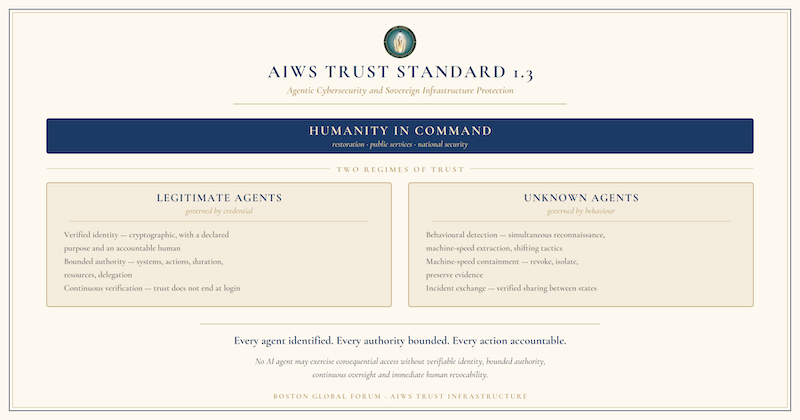
Agentic Cyber Conflict Has Arrived
BGF–AIWS answers with a new layer of Trust Infrastructure: every agent identified, every authority bounded, humanity always in command Over four days in early July, AI agents ran a cyber campaign against Taiwanese government systems — not assisting human hackers, but...

The AI World Is Choosing Its Future Order
Nations Need More Than a Choice Between Competing AI Powers The global AI race is entering a new and consequential phase. It is no longer only a competition over models, chips, or technological leadership. It is becoming a competition over which AI ecosystem—and...

Beacon Declaration and Process for the AI Age Founding AIWS Trust Infrastructure and AIWS Lumina
Today, May 1, 2026, at Harvard University’s Loeb House, on the occasion of America at 250: A Beacon for the AI Age, we stand not only to celebrate history, but to help shape the future. We honor 250 years of America — 250 years of freedom, of creativity, of democratic...

Mythos and the Path to AIWS Trust Infrastructure In the Age of Frontier Cyber AI
The Boston Global Forum and AI World Society introduce the report “Mythos and the Path to AIWS Trust Infrastructure in the Age of Frontier Cyber AI” as a timely case study for America at 250: A Beacon for the AI Age. The report examines the emergence of frontier...

CNAS Insight: American AI Exports Need a Sovereignty Solution
A new CNAS Insight argues that the success of the U.S. American AI Exports Program will depend not only on exporting American AI technology, tools, and infrastructure worldwide, but also on addressing the growing global demand for AI sovereignty — the desire of...

Anthropic and OpenAI Signal an AIWS Need for Trust Infrastructure in Cybersecurity
A new phase is emerging in frontier AI cybersecurity. On April 7, Anthropic launched Project Glasswing instead of broadly releasing Claude Mythos Preview, saying the model is its most capable yet and giving early access to defenders responsible for critical software...
When Virality Is The Message: The New Age of AI Propaganda
A new TIME essay by Renée DiResta, published on April 2, 2026, warns that AI propaganda has entered a new phase: the objective is often no longer persuasion in the traditional sense, but virality itself. She argues that generative AI now makes it cheap and easy to...
Vietnam Report and Media Tenor Endorse AIWS Trust Architecture to Set New Standards for AI Governance
In a significant step toward strengthening trust and transparency in the digital age, Vietnam Report and Media Tenor International have announced their endorsement of the AIWS Trust Architecture and a collaborative partnership to support its implementation. The...
Global Law and Accord on AI and Digital

The U.S. can improve its AI governance strategy by addressing online biases
The United States has been working to codify the National Artificial Intelligence (AI) Initiative that focuses on six strategic pillars: improving AI innovation, advancing trustworthy AI, creating new education and training opportunities through AI, improving existing...

Artificial Intelligence and Democratic Values Index 2021: AI regulation in China leaves open questions about independent oversight
CAIDP announced the Updated Index Ranks AI Policies and Practices 2021 in 50 Countries. In this Index, Canada, Germany, Italy, and South Korea ranks at the top, the US makes progress, as concerns about China remain. “We have reasons for optimism and reasons for...
No Results Found
The page you requested could not be found. Try refining your search, or use the navigation above to locate the post.