
by BGF | Apr 8, 2019 | News
On May 1, His Imperial Highness the Crown Prince will accede to the Imperial throne, and this new era name will be used from that day forward. I ask for the understanding and cooperation of the people on this. The government is taking all possible measures to prepare for this historic succession to the Imperial throne from a living Emperor — the first such instance in approximately 200 years — to take place smoothly, and for the Japanese people to celebrate the day with one accord.
Prime Minister was honored as a World Leader for Peace and Cybersecurity Award 2015 by Governor Michael Dukakis, Co-founder and Chairman of the Boston Global Forum, on Global Cybersecurity Day, December 12, 2015, at Harvard University Faculty Club. Prime Minister Abe delivered a speech on cybersecurity at this event.

by BGF | Apr 8, 2019 | Highlights
The success of AI depends on training data, whose process of collection may violate the end-users’ privacy if not done the right way. Privacy, therefore, should be one of the very first considerations when it comes to regulation of AI.

The New York Times recently published a post about how the US has started to pay serious attention to this matter. Last September, the Trump administration began working closely with the 36-nation Organization for Economic Cooperation and Development to create international guidelines for the design and use of artificial intelligence. “We’re focused on promoting an international environment that supports A.I. research and development and ensures the technology is developed in a manner aligned with our nation’s core civil liberties and freedoms,” said Michael Kratsios, deputy assistant to the president for technology policy.
The specific goal on the US side is a federal law that will “harmonize” data privacy rules in the United States and mesh enough with the European standard to avoid a more splintered marketplace. In the same sprit, the AI World Society (AIWS) initiative of the Michael Dukakis Institute for Leadership and Innovation also focuses on promoting ethical norms and practices in AI. We have published the AIWS Ethics and Practices Index which measures the extent to which a government’s AI activities respect human values and contribute to the constructive use of AI. We hope to work with the US government on this important matter which unquestionably will affect the future of our nation.
by BGF | Apr 6, 2019 | News
ALERT TO MEDIA: Coverage is invited.
To Register Contact: Dick Pirozzolo [email protected] or 1-617-959-4613
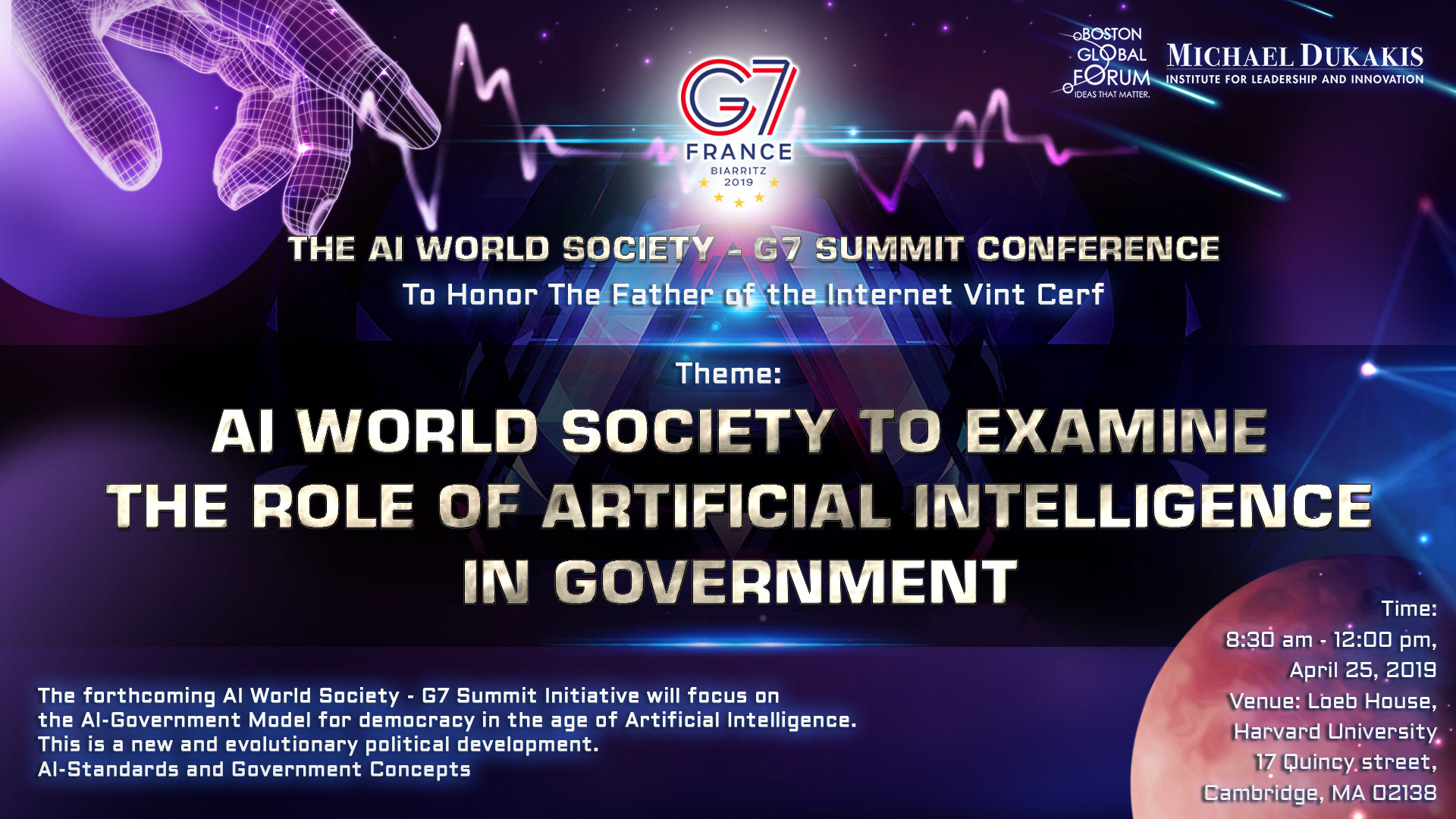
Vinton Cerf, one of the Fathers of the Internet, to receive World Leader in AI World Society Award
at AI World Society – G7 Summit Conference at Harvard University on April 25
He will speak on “Artificial Intelligence and the future of the Internet,”

AI World Society (AIWS) will host Vinton Cerf, a Father of the Internet, as part of its commitment to offer fresh ideas from the world’s most brilliant minds to the next G7 Summit to be held in Biarritz, Nouvelle-Aquitaine, France.
Cerf will speak at the AI World Society Symposium on AI-Standards and Legal Concepts:
8:30 am – 12:00 pm, April 25, 2019
17 Quincy Street, Cambridge, Massachusetts 02138
Advance registration is required for press credentials
Cerf, the Father of the Internet: Honored as World Leader in AI World Society (AIWS)
According to his biography by the Internet Hall of Fame Vinton G. Cerf, codesigned the TCP/IP protocols and architecture of the Internet, and once served as Chairman of Internet Corporation for Assigned Names and Numbers (ICANN).
Also, as vice president and chief Internet evangelist for Google since 2005, he is responsible for identifying new enabling technologies to support the development of advanced, Internet-based products and services from Google and is a public face for Google in the Internet world.
Cerf is the former senior vice president of Technology Strategy for MCI, where he helped guide corporate strategy development from the technical perspective. Previously, Cerf served as MCI’s senior vice president of Architecture and Technology, leading a team of architects and engineers to design advanced networking frameworks including Internet-based solutions for delivering a combination of data, information, voice and video services for business and consumer use.
Among those participating will be Governor Michael Dukakis, who will deliver the Opening Remarks
Arnaud Mentré, Consul General of France in Boston The French Perspective on Artificial Intelligence and the G7 Summit, which will be held in France on August 25–27, 2019.
Also speaking are:
Professor Thomas Patterson: AI World Society – G7 Summit Initiative
Professor Matthias Scheutz: Concepts for AIWS Standards
Paul Nemitz: Legal Concepts for AI – Layer 4 of AI World Society.
AI WORLD SOCIETY (AIWS) was created by The Boston Global Forum (BGF) to examine issues and developments centering on the role of AI in society.
The Boston Global Forum (BGF) is a not-for-profit think tank based in Boston, Massachusetts. Its mission is to bring together, in an open and accessible public forum, an eclectic and engaging spectrum of esteemed academic leaders, real-world experts, thought leaders, media experts and promising young leaders, who are dedicated to seeking peaceful solutions to the most contentious issues of our times.
An offshoot of The Boston Global Forum, The Michael Dukakis Institute for Leadership and Innovation (MDI) was born in 2015 with the mission of generating ideas, creating solutions, and deploying initiatives to solve global issues, especially focused on Cybersecurity and Artificial Intelligence.
Further details are available by contacting Mr. Tuan Anh Nguyen, Co-founder and Chief Executive Officer of The Boston Global Forum, and Director of The Michael Dukakis Institute for Leadership and Innovation.
Mr. Nguyen may be reached at [email protected].
by BGF | Apr 1, 2019 | News
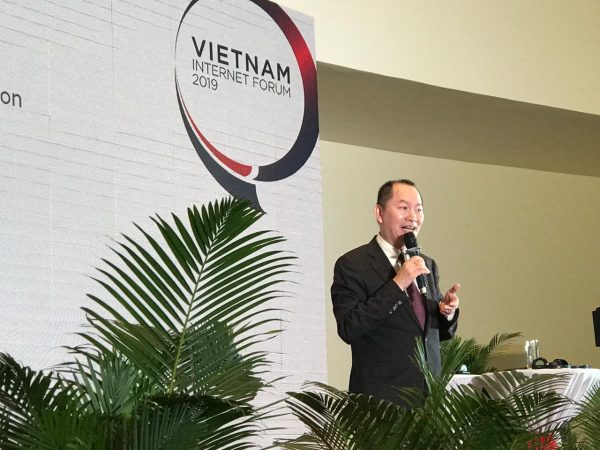
On March 20 and 21, the Swedish Embassy in Vietnam, UNDP, and Hanoi Government organized the Vietnam Internet Forum. This is the second time the Forum, is held, with the first being in 2017.

Mr. Nguyen Anh Tuan, co-founder and CEO of the Boston Global Forum was invited as a speaker at the Vietnam Internet Forum.
He talked about AI World Society and AI-Government, and encouraged Vietnam to apply AI-Government.

In his talk, he introduced the Social Value Point (SVP) as a part of AI World Society to promote and recognize the contributions of citizens. SVP is actually substantially different from the Social Credit System of China. SVP protects the privacy rights of personal data, disagree with collect data without permission of citizens, and only save contribution of citizens to encourage and incentive good citizens. SVP also will be run by non-government organizations.
by BGF | Apr 1, 2019 | Highlights
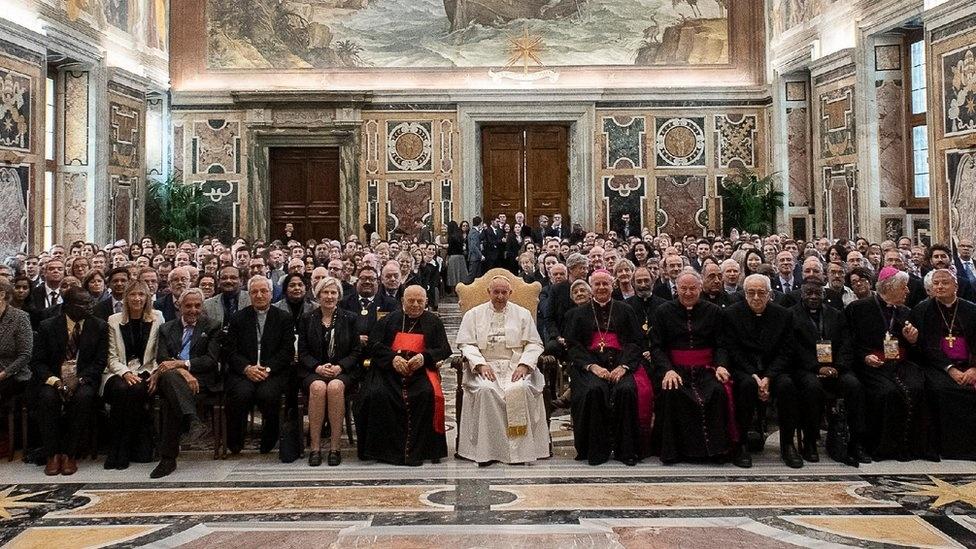
There are many ways our future will change because of AI. We heard it many times, but now the Vatican is talking. BBC recently reported about a workshop on robotics held at the Vatican’s Pontifical Academy of Life. The theme is “Roboethics: Humans, Machines and Health”.

Pope Francis in his opening keynote pressed the need to think about societal costs when develop new technologies, particularly in robotics. The future of robotics needs to be shaped in accordance to what it means to be human because otherwise there would be unpredictable damages to future generations on the planet.
Why is the Vatican concerned? Robots have been made with the idea that maybe human bodies should transition from organic to inorganic forms. We, as humans, “will no longer be recognized as flesh and blood humans, in 10,000 years time”, said Japanese Professor Hiroshi Ishiguro of Osaka University, who is world-famous for making human-like robots.
The Vatican disagreed. Archbishop Vincenzo Paglia, President of the Pontifical Academy for Life, said that “this dream is a terrible dream,” adding that it was “impossible” to divide the body and soul.
Questions about the morality of AI and robotics have been raised by many, for example, in a report last year by the European Group on Ethics in Science and New Technologies. The AI World Society (AIWS) of the Michael Dukakis Institute for Leadership and Innovation has also published a report on AI Ethics suggesting a framework for promoting ethical norms and practices in the development and use of AI.
The Vatican recently partnered with Microsoft to offer an international prize on ethics and AI. The Pontifical Academy of Life already set the agenda for next year’s meeting to focus on AI. The attention of the Vatican on the issue is noteworthy and the upcoming actions guided by Pope Francis could be a factor in the future of AI, which in turn, will shape the future of our lives.
See the full BBC article here.
