
by BGF | Jul 1, 2018 | News
The latest advance in artificial intelligence being combined with robots could take manufacturing and warehousing to a whole new level.

Reported by MIT Technology Review, Osaro – a San Francisco-based company – successfully created a robot arm with the ability to perform a kind of Sisyphean task. In particular, it hovers over a pile of chicken parts, retrieves a piece, swings around and gently places the chicken into a bento box along a conveyor belt The robot arm was created by a combination of older AI tools and more recent developments in machine learning, particularly as they apply to industrial robotics Including AI software in a physical body represents a revolution not just for robots but for AI too, “There is a huge amount of possibility for automating repetitive tasks,” said Willy Shih, trends in manufacturing student at Harvard Business School.
Yann LeCun, the head of Facebook’s AI research division until January, and now its chief AI scientist, wants AI to be able to reason, to see, and to hear. He believes this can be achieved by giving AI a physical presence so it can take advantage of its intelligence in interacting with the real world, just like human babies do.
As machines continue to develop human-like intelligence, there will be an increased need for ethical principles of the type advanced by MDI and its AIWS 7-Layer Model.
by BGF | Jul 1, 2018 | News
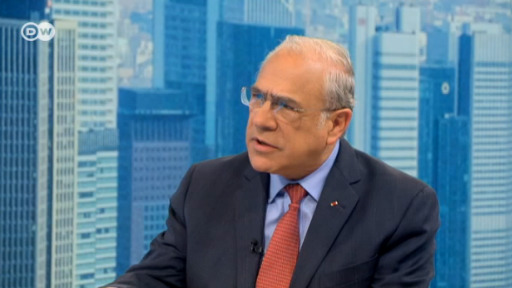
On June 12th, 2018, OECD Secretary-General Angel Gurria was invited to share his view on global trade by Deutsche Welle, a Germany’s international broadcaster.

Angel Gurria, the Secretary-General of OECD, was invited to share his point of view regarding factors that effect global growth. He stated that global trade is growing at the rate of 4-5%, which is higher than has been the case in many recent years—but that it could have been higher, around 7-8%. The reason for this is due to the tension the world is suffering from the global crisis leading to investors losing their confidence. He suggested unilateral solution for the global economy.
Angel Gurria was honored in April 2018 as the World Leader in AI World Society by BGF and MDI.

by BGF | Jul 1, 2018 | News
On March 15, 2018, Former President of Costa Rica, Laura Chinchilla, has been appointed to be new Vice President of the World Leadership Alliance – Club de Madrid (WLA-CdM).
The World Leadership Alliance–Club de Madrid, which is working closely with BGF and MDI in developing AIWS initiative and the AIWS 7-layer model, has recently welcomed the new Vice President Laura Chinchilla.

Laura Chinchilla is the first woman to become the President of Costa Rica. She’s dedicated to her work in WLA-CdM, especially for the Shared Societies Project where she co-led the Working Group on Sustainable Development. Her first activity with WLA-CdM was the Next Generation Democracy Regional Roundtable of the Americas, held in Bogota in 2015.
During her time as the Vice President of WLA-CdM, Laura Chinchilla will focus on certain areas of interest, such as protecting the environment, empowering women, and promoting social inclusion and democracy in Latin America.
by BGF | Jun 25, 2018 | AI-Government, AIWS and the Age of Global Enlightenment
Michael Dukakis, Nguyen Anh Tuan, Nazli Choucri, Thomas Patterson
Boston, June 25, 2018
***
Core Concepts for the design of AI-Government
The concept of AI-Government was developed at the Michael Dukakis Institute for Leadership and Innovation through the collaboration of Governor Michael Dukakis, Mr. Nguyen Anh Tuan, Professor Nazli Choucri, and Professor Thomas Patterson.
E-Government is the use of communication and information technology for improving the performance of public sector agencies. AI-Government transcends E-Government by applying AI to assist decision making for all critical public sector functions – notably provision of public services, performance of civic functions, and evaluation of public officials. At the core of AI-Government is the National Decision making and Data Center (NDMD). NDMD collects, stores, analyzes, and applies massive amounts of data relevant to the provision of public services and the evaluation of public programs and officials. It does not replace governance by humans or human decisional processes but guides and informs them, while providing an objective basis for service provision and evaluation.
AI supported public services span major critical functions to enable:
- AI for healthcare, social services
- AI for law, legal services
- AI for education
- AI for tourism
- AI for public transportation
- AI for labor
- AI for agriculture, fishing, and natural resource management
- AI for public finance
- AI for public housing
Structure of AI-Government:
- National Decision Making and Data Center (NDMD) lies at the core of AI-Government. It would link to all ministries, departments, and collects data from ministries, departments, provinces, provincial sub-units, cities, villages, schools, and other administrative units. NDMD would be located in the office of the President or Prime Minister
- NDMD would serve as the basis for automated public service functions. It would be a broad-based support system for public sector decision-making.
Tasks required to develop AI-Government:
- Build National Decision Making and Data Center (NDMD)
- Create regulations for automated public services
- Provide mechanisms to evaluate the performance of leaders or officials
- Facilitate feedback for civil society
- Set rules for decision making in all organs of government
- Set regulation to collect data from levels of governments, Party Office, National Assembly
- Establish a taskforce for implementation and evaluation
- Create methods to assist citizens through use of block chain ID for entities that would include corporations, institutions, social organizations.
Create automated public services assisted by AI, notably:
- Health care, public health, and social services
Build AI hospitals and other social services for remote, rural, and mountain area.
AI schools for remote, rural, and mountain areas.
Build AI law, legal services.
AI public transportation information, and support system.
AI public services for tourism.
AI labor, job guidance system.
- Agriculture, fishing, and natural resource management
AI agriculture, fishing, and natural resource guidance systems.
AI revenue collection and monitoring system.
AI public housing targeting, allocation, and monitoring system.
AI-Government is a component of the Artificial Intelligence World Society (AIWS) model developed by the Michael Dukakis Institute for Leadership and Innovation. The model has seven layers, two of which pertain to AI-Government.
***
Download The Concept of AI-Government

by BGF | Jun 25, 2018 | News
Recently, Governor Michael Dukakis, Director Nguyen Anh Tuan and Prof. Thomas Patterson discussed key parts of the AI Peace Treaty. They defined threats and challenges for AI peace, and discussed AI’s potential use as a weapon and the role of the UN, OECD countries, and top AI corporations in maintaining the AI peace.
The Michael Dukakis Institute’s missions are to provide an ethical framework for future generations of innovators, and to deploy initiatives to solve global issues involving Cybersecurity and Artificial Intelligence. With the work of Michael Dukakis – Governor of Masschusetts, Chairman of MDI, Nguyen Anh Tuan – Director of MDI and Professor Thomas Patterson – Bradlee Professor of Government & the Press at Harvard Kennedy School, key parts of the AI Peace Treaty are developing, including challenges for AI peace, AI weapons, the role of the UN, OECD countries and top AI corporations in maintaining the peace of Artificial Intelligence.
