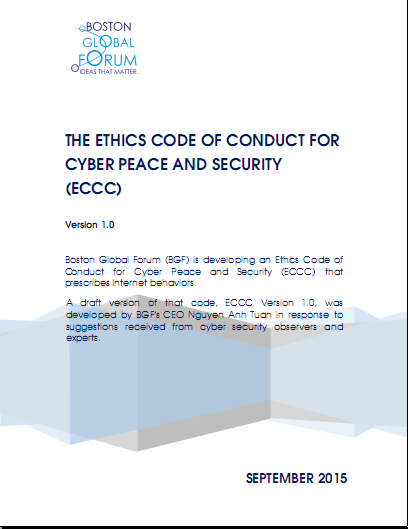
(September 23, 2015) – Boston Global Forum (BGF) is developing an Ethics Code of Conduct for Cyber Peace and Security (ECCC) that prescribes Internet behaviors.
A draft version of that code, ECCC Version 1.0, is conceived and developed by BGF’s CEO Nguyen Anh Tuan. The draft also received contributions from from cyber security observers and experts.
The ECCC Version 1.0 expressed ideas and viewpoints which are co-authored by:
Governor Michael Dukakis, Co-Founder, and Chairman of Boston Global Forum
Nguyen Anh Tuan, Co-Founder, and CEO of Boston Global Forum
Professor Thomas Patterson, Co-Founder, and Member of Board of Directors, Boston Global Forum
Professor John Quelch, Co-Founder, and Member of Board of Directors, Boston Global Forum
Professor Carlos Alberto Torres, Member of Board of Thinkers, Boston Global Forum
The ECCC Version 1.0 is now open for discussion and contribution by Members of Boston Global Forum’s Young Leaders Network for Peace and Security. It also welcomes contribution of other individuals and groups to make a complete version of ECCC for a more safer and healthy cyber world.
Members of Young Leaders Network for Peace and Security (YLNP ), and Michael Dukakis Leadership Fellows will contribute to develop next versions of ECCC.
BGF invites suggestions for amending and strengthening ECCC Version 1.0 for the purpose of preparing a new version, ECCC Version 2.0, by December 2015
_______________
THE ETHICS CODE OF CONDUCT FOR CYBER PEACE AND SECURITY (ECCC)
Version 1.0
The Boston Global Forum’s Ethics Code of Conduct for Cyber Peace and Security (ECCC) encompasses the following behaviors in all Internet communication, relationships and transactions.
Net Citizens: Ethics Code of Conduct for Cyber Peace and Security
Behavior toward others:
Be honest
Show respect
Avoid disreputable acts, and denounce those of others
Do not think or act involve with cyber terrorism.
Behavior towards information:
Assess its reliability before accepting it
Do not distribute unreliable or erroneous information
Behavior in discussions:
Do not endorse other’s comments when information has not been verified
Do not post negative comments on people’s private lives
Do not share or comment on unverified or unreliable defamatory claims about brands, organizations, or public figures
Be constructive, respective, and encouraging in comments
Policy Makers: Ethics Code of Conduct for Cyber Peace and Security
Do not establish, support, or endorse policies harmful to the Cyberspace environment
Do not unfairly criticize institutions, organizations, and brands
Do not unfairly criticize political opponents or other countries as using unverified, unreliable information etc.
Do not engage at any level in cyber spying, whether the target is an individual, firm, institution, or country
Do not engage in taking or disseminating private personal information
Do not engage or support in any form of cyber wars.
IT Engineers: Ethics Code of Conduct for Cyber Peace and Security
Develop products to enhance cybersecurity
Do not create or distribute Internet viruses
Do not launch denial-of-service (DoS) attacks
Do not attack, disable, or steal information resources
Do not blackmail or otherwise threaten any person or organization
Do not deliberately create gaps in Internet security, and report any that are discovered
Do not use and distribute private information about individuals or organizations
Do not engage or assist in any form of cyberterrorism
Business Firms and Business Leaders: Ethics Code of Conduct for Cyber Peace and Security
Take steps to secure company information
Do not unfairly attack other companies
Do not attack other governments
Do not use products or systems that operate counter to a free and open Internet
Do not invest in products or systems that go against the humane values of a free and open Internet.
Educators, Influencers/Institutions: Ethics Code of Conduct for Cyber Peace and Security
Do not disseminate or support negative opinions, doctrines that discourage the implementation of Cyber security measures
Educate and lead global citizens to support and execute ECCC
Propose solutions to build awareness of the value of ECCC and encourage its implementation
Foster public opinions that against bad behaviors such as theft of private data and information for distribution on the Internet.
Encourage those who use the Internet for purposes that contribute to a better life for all of mankind.
Create honors and awards to recognize outstanding individuals who contribute greatly for a secure and safe Cyberspace environment.
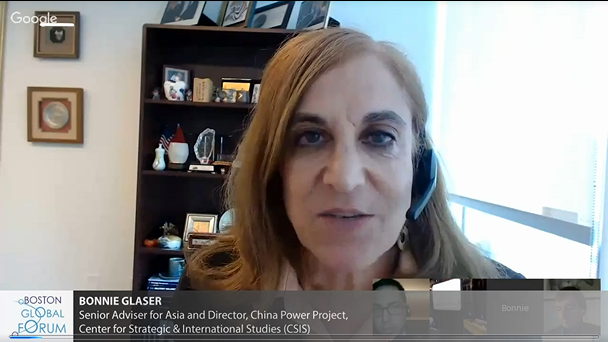
(October 17, 2015)- China’s President Xi Jinping did provide no definition to the term “militaritization” for its actions in the South China Sea, and in the view of Bonnie Glaser, the senior adviser for Asia and director of China Power Project at Center for Strategic & International Studies (CSIS), she suspected that US and China really do have different understanding about this.
“I think demilitarization in South China Sea is not achievable. The question is – what is achievable? So I like to be a little bit more constructive on what we got. I think maybe it is potential to have militarization, so the claimants could agree, for example, on weapon system and capabilities that would not be deployed on land features in South China Sea.”, she added.
Bonnie, from Washington D.C, made her keynote speech on the Boston Global Forum’s conference, “Dangerous Situation and Solutions for Peace and Security
in the South China Sea”, on October 16, 2015 which was held at Harvard Faculty Club. Other notable delegates include David Sanger, the Chief Washington correspondent of the New York Times; Bill Hayton, author of “The South China Sea: The Struggle for Power in Asia” (Yale University Press, 2014); and Professor Sean P. Henseler, Director of Operations, Operational Level Programs, U.S. Naval War College, Newport, Rhode Island.
(BGF) – In recent interview by Tsuyoshi Sunohara of Nikkei, Joseph Nye, member of Boston Global Forum’s Board of Thinkers and distinguished service professor at Harvard University, shared his different view of China’s land reclamation in the South China Sea.
He believed that China’s works do not change its balance of power at all. These moves actually has made artificial islands into “vulnerable targets”.
Read the full story here or visit the Nikkei website.
China’s artificial isles are vulnerable, fixed targets
TOKYO (October 29, 2015) — China is not changing the balance of power by building islands in the South China Sea and they are in fact very vulnerable targets, Joseph Nye, distinguished service professor at Harvard University, told The Nikkei.
The U.S. does not recognize the islands as Chinese territory, and it sent a destroyer within 12 nautical miles of the islands to exercise its navigation rights and freedoms under international law, he said in an interview here Tuesday. Nye worked to strengthen the U.S.-Japan security alliance as assistant secretary of defense, and he has served as the chair of the National Intelligence Council.
Q: What tension exists between the U.S. and China now, following Chinese President Xi Jinping’s visit to Washington in September?
A: There were two big issues that were disturbing the U.S. about China. One was the issue of cyberespionage for commercial purposes, and the other was the South China Sea, freedom of navigation.
When Xi Jinping came to Washington, he reversed the traditional Chinese position and said that China would not engage in cyberespionage for commercial purposes. Now, whether they will follow through in practice, we don’t know. But, at least in terms of the summit meeting, it was a 180-degree change in China’s position.
The other issue, the South China Sea, there was no progress, and that’s why we’re going to see these freedom of navigation cruises near the disputed islands.
Q: How does the U.S. view China’s island-building in the region?
A: Our position has been that we do not take a stand on the sovereignty of the various rocks and shoals, but that we take a strong view that the sea should be governed by the Law of the Sea Treaty. And the Law of the Sea Treaty says that you can’t take a rock, pile sand on it and call it a territory and have a territorial sea or an exclusive economic zone.
Q: How do you respond to assertions that China’s buildup of those islands will shift the balance of power in the region?
A: I think not. I think, in fact, they are very vulnerable. People say it’s a “stationary aircraft carrier.” It’s also very easy to sink. It’s a fixed target.
Q: So, you don’t view the islands as drastically changing China’s position?
A: I don’t think so. As one former military friend of mine said, if we really wanted to, we could put certain rockets in the Philippines, which would mean that these [islands] were totally militarily useless. So, I don’t think it’s a game changer if we actually enforce freedom of navigation. And that means this exercise of sailing within 12 [nautical] miles of these artificial islands and flying over them is very important, and I think that’s what we’re going to see in the next weeks.
Q: If you recall, in 2001, a U.S. Navy EP-3 plane and a Chinese fighter collided over the South China Sea. Might stepping up activity in the region lead to further such incidents?
A: Well, it’s always possible that you could have another EP-3 incident. It’s also subject to accidents as well as to decisions in national capitals. Many people say that the EP-3 incident was caused by a Chinese pilot who was trying to show how tough he was.
But I think, if you look at the question of whether Beijing wants to have something like this escalate, I think the answer is no. If you have a China that is suffering an economic slowdown, the last thing it needs is a conflict with the United States. And I think that Xi Jinping would run considerable risks if he did get into a conflict with the U.S.
Q: How do you respond to those who say the People’s Liberation Army is slipping from Xi Jinping’s control?
A: China clearly has politics, and Xi Jinping has to worry about his political control. The anti-corruption campaign raises problems because while he can use it as a weapon against his enemies, it also frightens a lot of people who worry that they may be next.
So, he doesn’t have total control. But it’s also true, I think, from my impression, that he has more strength than anybody since Deng Xiaoping.
Interviewed by Nikkei senior staff writer Tsuyoshi Sunohara
Professor Sean P. Henseler, Director of Operations of Operational Level Programs, U.S. Naval War College, Newport, Rhode Island in BGF’s conference on October 16, 2015.
(October 17, 2015) – What are china objectives in the South China Sea? ” I think China has every intention to insert its control and sovereignty over the entire South China and East China Sea”, Professor Sean P. Henseler, Director of Operations at Operational Level Programs in the U.S. Naval War College, Newport, Rhode Island said during the Boston Global Forum conference Dangerous Situation and Solutions for Peace and Security
in the South China Sea which was held on October 16 at Harvard Faculty Club.
Professor Henseler also suggested the conducting of US’s frequent Freedom of NavigationOperations (FONOPS) with other claimants in the South China Sea in order to go against all excessive claims in the disputed waters. Another solution might be the continual of having military-to-military exchange with Chineses to build transparency, build trust, build relationship. However, the most important is to look at “what the nature of relationship we want with China? This is going to be a competitive environment…. How do we deal with China in a competitive environment in a way that it doesn’t lead to all armed conflicts?”, he added.
(Boston, Oct 17, 2015) – Bill Hayton, author of The South China Sea: the struggle for power in Asia (Yale, 2014), made his keynote speech about the South China Sea issue on Boston Global Forum’s conference “Dangerous Situation and Solutions for Peace and Security in the South China Sea” on October 16, 2015 at Harvard Faculty Club.
According to Hayton, the significance of China’s island building in the South China Sea lies less in what it has done so far than in what it might be about to do. In his view, the current concern should focus on three areas of sea: the Vanguard Bank, off the Vietnamese coast; the Reed Bank, off the Philippines coast; and around the Luconia Shoals and James Shoal, off the Malaysian coast.
“All three have significant oil and gas potential. That’s not to say that hydrocarbons are the sole reason for China’s island building. There are many motivations – reflecting China’s many security interests and its many internal lobbies.”, he said.
Hayton closed his speech by giving his view on the use of UN Convention on the Law of the Sea (UNCLOS) as a solution: “…Beijing would prefer an ‘imaginative’ interpretation of customary international law that would recognize an historic claim to all the waters inside its self-proclaimed U-shaped line. It seems Beijing no longer regards UNCLOS as a neutral arbiter of disputes but rather as a partisan weapon being wielded to sever China from its historic rights.”
(Cambridge, October 20, 2015) – In recent conference on South China Sea disputes held at Harvard Faculty Club on October 16, Boston Global Forum has just proposed an initiative solution to keep peace and security in the South China Sea: establishment of the Pacific Security Alliance (PSA).
Boston Global Forum’s conference, “Dangerous Situation and Solutions for Peace and Security in the South China Sea”, held at Harvard Faculty Club on October 16, 2015
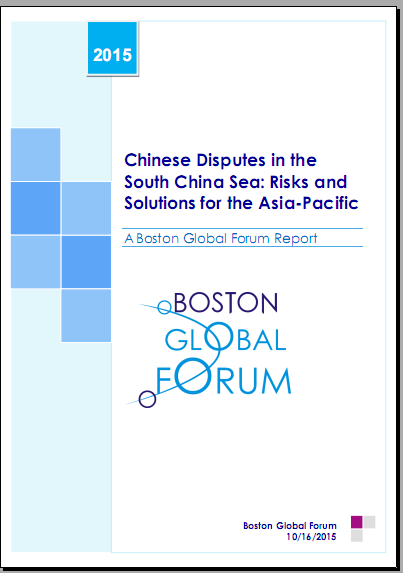
The PSA is proposed in the Boston Global Forum’s report, “Chinese Disputes in the South China Sea: Risks and Solutions for the Asia-Pacific”, which was mentioned by Professor Thomas Patterson, the co-founder of Boston Global Forum during the conference.
China’s influence-seeking efforts in the South China Sea are obvious. It uses its most advanced military techniques in support of these activities, and the resulting instability extends beyond Southeast Asia. China’s investment in cyber-weapon, artificial intelligence, drones, naval vessels, and its shrinking of Asian military distances through long-range weaponry, and most noteworthy, the construction of artificial island military air fields are threatening regional stability.
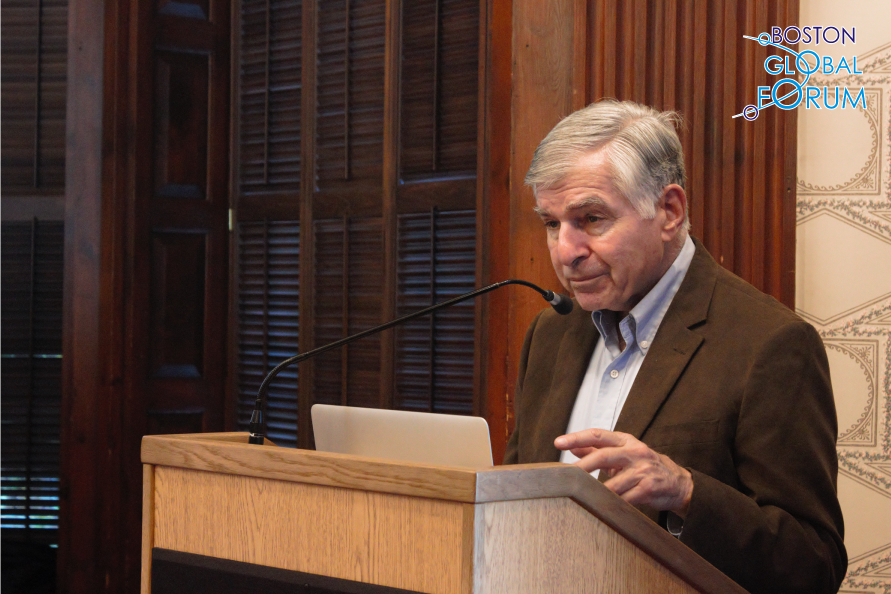
Governor Michael Dukakis, Chairman & Co-Founder, Boston Global Forum, moderates the discussion.
Concluding the discussion, Governor Michael Dukakis –Chairman of Boston Global Forum made the remarks:
Situation in Spratlys is becoming more serious with China’s violations of the United Nations Convention on the Law of the Sea (UNCLOS) with land reclamation that includes turning reefs and atolls into artificial islands and, and posing a high potential of military clash in the Spratly Islands.
All the countries in the South China Sea do not have enough power to stop China from violating the terms of UNCLOS. United Nations also cannot stop China, as well. The International Court takes a long time and there is still no institution in the world with enough power to enforce decisions of the International Court.
To resolve this dangerous situation by applying the Framework for Peace and Security in the Pacific, Boston Global Forum propose an initiative of establishing the Pacific Security Alliance (PSA) to maintain peace and security in the Pacific, with its focus on the South China Sea. The Alliance will set up norms, rules and regulations to keep peace and security in the South China Sea; join patrols in the region and stop all actions violating UNCLOS and international law in the region immediately. As the first step, the Alliance should include the United States, Japan, South Korea, Australia, Philippines, Vietnam, and invite China to join it if China accepts the rules, and regulations of the Pacific Security Alliance (PSA).
The Boston Global Forums’s conference was moderated by Governor Dukakis and attracted participation of several leading experts in international relations and South China Sea, who are scholars, analysts, policymakers, journalists.
Keynote speech by David E. Sanger, Chief Washington correspondent, The New York Times; Senior Fellow, Belfer Center for Science and International Affairs; Adjunct Lecturer in Public Policy, Harvard Kennedy School
The notable experts include Harvard’s professor Joseph Nye and Thomas Patterson; Bonnie Glaser, CSIS’s senior adviser for Asia; David Sanger, Chief Washington correspondent, The New York Times; Bill Hayton, BBC World News TV journalist and author of “ South China Sea: The Struggle for Power in Asia”; Professor Sean P. Henseler, Director of Operations for Operational Level Programs at U.S. Naval War College, Newport, RI; and Brent Colburn, the former assistant to the U.S. Secretary of Defense for Public Affairs.
(BGF) – Boston Global Forum successfully hosted the conference on Solutions to peace and security in the South China Sea on October 16, 2015 at Harvard Faculty Club.
The discussion was moderated by Governor Michael Dukakis, Chairman of Boston Global Forum, and attracted participants of many remarkable scholars, politicians, and journalists.
Keynote speakers: David E. Sanger, Chief Washington correspondent, The New York Times; Bonie Glaser, Senior Advisor for Asia and Director, China Power Project, Center for Strategic & International Studies
Other notable speakers:
Bil Hayton, TV journalist, BBC World News TV; writer, reporter, producer and occasional media development consultant
Professor Sean P. Henseler, Director of Operations, Operational Level Programs, U.S. Naval War College, Newport, Rhode Island
Richard JavadHeydarian, Assistant Professor in political science, De La Salle University (Philippines); Author of “Asia’s New Battlefield: US, China, and the Struggle for Western Pacific” (Zed, London)
Brent Colburn, Fellow of Institute of Politics, Harvard University; Former Assistant to the Secretary of Defense for Public Affairs
(October 19, 2015) – Boston Global Forum has announced its publication of report on risks and solution initiatives for disputes in the South China Sea after a series of international conferences on the issue with notable experts in international affairs, who are scholars, policy makers, and journalists.
The report’s focuses are concentrated on threats that China is deploying against the United States, Philippines, Malaysia, Brunei, Indonesia, Vietnam, and Taiwan in the South China Sea. China’s influence-seeking efforts in the South China Sea are obvious. China uses its most advanced military techniques in support of these activities, and the resulting instability extends beyond Southeast Asia. China’s investment in cyber-weapon, artificial intelligence, drones, naval vessels, and its shrinking of Asian military distances through long-range weaponry, and most noteworthy, the construction of artificial island military air fields are threatening regional stability.
The report also proposes three solutions to these disputes in the South China, based on the Boston Global Forum’s Framework for Peace and Security in the Pacific Sea. The first is ratification of the international law, in particular, the United Nations Convention on the Law of the Sea (UNCLOS). The second is proposal of the joint development or win-win solution, which is the China’s favored solutions with the Phillipines and Vietnam, in which they would be allowed to develop the oil and gas resources within their 200-mile EEZs, but only with the agreement of, and revenue sharing with, China. However, acquiescing to China’s claim of rights to revenue sharing would reward their modus operandi of making valuable claims and then attempting to bully smaller nations into acceptance. This is not in the spirit of international law, and weakens the law of the sea and its future applicability.
The third solution calls for strengthened alliance network in Asia in order to halt China’s actions. Such alliance, as the report suggests, would be called the Pacific Security Alliance (PSA). The PSA should include United States, Japan, Australia, South Korea, Vietnam, Philippines, and others who wish to join. China can also be invited if it is ready to prove with its speech and actions a commitment to international norms, standards, and regulations to keep peace and security in the Pacific region.
Mission of the PSA is to lead joint patrols in the South China Sea, if and to the extent that the Permanent Court of Arbitration does not solve the dispute. Joint international patrols will be crucial to operationalizing peace and security in the Pacific.
(BGF) – Professor Joseph Nye, mentioned two issues in the Xi JinPing’s visit to the United States: the Cybersecurity issue and South China Sea issue, in a conference about solutions to the military clash potential in the disputed waters hosted by Boston Global Forum on October 16, 2015 at Harvard Faculty Club.