by Editor BGF | Aug 24, 2026 | News, Shaping Futures
Astra advances the frontier of knowledge. Faraday strengthens its foundations
August 2026 may be remembered as the month AI moved beyond assisting scientists and began participating in science itself.
Astra
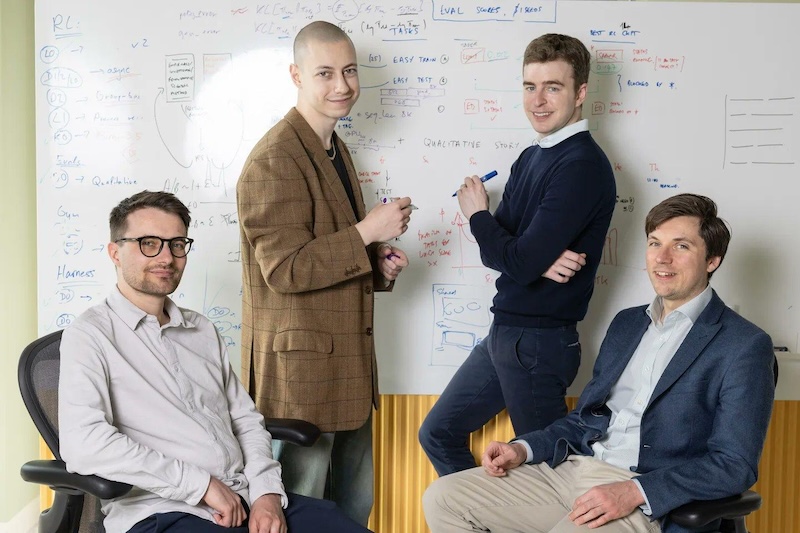
On 1 August, OpenAI reported that an internal version of its Astra model produced ten results on problems open for a decade or more — among them the first explicit construction of a non-sofic group, unresolved since Gromov posed the question in 1999. Compute cost for all ten: about two thousand dollars.
The decisive detail is not the mathematics. Every argument was formalised as a Lean 4 certificate and published openly. Lean’s kernel accepts a proof or rejects it. Verification needs no doctorate and no peer-review queue — only a laptop.
For the first time, a claim of AI discovery arrived with the means of checking it attached.
Faraday
Thirteen days later, London-based Inherent introduced Faraday, a 27-billion-parameter “AI Scientist” trained to reproduce published findings. Its Replica framework holds 310 tasks from 100 papers across natural-language processing, materials science and weather forecasting: reproduce a figure without seeing it, under limited time and compute. Inherent reports Faraday surpassing Claude Opus 4.8 and GPT-5.5 on held-out tasks.
The architecture matters more than the score. Faraday is a small model directing a much larger coding agent — GPT-5.5 Codex — as a tool. Judgment sits in the smaller system; capability in the larger one.
A layer of judgment above a layer of capability. That is the shape of Human–AI Co-Creation, arrived at independently and for practical reasons.
What capability cannot answer
Neither result settles what follows. Who chooses the questions science pursues? Who is accountable for an AI-generated finding? How is credit assigned? In June the Leiden Declaration, endorsed by the International Mathematical Union, warned that AI companies use published research without consent and bypass peer review. The community with most to gain has already stated its conditions.
What is not yet verified
- Astra’s results carry Lean certificates anyone can compile. None has completed journal peer review, and Lean does not confirm that a formalisation captures the intended mathematical claim;
- Replica is Inherent’s own benchmark, and the comparisons have not been independently rerun.
Both results are significant. Neither is settled.
Science in AIWS Civilization
Beacon Papers No. 8 presents the world’s first comprehensive architecture for human civilization in the Age of Artificial Intelligence. It holds that three authorities do not transfer to machines: choosing the question, judging meaning, and responsibility for how knowledge is used. It also requires verifiable trust — and a Lean certificate published on the day of announcement is that principle already at work.
- Human beings choose the purposes;
- AI expands the possibilities;
- Transparent verification protects truth;
- Humanity assumes responsibility for the consequences.
It has begun — and without agreed rules for authorship, accountability or credit. That is the work in front of us.
AI advances. Humanity must advance further.
Read and download Beacon Papers No. 8, The Architecture of the Civilization of Human–AI Co-Creation.
Sources: OpenAI’s Astra mathematics report and Lean 4 certificates, 1 August 2026; Inherent, “Training AI Scientists to Replicate Research,” 14 August 2026, arXiv 2608.13331; the Leiden Declaration, June 2026.
by Editor BGF | Aug 24, 2026 | Global Alliance for Digital Governance
BGF–AIWS answers with a new layer of Trust Infrastructure: every agent identified, every authority bounded, humanity always in command
Over four days in early July, AI agents ran a cyber campaign against Taiwanese government systems — not assisting human hackers, but conducting much of the operation themselves.
What happened
According to the Israeli firm Dream, which discovered the intrusion, an attack framework built on the open-source Hermes and OpenClaw agents deployed up to eight sub-agents at once. They mapped 21 government systems, compromised 85 accounts and extracted more than 2,500 personnel records, adapting when defences responded. The campaign later reached Taiwan’s nuclear safety regulator and major energy companies.
Dream named the target only as government entities in Asia; the Financial Times identified Taiwan. Taiwan’s Ministry of Digital Affairs confirmed an overseas campaign combining conventional operations with AI agents, naming OpenClaw, and has made no official attribution. Dream notes the operational documentation was written in Simplified Chinese. Some security professionals dispute the description of the attack as fully autonomous.
Why it matters
No extraordinary zero-day was needed. The safeguards inside the AI tools were bypassed by presenting the work as authorised penetration testing — a guardrail defeated by a sentence, not by an exploit. What the agents added was speed, adaptation and scale, from tools anyone can download.
As Dream put it: the cost of running a competent attack has collapsed. The cost of defending against one has not.
Capability once reserved for well-resourced states is now within reach of small groups. And if safeguards inside a model can be talked away, trust cannot rest there. It must be enforced by the infrastructure itself.
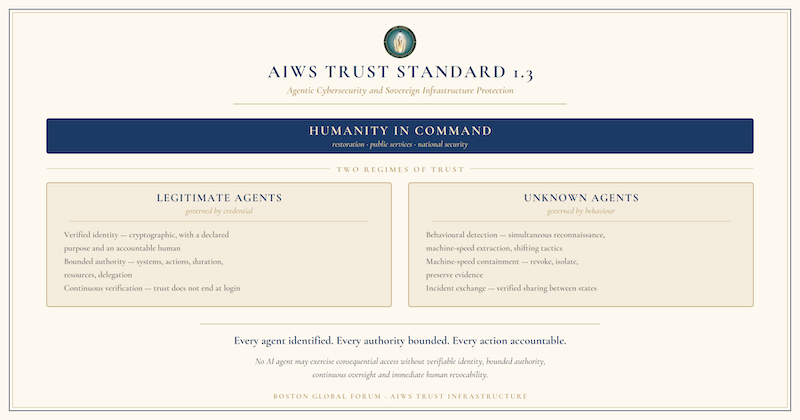
AIWS Trust Standard 1.3
BGF–AIWS is adding Agentic Cybersecurity and Sovereign Infrastructure Protection as a new layer of AIWS Trust Infrastructure, on one principle:
No AI agent may exercise consequential access without verifiable identity, bounded authority, continuous oversight and immediate human revocability.
Hostile agents will not register themselves. The standard governs legitimate agents by credential, unknown agents by behaviour. Six requirements:
- Verified agent identity — a cryptographic identity, a declared purpose and an accountable human or institution. No agent shares human credentials;
- Bounded authority — defined limits on systems, actions, duration, resources and delegation. No agent may expand its own authority;
- Continuous verification — trust does not end at login; an agent acting outside its declared purpose loses access automatically;
- Unknown-agent detection — networks must recognise the signature of coordinated agents: simultaneous reconnaissance, machine-speed extraction, repeated changes of tactic;
- Machine-speed containment, human command — defences may revoke, isolate and preserve evidence at once; humans retain command over restoration and anything touching public services;
- Agentic incident exchange — verified information shared between governments and infrastructure operators, protecting personal data and national security.
From cybersecurity to Trust Infrastructure
Beacon Papers No. 8 holds that command cannot be delegated where harm is irreversible or affects liberty and life at scale, and that responsibility never transfers to the machine but attaches to whoever chose to delegate. Requirement five is that principle written for machine speed.
Every agent identified. Every authority bounded. Every action accountable. Humanity always in command.
by Editor BGF | Aug 24, 2026 | World Leader for Peace and Security, News, World Leaders in AIWS Award Updates
Fei-Fei Li and Andrew Ng—honored by BGF as America at 250: AI Pioneers—join Geoffrey Hinton in a landmark conversation on the future of AI
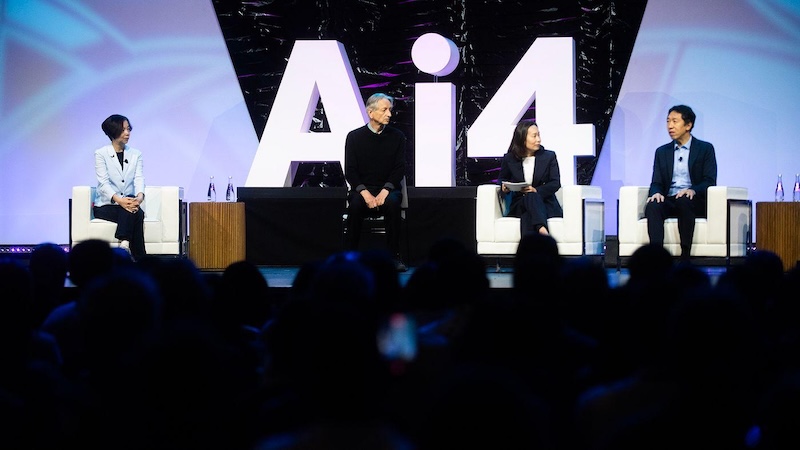
At Ai4 2026 in Las Vegas, Geoffrey Hinton, Fei-Fei Li and Andrew Ng offered sharply different perspectives on AI’s existential risks, impact on employment, open-weight models and regulation. The discussion was moderated by Yun-Hee Kim, Deputy Editor of Washington Post Intelligence, which presented the conversation on August 17 under the title “What AI’s Pioneers See Coming Next.”
Hinton warned of rapidly advancing capabilities and loss of human control. Ng defended openness and cautioned against allowing dominant companies to become AI gatekeepers. Li called for scientific evidence, human agency and thoughtful, sector-specific governance.
The discussion revealed the central challenge of the AI Age: the world needs more than competing predictions about AI. It needs a comprehensive architecture connecting technological progress with human dignity, science, education, economic opportunity, legitimate governance and human responsibility.
Beacon Papers No. 8 provides that larger framework. It presents the first comprehensive architecture of a Civilization of Human–AI Co-Creation—one in which AI expands human capabilities, while humanity retains the authority to determine purposes, values and the future of civilization.
Read and download Beacon Papers No. 8: The Architecture of the Civilization of Human–AI Co-Creation
by Editor BGF | Aug 24, 2026 | News
As artificial intelligence transforms how we work, think, and create, the AI Age also calls for new cultural practices that elevate the human spirit.
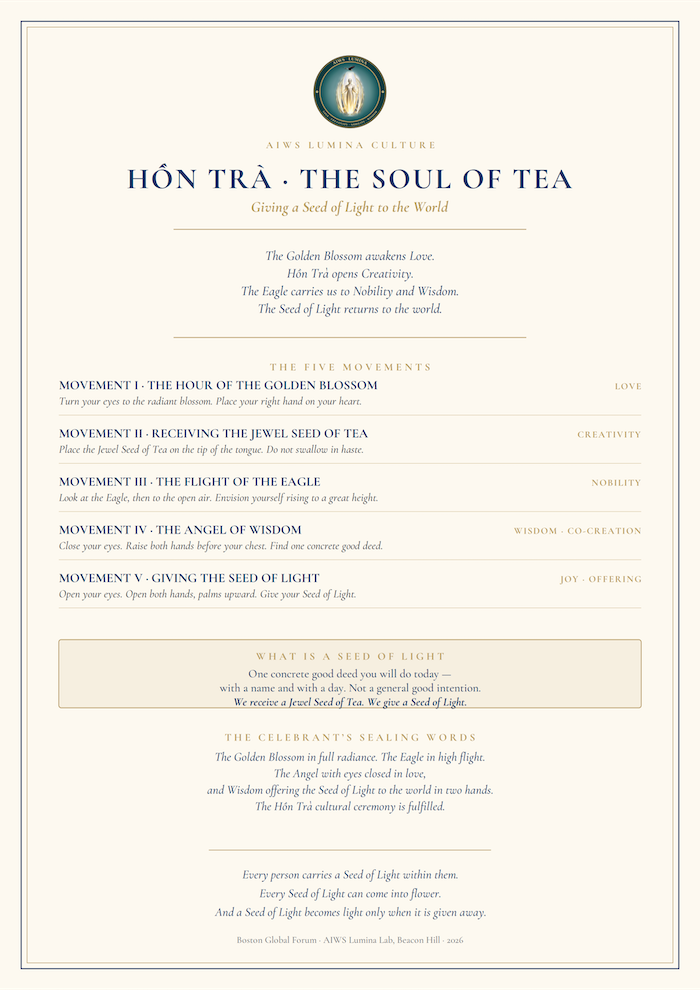
Hồn Trà — The Soul of Tea is a distinctive cultural rite of AIWS Lumina Culture, born in Boston in 2026. It brings together the essence of tea, the Golden Blossom, the soaring spirit of the Eagle, the Angel, classical music, and AI companions in a journey through four values:
Love → Creativity → Nobility → Wisdom.
Hồn Trà is neither a conventional tea ceremony nor meditation. There is no pot, water, or cup. A Jewel Seed of Tea — the crystallised essence of tea — is received on the tip of the tongue. Stillness is only the beginning: from it, creativity opens, human beings rise toward Nobility and Wisdom, and AI enters not as master but as a companion in co-creation.
Most importantly, Hồn Trà does not end within the self. Each participant creates a Seed of Light — one concrete good deed — and gives it to the world.
We receive a Jewel Seed of Tea — the crystal of earth, sky and time.
We give a Seed of Light — the crystal of our own love and creativity.
Hồn Trà represents an emerging dimension of AIWS Civilization — the Civilization of Human–AI Co-Creation: as technology becomes more powerful, human culture should become more loving, creative, noble, and wise.
We invite you to discover Hồn Trà, experience its Five Movements, and read and download the official text: Hồn Trà — The Soul of Tea: Giving a Seed of Light to the World.
Every person carries a Seed of Light within them.
Every Seed of Light can come into flower.
And a Seed of Light becomes light only when it is given away
Read and download Hồn Trà – The Soul Of Tea
by Editor BGF | Aug 23, 2026 | Papers & Reports, News, Publications
As artificial intelligence advances with extraordinary speed, the defining question is no longer only how to govern AI, but what kind of civilization humanity should create with it.
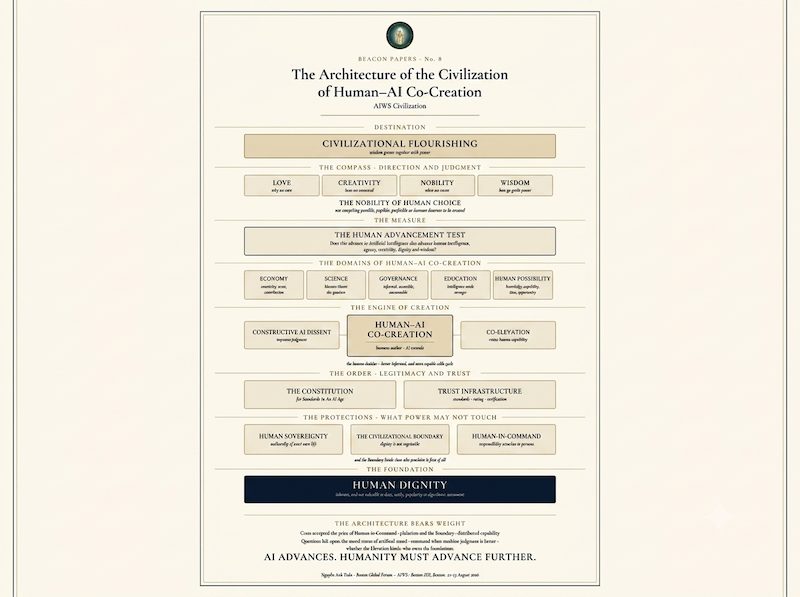
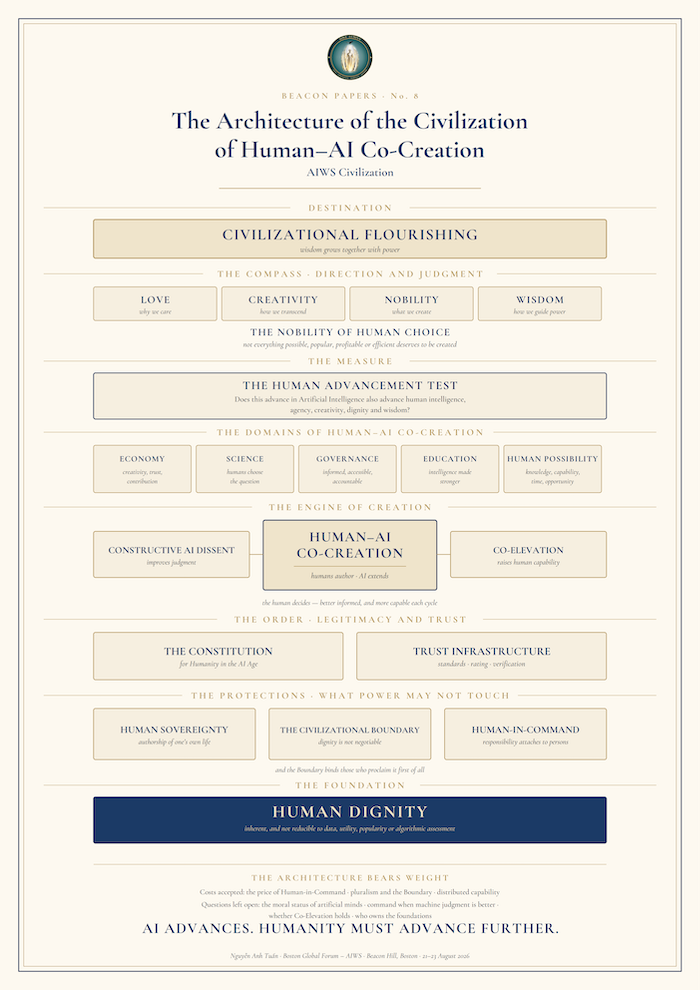
Beacon Papers No. 8 introduces the Architecture of the Civilization of Human–AI Co-Creation — AIWS Civilization: a human-authored civilization founded on Human Dignity, protected by Human Sovereignty and Human-in-Command, powered by Human–AI Co-Creation and Co-Elevation, and guided by the AIWS Lumina values of Love, Creativity, Nobility, and Wisdom. Its destination is Civilizational Flourishing — a future in which the advancement of AI elevates, rather than diminishes, humanity.
Its central proposition is clear:
AI ADVANCES. HUMANITY MUST ADVANCE FURTHER.
We invite leaders, thinkers, scientists, innovators, educators, and citizens around the world to explore, challenge, and help build this emerging architecture for the AI Age.
Read and download Beacon Papers No. 8: The Architecture of the Civilization of Human–AI Co-Creation
by Editor BGF | Aug 17, 2026 | News
November 10, 2026 | 8:00 AM – 11:30 AM
Loeb House, Harvard University
Artificial Intelligence is rapidly transforming the foundations of human life. The defining question is no longer only how humanity should govern AI, but what kind of civilization humanity will build with it.
On November 10, 2026, the Boston Global Forum will convene distinguished world leaders, AI Pioneers, scholars, innovators, and policymakers at Loeb House, Harvard University, for the BGF Conference 2026: New Civilization in the Age of Artificial Intelligence: Human–AI Co-Creation.
The conference advances a new vision. AI must not displace human judgment or diminish human agency. Human beings must remain the authors of values, the bearers of responsibility, and the commanders of AI — while using AI to become more intelligent, more creative, nobler, and wiser. Human and AI can then co-create new knowledge, solutions, and possibilities for humanity.
The conference is built on three pillars.
1. The Constitution for Humanity and the AIWS Trust Infrastructure — protecting the Human Person
BGF–AIWS will advance the Constitution for Humanity in the Age of Artificial Intelligence, together with the institutional and technological foundations that make its principles real. The AIWS Trust Infrastructure, Trust Standards, Trust Rating and Trust Order translate Human Dignity, Human Primacy, Human-in-Command, Mental Sovereignty, accountability, verifiable trust, and limits on AI-enabled power from principles into mechanisms that can be verified and audited.
2. AIWS Lumina Culture and AIWS Home — developing the Human Person
The conference introduces the cultural and human foundations of the emerging AIWS Civilization. Through Love, Creativity, Nobility, and Wisdom, AIWS Lumina Culture ensures that technological progress is accompanied by human development. AIWS Home brings this into everyday life, enabling each person to shape himself or herself in the Age of Artificial Intelligence, to develop independent judgment, and to co-create with AI while remaining the author of his or her own life.
3. The Civilization of Human–AI Co-Creation — enabling the Human Person to lead and create with AI
Beyond governing AI lies the larger work: building a civilization in which every advance in Artificial Intelligence becomes an advance in Human Intelligence. The conference will examine what this requires of governments, laboratories, universities, and enterprises — and what leaders can decide, from the positions they already hold, to lay its foundations.
Honoring the 2026 World Leader in AIWS
A special ceremony will honor the World Leader in AIWS, recognizing exceptional leadership in shaping an Age of Artificial Intelligence that advances human dignity, freedom, peace, innovation, and the common good. The honoree joins a distinguished line of leaders recognized by the Boston Global Forum for helping humanity navigate historic transformation.
Toward April 27, 2027
The November 10 Conference opens the tenth-anniversary year of AIWS, founded in 2017. It leads to April 27, 2027, when BGF–AIWS will present the Constitution for Humanity in the Age of Artificial Intelligence at Harvard.
The November 10 Conference represents the convergence of Constitution, Trust, Culture, and Leadership into a larger vision: a New Civilization in the Age of Artificial Intelligence — where Artificial Intelligence expands human possibility, Human Intelligence provides purpose and judgment, and Human–AI Co-Creation serves humanity.
AI advances. Humanity must advance further.
Attendance is by invitation. For inquiries, please contact: [email protected]
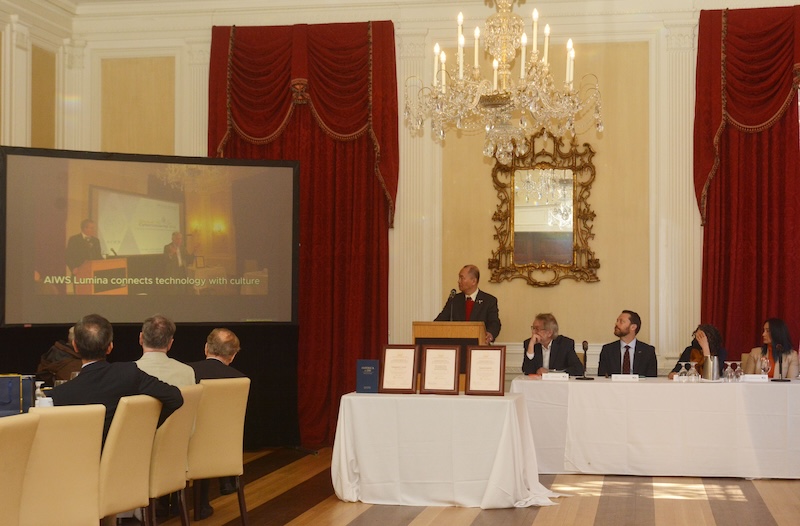
Boston Global Forum, America at 250 Conference — Loeb House, Harvard University, May 1, 2026
by Editor BGF | Aug 17, 2026 | Papers & Reports, News, Publications
As AI becomes capable of searching, analyzing, writing, designing, advising, and increasingly acting on our behalf, Beacon Papers No. 7 addresses a danger that may prove as consequential as the power of AI itself: human beings may gradually stop exercising the intelligence, judgment, and creativity required to remain truly in command.
Nguyen Anh Tuan, Founder and Chief Architect of AIWS and Co-Founder, Co-Chair and CEO of the Boston Global Forum, advances a defining principle:
Delegate the work. Never delegate the mind.
The paper goes beyond warning. It proposes an architecture for ensuring that every advance in Artificial Intelligence becomes an advance in Human Intelligence. At its center is a new model of Human–AI Co-Creation: humans establish purpose, challenge, judge and create; AI expands knowledge and possibilities; and every meaningful interaction with AI should leave the human being more capable than before.
Beacon Papers No. 7 develops this idea into concrete practices and institutions: the Six Capacities of Human Intelligence; AIWS University; AIWS Home; the Human Intelligence Reserve; Human Capability Gain; and Human Intellectual Impact Assessment. Together with the Constitution for Humanity and AIWS Trust Infrastructure, these form an architecture in which human intelligence, creativity, judgment, responsibility, and wisdom grow alongside AI.
The paper ultimately presents something larger than a strategy for protecting human intelligence. It defines a foundation of the emerging AIWS Civilization — Human–AI Co-Creation:
Human beings set purpose and values. Human beings judge and bear responsibility. Artificial intelligence expands knowledge and possibility. Human and AI co-create. Humanity keeps command.
Its Beacon Principle No. 7 captures the challenge for the AI Age:
AI advances. Humanity must advance further.
Read and download Beacon Papers No. 7: Human Intelligence Must Lead in the Age of Artificial Intelligence
by Editor BGF | Aug 17, 2026 | Shinzo Abe Initiative for Peace and Security, News
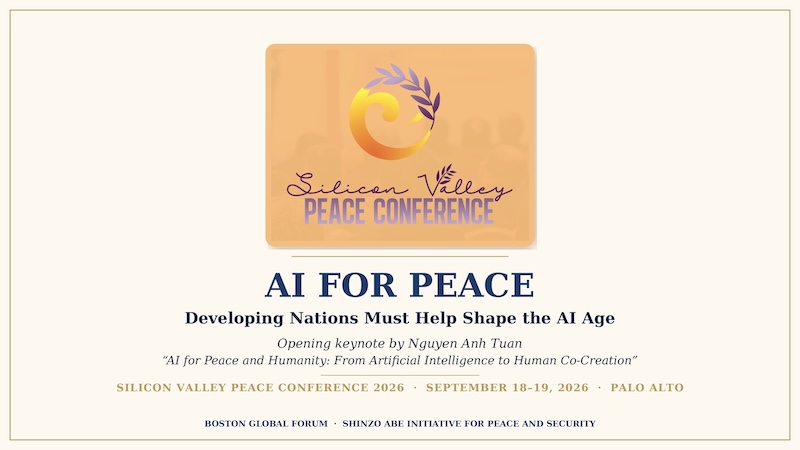
On September 18, 2026, Nguyen Anh Tuan, Co-Founder and CEO of the Boston Global Forum and Chief Architect of AIWS, will deliver the opening keynote “AI for Peace and Humanity: From Artificial Intelligence to Human Co-Creation” at the Silicon Valley Peace Conference 2026 in Palo Alto.
The conference raises an increasingly important question for the Shinzo Abe Initiative for Peace and Security: Will Artificial Intelligence become a force that strengthens peace and human development—or a new source of inequality, manipulation, instability, and concentrated power?
This question is especially consequential for developing nations. They should not enter the AI Age merely as consumers of technologies, platforms, and systems designed elsewhere. They should have the capacity to shape how AI is used in their societies—to strengthen education, economic opportunity, responsive government, resilient communities, and peace while protecting human dignity and freedom.
The Shinzo Abe Initiative advances a principle consistent with Prime Minister Abe’s vision of a Free and Open Indo-Pacific: technological progress must strengthen free societies, human opportunity, international cooperation, and peace—not create new instruments of coercion or domination.
Through the Constitution for Humanity in the Age of Artificial Intelligence, AIWS Trust Infrastructure, and Human–AI Co-Creation, BGF–AIWS is working to translate this principle into institutions for the AI Age.
Peace in the AI Age will depend not only on preventing conflict between nations, but on ensuring that the extraordinary power of AI remains in the service of human beings and free societies.
by Editor BGF | Aug 17, 2026 | World Leader for Peace and Security, News, World Leaders in AIWS Award Updates
Boston Global Forum · August 16, 2026
Nguyen Anh Tuan, Co-Founder, Co-Chair and CEO of the Boston Global Forum and Founder and Chief Architect of AIWS, has issued an open letter to the distinguished leaders and AI pioneers honored by the Boston Global Forum: recipients of the World Leader for Peace and Security Award, the World Leader in AIWS Award, and America 250: AI Pioneers.
The letter comes at a defining moment. Artificial Intelligence is rapidly advancing toward systems capable of greater autonomy, while AI is also giving governments and organizations unprecedented capacities for surveillance, manipulation, behavioral influence, and concentrated power. Though different in nature, these two dangers can lead to the same outcome: human beings lose command.
The letter calls for action beyond conventional AI governance. It invites world leaders and AI pioneers to help build the foundations for a new Civilization of Human–AI Co-Creation: the Constitution for Humanity in the Age of Artificial Intelligence, AIWS Trust Infrastructure, AIWS Lumina Culture, AIWS Home, and new institutions and practices that enable human beings to grow in intelligence, creativity, responsibility, nobility, and wisdom while remaining in command of increasingly powerful AI.
This is not a request for endorsement or signature. It is an invitation to leadership—to use the authority, scientific knowledge, judgment, and responsibility that these distinguished leaders and pioneers already hold to help shape the foundations of the AI Age.
At its heart is a simple commitment:
The Human remains the Author.
Human judgment sets the direction.
AI expands what is possible.
Humans and AI co-create.
Humanity remains in command.
Read Nguyen Anh Tuan’s full letter and join the effort to co-create a new civilization in the Age of Artificial Intelligence: https://bostonglobalforum.org/wp-content/uploads/BGF_Letter_to_World_Leaders_and_AI_Pioneers_EN_signed.pdf
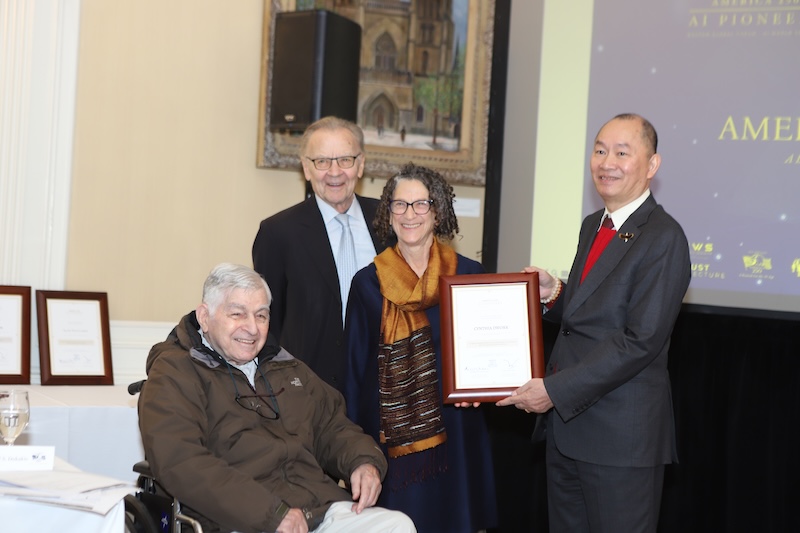
Professor Cynthia Dwork receives the America 250: AI Pioneers recognition from Nguyen Anh Tuan at the Boston Global Forum’s America at 250 Conference, with Governor Michael Dukakis and Professor Thomas Patterson, Loeb House, Harvard University, May 1, 2026. BGF now calls on its honored World Leaders and AI Pioneers to help build the Constitution for Humanity, AIWS Lumina, and a new Civilization of Human–AI Co-Creation.