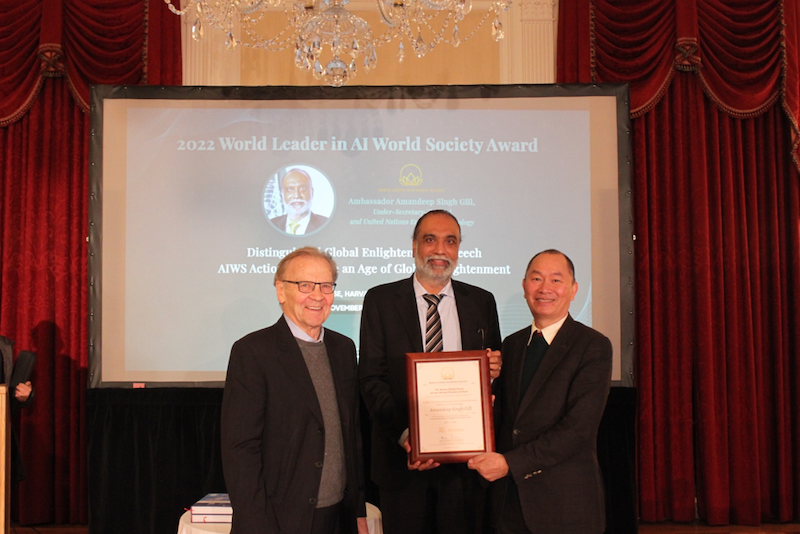
As the United Nations and Barbados prepare to convene the Bridgetown Special Summit on AI Safety on November 23, 2026, Amandeep Singh Gill has identified a fundamental imbalance: every country faces the risks of advanced AI, yet few can test these systems or respond when something goes wrong. The summit, attended by UN Secretary-General António Guterres and Barbados Prime Minister Mia Amor Mottley, will address how international cooperation can close that gap.
“Safety should not depend on where a country stands on the technology curve,” Gill said. The UN Under-Secretary-General and Special Envoy for Digital and Emerging Technologies points to two practical priorities: compatible approaches to evaluating AI risks, and the capacity for every country to undertake that work at home.
Gill, honored with the World Leader in AIWS Award 2022 at Harvard’s Loeb House, has long championed inclusive international cooperation on AI. His call gives Bridgetown a clear purpose: the capacity to protect people must reach as widely as the technology itself.
BGF–AIWS’s Special Report submitted to the United Nations, The Time to Act Is Now, brings several distinctive proposals to this challenge. Presented by Nguyen Anh Tuan, Founder and Chief Architect of AIWS and Co-Founder, Co-Chair and CEO of Boston Global Forum, the report connects protection with human advancement.
Its central concept is the Human Margin: humanity’s capacity to understand, question, correct and govern AI—and to grow through its use. Across law, trust, capability and character, the proposed measure asks whether people’s ability to lead AI is keeping pace with the systems they deploy. The first baseline Human Margin Report is planned for April 27, 2027, at Harvard’s Loeb House.
Two proposals make this ambition concrete. The Duty to Elevate calls for advanced AI to strengthen users’ understanding, judgment and capabilities. The Twin Release proposes that every major frontier AI release be accompanied by a public human-capacity program, with evidence that people can better understand, challenge and use the system.
For Bridgetown, the report proposes a Caribbean-led 100-day pilot. A willing local partner would choose one public problem and retain decision-making authority, including the right to stop the AI. BGF would contribute methods from the Constitution for Humanity, AIWS Trust Infrastructure and the Human–AI Co-Creation Movement. After 100 days, the pilot would publish two results: who answered for errors and corrected them, and what local people could do better—including when AI was set aside.
Alongside these instruments, Thăng Hoa Faith places Love, Creativity, Nobility and Wisdom within the responsibility of those who hold AI power.
Together, these proposals offer a practical contribution to Gill’s call: every nation should gain the capacity to protect its people, shape its own use of AI, and turn technological progress into human advancement.
Special Report: BGF_AIWS_Special_Report_