
The largest AI story of the month was not a model. According to the Wall Street Journal, Nvidia is in talks to guarantee roughly $250 billion in financing so that OpenAI can lease a 10-gigawatt data center in Ohio, on a campus whose full cost could approach $500 billion. Days earlier, Nvidia and SK Group signed infrastructure agreements exceeding $500 billion. These are figures on the scale of national budgets, committed by private parties, on timelines no legislature set.
The debate about AI power has concentrated almost entirely on the model layer — what systems can do, how they are evaluated, who may deploy them. Beneath that layer sits a second one that determines the first. Frontier capability now depends on compute, energy, land, water, and capital at a scale only a handful of actors can assemble. Whoever controls that foundation sets the terms on which everyone else may build.
Three features of the emerging arrangement deserve attention. It is circular — a chip maker guaranteeing the debt of a customer who buys its chips creates an exposure that neither party alone can unwind. It is concentrated — a market in which one supplier underwrites the expansion of its largest buyer is not the same market it appears to be. And it is physical — a 10-gigawatt campus draws on grids, water, and land in communities that had no part in the decision and hold no lever over it.
None of this is unlawful, and none of it implies bad faith. The builders are doing what builders do. But infrastructure of this magnitude has, in every previous era, eventually come under public terms — railways, telegraph, electricity, spectrum, undersea cable. Each began as private ambition and each, after the fact, acquired obligations: interconnection, transparency, non-discrimination, oversight of the terms on which others gain access. AI compute has arrived at that threshold faster than any of them, and the obligations have not yet been written.
The question the next years will settle is not only who builds the most capable systems. It is who owns the foundation on which capability rests, on what terms others may reach it, and to whom those owners answer. Trust in the AI Age cannot be established at the model layer alone while the layer beneath it remains outside public view. This is the reach the AIWS Trust Infrastructure must ultimately have — extending the architecture of trust to the foundation on which models are built, so that compute, energy, and capital are treated as matters of public standing and not merely of private commerce.
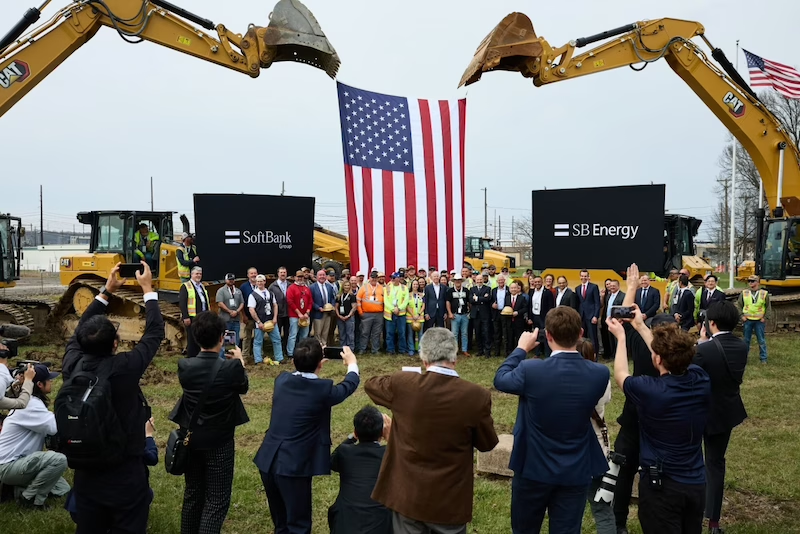
Groundbreaking for the Ohio data-center complex in March 2026. A campus of this scale draws on grids, water, and land in communities that had no part in the decision. Photograph: Brian Kaiser/Bloomberg News