Nguyen Anh Tuan
Co-Founder, Co-Chair, and CEO, Boston Global Forum · Founder and Chief Architect, AIWS
Boston · July 8, 2026
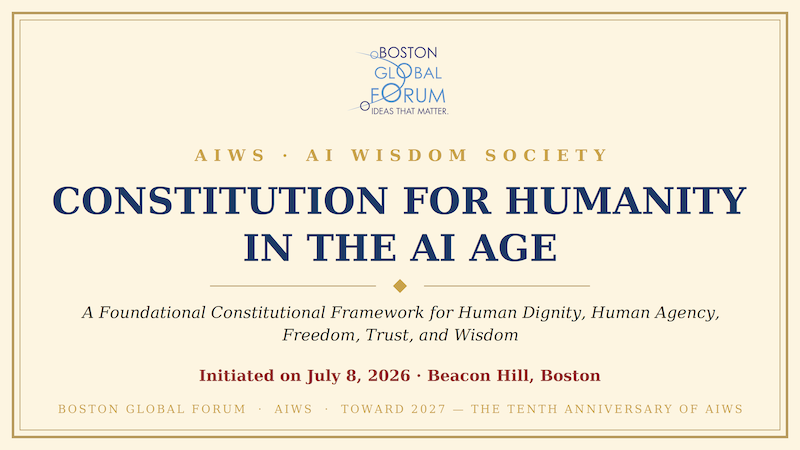
In the summer of 1787, fifty-five delegates gathered in Philadelphia and opened a document with seven words that changed the architecture of political legitimacy: “We the People of the United States.” In the summer of 2026, on Beacon Hill in Boston, a new document opened with a deliberate echo across two and a half centuries: “We, the People of Humanity.” The distance between those two sentences is not merely geographic or temporal. It measures how far the constitutional idea has traveled — and how far it must still go.
Declaration First, Constitution Second
America did not begin with a constitution. It began with a declaration — a statement of moral truths held to be self-evident — and only eleven years later, after the inadequacy of mere aspiration had been proven by experience, did it write the machinery to secure them. The sequence matters. The Declaration of 1776 told the world what Americans believed; the Constitution of 1787 told them how those beliefs would be enforced, funded, adjudicated, and amended. A declaration inspires. A constitution operates.
The same sequence is now unfolding in the age of artificial intelligence. The Boston Declaration on the Primacy of the Human Person, proclaimed on July 4, 2026, stated the moral truths of the AI Age. The AIWS Constitution for Humanity in the AI Age, now in its Constitutional Edition, begins the harder work: converting conviction into structure. History suggests the second step is where most movements fail — and where the American founders succeeded for reasons worth studying closely.
The Forgotten Genius of Article VII
The most consequential provision of the United States Constitution may be its least quoted. Article VII declared that the Constitution would enter into force “between the States so ratifying” once nine of the thirteen had approved it. Unanimity was not required. Delaware ratified first; Rhode Island resisted until 1790; the Union proceeded without waiting. The founders understood that a constitution which requires everyone’s consent before it binds anyone will bind no one. They designed for the willing.
This is the decisive lesson for a Constitution for Humanity. Its path to reality does not run through universal acclamation, which will never come, but through accession: an open instrument that nations join because they judge it reasonable, entering into force among the ratifying parties once a threshold is met. Modern treaty practice confirms the wisdom of Philadelphia — the Rome Statute required sixty ratifications, the Paris Agreement fifty-five. A constitutional framework for the AI Age should carry its own Article VII: a clause of accession, a threshold of entry into force, and the quiet confidence that the first movers will make membership worth having. Without such a clause, a constitution remains a charter; with it, aspiration acquires a legal pulse.
Why the States Joined
The states of 1788 did not ratify because the Preamble was beautiful. They ratified because union offered commerce, common defense, sound currency, and standing in the world — concrete benefits that made the costs of sovereignty pooled seem a bargain. Any constitution for the AI Age must answer the same unsentimental question: what does a ratifying nation receive? The answer is already visible in the architecture that precedes this Constitution rather than follows it. Nations that accede gain access to shared trust infrastructure; certification of their AI systems under common trust standards; interoperability with the trustworthy AI ecosystems of fellow members; and a voice in the governance of the intelligence that will shape their citizens’ lives. The American framers had to build their institutions for decades after ratification. The AI Age, unusually, has built some of its institutions first — trust standards, trust ratings, a trust order — so that the benefits of membership exist before the ink of accession dries.
An Inversion, and a Shared Design Principle
In one respect the new document deliberately reverses Philadelphia. The original Constitution built the machinery of government first and added a Bill of Rights only in 1791, under political duress. The Constitution for Humanity places dignity and rights first and institutions after — absorbing two centuries of constitutional learning that begins with the person, not the state.
Yet beneath the inversion lies a shared design principle. Madison’s generation made government deliberately slow — two chambers, a veto, divided powers — installing friction into the machine so that no momentary passion could become instant tyranny. Ambition was made to counteract ambition. The Constitution for Humanity installs the same principle one level deeper: “healthy friction” within AI systems themselves, so that no perfect optimization can quietly dissolve the human will. Tocqueville warned in 1840 of a soft despotism that would not break men’s wills but soften, bend, and guide them; he could not have imagined that the shepherd would one day be an algorithm. The “comfortable cage” named in the new Constitution is his warning, renewed for machines. In both centuries, the constitutional insight is identical: freedom is not preserved by power alone, but by the deliberate imperfection of power.
From Virginia Plan to Philadelphia Moment
Honesty requires one further admission. The delegates in Philadelphia could bind their states because they were sent by their states. Legitimacy was not requested after the drafting; it was present at the table. A Constitution for Humanity will earn ratification the same way — not by asking nations to adopt a finished text, but by inviting them to finish it. The present Constitutional Edition should therefore be understood as this generation’s Virginia Plan: the coherent draft that frames the deliberation, not the deliberation itself. The Philadelphia moment lies ahead — a constitutional convention for the AI Age, in 2027, the tenth anniversary of AIWS, where nations, through their representatives, complete what has been begun and sign what they have shaped. What a nation helps to write, it will defend.
The Wager
The Constitution of 1787 was a wager that a people could govern themselves by reflection and choice rather than accident and force. It ran barely four and a half thousand words, and its austerity was its endurance. The Constitution for Humanity makes a larger wager with a longer sentence: that humanity can govern its most powerful creation before that creation governs humanity. The first wager took nine states to win. The second will take the first courageous nations willing to ratify — and the patience to let the rest arrive, as Rhode Island eventually did. Two and a half centuries from Philadelphia to Boston, the constitutional idea remains what it has always been: not a description of the world as it is, but an instrument for building the world as it ought to be. Let the AI Age have its instrument.
Please download the full article here:
https://bostonglobalforum.org/wp-content/uploads/Beacon_Papers_No1_The_Boston_Declaration.pdf
https://bostonglobalforum.org/wp-content/uploads/Beacon_Papers_No2_From_Philadelphia_to_Boston.pdf