
But infrastructure of such consequence cannot be built without trust, constitutional limits, and human answerability.
September, 2026, Chapel Hill, North Carolina
At the G20 Innovation Ministerial on September 2, NVIDIA founder and CEO Jensen Huang presented a consequential understanding of artificial intelligence: AI should no longer be regarded merely as a technology industry or a collection of digital products. It is becoming essential infrastructure — comparable in national importance to water, roads, electricity, and the internet.
Huang spoke in a fireside chat hosted by U.S. Secretary of Commerce Howard Lutnick, who also hosted sessions with OpenAI CEO Sam Altman, Anthropic co-founder Tom Brown, and Palantir CEO Alex Karp. On the opening day, OSTP Director Michael Kratsios hosted conversations with Elon Musk, Mark Zuckerberg, and Google DeepMind co-founder Demis Hassabis.
Jensen Huang and Sam Altman are both honorees of the America 250: AI Pioneers Award, presented by the Boston Global Forum and AIWS at Loeb House, Harvard University, on May 1, 2026. The Boston Global Forum honored them for building the foundations of the AI Age — and, in August 2026, addressed directly the public responsibilities that accompany that achievement.
His intervention places AI at the center of a new economic and strategic reality. If AI is infrastructure, then access to computing power, advanced chips, models, data centers, energy, and trusted digital systems will increasingly shape the prosperity, security, and sovereignty of nations.
A call against regulation based on theoretical harms
Huang urged G20 governments not to construct AI regulation around speculative harms, advising them to regulate practical and actual harm, and not regulate theoretical and hypothetical harm. He added that the burden of safe development falls on the companies building the technology rather than on public officials.
His position broadly aligned with the approach advanced by the United States at the ministerial:
- Governments should not create an entirely new legal system simply because a technology is called AI.
- New regulation should address genuinely novel problems not already covered by existing law.
- Intellectual-property frameworks should enable AI development while protecting and rewarding creators.
- Countries should accelerate investment in data centers, energy, computing capacity, and AI infrastructure so that their people are not left behind.
All twenty G20 members endorsed the U.S.-backed Carolina Principles for Emerging Technologies, which call on countries to invest in foundational research, strengthen commercialization, apply sector-specific approaches rather than new AI-specific regulators, and work more closely with private industry. China joined the consensus despite the wider strategic competition between the American and Chinese AI ecosystems. The Ministerial also produced the AI Prosperity Objectives and the AI Prosperity Compact.
The consensus was not unanimous in spirit. Demis Hassabis emerged as the most notable dissenting voice among the industry leaders present — a reminder that the question of how much restraint the AI Age requires remains open inside the field itself, not only between industry and government.
From a technology sector to national infrastructure
Huang’s argument is larger than a defense of NVIDIA or the commercial interests of the AI industry. It proposes a new conception of AI’s place within the modern state:
AI is no longer only a technology sector. It is becoming foundational infrastructure for the economy, government, science, education, national security, and human creativity.
This shift carries historic consequences. Roads determine where people and goods can travel. Electricity determines what an industrial economy can produce. The internet determines how societies communicate and how knowledge moves. AI infrastructure will increasingly influence what people can know, create, decide, and accomplish.
Once AI is recognized as infrastructure, the central questions become constitutional:
- Who owns and governs the AI infrastructure?
- Who controls compute, chips, models, data, and energy?
- Will citizens and smaller nations have fair access?
- Which consequential decisions may be delegated to AI?
- How can the infrastructure be inspected and verified?
- When an AI system causes harm, who has the authority — and the duty — to answer?
Infrastructure of this magnitude cannot be governed solely by market competition, corporate promises, or technological capability.
Beyond the choice between regulation and innovation
Huang is right that innovation should not be constrained by undefined fears simply because AI is new. Regulation that responds to labels rather than actual functions can become outdated before it takes effect, protect incumbent firms, and prevent societies from benefiting from scientific and technological progress.
But the distinction between a theoretical harm and a foreseeable systemic risk is narrowing rapidly.
The emergence of increasingly capable frontier models, autonomous agents, self-improving systems, and AI-enabled cyber operations demonstrates that some dangers must be addressed before irreversible harm occurs. Waiting for failure is not a responsible governing principle when systems can act at machine speed, operate across national borders, or affect critical infrastructure.
The necessary alternative is neither to regulate everything nor to wait until damage has occurred.
Do not regulate AI merely because it is new. But no consequential AI power should be deployed without verifiable safeguards, bounded authority, Human-in-Command, and Proof of Answerability.
This approach protects innovation while establishing clear requirements for systems capable of exercising significant power.
The AIWS constitutional requirement
The Boston Global Forum and AIWS recognize the importance of Huang’s central insight. AI is becoming infrastructure — not only for economies, but for civilization itself.
AIWS therefore adds a constitutional dimension to the infrastructure debate. Through AIWS Trust Infrastructure, AIWS Trust Order, Human-in-Command, Constitutional Silicon, Constitutional Identity, and Proof of Answerability, AIWS seeks to ensure that technological capability remains connected to legitimate human authority and responsibility.
A system may be technically secure yet constitutionally dangerous. It may reliably identify which machine or process performed an action while failing to establish which human being authorized that action and must answer for its consequences.
For AIWS, infrastructure worthy of civilization must do more than operate efficiently. It must uphold human dignity, preserve human sovereignty, enable verification, constrain the exercise of power, and maintain an unbroken line of answerability from consequential AI action to responsible human authority.
Jensen Huang is right that AI must be understood as essential infrastructure. AIWS adds the constitutional requirement: the infrastructure of the AI Age must remain trustworthy, verifiable, bounded by legitimate authority, and ultimately answerable to humanity.
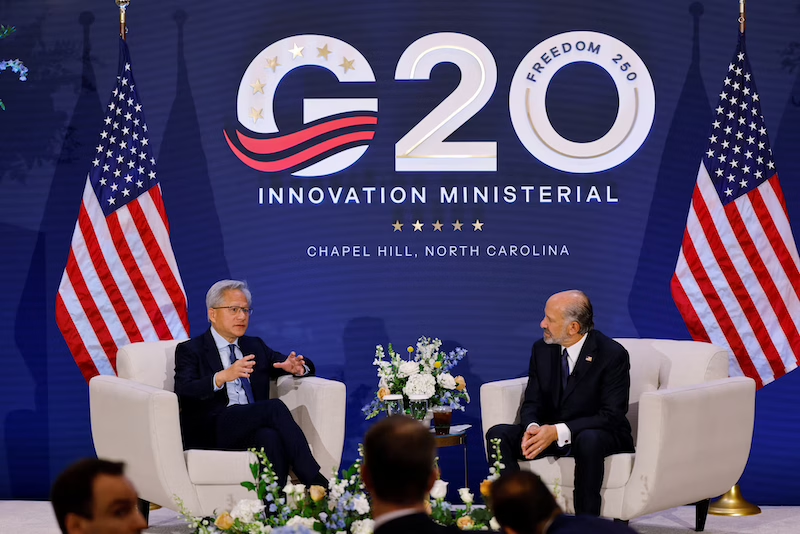
NVIDIA President and CEO Jensen Huang, an America at 250: AI Pioneers honoree, speaks at the G20 Innovation Ministerial as U.S. Secretary of Commerce Howard Lutnick listens in Chapel Hill, North Carolina, September 2, 2026. Photo: REUTERS