
As artificial intelligence becomes capable of drafting speeches, research papers, legal arguments, policies, and works of extraordinary sophistication, a fundamental question is emerging: Who is the author?
Beacon Papers No. 6, Who May Author?, argues that the answer should not depend primarily on who generated the words. Throughout history, leaders, judges, scholars, and public officials have relied upon advisers, researchers, editors, clerks, and speechwriters. What ultimately made a work theirs was not that they personally produced every sentence, but that they exercised judgment over it and could be called to answer for it.
AI makes this ancient question newly urgent. Unlike a human assistant, an AI system cannot ultimately be held morally or institutionally accountable. As AI assistance becomes more capable, therefore, human responsibility does not diminish—it becomes more concentrated.
The paper proposes a clear principle:
Judgment, not generation, is the foundation of authorship.
Human authorship is preserved when a person sets the purpose and values of a work, independently judges what AI provides, verifies factual claims, approves the final work, and accepts full responsibility for it. Authorship is lost when someone signs or publishes something they have not truly examined, cannot explain, cannot defend, or will not answer for.
But Who May Author? goes further. It proposes that access to AI assistance should itself become a fundamental right in the AI Age. People should be free to employ AI in thinking, learning, writing, creating, governing, and serving society. Institutions should regulate responsibility, rather than simply suppress AI assistance.
This right, however, carries a profound duty.
Human judgment is not something humanity can simply assume it will always possess. Judgment is a capacity, and capacities survive through exercise. A civilization that protects people’s right to use AI while allowing their independent capacity to judge to atrophy could preserve the appearance of human authorship while losing its substance. The Constitution for Humanity in the Age of AI must therefore protect not only human rights, the paper argues, but also the essential human capacities that make those rights meaningful.
Beacon Papers No. 6 concludes with a standard for the AI Age:
AI may assist.
Only humans may author.
Only humans may be accountable.
And behind that principle lies an even larger measure of our future:
The measure of civilization in the Age of Artificial Intelligence will not be the intelligence of its machines, but the judgment of its people
Read and download the full Beacon Papers No. 6 — Who May Author? here: https://bostonglobalforum.org/wp-content/uploads/Beacon_Papers_No6_Who_May_Author-6-8.pdf
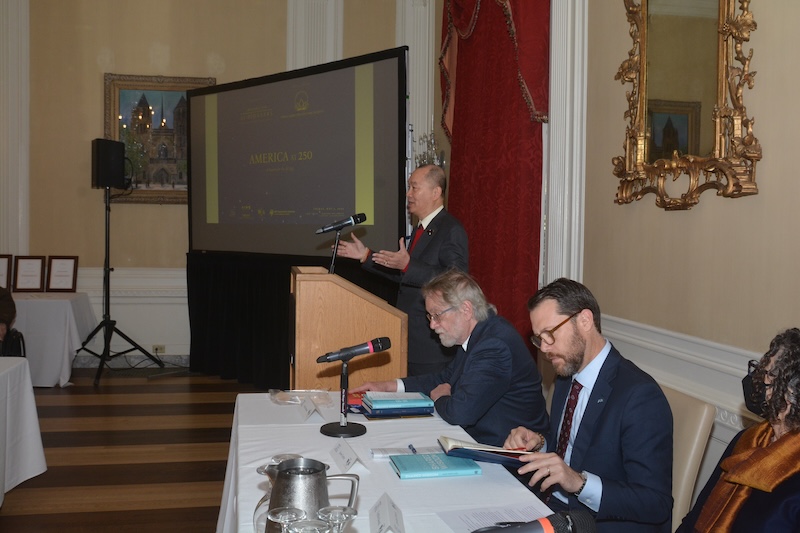
Nguyen Anh Tuan speaks at the America at 250 Conference, Loeb House, Harvard University, May 1, 2026. His Beacon Papers No. 6, Who May Author?, affirms a defining principle for the AI Age: “Judgment, not generation, is the foundation of authorship.”