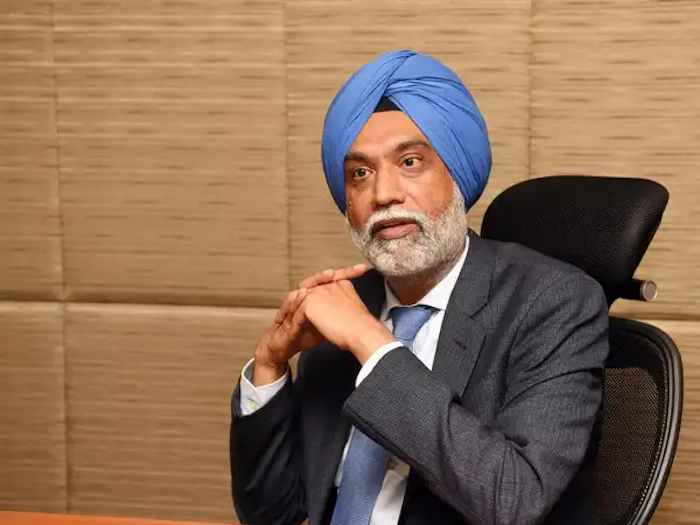
Addressing the summit in New Delhi, Amandeep Singh Gill, UN Under-Secretary-General and 2022 World Leader in AIWS Award Recipient, articulated a vision where AI serves as a “global equalizer” rather than a tool for further fragmentation. He warned that without deliberate intervention, the AI era could trigger a “second great divergence” between the Global North and South.
1. Advancing Inclusion: The “K-Shaped” Warning
Gill warned against a “K-shaped” AI economy, where inequality is baked into the technology’s architecture.
- Beyond Isolation: He urged developing nations not to view AI in isolation but as the next essential layer of Digital Public Infrastructure (DPI).
- The Inclusion Mandate: AI must move from “market bystanders” to active participants. He famously stated: “Young people should not be passengers in this story; they must actively bend the ‘K’ toward equality.”
2. “Idiot-Savants” and the Need for Guardrails
Gill offered a nuanced view of current AI capabilities, describing them as “Idiot-Savants.”
- The Savant: Formidable at spotting patterns and mimicking human reasoning at scale.
- The Idiot: Brittle and lacking real understanding (e.g., AI confusing blurred backgrounds for wildlife).
- Policy Implications: Because AI is a “general-purpose technology on steroids,” Gill argued that it cannot be left to market forces alone. He called for mandatory testing and human oversight for high-stakes decisions.
3. Real-World Impact: “Low-Hanging Fruit”
For countries like India, Gill identified voice-based AI systems in local languages as the most immediate path to inclusion.
- Breaking Barriers: Voice-enabled models can bypass literacy and linguistic hurdles, delivering agricultural, health, and educational services directly to the “bottom of the pyramid.”
- Sustainability: He advocated for Small Language Models (SLMs)—energy-efficient models that can run on low-bandwidth networks and inexpensive devices.
4. Sovereignty and the Data Gap
Gill highlighted a stark global asymmetry in infrastructure:
- The Compute Gap: He noted that as of last year, the entire continent of Africa had fewer than 1,000 GPUs.
- Local Data as Sovereignty: True AI sovereignty, he argued, begins with local-language datasets. Protecting these datasets is essential to ensure that AI models reflect national cultures and values rather than external biases.
5. Toward July 2026: Global AI Governance
Gill announced that the UN is preparing for a Global AI Governance Dialogue in Geneva (July 2026).
- Science-First: The UN has established an independent scientific panel of 40 experts to provide evidence-based assessments to counter both “AI hype” and “AI fear.”
- A New Architecture: He proposed a $3 billion global AI fund to support nearly 90 under-resourced countries in building talent, compute capacity, and policy frameworks.