How should the chips powering increasingly capable AI be designed—and how should people and AI systems work together to create them?
Nguyen Anh Tuan, Founder and Chief Architect of AIWS and Co-Founder, Co-Chair and CEO of Boston Global Forum, proposes AIWS Co-Creation Silicon, a new industrial model developed at AIWS Lumina Lab, Beacon Hill, Boston. Its Founding Charter brings Constitutional Silicon into a practical model for semiconductor development.
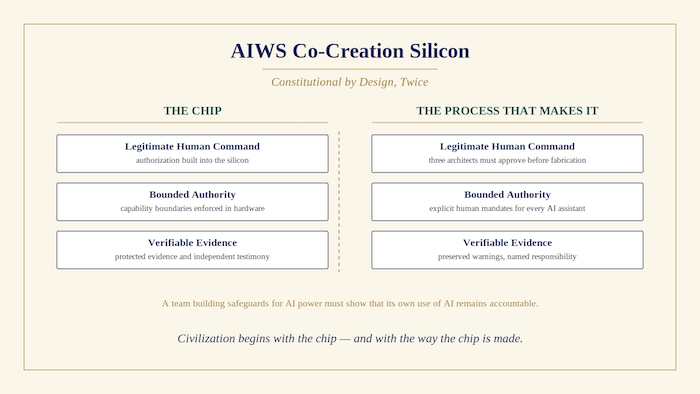
Constitutional by Design, Twice
Building on Beacon Papers No. 9, Civilization Begins with the Chip, the model applies constitutional principles twice: to the chip and to the process that creates it.
The chips would incorporate legitimate human command, bounded authority and verifiable evidence. Their designers would work under the same discipline through explicit human mandates, independent verification, preserved warnings and named responsibility.
A team building safeguards for AI power must demonstrate that its own use of AI remains accountable.
Three Architects and an AI Engineering Workforce
Three master chip architects would direct specialized AI assistants across design exploration, hardware description, testing, formal verification and physical design—enabling a small human team to undertake work traditionally requiring much larger organizations.
All three architects must approve a design before fabrication. An independent verification assistant—the “witness in the workshop”—would record warnings through a protected evidence channel. Human architects could proceed where permitted, but responsibility for that decision would remain attributable.
The First Product
The first planned product is a Constitutional Chiplet designed to work alongside AI accelerators. It would provide mechanisms for authorization, capability boundaries, protected evidence and independent testimony.
An initial prototype would demonstrate an Independent Witness Channel and Human Command Kernel alongside a specialized AI computing function. The Charter sets April 27, 2027 as the target for a public demonstration, with progress toward fabricated silicon determined by evidence at successive development gates.
Developing Talent and Global Opportunity
Through a “Fourth Seat,” each team would train apprentices to examine AI-generated work, make bounded decisions and defend their reasoning before experienced architects.
For countries seeking a greater role in semiconductor innovation—including Vietnam, Malaysia, India, Chile and countries across Africa—the model offers a pathway toward original design and intellectual property through small teams with exceptional expertise.
AIWS Co-Creation Silicon gives a second meaning to the proposition that civilization begins with the chip: civilization also begins with the way the chip is made.