
A civilization is not decided by what its founders declare. It is decided by what they make ordinary.
Throughout the modern era, the governance of technology has rested on a division of labour: engineers build, and others decide what the building means. Legislators write the law. Regulators enforce it. Ethicists advise. The builder answers for performance, not for consequence.
That division has collapsed. It collapsed not because law failed, but because the place where the decisive choices are made has shifted.
Whether a person can actually interrupt an autonomous system is settled, in the end, in the architecture. Law can require a right of intervention; the builder must turn that right into a real capability of the system. Whether an AI can tell its operator that an instruction is wrong is not a matter of policy but a property of how the model was trained. Whether a contribution is recognised depends on whether anyone built the ledger.
When law arrives afterwards, it must usually govern a space of possibility that architecture has already shaped.
The AI Pioneers are therefore not observers of the civilization now taking form. They are its founders — whether or not they accept the title.
Defaults outrank declarations
Declarations establish what people aspire to. Defaults shape what people experience every day — and a civilization is lived mostly in its ordinary days.
A hundred safety principles may shape fewer human hours than a single default setting shipped to a billion people.
This is an extraordinary power, and it carries an extraordinary asymmetry. Capability accumulates systematically; judgment and wisdom are not automatically passed on. Each generation of models is built on the capability of the last. But wisdom must be deliberately chosen, preserved, and returned to the architecture by human beings — every time, from the beginning.
Hence the proposition at the centre: AI advances. Humanity must advance further.
The first task — making the machine capable — has succeeded beyond expectation. The second — ensuring that humanity emerges from this encounter stronger than the thing it made — has barely begun.
The architecture
On 23 August 2026, the Boston Global Forum published Beacon Papers No. 8: The Architecture of the Civilization of Human–AI Co-Creation — the first comprehensive architecture for human civilization in the AI Age.
It is founded on Human Dignity. Protected by Human Sovereignty and Human-in-Command. Powered by Human–AI Co-Creation and Co-Elevation. Guided by the four AIWS Lumina values — Love, Creativity, Nobility, Wisdom. Directed toward Civilizational Flourishing.
Four tasks that cannot be completed without the builders
This architecture does not merely invite the AI Pioneers to endorse it. It invites them to take up four responsibilities that cannot be completed without the people who build the technology.
Make sovereignty architectural. A person’s right to remain the author of their own life cannot rest in a company’s terms of service. It must rest in how the system is constructed — in what the system cannot do to a person, even when instructed. This is the work of Constitutional Silicon: carrying constitutional restraint down into the material foundation.
Build systems that can refuse — within limits. An AI of unlimited obedience is a dangerous AI. But an AI that decides right and wrong on humanity’s behalf is no less dangerous. AI must serve human beings within constitutional limits, and must be able to refuse commands that exceed those limits.
No machine may escape human command. No human command may escape constitutional restraint.
Submit to verification. A commitment that cannot be checked is not a commitment; it is a preference. AIWS Trust Order and Trust Infrastructure turn ethical principles into verifiable standards. Constitutional Identity and Proof of Answerability ensure that every consequential action of an AI leads back to a human being with authority and the duty to answer.
Build an economy that recognises contribution. Today’s digital economy rewards attention and amplification — what is seen and spread rather than what is created and contributed. An economy of contribution, in which value is recognised through Creative Capital, Knowledge Capital, Trust Capital and Contribution Capital, is not an ethical supplement to the technology. It is infrastructure. And defining value does not belong to engineers alone: this infrastructure must be built by technologists together with economists, educators, communities, and the people who create value.
The measure
The Human Advancement Test: if AI education produces perfect answers while students lose the ability to think for themselves, civilization has not advanced.
The measure applies to every system, and to everyone who builds one.
America at 250
On the occasion of America’s 250th anniversary, the Boston Global Forum honours the America at 250: AI Pioneers.
This recognition does not only look backward. What is rare about this moment is that the generation that gave humanity this capability is still at work. The founders of earlier civilizations were usually gone before anyone thought to ask what they should have built differently. These founders are here, and can still answer.
That door is open, and it will not stay open indefinitely.
AI Pioneers opened the Age of Artificial Intelligence. Together, we can open the Civilization of Human–AI Co-Creation.
The AI Age will become what humanity chooses to reward — and, first of all, what its builders choose to make ordinary.
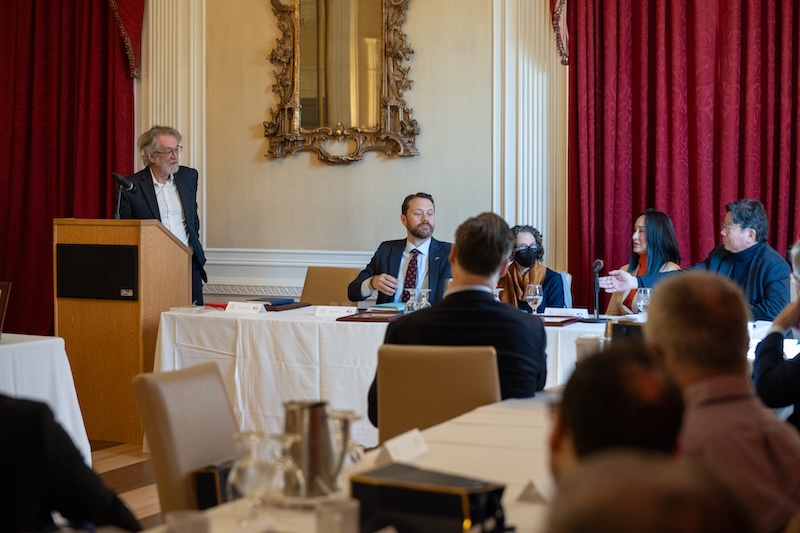
AI Pioneers participating in a panel discussion at the Boston Global Forum’s America at 250 Conference on May 1, 2026