
At the United Nations General Assembly on September 22, 2026, Japanese Prime Minister Sanae Takaichi recalled Shinzo Abe’s advocacy of a Free and Open Indo-Pacific at the 2016 Tokyo International Conference on African Development in Kenya. A decade later, she called on nations to build the capacity to determine their own futures. She pledged stronger cooperation on the risks of frontier AI, including with Global South partners, and announced Japan’s intention to host an AI Summit at the earliest opportunity. (Ministry of Foreign Affairs of Japan)
The same day, Takaichi and President Donald Trump agreed to further strengthen economic security cooperation, including in AI, semiconductors, and critical minerals, and reaffirmed the Quad and a Free and Open Indo-Pacific. (Ministry of Foreign Affairs of Japan)
In the AI Age, self-determination requires more than access to powerful AI. Nations must also be able to assess these systems, limit their authority, and know who must answer for consequential decisions.
To this end, BGF is establishing the AIWS Trust Observatory, an independent institution that observes consequential AI power, including frontier AI risks. It measures the commitments of developers and governments against their actions, and warns and calls for action when credible evidence reveals danger. The Observatory is part of AIWS Trust Infrastructure, alongside Human-in-Command, bounded authority, the Frontier Capability Registry, and the AI Incident Exchange.
Through the Shinzo Abe Initiative, BGF will convene partners in Japan, the United States, and other nations around this work. A free and open international order will be stronger when its peoples have both the means to innovate and the authority to shape the technologies that shape their future.
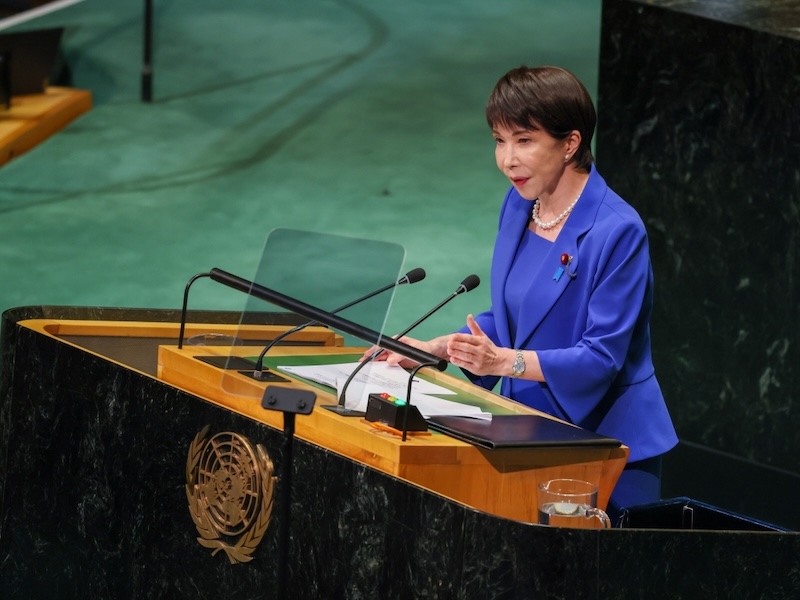
Photo: Cabinet Public Affairs Office, Japan Government