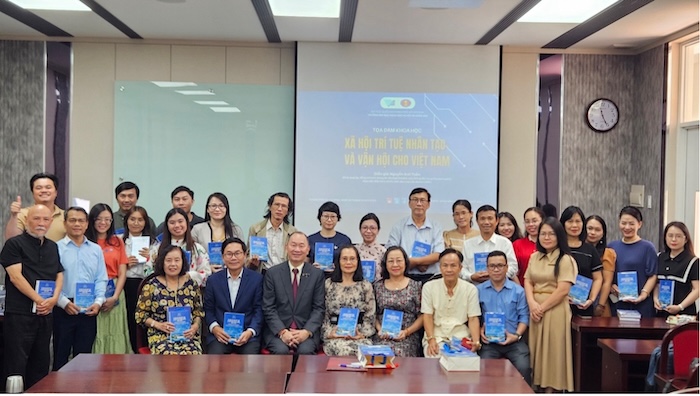
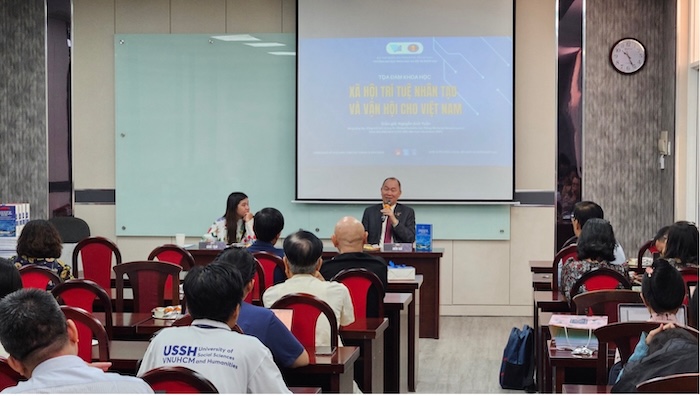
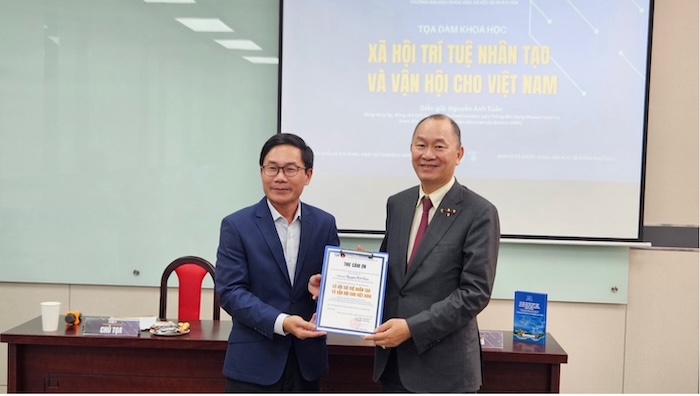
December 22, 2025 — The Faculty of Literature and Linguistics, University of Social Sciences and Humanities, Vietnam National University–Ho Chi Minh City, organized a scientific roundtable entitled “The AI World Society and Opportunities for Vietnam.” The event attracted the participation of numerous experts, researchers, graduate students, and undergraduate students with a strong interest in the topic.
Representing the Faculty of Literature and Linguistics, Assoc. Prof. Dr. Phan Manh Hung, Dean of the Faculty, delivered opening remarks highlighting the role of the social sciences and humanities in an AI-driven society. He emphasized that in the digital era, dialogue between science and technology and the humanities—as well as between individual identity and globalization—is essential for building a sustainable and balanced society.
Nguyen Anh Tuan, Co-Founder, Co-Chair, and CEO of the Boston Global Forum, delivered a keynote presentation on the concept of the AI World Society (AIWS) and the opportunities it presents for Vietnam. He noted that the idea of an AI World Society emerged early and has attracted growing attention from global political leaders and policymakers. When effectively applied, artificial intelligence can support public administration, assist citizens in administrative services, and accelerate national development.
Nguyen Anh Tuan emphasized that AI is a powerful tool for social development and innovation. He introduced several forward-looking proposals for Vietnam, including AIWS Government 24/7, digital asset innovation and trading centers, and AI-enabled film and cultural parks. He stressed that to build Vietnam’s global brand in the digital era, the social sciences and humanities must play a leading role in guiding the ethical, effective, and human-centered use of artificial intelligence.
During the discussion session, participants raised many practical questions related to the application of AI in daily life, the economy, education, the arts, and other fields. Both speakers and attendees agreed that while AI offers valuable benefits across many sectors, citizens must also be equipped with knowledge and skills to prevent potential risks in the future.
The roundtable concluded successfully, opening up meaningful reflections and ideas on the use of artificial intelligence in society in general, and in social sciences and humanities research in particular.